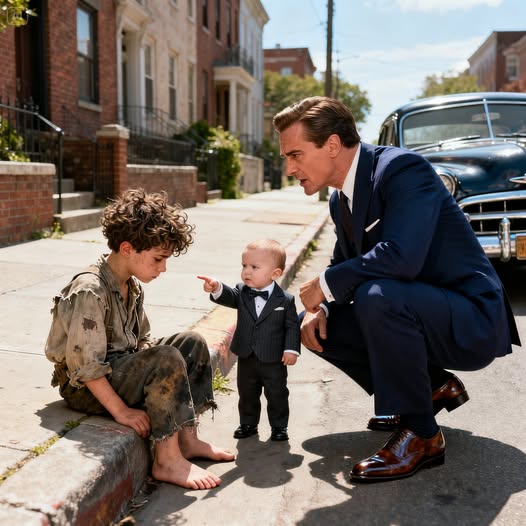
—Excuse me for butting in, Mr. Mateo… but that child has a certain look.
Mateo didn’t answer. He couldn’t.
The following days were strange and beautiful. Gael turned out to be an intelligent, polite, and deeply grateful boy. He read everything he could find, helped Doña Lupita without being asked, and cared for Santi with surprising patience. At night, the two insisted on sleeping together. Mateo would find them embraced, as if one had spent his entire life waiting for the other.
But the real earthquake came two days later.
His wife, Veronica, returned early from her business trip.
Mateo greeted her with a heavy heart. He told her everything: Lucía, the disappearance, the encounter in the street, the possibility that Gael was his son, the proof they were waiting for. Verónica listened without interrupting. First came bewilderment. Then pain. Afterward, a deeper wound: the realization that he had made such a momentous decision without consulting her.
“I don’t know what hurts more,” she finally said, “finding out that you have a son from your past… or that you brought that child into our house without thinking about me.”
“I know,” Mateo replied, his voice breaking. “I was wrong about you. But not about him. I couldn’t leave him on the street.”
Verónica took a deep breath. She looked down the hallway, where Santi was showing Gael the family portraits.
“That child is not to blame for anything,” she finally said. “I want to meet him before we decide how we proceed.”
And he met him.
She saw him thank God for every glass of water, get up early out of a survivor’s habit, read an anatomy book he found in the library, and say he wanted to be a doctor “to help children who are alone and sick.” And something in her began to surrender, not to Mateo’s past, but to the evident truth that Gael needed love, not judgment.
The results arrived the next day.
99.9% compatibility.
Gael was the son of Mateo.
Mateo wept in the car like he hadn’t wept since his father’s death. He wept for the certainty, for the lost years, for Lucía raising him alone, for the boy who had slept on park benches while he lived surrounded by comfort. He wept also for relief: at least he had arrived in time for the rest of his life.
But just when it seemed that everything was starting to settle down, a new blow appeared.
A woman named Rosa Rocha appeared before the social worker claiming custody of Gael. She was Lucía’s sister and the boy’s biological aunt. Legally, until Mateo’s paternity was registered, she had priority.
“Where was she when Gael was sleeping on the street?” Mateo burst out.
No one had an answer that would calm his fury.
That night they had to explain to the children that there was a possibility that Gael would go live with his aunt for a while. Santi immediately burst into tears.
—No! He’s my brother! Brothers don’t leave each other!
Gael tried to be brave, but his voice trembled.
—I want to stay here… with you.
Verónica hugged Santi, and Mateo went out onto the balcony, his despair choked back. She followed him a few minutes later.
“Let me talk to that woman,” Veronica said. “Sometimes the law understands less than the heart, but people can still understand.”
They met the next day at a downtown café. Rosa was a woman with a tired face and humble hands. She didn’t come with arrogance, but with guilt. She recounted how years before she had argued with Lucía when she learned she was pregnant and single. She judged her. She hurt her. Lucía distanced herself, and they never spoke again. Now Rosa wanted to repair some of the irreparable.
“He’s my nephew,” she said, holding back tears. “The only thing I have left of my sister.”
Veronica listened in silence and then answered honestly:
—Then honor your sister by thinking about what is best for Gael, not what will ease your guilt.
She told her about Gael’s dreams, his fear of thunder, how he slept better if Santi left a light on, his desire to study medicine, and how happy he was for the first time in a long time. Rosa broke down inside when she discovered how much this woman knew about a child she was only just beginning to imagine.
She agreed to go to the house for dinner.
Gael was nervous when he saw her come in. He hid a little behind Mateo. Rosa crouched down to his level.
“You look a lot like your mom,” he told her. “When she was little, she loved to fly kites.”
Gael looked up, surprised.
—Me too. My mom taught me.
That phrase opened a door.
During dinner, Rosa watched Gael share his dessert with Santi, call Verónica “Aunt Vero” without being asked, and Doña Lupita serve him soup with the same tenderness as she would a grandson. Finally, she asked to speak with him alone.
—If I told you that you could come live with me—he asked carefully—, what would you want to do?
Gael didn’t answer right away. He looked towards the living room, where Santi was putting together a jigsaw puzzle, waiting for him.
“I want to stay here,” she finally said. “Here I feel like I finally have a real family. But… I’d also like to meet you. Because you’re my mother’s.”
Rosa placed a hand on her chest. That child, wounded by life, still had room for kindness.
Two days later he returned to the house to talk to Mateo and Veronica.
“I’m not going to fight for custody,” she announced. “It would be cruel to tear him away from where he’s being loved. But I do want to be a part of his life. I want to be the aunt I wasn’t able to be for Lucía.”
Matthew, moved, extended his hand to him.
—That would also do Gael good.
The process expedited. Mateo legally recognized his son. Rosa was appointed as his substitute guardian in case of any emergency. Verónica, after a long and honest conversation with Mateo, decided to rebuild trust from a new place: complete honesty and shared participation in every important decision. It wasn’t magic or instantaneous, but it was real.
The rhythm of the house changed. There was more laughter, more mess, more food served, more bedtime stories. Santi stopped saying “my brother” as if it were a mysterious intuition and started saying it as if he were naming a hard-won certainty. Gael went back to school. Then came therapy, friends, afternoons of studying, chess tournaments, birthdays celebrated with piñatas, new photographs filling the walls where before there had been a whole story missing.
Years passed.
In the auditorium of the University of Guadalajara, Gael Rocha Cárdenas took to the stage to receive his medical degree with honors. Tall, serene, and with the same profound gaze as the boy who had once slept on a park bench, he took the microphone while his entire family watched him with tears in their eyes.
There were Mateo and Verónica, holding hands. There was Santi, now a teenager, smiling like the proud brother he had always been. There was Aunt Rosa. There was Doña Lupita. And, in an invisible but ever-present place, there was Lucía too.
“I want to dedicate this moment to my mother,” Gael said in a firm voice, “because she taught me not to give up on my dreams even when life hurts. To my father, who found me when I had almost given up hope that anyone would find me. To Verónica, who taught me that love can also be a choice. And to my brother Santiago, who knew we were family before everyone else.”
He paused. The entire auditorium fell silent.
—Many years ago, I was just a boy sitting alone on a bench. Today I’m here because someone decided not to turn their back on me. I learned that family doesn’t always begin with blood, nor does it always end with loss. Sometimes family arrives like a miracle: they recognize you, open their doors to you, and teach you to stay.
Santi was the first to stand up and applaud. Then he hugged him tightly, like that night they slept in the same bed for fear of being separated.
“I told you from day one,” he whispered in his ear. “You were my brother.”
Gael smiled, his eyes filled with water.
—And you were my first home.