“Trading. Investments. I don’t know.” Her voice shook. “All our savings are gone. He locked me out of the accounts. I took this catering job under my maiden name so I could get cash. For groceries. Prenatal vitamins.” Her hand trembled over her stomach. “If he finds out I’m working…” She didn’t finish. Dominic didn’t need her to. His jaw tightened. A man who choked his pregnant wife was not a husband. He was an infestation. “It’s not just him,” she said, wiping at her face angrily. “It’s the people he owes.” Dominic’s eyes sharpened. “What people?” “He says private lenders. Loan sharks. They call the house. They threaten him. They threatened me.” She swallowed hard. “He drinks after they call. Then he looks at me like… like I’m the reason his life collapsed.” “Who does he owe?” “I don’t know exactly. I heard one name. Sylvio. He kept begging someone on the phone last week. He said, ‘Please, tell Sylvio I just need one more month.’” The pantry went very still. Dominic already knew a Sylvio in Queens. Sylvio Dante, called Sylvio the Hammer by men who enjoyed breathing through unbroken noses. One of Dominic’s capos. Loan enforcement.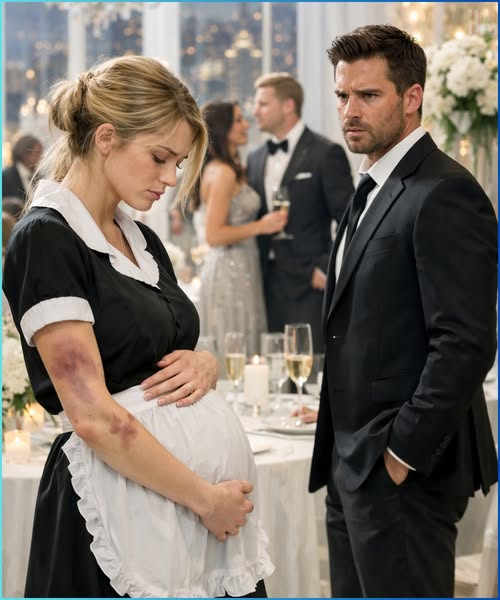
Collections. Pressure. Fear. Efficient and ugly, all of it sanctioned because Dominic had built an empire that ran on obedience and money and the illusion that consequences only belonged to other people.
Now he looked at the bruises on Isabella’s throat and saw the truth.
His world had reached into her house.
Maybe not by his hand.
But by his name.
She misread his silence at once. “I’m sorry. I shouldn’t have said anything. We’re not kids anymore. I know you don’t owe me—”
She reached for the door.
Dominic planted one palm flat against it above her head, stopping it from opening. He never touched her. He didn’t need to.
She looked up at him, startled.
“You aren’t leaving with those bruises,” he said.
“Dominic—”
“No.”
There was no force in his tone. Only absolute certainty.
“Listen to me carefully.” He held her gaze. “You’re going out the back entrance. My driver will be waiting in a black SUV. You are getting in.”
Her eyes widened. “I can’t just disappear. Arthur will—”
“Arthur Pendleton does not get another chance to scare you.”
“You don’t understand. He’ll go crazy.”
Dominic’s expression turned into something flat and lethal. “He should be worried about that.”
Fear flashed across her face, but not fear for herself this time.
“Don’t,” she whispered. “Please don’t do anything crazy.”
His laugh had no humor in it. “You’re asking the wrong man for moderation tonight.”
“Dom.” Her voice broke. “I’m pregnant.”
As if he could miss it. As if the sight of her carrying a child while working on swollen feet as hired help in his own home had not already split him open.
His gaze dropped briefly to her stomach, then returned to her face.
“I know,” he said.
Something changed between them then.
Not the history. Not the pain. Those stayed exactly where they were.
But for the first time since he’d seen her, some tiny fraction of the panic in her eyes eased. Maybe because he was still Dominic, somewhere beneath the steel. Maybe because wounded people learn very quickly which monsters are pointing the wrong direction.
“I have nowhere else to go,” she admitted in a whisper.
That truth landed in the center of his chest like a blade.
So this was what the last ten years had bought her. Not safety. Not peace. Just a prettier prison.
“You do now,” he said.
He stepped back and pulled out his phone. “Marco.”
“Yes, boss.”
“Bring the SUV to the service entrance. We’re moving a guest.”
There was a pause on the line. Marco was smart enough to hear the word guest and understand it meant blood-level priority.
“Yes, boss.”
Dominic hung up and looked at Isabella. “Doctor Harrison will meet you where you’re going. He’ll examine you and the baby.”
Her brow furrowed. “You already had a doctor?”
“I had a doctor five minutes after I saw your throat.”
That startled a breath out of her. Not quite laughter, but the memory of it.
He reached up, very slowly, and moved one loose strand of hair away from the bruise near her collar. His fingers barely grazed her skin. The tenderness of the gesture nearly undid them both.
“He touched what was never his to damage,” Dominic said, voice low and rough. “And he brought my business to your door.”
She stared at him.
There was no swagger in him now. No theatrical rage. Just a terrible, disciplined promise.
“For that,” he said, “I am going to end this.”
Rain had started by the time Marco drove her away from Oyster Bay.
Dominic stood under the stone arch of the rear entrance and watched the taillights vanish through the gates. Only when the SUV was gone did he turn back toward the mansion.
The gala was still in full swing.
A senator laughed too loudly at some private joke.
A real estate developer clinked glasses with a union boss.
Dominic walked back into the ballroom with a face carved from winter.
Leo intercepted him near the bar. “You want the short version or the ugly one?”
“Ugly.”
Leo lowered his voice. “Sylvio’s books confirm it. Arthur Pendleton borrowed eight hundred grand six months ago. Missed three vig payments. Been stalling ever since.”
Dominic’s hands went still.
“What was the money for?”
Leo glanced around before answering. “Not investments.”
Dominic already knew.
“Volkov’s private games in Brighton Beach. Baccarat. High-stakes poker. Escorts. A lot of cocaine.” Leo’s jaw hardened. “Also leveraged his wife’s childhood home as collateral, though the paperwork looks greasy.”
For one dangerous second, Dominic considered shooting Arthur Pendleton in the middle of his own charity gala just to improve the décor.
Instead he asked, “Where is he tonight?”
Leo checked a text. “At a diner in Queens, begging one of Sylvio’s guys for an extension.”
Dominic took a slow breath.
The room around him saw nothing. The music played. Waiters circulated. Society went on pretending that monsters only existed in tabloids and poor neighborhoods.
“Pick him up,” Dominic said.
Leo’s eyes sharpened. “Alive?”
Dominic looked toward the rain-black windows.
“Very.”
Part 2
The penthouse on Central Park South had never once felt like home to Dominic.
It was too quiet. Too clean. Too removed from the machinery of his life. He kept it because power required certain kinds of privacy and certain kinds of appearances. But until that night, the rooms had only ever held silence, expensive liquor, and the occasional sleepless hour between meetings.
Now Isabella was inside it.
By the time Dominic arrived, Doctor Harrison had already examined her. Marco met him in the private elevator foyer and gave a short nod.
“She’s in the kitchen,” Marco said. “Vitals stable. Baby’s heartbeat strong.”
Dominic didn’t realize how tightly he’d been holding himself together until he heard that last part.
He entered the kitchen quietly.
Isabella sat on a stool at the marble island, wrapped in one of his white robes because the agency uniform had gone into the trash. Her hair was down now, falling in tired waves over her shoulders. A mug of chamomile tea sat between both hands. She looked younger without the maid’s cap and somehow even more exhausted.
The bruises on her throat were livid beneath the warm lights.
He wanted Arthur dead all over again.
She looked up when he entered.
For half a second, she rose automatically, old fear rising before thought could stop it.
“You don’t have to stand for me,” he said.
She froze, then slowly sat again. “I didn’t mean to.”
“I know.”
That tiny mercy in his answer seemed to embarrass her more than anger would have. She stared into the tea. “The doctor was kind.”
“He works for me,” Dominic said. “He knows what kind of care I expect.”
“You say that like there’s a list.”
“There is.”
A weak smile touched her mouth and disappeared.
He stayed on the opposite side of the island, giving her room. “Harrison says the baby is stressed, but not in immediate danger. You’re dehydrated. Your blood pressure is too high. You haven’t been sleeping.”
She looked down.
“You haven’t been eating enough either.”
“I’ve been eating.”
“Not enough.”
Her fingers tightened around the mug. “Arthur had opinions about what I should weigh.”
Dominic stared at her for a long second.
He had been furious before.
Now he felt something colder, far more dangerous. Not rage. Judgment.
A man who starved a pregnant woman in order to control her body deserved a kind of ending Dominic normally reserved for traitors.
“I’m sorry,” she said suddenly.
His brows drew together. “For what?”
“For bringing this into your life.”
He gave one short, incredulous shake of the head. “Izzy.”
“I mean it. You built whatever this is.” She gestured vaguely toward the windows, the city, the polished steel and marble and security layered invisibly around them. “You have your world. I walked into it bleeding and made my mess your problem.”
Dominic leaned both hands on the counter and looked at her fully.
“You were never a problem.”
She swallowed.
He continued, more quietly, “You were the only good thing I ever walked away from on purpose.”
The words landed between them with all ten missing years attached.
She blinked quickly and looked down before he could read too much in her face.
“What happens now?” she asked.
“Now you stay here.”
“Arthur will look for me.”
“He can look.”
“He’ll tear through every place he thinks I might go.”
“Then he’ll waste a lot of time.”
She shook her head, panic creeping back in. “You don’t know him when he’s desperate.”
Dominic held her gaze. “You don’t know me when I am.”
Silence stretched.
He saw the moment it hit her—that the boy from Bensonhurst was gone, that the man in front of her now was someone newspapers would never name correctly, someone police watched without touching, someone who could lock down a hospital floor with a single phone call if he chose.
And yet, for the first time in a long time, she didn’t look frightened by that.
She looked relieved.
“Rest tonight,” he said. “By tomorrow, Arthur Pendleton will no longer be your problem.”
Her voice turned thin. “What does that mean?”
It meant Leo was bringing Arthur to a warehouse in Red Hook.
It meant Sylvio Dante was already waiting there with ledgers, forged clean transfer documents, and the kind of terror that convinced men to sign their names with steady hands while they were falling apart inside.
It meant Dominic was about to decide whether Arthur’s punishment would be legal, extralegal, or biblical.
What he said was, “It means he doesn’t get to hurt you again.”
She knew enough not to ask more.
That scared him too.
Dominic left the penthouse twenty minutes later and drove to Brooklyn through rain that made the city look blurred and dishonest.
The warehouse in Red Hook had once stored imported marble. Now it stored things far more useful: contraband shipments, discreet meetings, consequences.
Arthur Pendleton was tied to a steel chair in the center of the floor.
He was handsome in the way magazine ads made men handsome—clean jaw, expensive haircut, old-money features. Even terrified, he looked like he belonged on a golf course more than in a warehouse full of shadows.
It disgusted Dominic on sight.
Arthur jerked against the restraints when Dominic stepped under the hanging light. “Mr. Castellano? Sir, please—there’s been a misunderstanding.”
Dominic said nothing.
Leo stood a few feet back, arms folded. Sylvio was farther behind him, sweating through a dress shirt that probably cost more than a teacher’s monthly rent in Queens.
Arthur licked dry lips. “I was meeting one of your people. I just need time. I can fix this.”
Dominic stopped in front of him. “You owe my family eight hundred and fifty thousand dollars.”
Arthur nodded frantically. “Yes. Yes, but I can get it. The market—”
“Do not insult me with another lie.”
Arthur flinched.
“We know about the Volkov games. We know about the escorts. We know about the drugs. We know you used your wife’s property as leverage.”
Arthur went white.
Dominic crouched slightly, not out of kindness, but so the man would have no choice but to meet his eyes.
“You told her you were day trading,” Dominic said. “You told her the market was bad.”
Arthur’s mouth opened. Closed.
Then something revoltingly calculating entered his expression.
Desperate men sometimes turned honest.
Real cowards turned creative.
“Look,” Arthur whispered. “I can’t cover the whole debt in cash. But I have something else.”
Dominic waited.
“My wife.”
The silence after that was so complete the drip of rainwater from an overhead beam sounded loud.
Arthur rushed on, mistaking stillness for interest. “She’s high-risk. Placenta previa. Blood pressure problems. Six months ago I took out a major life insurance policy. Five million. Comprehensive coverage.” His voice dropped to an eager hiss. “If something happened—an accident, a fall, complications—the trust pays out clean. We all win.”
No one in the warehouse moved.
Even Leo looked sick.
Arthur kept talking because he was too stupid to stop. “I’ve already been putting pressure on her. Stress, you know? Her vitals are a mess. It wouldn’t take much. Break-in. Robbery gone wrong. One of your guys stages it right, nobody asks questions.”
Dominic stood absolutely motionless.
In his head, he saw Isabella in the penthouse kitchen wearing his robe, trying to hide bruises that Arthur had left on her throat.
He saw twelve-year-old Isabella on a Bensonhurst fire escape, handing him the bigger half of a cherry popsicle because she always did that when she knew he was pretending not to be hungry.
He saw a woman carrying a child, working as hired help under a false name for prenatal vitamins because the man who vowed to protect her had decided she was worth more dead than alive.
When Dominic finally spoke, his voice was very quiet.
“You’ve been trying to kill your pregnant wife.”
Arthur’s eyes flickered. “I wouldn’t say it like that.”
Dominic turned his head slightly and looked at Leo. “Did you hear that?”
Leo’s face was made of stone. “Every word.”
Arthur began to panic for real then. “No, no, listen, I’m talking business. That’s all. Business. You people understand business.”
You people.
The phrase nearly made Sylvio laugh in horror.
Dominic reached out and took Arthur by the jaw, not hard, but hard enough to force the man’s face upward.
“No,” Dominic said. “What I understand is value.”
Arthur shook under his grip.
“You had a wife who loved you. A child on the way. A house. A future. Respectability. And you sold every inch of it for cards, ego, and women who charged by the hour.”
Arthur’s breathing turned ragged.
“You put your hands on a pregnant woman.”
“Please—”
“You used fear from my world to terrorize her in your home.”
“I panicked—”
“You starved her.”
Arthur started crying.
Dominic let go of his jaw and straightened. “Here is what happens next.”
He nodded once to Leo, who set a thick file on a metal table and opened it.
Arthur’s eyes darted across documents, legal forms, transfer statements, notarized affidavits already waiting for signatures.
“You are going to handwrite a confession,” Dominic said. “Every debt. Every lie. Every asset you concealed. Every fraudulent loan and every act of domestic violence. You are going to sign over the house, the remaining accounts, and the insurance policy into a protected trust solely controlled by Isabella Ricci and her child.”
Arthur stared in disbelief. “No.”
Leo stepped forward and placed a pen on the table with eerie politeness.
“You are also going to sign a divorce agreement acknowledging abandonment, abuse, and financial fraud.”
Arthur shook his head harder. “You can’t do that.”
Dominic looked at him. “I can do anything in this room.”
Arthur’s face crumpled. “Please. I’ll leave. I’ll disappear. Just don’t take everything.”
Dominic’s expression did not change.
“You should have thought of that before you tried to turn your wife into a payout.”
He glanced at Leo. “If he hesitates, break his hands.”
Arthur screamed before anyone even touched him.
It took thirty-six minutes.
That was how long it took fear, pain, and the removal of illusion to turn Arthur Pendleton into a man who signed away every claim he had ever laid on Isabella’s life.
When it was finished, Dominic took the handwritten confession and read it in silence.
Then he handed it to Leo. “Archive this.”
Arthur’s head jerked up. “What happens to me?”
Dominic regarded him as if the answer barely mattered.
“You vanish.”
Arthur shook violently. “You said if I signed—”
“I said you would never hurt her again.”
The truth dawned on Arthur in waves. Whatever bargain he thought he had made was never going to save him.
“Please,” he whispered.
Dominic turned away.
“Take him out of New York,” he said to Leo. “Far enough that he can’t crawl back.”
Arthur began shouting then, crying Isabella’s name, promising therapy, church, rehab, sobriety, anything. The kind of promises men make only after someone stronger has taken away their choices.
Dominic never looked back.
When he returned to Manhattan, the city had gone from rain to silver midnight. He stood in the private elevator, blood humming low beneath his skin, and tried to prepare himself to look normal before he stepped into the penthouse.
He failed.
Isabella was still awake.
She sat near the windows in the living room, one hand over her stomach, the skyline reflected in the glass behind her. She looked up the second he entered, and he saw that she’d been listening for every sound in the hallway.
“What happened?” she asked.
Dominic took a sealed envelope from inside his coat and set it gently on the coffee table in front of her.
“Your freedom.”
She stared at him.
Then at the envelope.
Slowly, she picked it up and slid the papers free.
A trust statement. Asset transfer documents. Temporary protective filings. A notarized separation agreement. A letter in Arthur’s own handwriting, shaky and terrified, declaring that he was leaving the country, relinquishing all claims, and transferring control of every remaining asset.
She read the pages once. Then again.
Her fingers began to shake.
“He signed all this?”
“Yes.”
“He just… gave up?”
Dominic held her gaze. “Arthur was a coward long before tonight.”
She pressed one hand to her mouth.
The room was silent except for the distant murmur of traffic thirty floors below.
Then she whispered, “He’s gone.”
“Yes.”
She sank back against the sofa like someone whose spine had suddenly forgotten how to hold weight.
For almost a year, fear had been the architecture of her life. Fear when the phone rang. Fear when keys turned in the door. Fear when money vanished. Fear when footsteps came down the hall after midnight. Fear that the baby inside her would be born into screaming, debts, hands around throats, and apologies that meant nothing.
Now, all at once, the structure collapsed.
She didn’t cry immediately. Relief rarely arrives like that. It comes in stunned silence first, in disbelief, in the inability to trust that the nightmare has actually ended.
Then her face crumpled.
Dominic crossed the room without thinking and went down on one knee in front of her.
She looked at him with wet, astonished eyes. “What did you do?”
He could have lied.
Could have wrapped it in euphemisms. Legal pressure. Connections. Leverage. Negotiation.
Instead he said, “I made sure the man who hurt you no longer has the power to stand in the same world you do.”
She stared at him for a long moment.
Not naive. Not blind.
Bensonhurst had taught both of them too young what certain silences meant.
But she did not recoil.
She only whispered, “Thank you.”
And then, as if her body had been waiting for the exact second it felt safe enough to fail, her face went white.
The papers slid from her lap.
Her hand flew to her stomach.
“Dominic.”
He was already moving. “What is it?”
Her breath came sharp. “Something’s wrong.”
Pain twisted through her face. Her knees buckled as she tried to stand.
Dominic caught her before she fell.
Warm fluid soaked through the robe onto his arm.
Her eyes went huge. “My water broke.”
Part 3
There were moments in Dominic Castellano’s life when entire rooms full of armed men waited for him to decide whether they would live, die, pay, or beg.
None of those moments had ever terrified him.
This one did.
He carried Isabella through the private elevator and into the waiting SUV with the same controlled violence he brought to everything that mattered. But now the violence wasn’t for punishment. It was for speed. For precision. For fear he refused to show.
“Call Harrison,” he told Marco.
Already done.
“Presbyterian.”
“They’re expecting us.”
“Lock down the entrance.”
Leo’s voice came through the speaker at once. “On it.”
Isabella gripped Dominic’s sleeve so hard the fabric pulled. Her breathing came fast and uneven. “It’s too early.”
He crouched in front of her in the back seat while Manhattan lights streaked across the tinted windows. “Look at me.”
She tried. Failed. Tried again.
“Listen to my voice,” he said. “Not the pain. Not the road. Me.”
Another contraction hit. She cried out and folded forward.
He took her hand.
She crushed it without apology. He was grateful for the damage. It gave him somewhere to put his own panic.
“You’re okay,” he said, though the words felt absurdly fragile against the force of what she was enduring. “You’re getting to the hospital. Harrison will be there. You and the baby are not doing this alone.”
“I’m scared.”
The confession hit him deeper than any bullet ever had.
“I know,” he said.
It was the most honest answer he had.
By the time the SUV reached NewYork-Presbyterian/Weill Cornell, the maternity floor had been cleared of unnecessary foot traffic, the private elevator held open, and three hospital administrators had suddenly remembered how much charitable funding Dominic’s foundations moved through the city every year.
Nobody argued when he carried her inside.
Nobody mentioned policy when he refused to leave the delivery suite.
Doctor Harrison met them with an obstetric team already moving. “Blood pressure?”
“High.”
“Bleeding?”
“Not yet.”
“Contractions?”
“Five minutes. Then three. Then I lost count,” Isabella gasped.
Harrison nodded, calm and quick. “Let’s move.”
The delivery room was all light and stainless steel and urgent competence. Nurses clipped monitors on. A fetal heart monitor caught the baby’s rhythm. Another contraction hit and Isabella cried out again, gripping Dominic’s hand so hard his knuckles split against the bedrail.
He never pulled away.
At one point a younger doctor, not yet wise enough to read the room, told him, “Sir, you’ll need to wait outside.”
Dominic didn’t even turn his head.
The nurse beside the doctor did. One look at Dominic’s face and she quietly moved the younger doctor away by the elbow before anyone made a mistake they would tell stories about for years.
Hours blurred.
Outside, Dominic’s people held the floor.
Inside, Isabella labored like a woman clawing her way back into life.
He stayed by her head the whole time.
When pain tore through her, he bent close and spoke in the old neighborhood Italian his mother had once used when fevers hit and money for doctors ran out.
“You breathe. That’s it. I’m here. Don’t look at them. Look at me. You’re stronger than this pain. Again. Good. Again.”
At some point she began crying not from fear, but from exhaustion so complete it stripped language away. He brushed damp hair from her forehead with hands that had signed men’s death warrants without shaking, and now trembled at the sight of her suffering.
“I can’t,” she whispered once.
“Yes, you can.”
“I can’t.”
“You can because you already did the impossible. You survived him. You survived all of it. This is the part where you meet your son.”
Her eyes filled.
“My son,” she repeated, as if the words themselves were a rope she could hold.
A nurse glanced up. “Baby’s heart rate looks good.”
Dominic exhaled for what felt like the first time in an hour.
Toward dawn, everything changed at once.
Voices sharpened. Instructions came faster. Harrison’s tone turned precise and commanding.
And then, cutting through every machine in the room, came the single most startling sound Dominic Castellano had ever heard.
A newborn’s cry.
Sharp. Furious. Alive.
Time stopped.
One of the nurses laughed in relief. “It’s a boy.”
They wrapped the baby, checked him, cleared his airway, and placed him against Isabella’s chest.
She broke apart immediately.
So did Dominic, though far more quietly.
He stood a few feet away and watched her look at her son as if the entire universe had just been returned to her. The baby had a dark cap of hair damp against his head and a cry full of outrage, as if he’d entered the world already offended by everything it had put his mother through.
“He’s perfect,” Isabella whispered.
And he was.
Ten fingers. Ten toes. A strong set of lungs. A heartbeat that had made it through debt, bruises, fear, and a father who had never deserved the name.
Dominic looked at the child and felt something inside him reorganize permanently.
Harrison approached after the room settled. “He’ll need monitoring because he’s early, but he’s strong. So is she.”
Dominic nodded once, unable to trust his voice.
He waited until the nurses stepped back and the first storm of activity passed. Then, quietly, he moved toward the door.
He had done what needed doing.
She was safe. The baby was safe. Money would never touch her like a threat again. Arthur was gone. The trust was in place. Lawyers would finish what fear had started. There was no reason for Dominic to remain except selfishness.
And Dominic had spent ten years telling himself that loving Isabella from a distance was the least selfish thing he had ever done.
“Where are you going?”
Her voice stopped him with his hand on the door.
He turned.
She looked pale, exhausted, and more powerful than he had seen her in his life. The baby lay against her chest, tiny and sleeping now, one fist near his cheek.
“You have your life back,” Dominic said. “A clean slate.”
“No.”
The word was quiet.
Absolute.
He stared at her.
“Arthur was supposed to be the clean slate,” she said. “A nice house. Good schools. A man with a respectable job and clean shirts and polite parents. That was the version of safe everyone kept selling me.” Her eyes locked onto his. “It almost killed me.”
The room went still.
Dominic said nothing.
She continued, voice rough but steady. “When we were kids, you promised me nobody would ever hurt me if you could stop it.”
His throat tightened.
“Then one day you broke my heart because you thought pushing me away would protect me.”
He looked down.
She shifted the baby carefully in her arms and reached one trembling hand toward him.
“Look where that got us.”
Dominic stood motionless.
The hand stayed extended.
Not pleading.
Choosing.
“I don’t want clean,” she whispered. “I want real. I want honest. I want the man who sat on a fire escape with me and gave me the bigger half of everything even when he was starving. I want the man who saw me tonight and moved heaven, earth, and hell to get me out.”
Emotion hit him so hard it felt like impact.
“Isabella—”
“No.” Her eyes filled again, but this time she didn’t look fragile. She looked certain. “Don’t walk away from me again. Not now. Not after all this. We are your family, Dominic.”
Family.
Men had used that word around him his entire life. Blood family. Crime family. Loyalty family. Men who would kill on command and lie on oath and call it love.
This was the first time the word had ever sounded holy.
He crossed the room slowly, as if any sudden movement might break the moment.
Then he went down to his knees beside the hospital bed.
He took her outstretched hand in both of his scarred ones and lowered his forehead against the blanket near her wrist.
For a second, no one in that room breathed.
Dominic Castellano, who never bowed, bowed.
When he lifted his head, there was no king of shadows in his face. Only the boy from Bensonhurst and the man who had spent a decade ruining himself because he believed ruin was the only thing he had left to offer.
“I loved you enough to leave,” he said hoarsely.
A tear slipped down her cheek.
He continued, “I was too stupid to understand that leaving isn’t the same thing as saving.”
She threaded her fingers through his.
“And now?” she asked.
He looked at her. At the baby. At the life he had almost denied himself forever.
“Now I stay,” he said.
The months that followed shocked everyone except the people who understood how dangerous love became when it finally had somewhere to land.
Arthur Pendleton was declared missing after signing a statement that made it impossible for any halfway competent attorney to challenge Isabella’s control over the trust, the house, and the remaining assets. The divorce finalized quietly. No one came after her for Arthur’s debts. No one called after midnight. No one pounded on her door. The silence of safety took her weeks to trust.
Dominic made sure she never had to ask for proof twice.
She moved into a brownstone in Brooklyn with full security, sunlight in every room, and a nursery overlooking a private garden. The penthouse had been too sterile, too much like hiding. The brownstone felt like living. Doctor Harrison visited often. A postpartum nurse came and went. Marco became the kind of gentle giant who could sterilize a bottle one minute and make a grown man confess his sins the next.
The baby was named Luca.
Dominic pretended the first time Luca wrapped a tiny fist around his finger did not reduce him to speechlessness.
Isabella laughed when she caught him standing over the crib in the middle of the night like he was guarding the crown jewels.
“You know he’s six pounds, not the Roman Empire,” she whispered.
Dominic never took his eyes off the baby. “At the moment, he outranks Rome.”
She smiled in the dark.
Healing did not happen all at once.
Some days Isabella still startled at slammed doors. Sometimes she froze when someone moved too fast in a hallway. Sometimes she touched the faded skin near her throat and went somewhere far away for a few seconds. Dominic never rushed her through any of it. He sat beside her on the bad nights, held Luca when she needed two empty hands to steady herself, and learned that tenderness was not weakness but discipline of the highest order.
And because loving her required more than possession, it demanded change.
Dominic shut down Sylvio’s most predatory lending operations within a month. Publicly, he called it restructuring. Privately, everyone understood it as law. No wives would ever again answer telephones in fear because one of Dominic’s men wanted to squeeze blood from a coward. Legitimate fronts expanded. Dirtier routes shrank. It did not make him innocent. Nothing ever would. But for the first time, power in his hands began bending toward protection instead of simply punishment.
One Sunday in early spring, when Luca was three months old and New York finally smelled like thaw instead of stone, Isabella found Dominic in the brownstone garden holding the baby against his chest.
Luca was asleep.
Dominic, in a rare moment of peace, was too.
His head rested back against the iron bench. One huge hand supported the baby’s back. The other covered Luca’s small body completely, as if shielding him from drafts, weather, fate, and history all at once.
Isabella stood in the doorway and watched them.
Ten years. So much wasted time. So much fear.
And yet somehow, against every ugly law the world seemed to run on, they had made it here.
Dominic opened his eyes and found her staring.
“What?” he murmured.
She crossed the garden and sat beside him. “Nothing.”
He studied her suspiciously. “That tone means something.”
She leaned in and kissed him softly before answering. “It means you look exactly like the man I waited for, even when I told myself I stopped waiting.”
For once, the great Dominic Castellano had nothing smart to say.
That pleased her enormously.
Inside the house, Luca stirred and let out an offended little cry.
Dominic looked down at him at once. “See? I leave for one second and he’s already filing complaints.”
“He’s your son in every way that matters,” Isabella said.
Dominic glanced back at her.
There were no bruises left on her skin now. No fear in her eyes. Only strength, laughter returning in pieces, and the kind of peace that had to be fought for because it was never freely given.
He had once built an empire to survive darkness.
In the end, it was not fear, violence, or power that saved him.
It was the woman he had loved as a boy, lost as a man, and finally had the courage to choose without running.
Dominic took her hand.
Luca made another sleepy sound between them.
And in the quiet Brooklyn garden, with sunlight falling through new leaves and the city humming far beyond the walls, the three of them looked nothing like a scandal, a tragedy, or a headline.
They looked like a future.
THE END