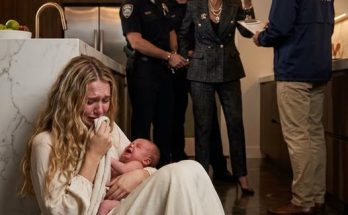
Not with open cruelty.
Not even, I think, fully consciously.
Just a gradual drift toward warmth and away from competition.
My career success made that easier.
I advanced faster than anyone expected.
I bought the apartment in Chicago.
Then the lake house.
Within the family, I became the daughter who had already “made it,” while Caroline remained the daughter still becoming someone.
My mother used that difference to motivate her, and in practical terms it meant my accomplishments became something I was expected to carry quietly, almost apologetically, so no one else would feel small beside them.
And I did that.
I kept the house quiet.
I offered it generously.
I never made a spectacle of the deed, the mortgage, or the fact that I had earned it.
And even that was not enough.
It was not even enough to prevent the moment when my mother decided what she wanted required pretending I did not exist.
On Friday the police department called.
The officer’s voice was different than it had been the previous Saturday—more careful now, more formal.
“Ms. Caldwell, we reviewed your documents. The property is clearly yours. The report contains statements that appear inconsistent.”
I let the word sit for a moment.
Inconsistent.
“We’ll be speaking to the reporting parties,” he continued. “Would you like to file a formal complaint?”
“Yes,” I said. “I would.”
So I filed it.
Evan also prepared a civil cease-and-desist letter and added one recommendation I hadn’t anticipated.
“Since they publicly claimed you were a stranger,” he said, “you should formally revoke any implied permission for them to enter the property. Put it in writing. Send it certified.”
There is something both sad and clarifying about mailing certified letters to your mother and sister informing them that they are no longer permitted on property you own and that any future entry will be treated as trespassing.
It was not an act of anger.
By then I was already beyond anger.
I was simply doing what needed to be done.
Still, the weight of it was real.
I mailed the letters Thursday afternoon.
The clerk took them behind the counter, and I thought of my father.
He had never said much about family conflicts, but when he spoke, he believed in exactness.
He would have said what he always said:
The paperwork matters.
The letters were delivered.
I had the confirmations.
Then I waited, because Evan told me people who rely on performance rarely stop after one scene.
They escalate.
They keep asserting because the moment they stop, facts begin filling the silence.
My phone rang at 7:14 Saturday morning.
Trevor.
Caroline’s fiancé.
I had only met him three times. He seemed pleasant, if somewhat inclined to accept Caroline’s version of events without much resistance.
I almost let it ring out.
But curiosity won.
“Harper,” he said, sounding like a man who had spent hours absorbing a situation too strange to process. “I didn’t know who else to call.”
He told me that my mother and Caroline had returned to the property that morning for more wedding planning—bridesmaids, a photographer, and apparently catering.
They found the gate codes changed.
They somehow got onto the property anyway through a neighboring lot manager who assumed they belonged there.
They started setting up.
Then police arrived.
I stayed quiet until he finished.
“Trevor,” I said, “they’re trespassing.”
There was a long silence.
“But Diane said the house was family property. She said your dad—”
“My father is dead,” I said evenly. “He left me money. I used it to buy that property. The deed is in my name.”
His voice lowered.
“Caroline said you’re unstable. That you have episodes.”
I laughed once, without humor.
“Did she also tell you she told an officer she didn’t know me? On my own walkway?”
The silence that followed answered everything.
I drove out to the lake that morning because Evan texted saying the officers wanted me there.
Part of me, if I’m honest, also wanted to watch what happened when the world my family had built out of confidence collided with deeds, camera footage, and certified mail receipts.
When I arrived, the driveway was cluttered with the evidence of a morning that had begun confidently and gone very wrong.
Cars were parked at careless angles.
Chairs had been set up on the lawn.
A catering van idled awkwardly near the trees.
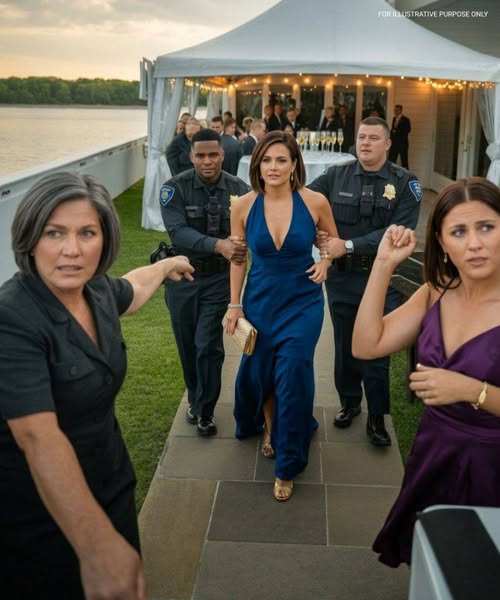
Two officers stood at the entrance.
My mother was speaking loudly to one of them, wearing the posture of someone accustomed to authority.
Caroline stood near the tent, appearing to cry in a way I couldn’t yet tell was real or strategic.
Evan stood nearby with a folder under his arm.
When he saw me, he gave one short nod.
Then my mother saw me.
“There she is!” she shouted, pointing. “That’s her. She’s harassing us again. Arrest her!”
An officer turned.
“Ms. Caldwell?”
“Yes,” I said. “I’m the homeowner. I revoked permission in writing. They were served. I have proof of delivery.”
Evan stepped forward and handed over the folder.
The deed.
Utility records.
Certified letters.
Delivery confirmations.
The prior incident report.
Everything organized, labeled, and in sequence.
I watched my mother’s face as the officer reviewed the documents.
There is a certain expression people wear when they realize the ground beneath them is not as solid as they believed.
I saw that expression move through her in real time.
Caroline stopped crying.
The bridesmaids stood near the cars, slowly recognizing that they had not shown up for wedding planning but for a legal problem.
The photographer lowered his camera.
“This is ridiculous,” my mother snapped. “You can’t do this to family.”