But the doctor and Rachel had already spoken to him. When he stepped into my room, his face looked strained and pale. “What really happened?” he asked. I looked at him and realized how exhausted I was from holding two versions of reality at once—the truth I lived and the lie Susan performed. “Your mother pushed me,” I said. He sat down slowly. “What?” So I told him everything. The bathroom. The warnings. The smaller moments I had minimized because I didn’t want him to feel torn between his wife and his mother. His expression changed with each detail—not into anger at first, but into something more painful: recognition. Then a police officer assigned to follow up on the report arrived to take my statement. And when Susan was questioned, her story shifted twice within ten minutes. That was what finally unraveled her version of events. At first, Susan told the officer I slipped stepping out of the shower. Then she said I lost my balance reaching for a towel. Later, when she realized the doctor had documented the pattern of my injuries, she changed it again and claimed she had tried to catch me. But lies built in haste fall apart in the
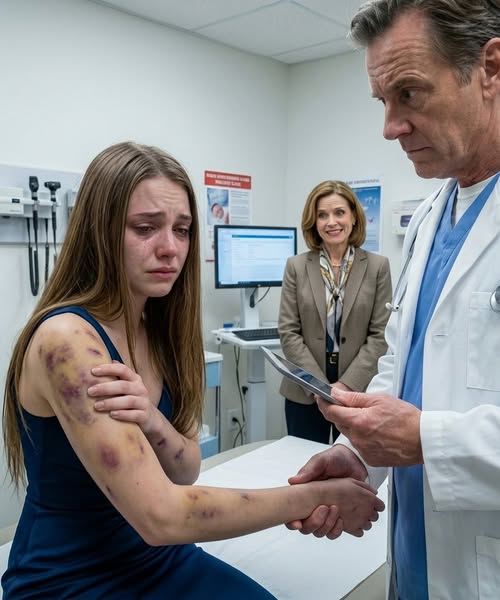
details. She couldn’t keep straight whether the floor was wet, whether I was inside or outside the tub, or whether she touched me before I fell. The more she spoke, the worse it became. The doctor’s notes became the foundation of everything that followed. He had recorded bruising on my
upper arm consistent with force, tenderness and swelling along my ribs and hip, and the fact that the injuries didn’t match the accidental fall Susan described. That mattered because it shifted the situation from “family conflict” into something observable and concrete. Rachel helped me
understand that what felt like a private nightmare had already become something larger. Once the report existed, there was a record. And once there was a record, Susan could no longer rewrite reality by speaking with confidence. The police opened an investigation that same week. I stayed
with my sister instead of returning to Susan’s house. Travis came with me. That was the first sign he understood the seriousness of what had happened. The second came when he asked, quietly, “Has she been doing things like this for a while?”
I said yes.
And once I began, everything that had felt scattered started to align. I showed him old messages where Susan wrote things like, A good wife knows how to respect the woman who built this family. I showed him photos of earlier bruises I had never shared. I showed him notes saved on my phone—dates, comments, threats, times Travis was out of town. He read them all without speaking.
Susan was eventually charged after interviews, medical documentation, and evidence made it clear her explanation didn’t hold. She wasn’t arrested because of a dramatic confession. She was arrested because the facts kept closing in. The doctor’s report, my statement, Susan’s contradictions, and the pattern of behavior all pointed to the same conclusion.
The court process took months. It wasn’t dramatic. It was draining. Susan appeared each time perfectly dressed, speaking softly, acting misunderstood. But by then, her mask had limits. The prosecutor used the medical record to show why her story failed. The officer testified about her shifting statements. Rachel spoke about my fear and disclosure. I testified. So did Travis. That part broke something in him—but also rebuilt something better. He admitted under oath that he had ignored warning signs because he wanted peace more than truth.
Susan was convicted, and the case moved forward because one doctor refused to accept the easiest explanation in the room.
That is what stays with me most. Not just that she was exposed, but that someone paid attention to details when I was too afraid to say everything at once. Sometimes justice doesn’t begin with a dramatic act of courage from the victim. Sometimes it begins with a professional saying, “This doesn’t add up,” and choosing to write it down.
So if this story stays with you, let it stay there. Behind a calm voice, a tidy home, and a simple explanation, real harm can still hide in plain sight. And sometimes the difference between silence and accountability is one person willing to trust the evidence over the story they’re told. If you’ve ever wondered whether details matter—they do. Sometimes they are the first crack in a lie that believed it could last forever.
Post Views: 422