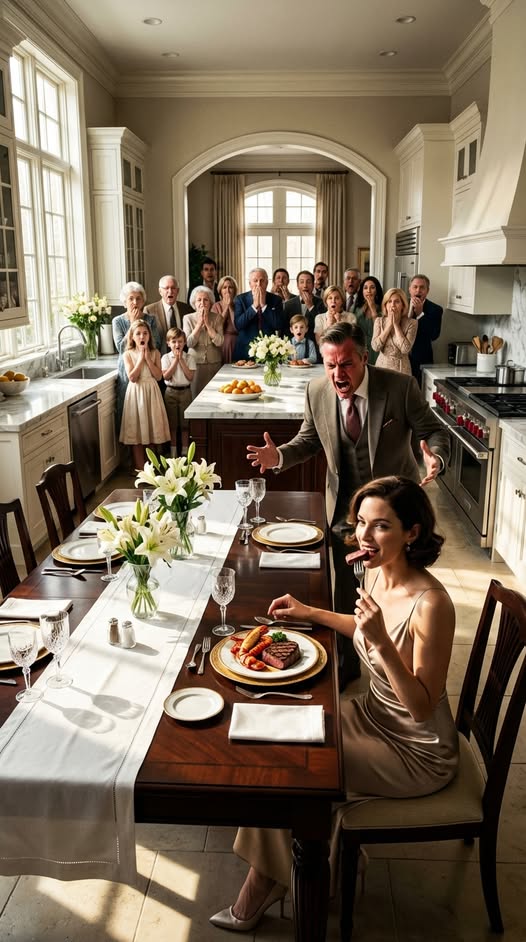
Instead, I just watched him. I felt a strange, crystalline click inside my chest—a locking mechanism. It wasn’t anger. Anger is hot and messy. This was something cold and structural. It was the sound of a woman deciding she was no longer an inhabitant of a marriage, but a tenant in a house.
“Okay,” I whispered. It was the easiest word I had ever spoken.
He let out a short, hollow laugh, misinterpreting my quietness for submission. He reached out, patted my shoulder as if I were a particularly dim-witted child, and walked toward the living room to catch the news. He thought he had corrected a small domestic inconvenience. He had no idea he had just handed me the blueprints for a coup d’état.
The rest of that night was terrifyingly normal. The house functioned on the momentum of five years of shared habits. But as I lay in bed, listening to the rhythmic cadence of his breathing, I wasn’t thinking about our upcoming vacation or the leaky faucet. I was conducting a mental inventory of every crumb, every spice jar, and every frozen pea that belonged to the man beside me.
Chapter 2: The Cartography of the Cupboard
The following morning, the transformation began. It was a metamorphosis of silence. I didn’t make a scene. I didn’t throw out his milk or hide his cereal. I simply stopped being the invisible hand that replenished the world around him.
I went to the store alone. I didn’t buy the brand of coffee he liked. I didn’t pick up the craft beer he usually expected to find chilling in the back of the crisper. I bought a single bag of groceries—small, efficient, and entirely for me.
When I got home, I cleared out the top shelf of the pantry. I moved my items there. I bought a small, permanent marker and, in a script that was almost beautiful in its precision, I began to label.
Elena’s Milk.
Elena’s Bread.
Elena’s Salt.
I felt like a cartographer marking the borders of a new, sovereign nation. For the first few days, Mark didn’t even notice. He was a man who moved through life assuming that things—clean towels, full salt shakers, cold orange juice—simply manifested by divine right. He would open a cabinet, his hand hovering over the space where the crackers used to be, pause for a microsecond, and then move on.
“Are we out of rice?” he asked on the third night, standing over a pot of boiling water.
I was sitting at the kitchen island, eating a bowl of quinoa I had prepared just for myself. The steam carried the scent of garlic and lemon—ingredients I had purchased with my own debit card.
“I didn’t buy any,” I said. My voice was neutral, the verbal equivalent of a blank sheet of paper.
He frowned, looking at the empty spot on the shelf where the five-pound bag of jasmine rice usually sat. “But I wanted stir-fry tonight.”
“Then you should probably head to the store,” I replied, returning to my book.
He stood there for a long moment, the silence of the kitchen stretching between us like a physical chasm. He was waiting for me to offer a solution. He was waiting for me to say, ‘Oh, I’ll run out and grab some,’ or ‘You can have some of my quinoa.’ But those versions of Elena had been evicted.
He eventually let out a huff of annoyance, turned off the stove, and ordered a pizza. He ate it in the living room, the cardboard box a temporary monument to his confusion. I cleaned my one bowl, my one spoon, and went to bed.
The weeks that followed were a masterclass in the architecture of absence. I stopped filling the pantry out of habit. I stopped anticipating his needs. I watched, with a detached, clinical interest, as the household infrastructure began to crumble. The toilet paper ran low. The dish soap became a watery slurry of the last few drops. The fridge, once a cornucopia of shared meals and half-finished leftovers, became a barren landscape of his condiments and my labeled containers.
He interpreted my behavior as a “mood.” He thought it was a temporary protest, a feminine pique that would eventually dissolve back into the comfortable servitude he required. He treated the tension like bad weather—something to be waited out under an umbrella of silence. He had no idea that I wasn’t waiting for the storm to pass. I was the storm.
Chapter 3: The Ghost at the Feast
As the end of the month approached, the air in the house grew heavy, charged with the static of things left unsaid. It was the week of Mark’s thirty-fifth birthday.
Every year, the routine was the same. He would announce the date, and I would spend a week in a frenzy of domestic engineering. I would coordinate with his mother, Sondra, and his sisters. I would spend three days prep-cooking hors d’oeuvres, marinating meats, and baking his favorite four-layer chocolate cake. I was the producer, director, and lead actor in the play called The Perfect Husband’s Celebration.
“Family’s coming over on Saturday,” he said on Tuesday, leaning against the doorframe while I folded a single load of my own laundry. “About twenty people. Mom, the girls, the cousins. I told them we’d do the usual spread.”
I didn’t look up from a pair of socks. “I heard you on the phone with them.”
“Great,” he said, turning to leave. “Make sure we have enough of those little crab cakes Mom likes. She won’t stop talking about them.”
I didn’t object. I didn’t say, ‘Who is paying for the crab?’ I didn’t say, ‘I’m not cooking.’ I simply continued to fold. He took my silence for agreement. In his world, my compliance was a natural law, as reliable as gravity.
Saturday arrived with a brilliant, mocking sunshine. I spent the morning cleaning the house. I polished the surfaces until they shone. I set the table with our finest linens. I made sure the vases were filled with fresh lilies. To any observer, it looked like a house preparing for a joyous occasion.
Mark spent the afternoon in the backyard, prepping the grill—his only contribution to the “labor” of the party. He assumed the kitchen was a hive of activity behind him. He didn’t check. He didn’t need to. In his mind, I was already there, a ghost in the steam, manifesting his desires.
At 4:00 PM, the doorbell rang.
The house filled with the exuberant, entitled noise of the Blackwood family. His mother, Sondra, entered like a queen dowager, handing me her coat without looking at me. His sisters, Megan and Chloe, swept in with their husbands and children, their voices a cacophony of greetings and expectations.
“Oh, Elena, the house looks lovely!” Sondra proclaimed, sniffing the air. Then her brow furrowed. “But… I don’t smell the brisket? Is it in the slow cooker?”
I smiled. It was a thin, practiced thing. “Everyone, make yourselves comfortable. Mark is so excited to see you all.”
I moved through the rooms with the grace of a ghost. I brought out pitchers of ice water. I offered napkins. I was the perfect hostess, providing everything except the one thing they had all come for: the sustenance.
The cousins settled into the den. The children ran through the hallways. The air was thick with the scent of lilies and the hum of twenty people waiting to be fed.
Chapter 4: The Thinning Sound of Plenty
The shift happened at 6:00 PM. It’s the hour when hunger stops being a suggestion and becomes an imperative.
The conversation in the living room began to flag. Eyes started darting toward the kitchen. Mark, sensing the lull, clapped his hands together with a jovial, birthday-boy energy.
“Alright, everyone! I think it’s time for the main event,” he announced, his voice booming. He looked at me, a smug glint in his eye. “Elena, love, are we ready to bring out the spread?”
He led the procession toward the kitchen. Sondra was in the lead, followed by the sisters and the cousins, a hungry phalanx of relatives settling in for the usual bounty.
The sound in the room didn’t change all at once. It thinned. It was like a radio station losing its signal, the exuberant voices fading into a confused static.
They stepped into a kitchen that was surgically, terrifyingly clean.
There were no platters of crab cakes. There was no slow-cooked brisket. There were no bowls of potato salad or trays of roasted vegetables. The stove was cold. The oven was dark.
The only things on the expansive granite island were twenty empty plates, twenty sets of polished silverware, and a single, small container of yogurt sitting in the middle of the counter.
It was labeled in black ink: Elena’s Dinner.
The silence was a physical weight. I stayed near the doorway, my hands folded neatly in front of me. I wasn’t hiding. I was witnessing.
Mark was the last to enter the room. He was still laughing at a joke his cousin had told, the sound dying in his throat as he took in the scene. He looked at the empty counters. He looked at the cold stove. Then he looked at the yogurt.
He turned to me, his face a complex map of confusion, then embarrassment, then a sharp, jagged spark of realization.
“What is this?” he asked. His voice wasn’t loud, but in the vacuum of the kitchen, it sounded like a gunshot.
The relatives looked between us, their hunger replaced by the voyeuristic thrill of witnessing a domestic collapse. Sondra let out a sharp, offended gasp.
“Elena, dear,” she began, her voice trembling with indignation. “Where is the food? We’ve been traveling for two hours.”
I met Mark’s eyes. I didn’t look at his mother. I didn’t look at the confused cousins. I looked only at the man who had told me to buy my own food.
“I did exactly what you told me to do, Mark,” I said. My voice was clear and devoid of heat. It was the voice of a judge reading a verdict. “I bought my own food. I stopped living off you. I assumed that for your birthday, you would want to provide for your own family.”
The room held its breath. It was a moment of absolute, blinding clarity. For years, I had been the scaffolding of his life—the invisible structure that held up his ego, his reputation, and his comfort. By removing myself, I had made the scaffolding visible by its absence.
Mark didn’t explode. He couldn’t. Not in front of twenty people whose opinion of him was the only thing he truly valued. He stood there, the “Successful Man,” the “Leader of the Family,” exposed as a man who couldn’t even put a piece of bread on his own table without the labor he had so casually dismissed.