1. The Suffocating Silence: I burst through the front door of our third-floor apartment at exactly 5:30 PM. I was exhausted, my feet aching from a grueling ten-hour shift at the firm, but my heart was already anticipating the familiar, chaotic slap of tiny, bare feet against the hardwood floor and the obnoxious, cheerful blare of afternoon cartoons. Instead, the apartment was tomb-quiet. The silence wasn’t peaceful. It was heavy, unnatural, and suffocating. It felt like the air itself had been sucked out of the rooms, leaving behind a thick, vibrating tension that immediately made the hair on the back of my neck stand up. “Lucy?” I called out, dropping my keys into the ceramic bowl on the console table. My voice echoed slightly in the stillness. No answer. I rounded the corner into the living room. I found my two-year-old daughter, Lucy, slumped awkwardly against the beige cushions of the sofa. She wasn’t sleeping. She was completely rigid, her tiny hands clutching the fabric of her t-shirt. Her face was flushed a terrifying, mottled, dusky red, bordering on a sickly shade of purple around her mouth. Her lips were parted, pulling desperately for air with a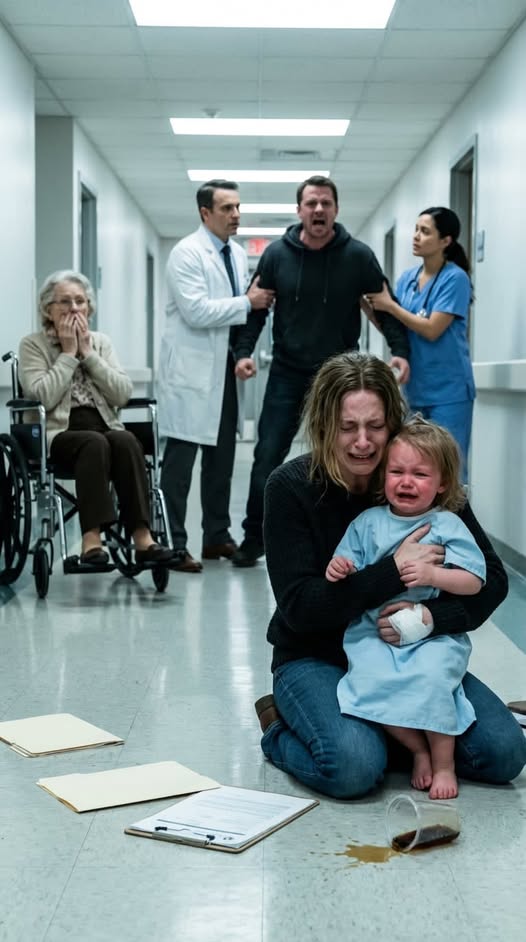
wet, ragged, high-pitched wheeze that sounded like a broken accordion. Her glassy, terrified eyes locked onto mine the second I stepped into the room. They were filled with absolute, primal panic—the look of an animal drowning in plain sight. “Lucy!” I screamed, dropping my heavy work bags onto the floor and throwing myself to my knees beside the couch.
I scooped her rigid, struggling body into my arms. Her skin wasn’t fever-hot; it was fright-hot, clammy, and drenched in a cold sweat fueled by pure adrenaline. Her chest heaved violently with every agonizing, microscopic breath she managed to pull into her lungs.
Travis, my husband of three years, was sitting in the plush leather armchair mere feet away.
He was casually, methodically scrolling through his smartphone, his thumb swiping across the glowing screen in a rhythmic, unbothered motion. The television was off. The room was silent save for the horrifying sound of our daughter suffocating.
“Travis! What happened?!” I yelled, my voice cracking with sheer terror as I cradled Lucy’s head, trying to tilt her chin back to open her airway. “Is she choking? Did she swallow something?!”
He didn’t even look up from his phone.
“She just fell,” Travis said. His voice was flat, bored, and profoundly annoyed by the interruption to his quiet evening. “She was running, she tripped over the rug, and she fell hard against the coffee table. Just leave her alone. She’s fine.”
“Fell?!” I shrieked, staring at the man I had married as if he had suddenly sprouted horns. “Travis, look at her! She can’t breathe! She’s turning purple!”
Travis finally looked up. He didn’t look at Lucy’s agonizing struggle. He looked directly at me. His eyes were cold, dead, and entirely devoid of any paternal concern or human empathy.
He let out a loud, exaggerated, performative sigh—the sound of a man deeply, profoundly inconvenienced by a hysterical woman.
“She cried for a bit because she was scared, and then she calmed down,” Travis said, his tone dripping with patronizing condescension. He picked up the television remote, preparing to turn on the evening news. “You always do this, Sarah. You always overreact to every little bump and scrape. She’s just holding her breath because she’s throwing a tantrum. Stop being so dramatic and put her down. You’re making it worse.”
As he spoke, Lucy let out a horrible, choking, wet gasp against my shoulder. Her tiny fingers dug painfully into my collarbone.
I didn’t argue. I didn’t scream at him for his sociopathic apathy. The maternal instinct overriding my brain recognized, with absolute, terrifying clarity, that the man sitting in the armchair was not an ally. He was an obstacle.
I hauled Lucy into my arms, ignoring the burning ache in my muscles. I grabbed my car keys from the bowl, kicked my work bags aside, and ran for the front door.
“Sarah, where are you going?!” Travis called out, a sudden, sharp edge of anger finally bleeding into his voice as I ripped the door open. “I said she’s fine! Put her down!”
I didn’t answer. I slammed the door behind me, leaving my husband sitting in the suffocating, deadly silence he had so carefully curated.
I sprinted down the three flights of stairs, the sound of Lucy’s ragged, whistling breaths drowning out everything else in the world. I threw her into her car seat, my hands shaking so violently I could barely buckle the straps, and slammed the door.
I drove to the Emergency Room like a woman possessed by a demon. I ran three red lights, my horn blaring, my tires screeching around corners. One hand gripped the steering wheel so tightly my knuckles ached; the other hand constantly, desperately reached back into the backseat, feeling the faint, terrifyingly shallow rise and fall of Lucy’s small chest.
“Hold on, baby,” I sobbed, tears blurring my vision as the neon red ‘EMERGENCY’ sign of the hospital finally came into view. “Mommy’s got you. Just keep breathing. Please, God, just keep breathing.”
I slammed the car into park near the ambulance bay, unbuckled her in a frantic blur, and sprinted through the sliding glass doors, screaming for help.
The triage nurses took one look at Lucy’s mottled face and the severe retractions of her chest muscles. They didn’t ask for insurance cards. They didn’t ask me to take a seat. They moved with terrifying, coordinated speed, snatching her from my arms and rushing her through a set of heavy double doors.
I heard them calling out terms that made the blood freeze in my veins: “Severe respiratory distress,” “Prepare for intubation,” “Possible airway trauma.”
I collapsed into a plastic waiting room chair, burying my face in my trembling hands. I thought the nightmare was peaking. I thought the worst part was the drive, the agonizing uncertainty of whether my daughter would take her next breath.
I didn’t know the true horror hadn’t even arrived at the hospital yet.
2. The Ghost in the ER
Twenty agonizing, eternity-long minutes later, a young, exhausted-looking resident pushed through the double doors and called my name. I practically tackled him.
“She’s stabilized,” the resident said quickly, holding his hands up to calm me. “We’ve got her on high-flow oxygen, and we administered a heavy dose of intravenous steroids and epinephrine to reduce the swelling in her airway. She’s breathing on her own, but she’s very weak. You can come back.”
I followed him into the pediatric trauma bay.
Lucy looked incredibly small in the center of the large, sterile bed. A clear plastic oxygen mask was strapped over her tiny face, fogging up with every steady, labored breath. Her eyes were closed, her body exhausted from the sheer physical effort of fighting for air. But the terrifying, ragged wheezing had stopped. The mottled purple color had faded from her lips, replaced by a pale, fragile pink.
The attending physician, Dr. Aris, a tall man with kind eyes and a serious demeanor, was standing beside the bed, updating her digital chart on a tablet.
“Mrs. Vance,” Dr. Aris said quietly, stepping closer to me so as not to wake Lucy. “She is going to be okay. But I need to ask you some very specific questions about what happened before you brought her in.”
“My husband said she fell,” I stammered, wiping the dried tears from my cheeks. “He said she tripped over a rug and hit the coffee table. I wasn’t there. I had just walked through the door from work.”
Dr. Aris frowned, his eyes dropping back to the tablet, then shifting to look intently at Lucy’s pale neck.
“Mrs. Vance, a fall against a blunt object like a coffee table typically presents with localized bruising, perhaps a laceration or a fractured collarbone if the impact is severe enough,” Dr. Aris said, his voice dropping to a cautious, clinical whisper. “But Lucy’s airway… her trachea is severely inflamed uniformly around the circumference. That is indicative of sustained, bilateral external compression. Not an illness, and certainly not a simple fall.”
He paused, looking me directly in the eyes.
“Did she swallow something large?” Dr. Aris asked. “Or… did something wrap around her neck? A cord from a window blind, perhaps?”
My stomach plummeted. A cold, nauseating dread washed over me. Before I could even begin to process the horrifying implications of his medical assessment, the heavy automatic doors of the trauma bay slid open with a soft whoosh.
Travis strolled into the room.
He didn’t run. He didn’t look frantic. He walked in with his hands casually stuffed into the pockets of his jeans, adopting a mask of mild, deeply irritated concern. He looked like a man who had been dragged away from a football game to deal with a leaky faucet.
“Is she fine?” Travis asked loudly, his voice carrying an unmistakable edge of ‘I told you so’. He stopped at the foot of the bed, looking at the oxygen mask with blatant annoyance. “I told you she was fine, Sarah. You completely overreacted. Now we’re going to be stuck here all night dealing with hospital bills.”
Dr. Aris stiffened, his professional demeanor instantly hardening at Travis’s callous tone.
But it wasn’t Dr. Aris’s reaction that made the blood roar in my ears.
A senior pediatric nurse, a woman with silver hair tucked under her scrub cap whose nametag read Elena, was standing on the opposite side of the bed, adjusting the flow rate on Lucy’s IV line.
As Travis spoke, Elena glanced up from the IV pump.
She looked at Travis’s face.
The transformation was immediate, visceral, and absolutely terrifying.
All the color drained entirely from Elena’s face, leaving her skin looking like a wax corpse under the harsh fluorescent lights. Her eyes widened to an unnatural degree, locked onto my husband with a look of pure, unadulterated, paralyzing horror.
The heavy plastic medical chart she had been holding under her arm slipped from her trembling fingers. It hit the linoleum floor with a loud, sharp clatter that made me jump.
Elena didn’t apologize. She didn’t pick it up. She took a rapid, involuntary, stumbling step backward, pressing her spine hard against the metal frame of the medical supply cart, physically trying to put distance between herself and Travis.
Her chest began to heave with sudden, rapid breaths. She looked as though she had just seen a demon materialize in the middle of the trauma bay.
Elena leaned slightly across the bed, toward me. Her eyes were still fixed on Travis in terrified disbelief.
“Why…” Elena whispered.
Her voice was shaking so violently I could barely hear her over the hum of the machines.
“Why is he here?” Elena breathed, pointing a trembling, accusatory finger directly at my husband.
3. The Code Blue-Eleven
I froze. My feet felt as though they had been cemented to the linoleum floor.
I looked at Travis. He wasn’t looking at me, or at our daughter. He was staring directly at Nurse Elena. The mask of the irritated, put-upon father had completely vanished. His eyes were dark, flat, and completely devoid of any human emotion. His jaw was set in a hard, rigid line. It was a look of cold, calculating, predatory recognition.
It wasn’t the look of a confused husband wondering why a stranger was afraid of him. It was a silent, lethal warning.
“He’s my husband,” I whispered back to Elena, my voice cracking, a sudden, cold sweat breaking out across my neck. “He’s Lucy’s father.”
Elena covered her mouth with both hands, a single, terrified tear spilling over her eyelashes and cutting a path down her pale cheek.
“Oh, dear God,” Elena breathed, the words muffled behind her hands.
She didn’t look at Travis again. She turned her head mechanically, her eyes locking directly onto Dr. Aris.
The silent communication between the two medical professionals was instantaneous. Dr. Aris saw the raw, unmistakable terror in his senior nurse’s eyes, he saw my confusion, and he saw the cold, predatory stillness of the man standing at the foot of the bed.
Elena mouthed a single, terrifying phrase to the doctor.
“Code Blue-Eleven.”
Dr. Aris didn’t hesitate. His posture shifted from that of a consulting physician to a tactical commander. He stepped smoothly, seamlessly around the end of the bed, physically inserting his tall frame between Travis and where Lucy and I were positioned.
“Sir,” Dr. Aris said, his voice entirely smooth, projecting an aura of absolute, boring, bureaucratic protocol. There wasn’t a trace of panic or accusation in his tone. “I’m glad you’ve arrived. We need the primary insurance holder to report to the front desk in the main lobby immediately.”
Travis frowned, his eyes narrowing suspiciously. The mask slipped slightly, revealing the irritation beneath. “Why? My wife has the insurance cards in her purse.”
“We need your physical, wet-ink signatures on the liability waivers to authorize the pediatric transfer from this trauma bay up to the specialized respiratory ward,” Dr. Aris lied flawlessly, gesturing toward the heavy double doors. “It is a mandatory hospital protocol for minors. If we do not have the primary holder’s signature on file within the next ten minutes, we are legally required to halt treatment and begin discharge procedures.”
Travis glared at me, clearly annoyed by the inconvenience of having to perform the duties of a father. He looked back at Dr. Aris, attempting to assert control. “I’ll do it later. I want to see my daughter.”
“It has to be right now, Mr. Vance,” Dr. Aris insisted, his tone polite but unyielding. He turned and caught the eye of a massive, broad-shouldered orderly passing by the open doorway. “Marcus, please escort Mr. Vance to Admissions Desk 3. Tell them it’s a priority intake.”
Travis clearly didn’t want to leave the room. He wanted to maintain his control over the narrative, to ensure I didn’t say anything “dramatic” to the doctors. But the presence of the large orderly and the threat of a massive, uninsured hospital bill ultimately outweighed his desire to hover.
He shot me one final, warning glare. “Don’t sign anything until I get back,” he ordered, before turning on his heel and following the orderly out the double doors.
The second the heavy doors clicked shut behind him, the atmosphere in the trauma bay violently shifted.
Nurse Elena didn’t walk to the door; she sprinted. She hit the heavy, red, industrial lockdown button on the wall panel, engaging the electronic deadbolt from the inside with a loud, definitive clack.
She spun around to face me, tears now streaming freely down her face, her hands shaking as she gripped the metal rail of Lucy’s bed.
“His name is Travis Vance, isn’t it?” Elena asked, her voice cracking, her chest heaving. “He used to live in Seattle, Washington, five years ago.”
I stared at her, my mind spinning, desperately trying to keep up. Travis had lived in Seattle before we met in Chicago. He rarely talked about his past, claiming it was a painful chapter he preferred to leave behind. I had respected his boundaries. I had thought he was simply a private man.
“Yes,” I stammered, gripping the edge of the mattress. “Yes, he lived in Seattle. How do you know that? Who are you?”
“Because five years ago, I wasn’t a nurse in Chicago,” Elena sobbed, wiping her face with the sleeve of her scrubs. “I was a senior pediatric trauma nurse at Seattle Grace Hospital. I was the charge nurse on duty the night he brought in his six-month-old stepson.”
The room went completely, utterly silent. The rhythmic beeping of Lucy’s heart monitor suddenly sounded deafening.
“He carried the baby into the ER,” Elena continued, her voice dropping to a horrifying, haunted whisper. “He was playing the exact same part. Annoyed. Bored. Said the baby had ‘just stopped breathing in his crib.’ Said it was probably SIDS.”
I couldn’t breathe. I looked down at my two-year-old daughter, fighting for air through an oxygen mask.
“But it wasn’t SIDS,” Elena wept, her hands trembling violently. “The autopsy showed petechial hemorrhaging in the eyes and severe, sustained manual compression of the trachea. Manual strangulation. Travis choked that baby to death in his crib because he wouldn’t stop crying.”
The floor seemed to drop out from beneath me. The sterile walls of the trauma bay spun wildly.
“The police arrested him,” Elena said, her voice filled with a profound, agonizing frustration. “But his ex-wife… the baby’s mother… she was so terrified of him, so completely brainwashed and dependent, she refused to testify. She told the police she had seen the baby get tangled in a blanket earlier that day. Without her testimony, the police couldn’t definitively prove beyond a reasonable doubt that it wasn’t a horrific, tragic accident. The DA dropped the charges. He walked free. And he moved away.”
I looked at the faint, reddish-purple, mottled handprints that Dr. Aris had been examining on my daughter’s pale, fragile neck.
He hadn’t ignored a fall. He hadn’t been annoyed by a clumsy toddler.
He had put his hands around her throat and squeezed until she stopped breathing, simply because he was tired of hearing her exist.
4. The Hospital Trap
“He likes the attention of the tragedy, but he absolutely hates the crying,” Elena whispered, stepping around the bed and gripping my arms tightly, her eyes boring into mine with desperate intensity. “Sarah, you have to listen to me. If he takes her home tonight, if you let him convince you that this was an accident or an illness… she will not survive the week. He will finish what he started.”
My knees buckled slightly. Dr. Aris immediately grabbed a rolling stool and pushed it behind me, guiding me down before I collapsed.
“Code Blue-Eleven is our internal hospital protocol for imminent, life-threatening domestic violence or child abuse where the perpetrator is currently on the premises,” Dr. Aris explained rapidly, his voice calm and authoritative. “The orderly I sent with your husband isn’t taking him to admissions. He’s taking him on a deliberate, ten-minute detour through the most confusing corridors of the hospital to buy us time.”
“Time for what?” I rasped, staring at my daughter’s chest, my brain struggling to process the reality that the man I slept next to was a monster who murdered infants.
“Time for you to make a choice, Mrs. Vance,” Dr. Aris said gently, kneeling down so he was at eye level with me. “We can transfer Lucy to the pediatric ICU under a pseudonym, lock the ward down, and claim it’s a medical necessity, keeping him out for tonight. But tomorrow, as her legal father, he has the right to demand her release against medical advice. We cannot hold her indefinitely without cause.”
I looked at Elena, who was crying silently. I looked at Dr. Aris, whose kind eyes were filled with grim determination.
Finally, I looked at Lucy. The small, innocent, beautiful life that I had created. The child who had looked at me with primal terror as she suffocated on our living room floor while her father scrolled through his phone.
The shock and the terror evaporated. They were instantly replaced by a cold, hard, and absolute maternal fury.
I didn’t cry. I didn’t scream. The woman who had rushed into the hospital in a blind panic was dead. The woman sitting on the stool was a mother preparing for war.
I looked directly at Dr. Aris.
“I don’t want to hide her for tonight,” I said, my voice dead, flat, and completely devoid of fear. “I want to call the police. I want the Seattle PD contacted immediately. And I want him in a cage.”
Dr. Aris nodded once, a sharp, definitive movement. He stood up and pulled a radio from his belt.
“Security,” Dr. Aris spoke into the radio. “This is Dr. Aris in Trauma Bay 4. Code Blue-Eleven is confirmed. We need local PD dispatched to this location immediately. Armed response required. Suspect is currently on the premises, being monitored by Orderly Marcus in Sector G.”
For the next eight minutes, the trauma bay was a flurry of silent, coordinated activity. Elena adjusted Lucy’s monitors, ensuring she was completely stable and comfortable. Dr. Aris compiled the medical evidence, taking high-resolution, forensic photographs of the bilateral bruising on Lucy’s neck with a specialized camera.
I sat by Lucy’s bed, my hand resting protectively, immovably over her small chest, waiting.
At exactly the nine-minute mark, the heavy electronic lock on the double doors clicked, disengaged remotely by the security desk.
The doors slid open.
Travis walked back into the room. He didn’t look like a man playing a role anymore. He looked furious. The mask of the mildly annoyed father had completely slipped, revealing the aggressive, controlling predator beneath.
“They didn’t need my signature,” Travis snapped, glaring at Dr. Aris. “The receptionist at the main desk said she had absolutely no idea what you were talking about. This is ridiculous. You’re incompetent.”
He turned his blazing eyes on me.
“Get her coat, Sarah,” Travis ordered, his voice a low, threatening growl. He pointed a finger at the door. “We’re leaving. Right now. I am pulling her out of this hospital against medical advice. I’ll take her to a clinic tomorrow.”
He took a step toward the bed.
“She’s not leaving, Mr. Vance,” Dr. Aris said, stepping out from behind the privacy curtain, blocking Travis’s path with his own body. “And neither are you.”
Travis’s eyes narrowed into dangerous slits. His fists clenched at his sides. “Excuse me? I am her father. I have legal custody. You cannot keep my child here against my will.”
“Actually, sir, I can,” Dr. Aris stated, his voice ringing with absolute, clinical authority. “Under state law, as a mandated reporter, I am invoking emergency medical custody due to suspected, imminent, and severe child abuse.”
“Abuse?!” Travis shouted, his face flushing dark red. He lunged toward the bed, trying to push past the doctor, reaching a hand out for me. “Sarah, don’t listen to him! He’s crazy! She fell! You know she’s clumsy! She tripped on the rug!”
“The inflammation in Lucy’s airway is not from a fall, Mr. Vance,” Dr. Aris said, his voice rising in volume, dominating the room. “It is from sustained, bilateral pressure to the trachea. Strangulation. I have already submitted the forensic photographs to Child Protective Services, and they have assumed temporary emergency custody.”
Travis’s arrogant, controlling facade completely shattered. He realized the trap had been sprung. He looked at me, desperation and fury warring in his eyes.
“Sarah, tell him!” Travis bellowed, pointing at me. “Tell him she fell! Tell him the truth!”
I slowly stood up from the stool. I didn’t back away. I looked into the eyes of the monster I had married.
“I know the truth, Travis,” I said, my voice as cold as liquid nitrogen. I reached over and gently pulled Lucy’s IV line and oxygen tubing out of his reach, shielding my daughter with my body. “I know exactly what you are. And I know what you did in Seattle.”
Travis froze. The blood instantly drained from his face, leaving him looking exactly as Elena had when he first walked into the room.
Before Travis could take another step, before he could formulate a lie or attempt to flee, the heavy double doors behind him burst open.
Two uniformed police officers and a plainclothes detective, flanked by three massive hospital security guards, stepped into the room, completely blocking the exit.