Chapter 5: The Reckoning of Margaret Ruth: “But we aren’t just here to talk about Lily’s hair, are we?” I asked. I signaled for Mark to turn to page four. Mark’s eyes scanned the “Familial Matches” section. He stopped. He read the name James M. out loud. Then he read the relationship estimate. “Half-Uncle.” “Mom?” Mark’s voice was hollow. “Who is James Michael Callahan?” The manila envelope, once Patricia’s weapon, now lay on the table like a discarded shroud. Patricia sank into her chair. She looked at Margot. Margot’s face had crumpled into a mask of thirty-six-year-old exhaustion. “Trish, tell him,” Margot whispered. “It’s over.” “I was twenty-five,” Patricia stammered, her voice suddenly sounding like a frightened girl’s. “I wasn’t married. My parents… they said it would ruin the Atwood name if people knew. We gave him up in Hartford. I thought… I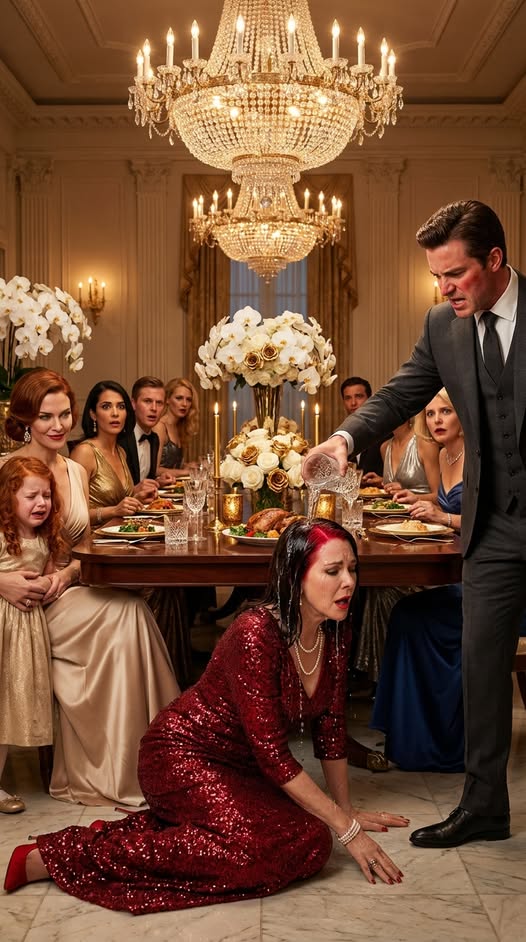
thought it was buried.” Warren stood up. He didn’t yell. He didn’t throw a chair. He just looked at the woman he had been married to for thirty-four years as if she were a stranger he’d met on a train. “Thirty-four years,” Warren said, his voice a dry rasp. “We’ve been married thirty-four years, and you let me believe you were someone else. You let me watch you judge every other woman’s ‘character’ while you were hiding a son in Oregon?” “I was protecting us!” Patricia wailed.
“No,” Mark said, standing up and towering over her. “You were protecting your image. You were so afraid of your own truth that you tried to destroy my wife to keep the focus off yourself. You stole my daughter’s DNA to find a sin that wasn’t there, only to have the system find yours instead.”
Courtney was crying now, the “branding” forgotten. “I have a brother? I have a brother and you never told me?”
I stood up then. I didn’t feel triumphant. I felt the weary satisfaction of an OT who had finally corrected a dangerous misalignment.
“Patricia,” I said, “what you did is illegal. Testing Lily without my consent is a violation of state statutes. I have a cease and desist already drafted. But more than that, you’ve done something you can’t litigate your way out of. You’ve emptied this house.”
Warren didn’t wait for her to respond. He walked to the hallway, grabbed his jacket, and walked out the front door. The sound of his truck starting in the driveway was the loudest thing in the world.
Mark turned to me. “Get Lily. We’re going.”
As we walked out, Patricia reached for Mark’s arm. “Mark, please. I did it for the family!”
Mark pulled away with a look of pure, unadulterated revulsion. “You don’t know the first thing about family, Mom. Family is the people you don’t have to test to love.”
As we drove away from the Atwood estate, the red tail-lights fading into the Connecticut dusk, I looked at Mark. His jaw was still set, his hands tight on the wheel. “I want to call him,” he said. “James. I want to call my brother.”
Chapter 6: The Silver Ghost
Six months have passed since that dinner.
The Atwood foundation didn’t just crack; it underwent a total structural overhaul. Warren moved out that night and never moved back. He lives in a small apartment in New Haven now, close to Dennis. He sees Lily every Saturday. He brought her a wooden truck he built himself—painted red.
Patricia lives alone in the big house in Milford. She stopped dying her hair. It grew out in a shock of silver-gray with streaks of that defiant, recessive red at the temples. She looks like the woman in the attic photo now. She sends letters—long, rambling apologies that Mark doesn’t open. He isn’t ready. Maybe he never will be.
Courtney sent me a three-page handwritten letter of her own. I was wrong, she wrote. I followed her because I didn’t know how to lead myself. I’m sorry I was a part of her campaign. I replied with a “Thank you.” Some progress is measured in millimeters.
But the real story—the one that makes my work as a therapist feel like a small miracle—happened in August.
James Callahan flew in from Portland. We met at a diner halfway between Milford and Bridgeport. I watched from the booth as Mark walked toward a man who had his exact jaw, his exact slightly crooked nose, and his exact capable hands.
They didn’t hug at first. They just stood there, two versions of the same blueprint, thirty-six years apart. Then James smiled.
“I hear we have the same taste in construction,” James said.
Mark laughed, a real, chest-deep sound I hadn’t heard in months. “And the same taste in stubborn mothers.”
They spent four hours in that diner. James has a daughter too—Sophie, age four. She has dark hair, but she has the Atwood brow.
Lily and Sophie met in our backyard later that week. I sat on the porch with Mark and James, watching the two girls chase each other through the sprinkler. Red curls and dark braids flying through the air, their laughter a bright, silver cord connecting a family that Patricia had tried to keep apart.
I still have the manila envelope in my desk drawer. I keep it as a reminder. Sometimes the weapons people build to destroy you are the very things that set you free.
The truth doesn’t need a deposition. It doesn’t need a pearl-earning smile or a secret lab test. It just needs someone willing to stand in the light and say, “This is who we are.”
Patricia Atwood wanted to know where things came from. She wanted to track origins. Well, she found them. She found a son she’d abandoned, a husband she’d deceived, and a daughter-in-law she’d underestimated.
And me? I’m still an occupational therapist. I still document everything. I still watch the millimeters. But when I look at my daughter now, I don’t see an “Atwood outlier” or a “recessive gene.”
I see a girl who is exactly where she is supposed to be.
I stood at the kitchen window that evening, watching Mark and James shake hands as James prepared to head to the airport. And as I watched them, I realized that the red hair wasn’t a crack in the foundation. It was the fire that had finally cleared the ground for something real to grow.
Epilogue: The New Blueprint
Mark and James talk every Sunday now. They’re planning a joint project—a summer cabin. James handles the history, Mark handles the structure.
Warren is dating a woman named Elaine, a nurse who doesn’t care about origins, only about how a man treats his granddaughter.
And Patricia? She called last week. She didn’t argue. She didn’t score. She just asked if she could send Lily a birthday card.
“You can send the card, Patricia,” I told her. “But don’t send anything else.”
The silence on the other end was the sound of a woman finally learning the rules of a world she no longer rules.
That is my story. A DNA test, a pot roast, and a secret that was thirty-six years too old. If you ever find yourself at a table where the truth is being used as a blade, just remember: blades have two edges. And sometimes, the person swinging is the only one who gets cut.
Thank you for listening. Keep your grip steady. I’ll see you in the next one.