The smartphone in my leather purse buzzed three times before I even bothered to pull it out. I was standing in the cramped supply closet of the community health clinic where I volunteered twice a week, trying to wedge a heavy box of sterile bandages onto a shelf that was already buckling under the weight. It was the kind of quiet, monotonous task that retirement leaves you with after forty grueling years working in hospital emergency rooms. Not earth-shattering in the grand scheme of things, but useful. Orderly. The exact sort of work that gives your aging hands something to do when the frantic pace of your life has finally grown still. The number flashing on the screen had an Alaska area code. I almost let it ring out to voicemail. Over the past few years, I had learned the hard way to ignore unknown numbers. Scammers were relentless, and I had absolutely no patience left for fake charities or aggressive men from a phantom “legal department” threatening me over taxes I did not owe. But something deep inside my chest made me swipe the green icon. Maybe it was a mother’s instinct. Maybe it was decades of old hospital training.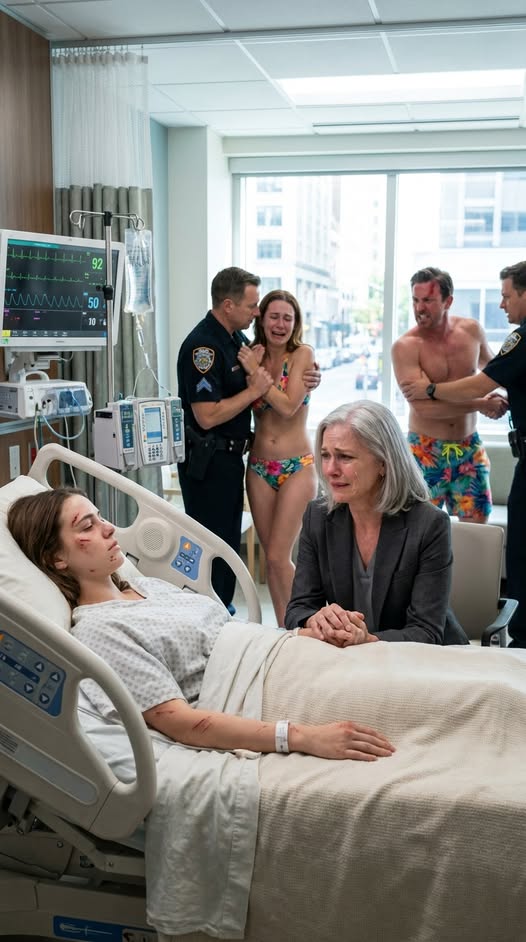
After forty years in medicine, some hidden corner of my soul had become a highly sensitive tuning fork for bad news. “Is this Martha Hayes?” The voice on the other end was female. Young. Incredibly careful. I shifted the heavy box against my hip, my brow furrowing. “Yes, speaking.” “Mrs. Hayes, my name is Brenda. I’m a registered nurse at the Providence Hospice Center up in Anchorage. I am calling about your daughter, Sarah.”
The cardboard box slipped entirely from my hands.
Hundreds of bandages burst across the linoleum floor in a chaotic spray of white paper sleeves, but I didn’t even hear them hit the ground. All the air was sucked out of the tiny closet.
“What about Sarah?”
My voice came out much steadier than I actually felt. Decades in the ER had taught me how to sound perfectly calm before my brain even processed the panic. Keep the voice level. Get the clinical facts. Fall apart later.
Brenda hesitated for one beat too long.
“Mrs. Hayes, I am so incredibly sorry to be the one telling you this, but Sarah was admitted to our end-of-life facility three weeks ago. Her condition has deteriorated significantly in the last forty-eight hours. I found your number in her unlocked phone under ‘Mom, Emergency.’ She begged me to call you as soon as she was lucid enough to speak. I really think you need to get on a plane.”
Three weeks.
Those two words struck me harder than a physical blow. Not hospice. Not deteriorated. Not come quickly.
Three weeks.
My beautiful, vibrant daughter had been dying in the freezing dark of Alaska for twenty-one days, and I was just now hearing about it from a total stranger.
“Where is Greg?” I demanded, my grip on the phone tightening until my knuckles turned white. “Her husband. He is her emergency contact. Why on earth didn’t he call me?”
There was another agonizing pause on the line. This one told me that Brenda knew far more than she was legally or professionally comfortable saying.
“Mr. Lawson hasn’t been here,” she said, her voice dropping to a sympathetic whisper. “Not once since Sarah was admitted. He filled out the intake forms, listed himself as traveling out of the country for a vital business acquisition, and left. Mrs. Hayes… I don’t think your daughter has had a single visitor.”
I closed my eyes, leaning my back against the cool plaster of the wall. For one terrible second, the supply closet smelled like harsh antiseptic, old paper, and pure terror. For one second, I was thirty-four years old again, standing in a sterile hospital corridor waiting for a surgeon to tell me whether my husband was still alive after his massive heart attack. Same icy hollowness. Same absolute certainty that my life had just split cleanly in two.
“I’m coming,” I said, my voice hard as iron. “Tell Sarah I am coming right now.”
I hung up the phone before Brenda could say something kind that would have shattered my composure.
Sarah. My sweet Sarah. Six months ago, she had called me on Christmas Eve from Juneau and casually mentioned she was exhausted, that the winter felt brutally long. She had laughed lightly and promised me she was fine. She had lied. Or, someone had systematically taught her to stay quiet about her suffering until silence felt like a mandatory duty.
I grabbed my purse, marched to the front desk, told the clinic manager I had a family emergency, and walked to my car with the same clipped, controlled stride I used when racing toward a trauma bay.
I packed a single carry-on bag in fourteen minutes. Sweaters, toiletries, blood pressure medication. And, without fully understanding why, the little pink construction-paper photo album Sarah had made for me for Mother’s Day when she was twelve. “My mom is the strongest person I know,” she had written in crooked glitter glue. I packed it because if I was about to walk into the room where my daughter was dying, I desperately needed to carry a version of her that hadn’t yet been broken.
As I sat in the airport terminal waiting for my emergency red-eye flight to Seattle, my phone buzzed. It was an email containing a scanned document from Brenda at the hospice center. I opened it with trembling fingers.
It was a copy of Sarah’s emergency intake form. Greg’s signature was at the bottom. But right above it, under the “Current Location of Primary Contact,” Brenda had written a small, handwritten note just for me.
Mrs. Hayes, the note read. I thought you should know before you arrive. He isn’t on a business trip. His public social media shows he is currently on a honeymoon in the Bahamas with another woman.
The flight from Chicago to Seattle, and then onward to Anchorage, felt like navigating through a suffocating, frozen purgatory. My movements were oddly crisp and mechanical, as if someone else’s hands were unzipping my bag and buckling my seatbelt while my actual mind lagged thousands of miles behind.
All the way across the continent, I replayed my last in-person visit with Sarah.
It was Christmas at my house in Illinois. She had arrived completely alone. Greg had stayed behind in Alaska because, according to Sarah, “year-end financial audits are absolute chaos” and his wealth management firm simply could not spare him. Greg dealt in luxury portfolios, expensive tailored suits, and utilizing corporate jargon to make ordinary people feel stupid.
I had never liked him. God knows I tried. I smiled warmly at their rehearsal dinner. I danced at their wedding. I invited him into my home and pretended not to notice how he evaluated every single room he entered, as if every space and every person existed solely to be assessed for their net worth. There was a slick, reptilian carefulness to him. He had the kind of superficial charm that never actually warmed a room; it only claimed ownership of it.
And Sarah—my bright, stubborn, big-hearted girl who loved teaching fifth grade—had grown progressively quieter year by year after she married him. She developed a heartbreaking habit of checking herself before she spoke, glancing at his face as if every sentence she uttered required his silent permission. At Christmas, she had been frighteningly pale and bone-thin, complaining of severe migraines. I told her to see a specialist. She had just smiled and said, “Greg says you always think everything is medical, Mom.”
I should have pushed harder. I should have dragged her to a clinic myself.
By the time the plane touched down in Anchorage, it was nearly midnight. The airport was blindingly bright and eerily empty. I rented a compact car and drove out into the Alaskan night. The air outside cut the lungs like shattered glass. I had forgotten how brutal the cold up here felt—not just in temperature, but in its vast, isolating scale.
The Providence Hospice Center sat tucked into a quiet, snow-covered neighborhood on the edge of the city. The automatic doors slid open with a soft hum.
A woman at the front desk stood up immediately. “Martha Hayes,” I said. “I’m here for Sarah Lawson.”
“I’m Brenda,” the nurse said gently, stepping out from behind the counter. “Come with me.”
We walked down a long, dimly lit corridor that smelled faintly of industrial lavender, hand lotion, and bleach. I knew that specific, terrible smell. It was the desperate medical attempt to drape a floral curtain over the stench of inevitability.
When Brenda pushed open the heavy wooden door to Room 107, I completely forgot how to breathe.
My daughter was in that bed.
And for one horrifying, agonizing second, I did not recognize her.
Sarah had always been beautiful in an unpolished, radiant way. Dark hair, bright green eyes, and a smile that made her fifth-grade students trust her instantly. But the frail, skeletal woman lying in the hospital bed looked as though the world had erased her with a dry, abrasive brush. Her cheekbones protruded sharply. Her skin was the waxy, translucent color of old parchment. An oxygen cannula rested beneath her nose, and a cardiac monitor ticked out a fragile, failing rhythm beside her head.
I dropped my heavy bag onto the linoleum and crossed the room before my brain consciously registered the movement.
“Sarah,” I whispered, my voice breaking into a jagged sob.
I took her hand. It was ice-cold and impossibly light, as if nothing but brittle bone and translucent skin remained. “Baby, I’m here. Mom is here.”
Her dark eyelashes fluttered. For a terrifying moment, I thought I had arrived too late. Then, slowly, painfully, her green eyes opened. They were unfocused at first, clouded by heavy morphine, but then they locked onto my face.
“Mom,” she breathed.
Those three letters completely shattered me. I bent over the metal rail of the bed and pressed her fragile hand against my wet cheek. “Of course I came,” I wept. “Why didn’t you call me? Why didn’t you let me come take care of you?”
Sarah’s eyes drifted shut, a tear leaking from the corner of her eye. “Greg told me not to bother you. He said you were enjoying your retirement. He said… he said I’d be a burden, and that I’d be getting better soon anyway.”
A burden. I had raised her single-handedly after her father died when she was eight. I had worked double shifts at the hospital to pay for her college. I would have ripped my own heart out of my chest and handed it to her if she needed it. And some arrogant, manipulative monster had convinced her I was too busy to hold her hand while she died.
Brenda touched my shoulder gently. “Mrs. Hayes? Can we step into the hallway for just a moment?”
I kissed Sarah’s burning forehead, promised I would be right back, and followed the nurse out the door.
The moment the door clicked shut, the grief in my chest instantly solidified into a cold, terrifying rage.
“How long does she have?” I asked.
Brenda didn’t force me to beg for the truth. “Days. Maybe a week if her heart holds out. The pancreatic cancer is fully metastatic. It ravaged her liver, then her lungs. We are keeping her comfortable, but there is no reversing this.”
I braced my hand against the wall to keep from collapsing. “When was she diagnosed?”
“Four months ago.”
Four months of agonizing scans, brutal treatments, and sheer terror, and not a single phone call had reached me.
“Tell me about the Bahamas,” I said, my voice dropping to a glacial, deadly whisper. “Tell me exactly what her husband has done.”
Brenda pulled a thick, manila folder from the nurse’s station and led me into a private, empty staff breakroom. She spread the paperwork across a laminate table.
“Greg came here exactly once,” Brenda said, her voice laced with professional disgust. “The day she was admitted. He stayed for twenty-three minutes. He filled out the intake forms, explicitly left your name off the contact list, claimed he had urgent international corporate travel, and walked out. We haven’t seen him since.”
She pulled out her smartphone and pulled up the Instagram screenshot she had emailed me.
There was Greg, heavily tanned, standing on a pristine white-sand beach in turquoise water. He was wearing expensive sunglasses, his arm wrapped tightly around the waist of a stunning, twenty-something blonde woman in a bikini. The woman was leaning into his chest, laughing.
The caption read: Paradise found with my forever paradise. #Bahamas #NewBeginnings #Wife
The blonde was tagged. Chloe Vance.
“She works as a junior analyst at his wealth management firm here in Anchorage,” Brenda explained quietly. “But Mrs. Hayes… it gets worse.”
I stared at the photo of the smiling monster who had married my daughter. “Tell me.”
“Emily and Greg finalized an expedited divorce last month,” Brenda said. “He claimed legal abandonment and ‘incompatibility due to chronic illness.’ Sarah signed the divorce papers right from her oncology bed while heavily medicated on fentanyl. He officially remarried Chloe two weeks later in Nassau.”
I gripped the edge of the table so hard my fingernails dug into the cheap laminate. He hadn’t just abandoned her. He had systematically, legally discarded her. While she was actively dying, he coerced her into signing away her marital rights.
“Why didn’t anyone stop this?” I demanded, my voice shaking with fury.
“He isolated her completely. The admission papers barred us from contacting unlisted family without patient consent. Three days ago, Sarah had a brief, lucid interval. She fought through the pain, asked for her phone, found your contact, and begged me to call you.”
A coldness settled deep into my marrow. It wasn’t the hot, erratic burn of sudden anger. It was a surgical, precise, and permanent ice.
“I need a computer,” I said. “Right now. And I need copies of every single financial billing statement he left with this facility.”
Brenda logged me into an empty terminal. I began the grim task of pulling apart my daughter’s financial life. Years earlier, Sarah had listed me as an emergency co-signer on her primary bank accounts. I had never used the access. Parents don’t snoop through their adult children’s money unless the world has ended.
I logged into her checking account.
Balance: $83.14.
I checked her savings account, which had held nearly forty thousand dollars from her teaching salary just six months ago.
Balance: $0.00.
I went line by line through the transaction history. Electronic transfers. Repeated, precise, ruthless withdrawals over the span of three months. The same destination account every single time: Gregory Lawson.
I pulled up the Alaska public court records for their divorce. Greg had painted my daughter—a sweet schoolteacher who bought winter coats for her poorer students out of her own pocket—as erratic, verbally abusive, and financially unstable. He had awarded himself the house, the luxury vehicles, the liquid cash, and the entirety of their joint assets. He achieved this because the only person who could have contested it was medicated, vomiting from chemotherapy, and utterly alone.
Then, I checked her employer benefits portal.
I found the life insurance policy.
Payout: $500,000.
Status: Active.
Primary Beneficiary: Gregory Lawson.
I stared at the glowing screen until the letters blurred into a sickening smear of pixels. He hadn’t just abandoned her. He had meticulously structured her ruin. He had drained her cash, expedited a divorce, remarried his mistress, and deliberately left himself as the sole beneficiary of her death. He was waiting at the finish line for a half-million-dollar payout.
I pulled out my cell phone and dialed David Caldwell.
David and I had worked in the trauma ward together back in Chicago. He had been a brilliant trauma surgeon before getting burned out and going to law school. He was now one of the most ruthless, highly-paid estate and litigation attorneys in Illinois.
He answered on the second ring. “Martha? It’s two in the morning. What’s wrong?”
“Everything,” I said.
I spent the next ten minutes laying out the entire, horrifying blueprint of Greg’s betrayal. David didn’t interrupt once.
When I finally finished, the silence on the line was deadly.
“Does Sarah currently have a Last Will and Testament?” David asked, his voice slipping into a sharp, predatory legal register.
“I don’t know,” I said. “Probably whatever Greg forced her to sign.”
“Find out,” David commanded. “If she doesn’t, or if Greg controls it, we are drafting a new one tonight. I am sending you a bulletproof template right now. Get two independent medical witnesses. Get a mobile notary to the hospice by dawn. Furthermore, we are initiating an immediate insurance dispute and filing formal fraud concerns before he even attempts to file a death claim. Martha, we aren’t just protecting her remaining money.”
“What are we doing?” I asked.
“We are building irrefutable legal intent,” David said darkly. “We are going to financially crucify him.”
Just as I hung up the phone, a piercing, high-pitched alarm echoed from the hallway outside. It was coming from Room 107. Sarah’s cardiac monitor was flatlining.
I sprinted down the hallway, bursting through the door of Room 107. Brenda was already at the bedside, adjusting the oxygen flow and stabilizing the IV lines. The horrific blaring of the monitor ceased, returning to a weak, fragile rhythm.
“False alarm,” Brenda breathed, wiping sweat from her forehead. “A sensor slipped off her chest. But her vitals are dropping, Martha. She doesn’t have much time.”
I pulled a chair to the edge of the bed and took Sarah’s translucent hand in mine. Her eyes fluttered open.
“Mom,” she whispered, her voice barely a rasp. “I’m so sorry.”
“No,” I said fiercely, kissing her knuckles. “Do not apologize to me. Not for a single second.”
Tears slid down her sunken cheeks, soaking into her pillow. “I should have called you months ago. I was just… I was so ashamed.”
“Why didn’t you?” I pleaded gently.
She stared at the ceiling for a long time, gathering the strength to speak. “Because Greg kept telling me I was making everything harder. He said that if I got you involved, you’d only worry, and you’d hate him, and it would make my treatment messier. He said that if I really loved him, I wouldn’t drag my family into my illness. He told me isolation was maturity.”
I closed my eyes, a physical nausea washing over me. There it was. The classic playbook of an abuser. Convince a sick, vulnerable woman that asking for her mother’s love is selfish. Convince her that being easy to discard is a virtue.
“Sarah, listen to me,” I said, leaning in so she could focus solely on my eyes. “He lied to you. About everything. About me. About what love actually costs.”
She nodded weakly. “I know that now. I just realized it too late. He took everything, Mom. I have nothing left to give.”
“It is not too late,” I said, pulling the freshly printed legal documents from my folder. “I need your help, baby. We are going to change exactly what he thinks he gets to walk away with.”
I explained the new will. I told her about the $500,000 life insurance policy that Greg was waiting to collect. Then, I told her about the idea David and I had quickly formed on the phone. We would establish a charitable foundation in her name. A foundation designed exclusively to support public school teachers facing terminal illnesses—grants for medical travel, classroom continuity funds, and emergency rent support.
As I described the foundation, a miraculous transformation occurred. The deep, haunting shadow of defeat lifted from her eyes. A spark of the passionate fifth-grade teacher returned.
“For teachers?” she whispered, a faint smile touching her cracked lips.
“For teachers exactly like you,” I promised.
She swallowed hard. “Could we… could we buy books, too? For kids who don’t have any at home?”
I laughed, a wet, tearful sound. “Yes, my sweet girl. We can buy all the books in the world.”
Brenda and another night-shift nurse stood by as witnesses. A mobile notary public, a stern Alaskan woman who had driven through the snow at 6:00 AM, oversaw the process. Sarah signed the documents slowly. Her hand trembled violently, each stroke of the pen a monumental, agonizing labor of love and defiance.
When the final seal was stamped, Sarah let her head fall back against the pillows. She closed her eyes and let out a long, shuddering sigh.
“I feel like I can finally breathe,” she whispered.
We spent her final two days immersed in memory instead of fear. We didn’t mention Greg’s name again. We talked about her childhood in Chicago. We talked about her favorite students. We looked through the glittery pink photo album I had brought, laughing at the crooked construction paper hearts.
On the third afternoon, the golden Alaskan sunlight slanted across her bed. The room was perfectly quiet.
Sarah opened her eyes one last time, looking directly into my soul.
“I love you, Mom,” she breathed.
“Always, my baby. Always.”
She took one more shallow breath. And then, none.