Arthur stood on the porch, his chest heaving, clutching his wallet in his hand. He looked at the retreating van, then slowly turned his gaze up to me. The mask had completely fallen. There was no fatherly authority left in his eyes—only raw, hateful vengeance. He bent down, grabbed a heavy, painted ceramic garden gnome from the flowerbed—a stupid, ironic housewarming gift from Aunt Diane—and hurled it with all his strength directly at my face. I ducked instinctively as the heavy ceramic smashed against the siding just inches below the window frame. A jagged chunk of shattered pottery ricocheted upward, striking the bottom pane of the window with a sharp CRACK, leaving a spiderweb fracture in the expensive glass. “You ruined everything!” Arthur screamed, his voice breaking into a hoarse sob. “You ungrateful, hateful parasite! We sacrificed our lives for you!” I stared at the shattered glass. I stared at the broken pieces of ceramic scattered in the dirt. The line hadn’t just been crossed; it had been obliterated. This was no longer a toxic family dispute. This was destruction of property. This was violence. I closed the window, locked it, and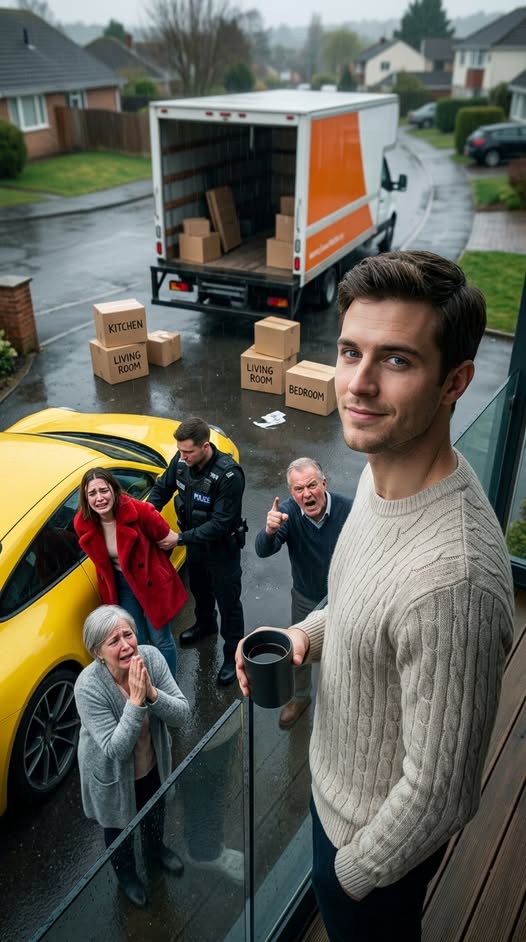
pulled my phone from my pocket. My hands were perfectly steady now. I didn’t call my therapist. I didn’t call Aunt Diane to argue. I dialed 9-1-1. “911, what is your emergency?” the dispatcher answered smoothly. “I need a sheriff’s deputy at my residence,” I said, my voice eerily calm in the quiet house. “I have three hostile trespassers refusing to leave the premises. They have begun violently destroying my property, and I am in fear for my physical safety.” “Are the trespassers known to you, sir?”
“Yes,” I replied, staring at the cracked glass. “They are my parents and my sister.”
Twenty minutes later, the crunch of gravel signaled the arrival of the law. I downloaded the security footage of Arthur cutting the power and throwing the gnome to my phone. I printed a copy of my property deed.
When I unlocked the front door and stepped onto the porch, a white Ford Explorer with SHERIFF emblazoned in gold letters had parked behind the Porsche. Its blue and red lights washed silently over the wet trees.
Deputy Miller, a broad-shouldered man I recognized from local town hall meetings, stepped out of the cruiser. He took one look at the U-Haul, the yellow sports car, the soggy boxes, and the shattered ceramic on the grass.
Arthur rushed forward instantly, employing his most respectable, aggrieved-citizen voice. “Officer! Thank God you’re here. My son is having a massive psychological breakdown. He’s locking us out of our own home. We just moved our entire lives here.”
Miller held up a hand, stopping Arthur in his tracks. He looked up at me standing on the porch. “Morning, Carter. Quite a mess you’ve got here. What’s the situation?”
“They don’t live here, Jim,” I said clearly. “They are trespassing. They showed up uninvited yesterday after selling their home in Ohio. They have never stepped foot inside this house, and I have formally denied them entry.”
Martha burst into dramatic tears, clutching Arthur’s arm. “We’re his parents! How can we be trespassing? We have an oral agreement to live here!”
“Do you have a lease, ma’am? Keys? Mail delivered here?” Miller asked, his voice neutral but firm.
“Well, no, because he locked us out!” Arthur sputtered indignantly.
“Then you haven’t established residency,” Miller stated flatly. “You are guests, and the property owner is revoking his invitation.”
Chloe scoffed from the hood of her Porsche. “We’re family, you rent-a-cop. It’s a civil matter. You can’t do anything.”
Miller’s jaw tightened. He looked at the shattered window. “Carter, you mentioned property damage on the call?”
I walked down the steps and handed Miller my phone. I played the crystal-clear night-vision video of Arthur tampering with the electrical breaker, followed by the daytime footage of him hurling the heavy ceramic gnome at my head.
Miller watched the videos in absolute silence. He handed the phone back to me and turned to Arthur. The polite, neighborly demeanor was entirely gone. His hand rested casually on his utility belt, inches from his handcuffs.
“Sir,” Miller said, his voice dropping to a dangerous register. “Did you intentionally cut the power to this residence and hurl a projectile at that window?”
“He provoked me!” Arthur shouted, pointing a shaking finger at me. “He was disrespecting me as his father!”
“Being a father doesn’t give you immunity from vandalism and criminal mischief,” Miller snapped. He squared his shoulders, looking at the three of them. “Here is how this is going to go. Option A: You pack your garbage back into that truck and vacate this property immediately, never to return. Option B: I arrest you for destruction of property, and I arrest your wife and daughter for criminal trespass. Make your choice right now.”
Absolute, suffocating silence fell over the driveway.
Chloe’s jaw dropped. Martha let out a terrified whimper. Arthur looked at Miller, realizing for the first time in his life that his volume and his demands meant absolutely nothing against the badge and the law.
Arthur slowly turned his head to look at me. His eyes were wide, pleading silently for me to call it off, to be the obedient son, to absorb their mistakes one last time.
I looked him dead in the eye, feeling the cold wind off the lake at my back.
“Option A sounds appropriate,” I said softly.
Arthur’s shoulders collapsed. The fight drained out of him, leaving only a hollow, defeated old man. He realized, finally and irrevocably, that the bridge was burned.
“Load the truck,” Arthur whispered to Martha. He looked back at me, his eyes filled with a venomous bitterness. “You are dead to us, Carter. You have no family.”
“I haven’t had a family in years, Dad,” I replied, turning my back on them. “I just had dependents.”
The fallout was as predictable as it was toxic.
By that evening, my extended family had formally declared war. My phone became a hazardous object, buzzing relentlessly with vitriolic text messages from cousins and aunts I hadn’t spoken to in a decade. They accused me of leaving my elderly parents to freeze on the streets. They claimed Martha was in the hospital with a stress-induced heart condition.
I didn’t argue. I didn’t defend myself in private messages. I executed a precise, surgical counter-strike.
I compiled the security footage: Arthur cutting the power, Arthur threatening the locksmith, Arthur shattering my window. I scanned the insane rental agreement demanding I live in my own basement. Finally, I took screenshots of Chloe’s public Instagram posts—the canary-yellow Porsche and the five-star champagne toasts—timestamped on the exact day my parents claimed they were destitute.
I posted the entire dossier on my public Facebook page with a single, unembellished caption:
“For those concerned: My parents sold their paid-off home for $620,000. They handed the cash to Chloe for a luxury vehicle and a cryptocurrency scheme. They then attempted to break into my home, demanding I live in my basement while they took my master bedroom. Here is the video of the resulting vandalism when I refused. I will not be commenting further. Anyone who supports this financial abuse is cordially invited to house them.”
The silence that followed was absolute and deafening.
Within an hour, Aunt Diane hurriedly deleted her dramatic posts. The hateful text messages ceased entirely. My cousin eventually messaged me a quiet, embarrassed apology, admitting he had no idea about the massive sum of cash or the sports car.
Through the small-town grapevine, I learned the grim reality of their subsequent weeks. After two nights at a miserable local Motel 6, the reality of their “illiquid” investments crashed down upon them. They were forced to surrender the leased Porsche, swallowing a massive financial penalty that evaporated whatever cash they had left.
With the remnants of Arthur’s monthly pension, they rented a dilapidated, unfurnished double-wide trailer in a park thirty miles out of town. Chloe, the golden child for whom they had sacrificed their entire empire, stayed with them for exactly six days before abandoning them to fly to Miami with a man she met on the internet, chasing another delusion.
Arthur tried to call me exactly once, about a month later. I let it go to voicemail. He didn’t apologize. He merely asked, his voice stiff with wounded pride, if I had any spare couches or mattresses I wasn’t using, as the trailer was cold and empty.
I blocked the number permanently.
It has been six months since the siege. Winter has fully descended on Lake Superior. The water is frozen over, a brutal, pristine sheet of jagged white ice stretching endlessly to the horizon. I paid a contractor to fix the broken window. I replaced the shattered ceramic gnome with a solid concrete statue of a gargoyle, one far too heavy for an old man to throw.
I spend my evenings working by the massive stone fireplace, the heat radiating against my skin. It is incredibly quiet here. Sometimes, in the dead of night when the wind howls against the glass, it is profoundly lonely.
I will not lie and pretend it doesn’t leave a scar. There is a very specific, gnawing grief in realizing you are effectively an orphan because your parents loved their own egos—and your sister’s delusions—more than they loved you.
But then I look around. I look at the towering timber walls I built with my own hands. I look at my bank accounts, which are no longer being chronically drained to extinguish the fires my family intentionally sets. I look at the absolute, untouchable peace I have cultivated in this fortress.
I realize that DNA is not a suicide pact. Family is not a blank check drawn against your own sanity. You are allowed to save yourself. When the hurricane inevitably turns back toward the coast, you are allowed to lock the doors, board up the windows, and refuse to let it tear your roof apart.
For the first time in my thirty-six years, I am no longer the safety net. I am simply a man in a warm house by a frozen lake, finally enjoying the silence he earned.
If you want more stories like this, or if you’d like to share your thoughts about what you would have done in my situation, I’d love to hear from you. Your perspective helps these stories reach more people, so don’t be shy about commenting or sharing.