The shift in our dynamic didn’t happen with an explosion; it happened with a slow, silent erosion. I didn’t even notice the walls closing in until I was suffocating. It began when we moved into his parents’ sprawling estate, the aforementioned Whitmore Manor, ostensibly on a temporary basis. “Just for a few months, Em,” Mark had promised, kissing my forehead in our cramped city apartment. “Just until the paperwork and renovations on our own place in the valley are finalized. It makes financial sense.” Those few months bled into a year, and then two. By the time I realized I was pregnant, the renovations on “our” house had stalled indefinitely, and I had seamlessly transitioned from an independent financial auditor into an unpaid, glorified servant in the relentless rhythm of the Whitmore household. I was the one who woke up at dawn to ensure his father’s specific blend of coffee was exactly 175 degrees, not a degree warmer, lest a tantrum ensue. I was the one who spent hours huddled over spreadsheets, helping his mother, Evelyn Whitmore, manage the guest lists and caterers for her endless, self-aggrandizing charity galas. I was the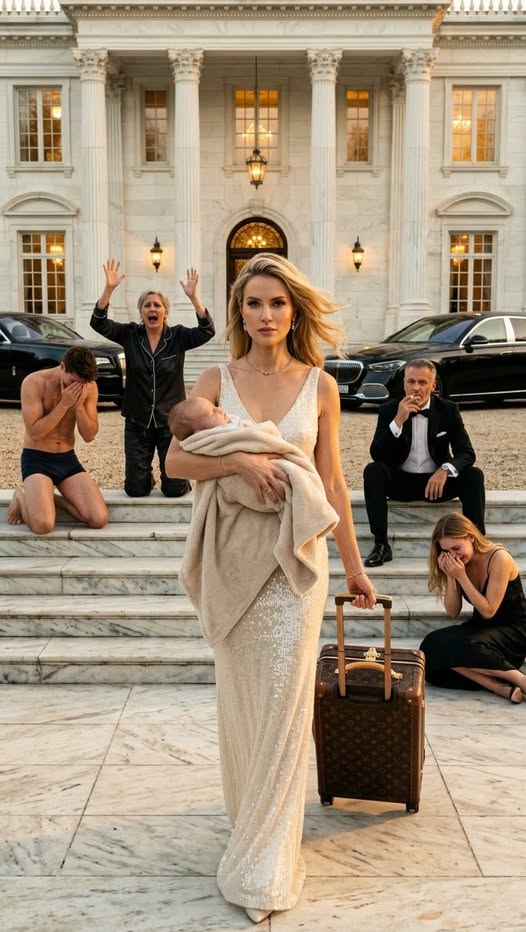
woman who smiled graciously through passive-aggressive comments that were always surgically precise in their cruelty. “You’re so incredibly lucky Mark works such grueling hours for you,” Evelyn would say, her cold, appraising eyes tracking the way I folded the organic linens, her tone dripping with mock sweetness. “It’s so good you decided to stay home and take care of the real work. Family comes first, sweetheart. After all, a woman with your… modest background needs the stability.”
I told myself it was normal. I gaslit myself into believing this was the “sacrifice” older women talked about in marriage counseling. But Mark stopped asking about my day. He stopped noticing the exhaustion bruising my eyes or the way my shoulders slumped under the weight of his family’s expectations. When Leo was born, the emotional gap between us didn’t close with the joy of a child; it fractured into an impassable abyss. I became a ghost haunting my own life—a silent caregiver who was expected to physically disappear into the background the moment the “real” Whitmores started discussing business or legacy at the dinner table.
But there were signs. Blaring, neon signs that I had deliberately chosen to ignore to keep the peace.
The late nights at the office that inexplicably didn’t align with his firm’s project deadlines. The hushed phone calls he took on the Juliet balcony, his voice dropping to a conspiratorial, urgent whisper the moment I entered the room. The way the joint bank statements stopped arriving in the mail, replaced by digital formats locked behind passwords he decided I “didn’t need” to access anymore, citing my “baby brain.”
I didn’t ignore them because I was stupid. I ignored them because I was terrified. I knew that if I pulled at one loose thread, the entire tapestry of my marriage would unravel, leaving me naked in the cold.
But that morning, Mark didn’t just pull the thread; he doused the tapestry in gasoline and struck a match.
I drove for twenty minutes through the winding, tree-lined roads, heading toward the only place in the county that felt like a sanctuary: a small, weathered pale-blue house on the edge of town, boasting a narrow porch and a set of heavy brass windchimes that sang a mournful, haunting song in the morning breeze.
Martha Henderson’s House.
Martha had been my neighbor years ago, back when I was a single, fiercely independent woman living in a studio apartment, armed with an accounting degree and convinced the world was mine for the taking. She was a widow in her late sixties, sharper than a shard of broken glass, and the kind of woman whose gaze could see through three layers of polite societal lies.
When she opened her heavy oak door at 5:15 a.m. and saw me standing on her porch—disheveled, shivering, holding a sleeping infant and a single suitcase—she didn’t ask for an explanation. She didn’t gasp or offer empty platitudes. She took one look at my eyes, simply unlatched the screen door, and said in her raspy, commanding voice, “The kettle’s already on, Emily. Bring that boy inside before he catches a chill.”
It was the first time in three years I felt like I could actually let go of the steering wheel of my life without crashing.
As I sat at her scarred wooden kitchen table, watching the steam rise from a delicate porcelain cup of Earl Grey, the icy clarity I felt in the manor didn’t fade. It sharpened to a razor’s edge.
“He said divorce,” I whispered, the word tasting like poison on my tongue.
Martha sat across from me, her weathered, vein-mapped hands folded neatly over a floral tablecloth. “And you left without a fight. Good.”
“You don’t think I should have stayed? Screamed at him? Fought for my marriage and his fatherhood?”
“Emily,” she said, her tone devoid of pity but full of fierce respect. “Men who casually drop the word ‘divorce’ at 4:30 in the morning to a woman holding their newborn child aren’t looking for a fight. They’re looking for a clean, cowardly exit. You just gave him exactly what he wanted, but I suspect, not in the way he expected.”
I looked over at my battered navy suitcase resting in the corner, then down at my leather tote. “They think I’m entirely helpless, Martha. Evelyn always made sure I felt like a charity case. They think I have nowhere to go, no resources, and no way to survive a legal war with the Whitmore empire.”
Martha leaned forward, the dim kitchen light catching a dangerous, thrilling twinkle in her dark eyes. “Then let them keep thinking that. Sun Tzu said all warfare is based on deception. Let them think you are a wounded deer. It’s the greatest tactical advantage you’ll ever possess.”
I looked down at Leo, who shifted in his sleep, his breathing soft and even. Then I looked back at my mentor. The ghost of the terrified wife shed its final skin. I wasn’t just a rejected mother or a discarded wife. I was a senior forensic bookkeeper. I understood the language of numbers better than I understood the language of men.
And it was time to audit the life I had been living.
I reached into my tote bag, bypassing the diapers, and pulled out the small, sleek metal hard drive. I placed it gently on the wooden table. It sat there, heavy with encrypted secrets.
Martha raised a silver eyebrow. “What is that, Emily?”
I met her gaze, a cold smile finally touching the corners of my mouth. “That, Martha, is the Whitmore empire. Every single cent. And it’s bleeding.”
Before the dark era of the Whitmore Manor, I had worked in high-stakes corporate accounting. I specialized in finding money that people had spent millions trying to hide. I understood fundamentally how wealth moved. I understood that numbers were never just sterile digits on a glowing screen; they were living, breathing stories. They documented greed, they mapped out affairs, and they outlined betrayals.
And for the last fourteen months, while playing the dutiful, sleep-deprived housewife, I had been reading the horrific subtext of our household finances.
I never confronted Mark about the glaring discrepancies because I hadn’t been ready to face the truth that my marriage was a financial sham. But I had been diligent. I was a professional. Every time a stray statement was carelessly left on the marble counter, every time a tax document arrived via FedEx, every time Mark left his laptop unlocked to take a call, I had made copies. I had created a secure digital folder, heavily encrypted and hidden on a cloud server, containing a meticulous map of every cent that had flowed in and out of the Whitmore accounts, trusts, and LLCs.
I knew about the inheritance—the two hundred thousand dollars I had received when my father died—that I had foolishly contributed to the “renovations” on a house my name wasn’t even on. I knew about the exorbitant “consulting fees” Mark had been routing into a holding company that looked suspiciously like a massive slush fund for a parallel life I wasn’t invited to.
“I need a lawyer,” I told Martha that afternoon, once Leo was settled in a makeshift crib in the guest room. “Not just any lawyer. I need a monster.”
Martha took a slow sip of her tea. “I know exactly the monster you need. Harrison Sterling. He’s mostly retired now, operates out of a dusty office downtown. But he hates bullies. And he possesses a specific, venomous disdain for old-money families who think they can buy reality. Especially the kind that hide their cruelty behind silk ties and charity galas.”
Meeting Harrison was like stepping into a different century. His office, located above a failing bakery, was filled with the heavy scent of old legal parchment, floor wax, and pipe tobacco. He didn’t use a laptop; his massive mahogany desk was covered in legal pads, and he wrote with a heavy gold fountain pen. He was a large man with a booming voice and eyes that missed nothing.
When I sat across from him and laid out the situation—the 4:30 a.m. ultimatum, Evelyn’s psychological control, and finally, the financial trail—he didn’t look surprised. He looked hungry.
“The Whitmores,” Harrison mused, tapping his fountain pen methodically against his chin. “They believe they are the undisputed kings of this county. They believe their reputation is an impenetrable armor. But armor has joints, Emily. It has rusted hinges. And looking at your eyes, I’d say you know exactly where to slide the dagger.”
“I don’t want to destroy them for the sake of petty revenge, Harrison,” I said, my voice steady, though my heart pounded. “I want what legally belongs to me and my son. I want my father’s money back. And I want to ensure Mark can never, ever control me again.”
“You are not in a weak position, young lady,” Harrison said, leaning over the printed spreadsheets I had extracted from the hard drive. His finger traced a line of bolded numbers. “You have documented every cent of your personal inheritance that was funneled into their property under false pretenses. You have the routing numbers for the ‘consulting fees’ Mark has been paying to this shell company—Aria Development Group. This isn’t just a simple divorce proceeding, Emily. This is a financial reckoning. We have them by the throat.”
We filed the papers three days later.
There was no dramatic phone call. No tearful pleading. Just a bonded courier delivering a thick stack of explosive legal documents directly to the heavy oak doors of Whitmore Manor during their Sunday brunch.
The response was immediate and violent.
My cell phone, which had been silent for days, began to ring incessantly. Texts from Mark flooded the screen, shifting wildly in tone.
What the hell is this, Emily?
Harrison Sterling? Are you out of your mind?
You’re overreacting and being hysterical. Come home right now so we can talk about this like adults.
You are making a massive mistake.
I didn’t answer a single one. I put the phone on silent and let the crushing weight of my silence do the heavy lifting. Panic is a powerful catalyst; it makes the guilty reveal themselves.
Then, the matriarch arrived.
Evelyn Whitmore showed up at Martha’s door five days after I had fled. She didn’t bother to knock; she pounded on the wood with the silver head of her designer cane. When I opened the door, dressed in simple jeans and a sweater, she looked at me with a potent mixture of disbelief and absolute, venomous disdain.
“This is entirely beneath you, Emily,” she spat, sweeping past me into Martha’s small, cozy living room as if she were inspecting a peasant’s hovel. “Running away in the dead of night? Stealing my grandson? Hiring a gutter-shark like Sterling? You are making a horrific spectacle of this family.”
“Mark made the spectacle when he coldly asked for a divorce while I was desperately trying to soothe his child,” I replied, crossing my arms, refusing to shrink under her glare.
“Men have moods! They endure tremendous corporate stress!” Evelyn waved a perfectly manicured, diamond-laden hand dismissively. “You do not dismantle a legacy because your husband had a late night and a sour temper. Think of the child, for God’s sake. Think of his future. He requires the Whitmore name to open doors in this world.”
“He needs a mother who isn’t treated like an indentured servant,” I countered, my voice rising, the iron in my chest hardening. “And he needs a father who has an ounce of respect for the woman who gave him that son. The Whitmore name is useless if it’s built on lies.”
Evelyn’s face hardened into a terrifying mask of aristocratic fury. “You will not win this, you ungrateful little girl. We have infinite resources. We own the judges. We have a century of history in this town. You have… what? A cheap suitcase and a pathetic grudge?”
I stepped closer to her, invading her space, dropping my voice to a dangerous whisper. “I have the receipts, Evelyn. I have the ledger. All of them.”
She laughed, a sharp, brittle, ugly sound that echoed in the small room. “You are making a mistake, Emily. A very, very expensive, dangerous mistake. You have no idea what we are capable of.”
She turned and marched out, her heels clicking aggressively against the porch steps. As the screen door slammed behind her, I let out a breath I didn’t know I was holding.
I turned around. Standing in the dark shadows of the hallway, holding a small, black digital recording device with a blinking red light, was Martha.
“Every word,” Martha whispered, a savage grin on her face. “In a one-party consent state, no less.”
We had her. We had the threat on tape.
But as I smiled back at Martha, my cell phone buzzed on the counter. It was a blocked number. I answered it, expecting another of Mark’s rants. Instead, a mechanically altered, dark voice whispered through the speaker.
“You think you’re smart with your little spreadsheets, Emily? You’re digging in a graveyard. Stop digging, or you’ll fall in.”
The line went dead. The cold iron in my chest suddenly felt like a block of ice.
The legal process of Financial Discovery is a slow, agonizing, bone-grinding machine for the person who has something to hide. For me, it was a glorious revelation. It was watching a fortress dismantle itself brick by brick.
Harrison Sterling pushed mercilessly for a full, unredacted audit of Mark’s private business dealings and the outer layers of the Whitmore family trusts. At first, their high-priced corporate defense attorneys resisted fiercely, throwing up walls of motions, citing “invasion of privacy” and “protection of proprietary trade information.” But the presiding judge, faced with the preliminary, irrefutable evidence I had already provided from my encrypted drive, possessed zero patience for their stalling tactics. The subpoenas were issued.
We sat in a sterile, glass-walled conference room in downtown for our first mandatory mediation session. The air conditioning was cranked too high, making the room feel like a meat locker.
Mark sat across the heavy mahogany table from me. He was flanked by two slick, expensive lawyers who looked increasingly like they were deeply regretting taking his retainer. Mark looked vastly different from the man who had dismissed me at 4:30 in the morning. The polished, untouchable “golden boy” exterior was rapidly fraying at the edges. His eyes were bloodshot, his skin pale, and he kept nervously adjusting his Rolex.
“Emily, let’s just be adults and settle this quietly,” Mark pleaded, his voice straining to project a calm authority he no longer possessed. He leaned forward, attempting a conciliatory smile that looked more like a grimace. “I am prepared to offer you a very generous monthly alimony allowance. You can keep the sedan. We can negotiate a fair shared-custody arrangement for Leo. There’s absolutely no need for this scorched-earth tactic. No need to dig through my father’s business files.”
I looked at him, feeling a wave of profound nausea. He was still trying to play the benevolent master.
“It’s not your father’s business I’m remotely interested in, Mark,” I said, my voice perfectly level, ringing clear in the silent room. “It’s the staggering amount of capital that was systematically diverted from our joint savings into the Aria Development Group. A group, I might add for the record, that is registered exclusively in your name in Delaware, and hasn’t produced a single day of actual developmental work or revenue.”
The lead lawyer for the Whitmores, a man with a severe haircut and a tight collar, cleared his throat aggressively. “That is a private, high-risk venture investment. It falls outside the purview of—”
“It is community property,” Harrison Sterling roared, interrupting the lawyer, his deep voice rolling like thunder through the glass room. He slammed a thick binder onto the table. “And according to the immaculate, timestamped records my client meticulously kept over the last year, it was directly funded by the liquidation of the inheritance she received from her deceased father. Money that, according to emails we have recovered, was explicitly promised as a down payment on their marital home.”
Mark recoiled as if he had been physically struck. He stared at me, his mouth slightly open, as if he were looking at a complete stranger. And in a very real way, he was. He was finally seeing the highly educated, dangerously competent woman I had been before I allowed his family to shrink me into a subservient ghost.
“You’ve been… watching me,” he whispered, the realization draining the last bit of color from his face. “You were spying.”
“I’ve been paying attention, Mark,” I corrected him coldly. “There is a massive difference. You left the vault open; I just took inventory.”
The room descended into a suffocating silence as Harrison forcefully laid out the giant spreadsheet across the table. It was a masterpiece of forensic accounting. It wasn’t just about the stolen money anymore. It was about the undeniable pattern of coercive control. The undeniable documentation of how the Whitmores had used my presence to boost their philanthropic social image while systematically, legally stripping away my financial independence and preparing to leave me destitute.
By the end of that three-hour meeting, the “generous monthly allowance” was completely off the table. The Whitmore lawyers were visibly sweating. We weren’t just talking about a divorce settlement anymore; we were talking about potential criminal fraud and a forced restructuring of their precious estate to pay back what was stolen.
But as I walked out of the towering office building that afternoon, clutching my briefcase, the victory tasted like ash. I felt a heavy, oppressive shadow following me. It wasn’t Mark. It was the chilling realization that a family like the Whitmores wouldn’t just roll over and accept the destruction of their legacy. They had lived in the untouchable sun for far too long to accept the darkness of a public, humiliating scandal.
That night, back at Martha’s house, I couldn’t sleep. I sat by the front window in the dark, nursing a cup of cold tea.
At 2:00 a.m., a car slowly pulled up and sat idling at the end of Martha’s driveway. It was a heavy, black sedan with heavily tinted windows. It had no license plates. It just sat there, the low rumble of its engine a silent, vibrating threat in the quiet suburban night.
I held my breath, my hand hovering over my phone to dial 911.
They know I’m not just leaving, I realized, my pulse hammering in my ears. They know I’m taking their entire world down with me. And they can’t afford for that truth to see the light of a courtroom.
Suddenly, the rear window of the black sedan smoothly rolled down. A dark shape shifted inside. A blinding flash of light pierced the darkness—a camera flash, aimed directly at the second-story window.
Leo’s window.
My blood ran instantly cold. This wasn’t a legal battle anymore. It was a war for survival, and they were telling me my son was a target.
The final family court hearing was held on a crisp Tuesday morning in November. The air outside was biting, the kind of brutally clear day that feels either like a fresh, stinging start or a devastating, final end.
The courtroom was much smaller and more intimate than I had imagined from television, but the sheer atmospheric tension was enough to fill a massive stadium. The wooden benches gleamed under harsh fluorescent lights.
Mark was already seated at the respondent’s table when I walked in with Harrison. He looked destroyed. His designer suit hung slightly loose on his frame, and he was restlessly tearing a paper napkin into microscopic shreds. His parents, Evelyn and Richard Whitmore, sat directly behind him in the front row of the gallery. Their faces were rigid masks of stony, aristocratic indignation. But I saw the microscopic tremor in Evelyn’s hands as she gripped her vintage Chanel handbag with white-knuckled desperation.