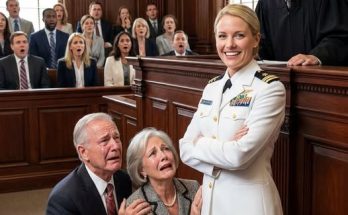
Madeline leaned into the microphone, her voice echoing with unshakable authority. “Sir, psychological abuse does not require the victim to be stupid. It requires the abuser to be incredibly patient, and entirely devoid of a conscience.” I sat in the gallery, my nails digging into my palms, overwhelmed with pride. That is my daughter. Not the broken bird on the floor. Not the apologetic ghost. A warrior. When it was my turn to testify, the defense attorney thought he saw an opening. “Mrs. Mitchell,” he sneered, pacing before the jury box. “Isn’t it a fact that you have spent your entire career harboring a deep-seated bias against men? Building an empire on destroying marriages?” I smiled. A genuine, terrifying smile. “I have spent my career destroying abusers, yes.” “So you entered that dinner party with a pre-existing bias against my client?” “No, sir. I entered that dinner party with grief for my late husband, and hope for my daughter’s happiness.” “You are not a neutral observer!” he shouted, pointing a finger at me. “You are her mother. You orchestrated this entire setup to frame him!” “You are absolutely correct,” I fired back, my voice cutting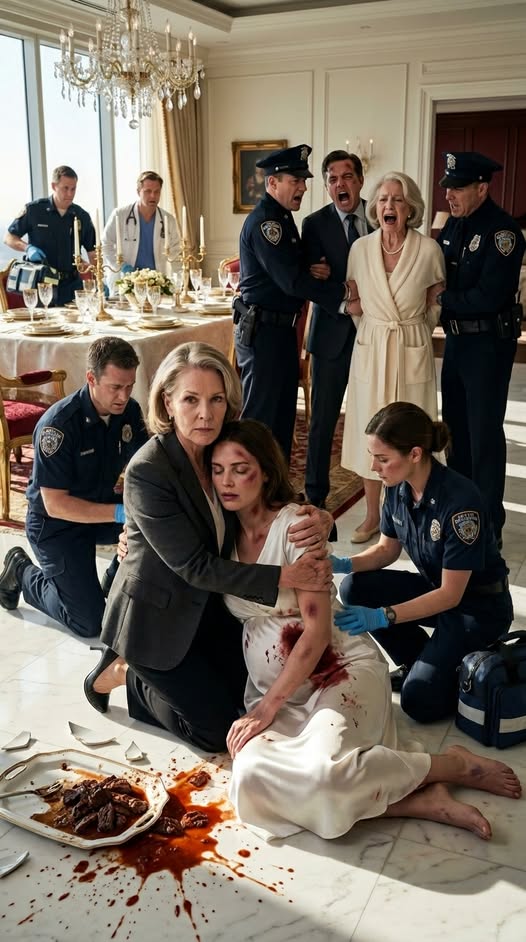
through the room like a whip. “I am not neutral. I love her with every fiber of my being. But the evidence you are fighting is entirely neutral. The audio recording of your client striking her is neutral. The bank wires stealing her inheritance are neutral. The forged life insurance policies are neutral. My maternal love does not magically make his felony violence imaginary.” He sat down abruptly, his face pale. The prosecution’s masterpiece, however, was Constance. Against the frantic advice of her own counsel, her massive ego compelled her to take the stand to defend her
“honor.” She sat in the witness box, draped in gray silk, oozing aristocratic disdain. Under direct examination, she painted Madeline as a hysterical, career-obsessed, frigid woman who fundamentally failed to understand the duties of a “traditional” wife. The lead prosecutor, a shark named Marcus Bennett, stood up for cross-examination. He didn’t yell. He simply played the recording of the dinner.
“A clumsy wife needs correction.”
Marcus walked slowly to the podium. “Ma’am, what specific ‘correction’ did you believe Madeline required when she spilled a drop of water?”
Constance’s eye twitched. “It was… a figure of speech. I was startled.”
Marcus pulled up the bank documents on the projector. “Were you startled when two hundred thousand dollars of Madeline’s stolen inheritance was used to secretly purchase a luxury condominium in your name?”
“I assumed my son was highly successful. I don’t follow his ledgers.”
Marcus hit a button on his laptop. The text messages from the burner phone appeared on the massive screen.
“Make her look medically unstable… The mother can be handled permanently once the payout is secure.”
“Did you misunderstand this text message as well, Constance? Were you planning to ‘handle’ Katherine Mitchell before or after you cashed in the three million dollar forged life insurance policy on her daughter’s corpse?”
Constance’s aristocratic mask violently shattered. She gripped the edges of the witness stand, her face contorted in demonic rage, and screamed, “That ungrateful little bitch was going to ruin him! He deserved that money! He earned it by putting up with her!”
The courtroom erupted into total chaos. The judge hammered the gavel. But the damage was fatal. The jury had seen the monster beneath the silk.
Spencer, a coward to his marrow, refused to testify in his own defense.
The jury deliberated for less than three days.
When the foreperson stood, the air in the room was pulled into a vacuum.
Guilty on aggravated domestic assault. Guilty on massive financial exploitation. Guilty on felony forgery. Guilty on conspiracy to commit insurance fraud.
Madeline gripped my hand so fiercely I thought my bones would snap. When the final “Guilty” echoed, Spencer stared blankly at the defense table. Constance twisted in her seat, locking eyes with me. Her hatred was so pure, so unadulterated, it almost felt cleansing.
At the sentencing hearing a month later, Madeline stood before the judge to deliver her victim impact statement. She didn’t cry.
“For years,” she began, her voice steady and resonant, “I believed that surviving my marriage meant keeping the peace. I have since learned that peace built on terror is just a prison in disguise.”
She turned her body to look directly at Spencer. He refused to meet her gaze. “You didn’t love me, Spencer. You managed me. You meticulously studied what I would forgive, what I would hide, and you used my father’s legacy and my mother’s grief as weapons against me.”
She then turned her gaze to Constance, who glared back defiantly. “And you. You draped your cruelty in the camouflage of tradition. You raised a predator and called him a prince. You both looked at me and thought I was isolated and weak. But you made a fatal miscalculation. You forgot who raised me.”
Tears finally spilled hot down my cheeks. William would have been so endlessly proud.
Spencer was sentenced to fourteen years in state prison. Constance received eight. The asset freezes held, and while money recovered from fraudsters is rarely whole, civil litigation managed to claw back a significant portion of Madeline’s inheritance from the shell companies.
The final act of the ordeal was the apartment.
Madeline sold the Houston condo. But before handing over the deed, she, Rebecca, a locksmith, and I walked through the empty rooms one last time. The oppressive furniture was gone. The stifling rules were gone. The harsh Texas sunlight poured through the floor-to-ceiling windows, illuminating the dust dancing in the air.
Madeline walked into the dining room and stood on the exact marble tile where she had been struck to the floor.
I held my breath, watching her.
She took a deep, expanding breath, letting the air fill her lungs completely. “I used to look at this spot and think it was the epicenter of my greatest failure,” she murmured.
I stepped up beside her, my shoulder brushing hers. “And what is it now?”
She looked around the empty, echoing room, a soft, triumphant smile touching her lips. “It’s just a crime scene. And I’m the survivor who walked away from it.”
She dropped the heavy brass keys onto the kitchen counter, turned her back on the past, and walked out the door.
Chapter 6: Clear Water
Three years after the heavy steel doors of the penitentiary locked behind Spencer and Constance, Madeline launched a commercial startup.
She pivoted away from corporate consulting and returned to her roots, developing high-efficiency, low-cost water purification filtration systems designed for deployment in rural, underdeveloped communities and disaster relief zones. The twelve-year-old girl who had manipulated sand and charcoal had evolved into a thirty-five-year-old CEO with a wall of patents, a mosaic of invisible scars, and a board of directors who quickly learned that interrupting her during a presentation was a catastrophic mistake.
She named the enterprise William ClearWater Labs.
At the ribbon-cutting ceremony for their new headquarters in Silicon Valley, I stood in the front row, wearing my favorite blazer.
Madeline stood at the podium, radiant and commanding. “My late father taught me that access to clean water is a fundamental human dignity,” she projected to the crowd. “My mother, however, taught me that the law can be utilized as a battering ram to break down the doors that trap us. I am standing on this stage today because both of my parents believed, fundamentally, that I was not put on this earth to shrink myself for anyone.”
I pressed a hand to my mouth to stifle a sob.
After the applause died down, she pulled me aside into her corner office. She handed me a small, beautifully framed photograph. It was a grainy image from that old middle-school science fair. She was twelve, wearing a hideous oversized sweater, standing proudly next to her PVC-pipe water filter with a grin that threatened to split her face in half.
I turned the frame over. On the back, in her elegant handwriting, she had penned: Thank you for finding me again.
I clutched the frame against my chest, shaking my head. “No, my sweet girl,” I whispered, my voice thick with emotion. “I didn’t find you. You fought your way back to yourself.”
She smiled, a brilliant, unshadowed expression. “Maybe we were just a really good legal team.”
Time is a relentless river, but it eventually smooths the jagged rocks.
I officially retired from full-time litigation at sixty-four, though the local judges knew that simply meant I operated from the shadows, mentoring young, viciously protective female attorneys and answering midnight emergency calls. With a portion of the recovered funds, Madeline and I established a philanthropic foundation dedicated to funding STEM education for young women who were survivors of domestic violence households. Madeline always said that girls needed to learn, as early as possible, that towering intellectual brilliance and absolute physical safety could co-exist in the exact same body.
The inaugural scholarship went to a sixteen-year-old girl from Fresno who had engineered a low-cost atmospheric air-quality sensor shortly after helping her mother flee an abusive, alcoholic boyfriend in the dead of night.
At the foundation’s award banquet, Madeline watched the young girl confidently accept the check. She leaned over and whispered, “She reminds me of me.”
I nodded slowly, watching the girl’s defiant posture. “She reminds me of the future.”
Eventually, Madeline began to date again. It was a glacial, hyper-vigilant process.
His name was Daniel Hayes. He was a pediatric oncologist. He was deeply gentle without possessing an ounce of weakness, and profoundly steady without being dull. The first time he came to my home to pick her up for a date, I sat him down at the kitchen table and relentlessly cross-examined him for twenty minutes regarding his conflict resolution strategies, his financial philosophies, and his understanding of maternal boundaries, before I even offered him a glass of water.
Madeline stood in the doorway, burying her face in her hands. “Mom, please, I’m begging you. Stop.”
Daniel didn’t flinch. He maintained eye contact, answered every single question with thoughtful precision, and then paused. “Mrs. Mitchell, may I ask you one question in return?”
I raised a skeptical eyebrow, mentally preparing an objection. “Proceed.”
“How do I best support Madeline on the days when the trauma ghosts wake up, and the present suddenly feels like the past?”
I looked past him to my daughter. She was leaning against the doorframe, tears silently tracking down her cheeks.
I stood up, walked to the counter, and poured him a cup of coffee.
Daniel stayed. He didn’t try to play the knight in shining armor. He didn’t try to “fix” her. He stayed because he never, not once, asked her to make herself smaller to make him feel bigger.
On my seventieth birthday, Madeline hosted a massive dinner party at her home. It was a different house entirely—a sprawling, chaotic, wildly warm Spanish-style villa in the hills, bursting with blooming jasmine, overflowing bookshelves, raucous laughter, and an absolute absence of laminated rules.
Daniel was in the kitchen, pouring wine. Rebecca Thorne was arguing good-naturedly about appellate law with Detective Miller on the patio. Lauren Brooks was there, holding court. Even Captain Jessica Lawson had arrived with a massive bouquet of sunflowers, loudly recounting to anyone who would listen about the night a terrifying lawyer turned a Houston dining room into a federal tribunal.
Madeline had spent two days making the braised short ribs.
This time, nobody dared utter a single critique.
Before we cut the cake, Madeline tapped her fork against her wine glass. The chaotic chatter of the house slowly quieted down.
She looked across the long, crowded table directly at me.
“To my mother,” she began, raising her glass. “A woman who spent her entire adult life serving as a human shield for battered women, and still had the grace to accept that even the greatest experts can be blind to the pain bleeding out in their own living rooms. But more importantly… to a mother who, when the blindfold was finally ripped off, did not freeze in despair. She went to war.”
I shook my head, pressing my napkin to my eyes as the tears inevitably rose.
She wasn’t finished. “I spent a long time believing that she saved my life that night. But I look around this table now, and I realize the truth. She didn’t just save me. She gave me the tools to prove to myself that I was worth saving.”
The room descended into a profound, reverent silence. I pushed my chair back, walked around the table, and pulled her into a fierce, desperate embrace. For the first time in years, neither of us felt the need to apologize for our tears.
Hours later, after the final guest had departed and Daniel was inside cleaning the kitchen, Madeline walked me out to the front porch. The California night air was thick with the intoxicating scent of blooming night jasmine.
She leaned her head against my shoulder as we looked out over the twinkling lights of the valley.
“Mom?” she asked softly. “Do you think Dad would be proud?”
I looked up at the vast, star-swept sky. “Of you? He would be so proud his heart would burst.”
“Of us?”
I smiled, feeling a profound, settling peace in my bones. “Yes. Of us.”
Madeline was quiet for a long time, listening to the crickets chirping in the brush. Then, she let out a long, slow breath. “I don’t hate Spencer anymore.”
I turned my head to look at her profile.
“I absolutely do not forgive him,” she added instantly, her voice hardening with iron clarity. “I will never forgive him or his mother. But… I just don’t feel like his ghost lives inside my body anymore. He doesn’t take up space in my brain. He’s just… a bad thing that happened a long time ago.”
I felt a tear slide down my cheek. That is the definition of true freedom. It isn’t forced amnesia. It isn’t toxic positivity. It isn’t making peace with the monsters who tried to consume you.
Freedom is the quiet, miraculous morning you wake up and realize that the trauma no longer holds the keys to the house.
I reached out and squeezed her hand, her strong, capable, brilliant hand. “That is more than enough, Maddie. That is everything.”
So, if anyone ever asks you what transpired after an arrogant, entitled man slapped his wife at a dinner table while his enabling mother applauded the violence, you tell them this:
I did not beg him to stop. I did not prioritize the preservation of his corporate reputation. I did not allow his vile mother to rebrand psychological torture as family tradition. I dialed 911. I hit record. I hunted down the stolen money. I exposed the forged policies. I ripped the mask off their monstrous conspiracy. And I stood in the gallery and watched my daughter reclaim her soul on the public record.
Spencer and Constance fundamentally believed they were simply disciplining a compliant, wealthy wife. They completely forgot she had been raised by an apex predator who knew exactly how the dark machinery of abuse operates.
But their greatest, most fatal error was forgetting something far more dangerous.
Madeline was not just Katherine’s daughter. She was William’s daughter, too.
She was a girl who once knew how to take contaminated, toxic water and purify it using nothing but sand, crushed charcoal, science, and relentless patience.
She was a woman who ultimately learned how to purge the poison from her own life, utilizing the blunt force of the law, the armor of undeniable evidence, and the one, solitary weapon Spencer could never manage to break.
Her own voice.