The extraction zone in the Hindu Kush was a sauna of dust, diesel fumes, and the metallic tang of adrenaline. As the commander of a specialized Tier-One asset group, my life was measured in heartbeats and high-velocity lead. I am Captain Elias Thorne. For twelve years, my world has been a chessboard of threat neutralization, tactical breaches, and the silent brotherhood of men who bleed the same color. I stood in the belly of the C-130 transport plane, the massive engines vibrating right through the soles of my combat boots. In my hand, slightly crumpled and dusted with Afghan sand, was a photograph of Tessa. My wife. She was radiant, her smile brighter than the flares that often lit up my night sky, her hands resting protectively over the gentle swell of a six-month pregnancy. When I married Tessa, I didn’t just marry the woman I loved; I married into the Sterling dynasty. The Sterlings were old money, Boston blue-bloods who viewed the military not as a noble sacrifice, but as a dirty, lower-class necessity they preferred not to think about at their country club dinners. I still remember her father, Silas Sterling, pulling me aside at the rehearsal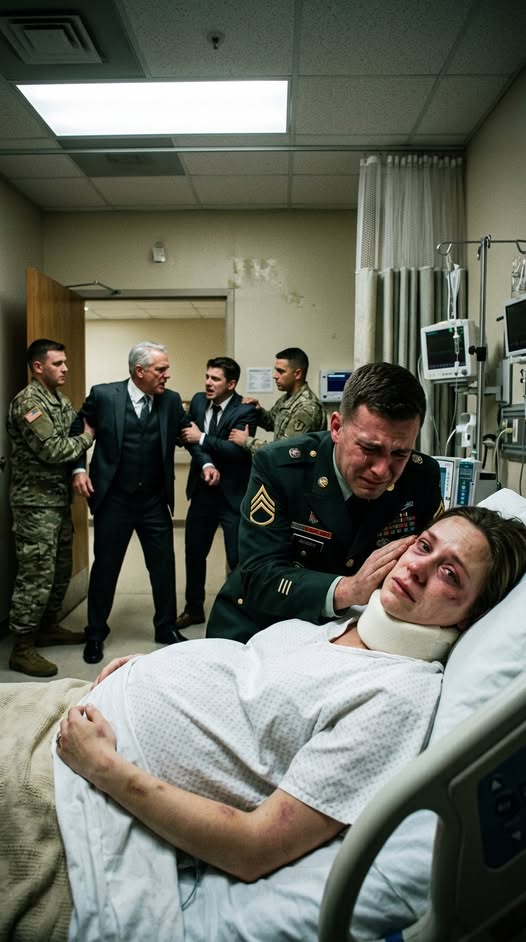
dinner. He smelled of scotch and arrogance. “You can take the boy out of the mud, Elias,” Silas had sneered, looking at my dress uniform with undisguised contempt, “but you can never take the mud out of the man. Don’t think for a second you actually belong here.” I hadn’t cared then. I had Tessa. But right now, the mud felt very real. The satellite phone on my tactical vest vibrated. The caller ID was restricted, but the routing code belonged to Massachusetts General Hospital. I answered it, the roar of the C-130 drowning out the world. “Captain Thorne?” The nurse’s voice was
measured, professional, but underneath the clinical tone, I heard the tremor of genuine horror. “It’s about your wife, Tessa.” “I’m listening,” I said, my voice dropping an octave, instinctually shifting into the icy calm I used during an ambush.
“She’s alive, Captain,” the nurse said, “but she is in critical condition. She’s currently in surgery. There was… a severe trauma. You need to come home now.”
The silence stretched over the encrypted line. A cold, hollow void opened in my chest. I was fighting a war thousands of miles away, dealing with insurgents and warlords, while the real enemies had somehow breached the walls of my own living room.
I disconnected the call. The flight back to American soil was an agonizing blur of logistics and suppressed rage. For fourteen hours, I was a ghost trapped in a steel tube, a man who dealt exclusively in violent solutions but was currently utterly powerless. I stared at the photo of Tessa, the realization settling like lead in my stomach: I had failed my most basic, fundamental duty.
As the wheels of the C-130 finally hit the tarmac at Andrews Air Force Base, my encrypted personal phone chimed. It wasn’t Tessa. It was an anonymous message containing a single photograph pulled from a hospital security feed.
It showed the hospital cafeteria. Sitting around a large table, drinking coffee and laughing—actually laughing—were Tessa’s eight brothers and her father, Silas. They didn’t look like a family in mourning. They looked like a pack of wolves who had just finished a meal.
The smell of the ICU is universal—antiseptic, bleach, and the metallic scent of fear. I walked down the long, sterile corridor, the heavy tread of my boots unnaturally loud against the linoleum. Every nurse and doctor I passed stepped out of my way, instinctively sensing the lethal frequency I was radiating.
I stopped outside Room 412. Through the glass, I saw her. Tessa looked like a broken porcelain doll, dwarfed by the rhythmic beeping of the life-support machines.
The attending physician met me at the door. His eyes were downcast. “Captain Thorne. I am so sorry. She suffered massive blunt force trauma. Multiple fractures, severe internal hemorrhaging…” He paused, his voice catching. “We couldn’t save the pregnancy. The trauma to the abdomen was… too severe.”
My child. Gone.
I didn’t scream. I didn’t cry. The soldier inside me took over, sealing the grief behind a blast door of pure, unadulterated focus. I turned away from the window.
Silas Sterling and his eight sons were standing at the end of the hallway, adjusting their tailored suits, looking thoroughly inconvenienced. I walked toward them. The air around me seemed to drop ten degrees.
“Elias,” Silas said, stepping forward. His voice was devoid of a single ounce of grief. “A terrible tragedy. She fell, Elias. Down the main staircase at the estate. You know how women get emotional and clumsy when they are pregnant.”
I looked at Silas, then scanned the faces of his sons. Caleb, the eldest, had fresh, purpling bruises across his knuckles.
“She fell,” I repeated softly, my voice like dry ice.
“Exactly,” Caleb stepped forward, a smug, arrogant smirk playing on his lips. “It’s a shame about the kid, but accidents happen. Besides, what are you going to do, Thorne? You’re just a grunt. A soldier. You don’t have the lawyers, the money, or the spine to take us on. You’re out of your depth here.”
They looked at me not as a grieving husband, but as an annoyance. A minor obstacle. They believed their wealth and status were an impenetrable armor. They thought distance made them safe.
I looked at Caleb’s bruised knuckles again. I didn’t see a brother-in-law. I saw a hostile combatant.
“I don’t need lawyers, Caleb,” I whispered, stepping into his personal space, watching the smirk slightly falter under my dead, empty stare. “I need targets.”
Silas let out a condescending laugh and turned to walk away. “Let’s go, boys. Let the soldier play nurse.”
I didn’t move. I simply raised my left hand and pressed a small, rubberized button on the side of my tactical watch.
“The perimeter is hot,” I said into my wrist.
Silas stopped dead in his tracks. He turned back, his brow furrowed in sudden, sharp confusion. “What did you just say?”
The Sterlings were still trying to process my words when the air in the hallway shifted.
Caleb’s sleek, expensive smartphone vibrated aggressively against his thigh. He pulled it out, annoyed, but the moment he read the screen, his face drained of color, going from a flushed, arrogant red to a sickly, panicked grey.
“Dad…” Caleb stammered, his voice cracking. “The offshore accounts in the Caymans. The trust funds. They’re… they’re being emptied. Right now. The balances are zeroing out.”
Silas ripped the phone from his son’s hand, but before he could even look at it, his own phone began to ring. He answered it, barking a command, but I could hear the panicked voice on the other end. It was the District Attorney, a man Silas had kept on a very lucrative payroll for a decade.
“I can’t help you, Silas!” the DA shouted through the speaker, the sound echoing in the quiet hospital corridor. “My own house is being raided by federal agents. They have everything, Silas! The ledgers, the bribes! They have it all!”
Silas dropped the phone. It clattered against the linoleum. The arrogance that had defined his entire existence began to fracture.
Outside the hospital’s massive plate-glass windows, the street vibrated with a low, heavy rumble. A line of five blacked-out, armored SUVs pulled up to the curb with terrifying precision. The doors opened in unison.
Twelve men stepped out. They weren’t wearing uniforms, but tactical civilian gear—dark jackets, heavy boots, and earpieces. They moved with the unmistakable, lethal fluidity of men who had spent their lives clearing rooms in Kandahar and surviving ambushes in Fallujah. They didn’t look at the nurses. They didn’t look at the security guards. They walked directly into the hospital, their eyes locked on me.
At the head of the formation was “Reaper,” my communications specialist, a man who could hack a central bank while drinking a coffee. Next to him was “Viper,” our intelligence operative, holding a thick, encrypted tablet.
They stopped ten feet away. Reaper looked at me, gave a sharp, abbreviated nod, and simply said, “The package is delivered, Captain. The network is secured. Give the word.”
The Sterlings huddled together, the pack of wolves suddenly realizing they were surrounded by lions. Silas looked from the terrifying men in the hallway back to me, his jaw trembling.
I walked to the window, looking down at the armored convoy that had essentially blockaded the hospital entrance. I turned back to Silas.
“I told you I wasn’t just a soldier, Silas,” I said, the quiet fury finally breaking through the ice. “I am the reason the monsters stay in the dark. And today, I’m bringing the dark to you.”
Thirty minutes later, the dynamic had entirely inverted.
We had relocated to a private, subterranean parking garage owned by the Sterling Corporation, a concrete cavern that Viper had “liberated” and electronically isolated from the outside world. The nine Sterling men were lined up against the cold, damp concrete wall. They weren’t fighting back. They were shivering.
This wasn’t a street brawl. This was a tactical interrogation. There was no unnecessary violence, no shouting. Just the clinical, terrifying application of absolute pressure.
Silas was pinned against a concrete pillar by Viper, who held him there with seemingly zero effort. Silas was hyperventilating, looking into the eyes of men who had seen the end of the world and walked away bored.
I stood in front of Silas, holding the encrypted tablet Viper had handed me.
“You thought you were smart, Silas,” I said, my voice echoing off the concrete. “You thought doing it at the estate meant there were no witnesses. You thought the security cameras were turned off.”
Silas swallowed hard, sweat beading on his forehead. “You can’t prove anything, Thorne. It’s your word against our dynasty.”
I tapped the screen and held it up to his face. The video was crystal clear, shot in infrared.