Then came the transfer that worked much better than we had ever expected, resulting in our triplets, Leo, Sam, and Maya. They arrived early and spent time in the specialized nursery, and we learned how to live our lives by the sound of medical monitors. Two years of beautiful and loud chaos followed, and then I got sick one morning and assumed it was just the stress of my job. It was not stress, and our twins, Jonah and Sarah, arrived only eight weeks before Penelope’s baby shower. So there I was, a mother of five children under the age of four, and my mother thought I was a barren woman living in a studio. I checked my watch again and saw that it was exactly 1:17 p.m. as my sister called my name. Penelope was waving me toward the center of the room, and I could feel the eyes of every guest following me as I approached her. I crossed the polished floor and felt a strange sense of calm as I reached for my sister’s hand. “I am so glad you came today, Lydia,” Penelope said quietly, and for a moment, she sounded like the sister I used to know. She squeezed my fingers and asked if being in this room was hard for me, and I saw the pity in her eyes.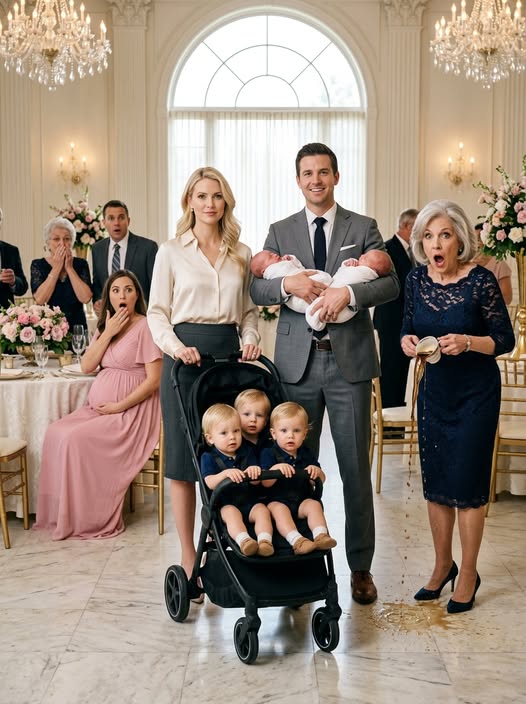
She told me that our mother said I might feel jealous, and that sympathy hurt more than my mother’s coldness. “I am not jealous of anyone, Penelope, because I have a very full and happy life,” I said to her. Madeline interrupted us immediately, appearing beside us as if she had been summoned by the possibility of a conversation she could not control. She placed a hand on Penelope’s shoulder and turned toward the guests to raise her voice for everyone to hear. “We should all be extra kind to Lydia today,” my mother announced, and the entire conservatory went
completely silent. She told the room that it takes a lot of strength to celebrate a sister’s joy when you know you will never have it yourself. Penelope whispered for her to stop, but my sister did not stand up or remove my mother’s hand from her shoulder. Madeline looked directly at me and
said that some women are built for legacy while others are just damaged goods. For one second, I heard nothing but the sound of my own heartbeat against the backdrop of that cruel silence. The old Lydia might have cried, but the woman standing there had been through too much to be
broken by a few words. I felt a clean, white flame of fury rising in my chest, and I looked at my mother and smiled a very slow and deliberate smile. “Is that really what you think, Mother?” I asked, and my voice carried clearly to the back of the room.
I asked her if a woman’s worth was only defined by her ability to reproduce, and Madeline lifted her chin and said she was just stating facts. “Well, let us talk about reality then,” I said while turning toward the heavy oak doors at the entrance.
My watch read 1:19 p.m., and I told my mother that she might want to put her teacup down because her hands looked shaky. The doors groaned as they were pushed open from the outside, and every head in the room turned to see who was entering.
It was not a waiter, but rather Rosa, our nanny, who strode into the room with the confidence of a woman who handled five toddlers for a living. She was pushing a custom, triple wide stroller that looked like it had been designed by a military contractor.
Inside the stroller sat Leo, Sam, and Maya, who were my two year old triplets, and the room let out a collective gasp of shock. Leo was clutching a stuffed dinosaur, while Maya immediately began waving at the faces she saw in the crowd.
Rosa parked the stroller beside me and apologized for the delay because Sam had dropped his pacifier in the fountain outside. “Thank you, Rosa,” I said while reaching down to smooth Sam’s hair, and he looked up at me and clearly said the word Mama.
My mother’s face changed as if something inside her had shattered, and she asked whose children they were in a very thin voice. Before I could answer her, the doors opened again and Marcus stepped into the conservatory.
He filled the doorway in his charcoal suit, and he carried a sense of authority that made the room feel even smaller than before. In his arms, he held Jonah and Sarah, our eight week old twins, who were sleeping peacefully against his chest.
Marcus walked through the room, passing the shocked guests without a word, and came directly to my side to kiss my forehead. “Sorry I am late, love, but the hospital board meeting ran much longer than I expected,” he said loudly.
Someone in the crowd whispered the name Dr. Marcus Cross, and others began to realize exactly who my husband was. Marcus turned to look at Madeline and told her that he now understood why I had told him so little about her.
My mother dropped her teacup, and it struck the saucer with a loud clatter as the tea spilled across her designer suit. She did not even seem to feel the heat as she whispered the word five while staring at the children.
“Triplets and twins, Mother,” I said while lifting Leo from the stroller and settling him firmly on my hip. I told her that it turned out I was never broken, but I simply needed to be away from the person who was breaking me.
Penelope stood up slowly and moved toward the stroller with a face that was pale from the shock of the revelation. She asked if they were biologically mine, and Marcus answered for me by saying that every single one of them belonged to us.
“I did not lie to you, Mother, but I simply stopped giving you access to information that you would only use as a weapon,” I said. She claimed that I had hidden her grandchildren from her, but I corrected her by saying that I had protected them.
I looked around at the guests and saw that some were embarrassed while others were absolutely fascinated by the drama. Mrs. Perkins asked Marcus if he was the neurosurgeon who developed the famous spinal repair protocol, and he nodded once.
He introduced himself and then told the room that I was his wife, a successful gallery owner, and the strongest person he knew. Each of those phrases landed in the room like a heavy stone, and my mother looked as if she might collapse.
She told me that she had a right to know about the children, but I told her that she only had the right to remain silent. “My children are not trophies for your vanity or props for your social media pages,” I said while shifting Leo on my hip.
I told her that they were human beings and I had vowed that they would never be exposed to her kind of love. My cup was indeed running over, and for once in her life, Madeline Huntington had absolutely nothing to say in response.
She reached out toward Jonah, but Marcus took a step back and created a physical wall between her and our son. “You do not get to hold them, and you do not get to be a grandmother in public after being an executioner in private,” I said.
Penelope began to cry and said that we were family, but I told her that family is supposed to protect you rather than watch you bleed. I told my sister that I was leaving with my husband, my children, and my nanny because my real family was right here.
My mother snapped and asked what people would think if I left like this, and I actually laughed at the absurdity of her question. I told her that I no longer cared what any of these people thought of me, and then we began moving toward the exit.
The crowd parted for us as we walked through the room, and I felt a sense of power that I had never experienced in that house. My father called my name as we reached the threshold, and I saw that there were tears in his eyes as he looked at the children.
“They are beautiful, Lydia, and you did a good job,” he said softly, and I told him to call me if he ever decided to stop being a spectator. We stepped out into the cool air and the bright sunlight, and the world outside seemed incredibly clean.
We loaded the children into the SUV and counted them twice before pulling out of the long driveway of the estate. I looked in the side mirror and saw Madeline standing on the steps, looking like a ghost haunting a house that no longer held any treasure.
None of the adults spoke for the first ten minutes of the drive because the children were making enough noise to fill the silence. Maya was singing and Leo was talking about the trees, while Sam was loudly demanding a snack from the back seat.
Rosa eventually told me that it was the best baby shower she had ever attended, and Marcus and I both started laughing. By the time we reached our home in Philadelphia, my hands had finally stopped shaking from the adrenaline of the confrontation.
That night, after the children were finally asleep, Marcus and I sat on the kitchen floor because every chair was covered in toys. He handed me a glass of wine and asked if I had any regrets about how I had handled the afternoon.
I told him that I had no regrets, though I admitted that the situation with my sister still hurt my heart. My father called me the next morning to tell me that my mother was spiraling and that he had moved into the guest room.
He told me that he had sat there and realized he had watched her hurt me for my entire life while he remained neutral. “I am seeing a therapist, Lydia, because I want to learn how to be a better man,” he admitted during our call.
Penelope came to visit me a few weeks later, and she cried when she saw the children playing in our living room. She told me that she was tired of being the good daughter and she asked me for help in setting her own boundaries.
I told her that it starts with the word no, and I promised to help her navigate the difficult path ahead of her. My mother tried to contact me many times, but I refused to answer her calls or her letters until she offered a real apology.
It took a year of consistent behavior and several therapy sessions before she finally sent a letter that admitted she was wrong. I allowed her to see the children in a park for one hour while Marcus and I watched her every move.
She was not a perfect grandmother, but she learned that she had to respect my rules if she wanted to be in our lives. I never went back to calling her Mom, but I stopped flinching when I saw her name on my phone, and that was a victory.
My children grew up knowing that they were loved for exactly who they were, and not for what they could provide for the family legacy. I realized that my children were not proof of my worth, but they were simply people I was lucky enough to raise.
I was never a broken vase, as my mother had claimed, but I was the well that provided water for my entire family. I built a life that she had no power to define, and that was the greatest revenge I could have ever imagined.
THE END.