The office became very quiet as I realized the scale of the deception they had practiced. I asked her if this evidence was enough to stand up in a court of law. Sandra’s eyes sharpened with a predatory light that I recognized from my own commanders. “It is more than enough to ruin their entire morning,” she said. At exactly nine o’clock, I walked into the offices of Thompson and Associates without bothering to knock on the door. The large conference room went completely silent as I stepped inside. Brenda sat at the head of the polished oak table with Logan sitting right beside her. Logan’s tie was loosened as if he had already begun celebrating his new fortune. Cassidy sat near the window, looking pale and withdrawn as she twisted a tissue in her shaking hands. Mr. Thompson, the family attorney, looked up at me with a look of professional annoyance. “Major Jennings,” he said while clearing his throat. “As my email clearly stated, this meeting is for heirs only.” I did not say a word as I dropped Sandra Quinn’s folder onto the table with a heavy thud. The sound cracked through the room like a gunshot, startling everyone at the table.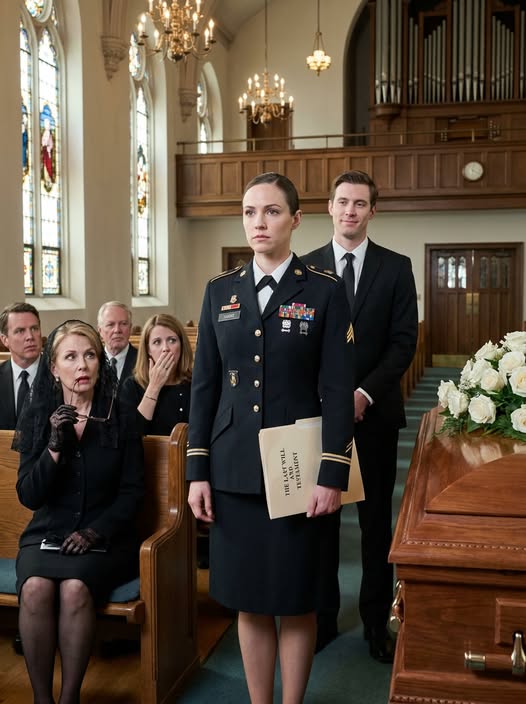
“The will you are about to read is completely obsolete,” I said while looking directly at Brenda. “This folder contains the valid final testament of Thomas Jennings.” Logan scoffed and leaned back in his chair with a look of pure derision. “Here we go with the drama,” he muttered. Mr. Thompson opened the folder and his initial irritation began to fade away one page at a time. Brenda’s smug smile stayed frozen on her face until he reached the psychiatrist’s affidavit and the medication logs. Then the smile died a very sudden death. “What exactly is that supposed to be?”
she demanded while her voice rose in pitch. Mr. Thompson did not answer her immediately, which was an answer in itself that everyone understood. “This document appears to be properly executed and notarized fourteen months ago,” he said finally. He noted that it had been witnessed
and that there was a medical competency report attached to the back. Brenda stood up so quickly that her chair scraped loudly against the floor. “Thomas was confused and he didn’t know what he was doing!” she shouted.
“No,” I replied with a calm that seemed to infuriate her even more. “According to the doctor, he was perfectly sane when he signed this document in Clearwater.”
I told her that according to Mrs. Higgins, he only became confused after her private nurse began sedating him against his will. Logan slammed his fist onto the table so hard that the water glasses rattled.
Cassidy flinched at the noise and pulled her chair further away from her brother. “You are a lying parasite!” Brenda hissed at me.
There she was at last, stripped of the grieving widow persona and the church-lady mask. The real Brenda was finally visible, and she was a woman stripped of her lace and her expensive perfume.
“You locked a fourteen-year-old girl in a basement emotionally, even if you didn’t do it legally,” I said to her. “You took my mother’s room, you took my father’s voice, and you took my rightful place in that house.”
I told her that she did not get to take the truth away from me as well. Mr. Thompson slowly closed the folder and looked at his client with a look of deep concern.
“Mrs. Jennings, I would strongly advise you not to say another word without seeking separate legal counsel,” he warned. Logan’s face turned a deep shade of red as he glared at me.
“We will sue you for every dime you have!” he yelled.
“You are certainly welcome to try,” Sandra Quinn said as she entered the room behind me. She had entered quietly and now stood in the doorway with her briefcase held firmly in her hand.
“But if you choose to challenge this will, we will be forced to introduce the medication logs into the record,” she continued. “We will also bring in the nurse’s sworn statement and the formal allegations of elder abuse.”
Brenda sat back down as if her bones had suddenly dissolved into water. For the first time since I was a child, she looked remarkably small and powerless.
The legal fight that followed lasted for eleven long and grueling weeks. Brenda tried every tactic she could think of to retain her hold on the estate.
She claimed that she was a devoted wife and that I had abandoned the family when they needed me most. Logan shouted so often in the courtroom that the judge eventually threatened to have him forcibly removed.
Cassidy said almost nothing during the entire process, though I saw her in the hallway once. She looked at me with red, swollen eyes and whispered that she truly didn’t know what her mother had been doing.
I believed her, but I did not forgive her, because those are two very different things. The judge officially upheld the second will on a gray and rainy Thursday morning.
The Stone Ridge Estate was legally mine. Logan reacted to the news by breaking into the house late that same night.
The county sheriff called me at nearly three o’clock in the morning. “You need to get up here right away, Major,” he said.
By the time I arrived at the house, the blue and red lights of the police cars were washing over the old cedar siding. The front door was hanging crookedly on its hinges.
Inside, the parlor looked as though a violent storm had learned how to feel hatred. The drywall had been ripped open in several places and the furniture had been overturned and smashed.
The piano that my mother used to play had been attacked with a crowbar. Its ivory keys were scattered across the hardwood floor like a row of broken teeth.
Logan was on his knees in the center of the room, handcuffed and sobbing like a child. “It was supposed to be mine,” he kept repeating over and over again.
I stepped around him without saying a single word to him. Near the fireplace, he had driven a crowbar through a false wall that Brenda had installed years ago.
Something metal glinted in the dust behind the broken plaster. After the deputies took Logan away, I reached into the hole in the wall and pulled out a heavy steel box.
My name was written across the top of it in my father’s distinctive handwriting. Inside the box were dozens of birthday cards that had never been mailed.
There were Christmas letters that had never been sent and a photograph of me from basic training that was worn at the edges. At the very bottom of the box was a letter that smelled faintly of old paper.
He wrote that he had driven to the bus station the morning I left town, but he had been twenty minutes too late. He had watched the empty road and realized that he had failed me in a way that no apology could ever fix.
He said that Brenda had told him I hated him, but he had never truly believed her lies. He admitted that he had hated himself enough for both of us.
The letter ended by saying that he loved me every single day, even if he had loved me weakly and too quietly. I sat on the ruined floor of my childhood home and I finally allowed myself to cry.
It wasn’t a loud or dramatic sob, but just one tear followed by another onto the letter. By the end of the summer, Brenda had moved away from Oak Creek forever.
Logan took a plea deal for the burglary and the vandalism he had committed. Cassidy moved to Oregon and sent me a long letter that I didn’t answer for two weeks.
When I finally wrote back, I told her that the door was open but no one gets to pretend the fire never happened. I did not move back into the house on Stone Ridge Hill myself.
Some places are just too full of ghosts to ever become a normal home again. Instead, I spent the next year restoring the property to its former glory.
The false walls were torn down and the heavy gray drapes were thrown into a dumpster. The piano was repaired by a professional tuner who actually cried when he heard the first note ring out clearly.
I replanted my mother’s lavender garden with my own two hands. By the time September arrived, the entire hillside was a vibrant purple once again.
I turned the estate into the Grace Jennings Center for Veterans and Displaced Youth. Every Saturday, former soldiers would sit on the porch and drink coffee together.
Teenagers who had nowhere else to go could sit in the sun without having to explain why their own homes hurt them. In the front hallway, I hung the cracked wedding photograph of my parents that Brenda had hidden.
My mother was laughing in the photo and my father looked young and unbroken. The glass still had a long diagonal fracture running through the center of it.
I chose to leave it exactly that way. I have learned that broken glass can still protect a beautiful picture.
One Saturday afternoon, Cassidy walked up the long driveway. She was holding a paper bag of grocery-store muffins as if it were a peace offering.
I watched her from the porch as she stood at the edge of the lavender garden. She did not ask me to forgive her for the past.
She only said that she would like to help with the center if I would let her. I didn’t say much, but I handed her a pair of sturdy gardening gloves.
We worked together in silence for an hour, pulling weeds from the soil that Brenda had once tried to bury. When Cassidy began to cry quietly, I did not reach out to comfort her.
However, I did not send her away either, and that was enough for our first day. At sunset, I stood alone on the porch and looked out over the town of Oak Creek.
The town that had watched me vanish now watched the lights come back on in the house on the hill. For years, I had thought that reclaiming the house would feel like a grand military victory.
It didn’t feel like that at all. Victory sounded like the piano being tuned to perfection.
It smelled like the fresh lavender in the wind. It looked like a frightened teenager asleep in the parlor because she had finally found a safe place to rest.
My father had been a weak man and Brenda had been a cruel woman. Logan had been a thief dressed in the clothes of a son.
I had spent sixteen years believing that survival meant becoming completely untouchable. I was wrong about that.
Survival actually meant coming back with steady hands to fix what was broken. It meant opening the rooms that had been locked for decades.
It meant taking the territory that grief had stolen and turning it into a shelter for someone else. I am Major Sarah Jennings.
I was blocked from my own father’s funeral and I was told that I was no longer part of the family. But blood is not something that can be erased by a church aisle or a forged document.
The house on Stone Ridge Hill stands again. And so do I.
THE END.