Safe and close. She wanted to know the neighborhood. She wanted to be part of the transaction. Jason said more quietly, “We just feel that going through all of this alone with attorneys we have never met, financial advisers, Mom, that is a lot to manage by yourself. We want to help. We are your family. That is what family is for.” I looked at my son, then at Kimberly. I thought about the folder moved a half inch to the left. I thought about “took you in.” I thought about Kimberly’s voice through the bedroom wall: She eats our food, uses our utilities, and contributes what exactly? I thought about the fact that they had sat in this room, on this guest bed, and framed wanting control over my finances as wanting to keep me safe. I said, “I appreciate what you are saying, both of you.” Kimberly’s expression became more earnest. She leaned forward slightly. She said, “Matilda, if you have come into money, and I think you have, I think something significant has happened. Please do not make decisions in a vacuum. Jason is your only son. Think about what Samuel would have wanted. Think about what this does to your relationship with your grandchildren.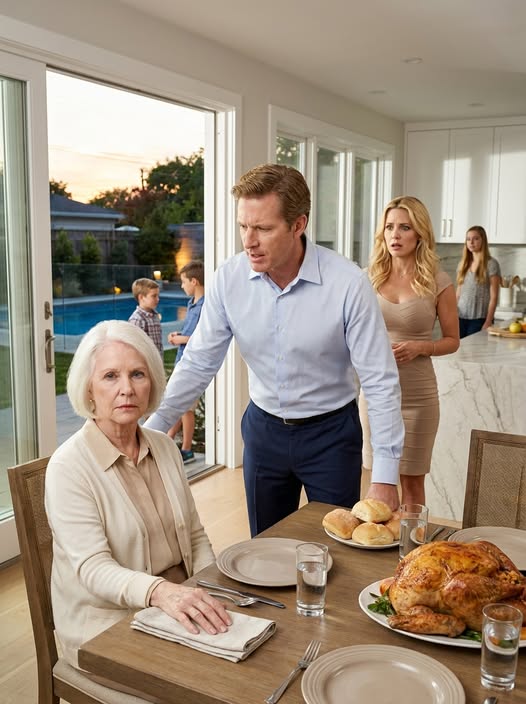
Henry and Grace love you.” There it was. The children. I said, “They do love me, and I love them. That is not going to change.” She asked, “Then why are you doing this alone?” Her voice had an edge now, carefully wrapped in concern. “What has someone told you that made you feel like you need to hide things from us?” I looked at her for a long moment. I said, “No one told me anything. I watched and I listened and I drew my own conclusions. I have been doing that for seventy one years. I am quite good at it.” The warmth in Kimberly’s face shifted. It was a small shift, but I had
been watching her face for two years. She said, “You are making a mistake.” Her voice was flat now. The performance peeled back. Jason put a hand out and said, “Matilda.” He continued, “Whatever you have, whatever this is, if you are not careful, someone will take advantage of you. People
will find out. You will be a target. We are the people who should be protecting you.” I repeated, “Protecting me?” He said, “Yes.” I unfolded my hands. I stood up from the desk chair. I was not a large woman, but I had good posture. Samuel used to say I had the spine of someone who had been
told her whole life to stand up straight and had believed it. I said, “I have a very competent attorney. I have a financial adviser I trust. I have a best friend of forty years coming to help me move. I have a house on a street with oak trees and a porch swing, and the closing is in forty eight hours.” I
looked at them both. I said, “I am not a woman who needs protecting. I am a woman who needed to be treated with dignity. There is a difference.”
Kimberly stood up. Her jaw was tight. She said, “You will regret this.” I said, “Maybe. I can live with that.” Jason looked at me for a long moment. Something was moving behind his eyes that I could not fully read. Something not quite anger. Maybe the beginning of understanding. Or maybe anger’s quieter cousin. And then he followed his wife out of the room.
The door closed. I sat back down. My heart was beating fast. I looked down at the photograph still in my hand, the one of nine year old Jason with the fish. His smile was enormous, the kind children have before they learn to manage their faces. I had loved him so much at nine. I loved him still, which is perhaps the most difficult part of any of this to explain. But love, I had learned, did not require you to make yourself small.
I set the photograph in the packing box, face up, surrounded by tissue paper. Then I went downstairs, made myself a cup of tea, and sat with it at the kitchen table in the dark for a while. The fear was there. I will not pretend it was not. But underneath it, quiet and clean as a current, was something else entirely. I was still standing. I was still myself. And in forty eight hours, I would have a key in my hand.
The house on Meadowbrook Lane smelled like old wood and something faintly floral. Previous owners, Susan told me, had kept lavender in the rooms. Dorothy arrived Friday evening and walked through every room with her hands clasped behind her back, the way she always moved through spaces she was assessing. She said at the end of the walkthrough, “It is yours. I can feel that. It already knows it.”
I do not know that I believe in houses knowing things, but I believed her. We moved in on Saturday. The movers were efficient and quiet. By afternoon, my boxes were stacked in the rooms where they belonged, and Dorothy and I sat on the porch swing with iced tea while the March light went golden over the oak trees. For the first time in two years, I exhaled completely.
I had sent Jason a text the morning of the move. I have moved out today. The room is cleared and clean. Thank you for the time I was there. I will be in touch about getting together soon. Brief. Civil. True. He did not reply for six hours. When he did, it was three words. Are you okay?
I answered. Yes, very much so. That was Saturday. The gathering happened the following Sunday. Jason called me Thursday to invite me to a family lunch at his house. His parents in law would be there, Kimberly’s sister Wendy, and the children. He presented it as an olive branch, a normalization of things. I had been expecting something like this. I said yes.
I called Penelope Holloway on Friday morning. I told her what I was walking into. She was quiet for a moment and then said, “Do you want me to prepare anything?” I said yes. And we spoke for an hour. I also called Gregory Nolen, who sent me a summary document I printed and placed in my good leather folder.
When I arrived at Jason’s house on Sunday at noon, the table was set for nine, and the house smelled of something in the slow cooker. Kimberly’s parents were there, Arthur and Martha, polite, in their late sixties, who had always been kind to me. Wendy, Kimberly’s younger sister, sat next to her husband. The children moved between rooms. It looked warm. It was constructed to look warm.
I greeted everyone, accepted a glass of water, and sat in the chair they had placed deliberately, I noted, in the corner, slightly removed from the table’s main axis. The observer’s seat. Lunch was served. Conversation moved through weather, the children’s activities, a trip Arthur and Martha were planning. Kimberly let it run for approximately forty minutes before she moved.
She began, addressing the table generally, her voice taking on the register of a woman making a considered, reluctant announcement. She said, “I wanted to say something. I want to say it because I think family should be able to talk about hard things.” She looked at me. She said, “We are worried about Matilda.”
Arthur and Martha looked at me with concern. Wendy arranged her face into sympathy. Kimberly said, “Matilda has recently made some significant financial decisions, large ones, without consulting any of us, without consulting Jason, who is her son and her closest family. We have tried gently and privately to understand what has happened, and she has not been forthcoming.”
Kimberly paused. She said, “We believe she may have come into a sum of money, and that she is being guided by people she has only recently met in ways that could be very harmful. We think, as a family, we need to address this together.”
The table was quiet. I looked at Kimberly. I looked at Jason, who was looking at the table. Then I reached down and opened my leather folder. I said, “I appreciate the concern. Since we are talking about it openly, let me be open.”
I looked around the table, at Arthur and Martha, at Wendy, at the children half listening from the other room. I said, “In February of this year, I won the state lottery. The prize after taxes was approximately fifty two million dollars.” I let that sentence exist for a moment. I continued, “I did not tell anyone in this household because I wanted to understand my situation clearly before making decisions. I retained a licensed estate attorney and a certified financial adviser. I purchased a home. I have done all of this legally, thoughtfully, and with appropriate guidance.”
The table was completely silent. Kimberly’s expression had gone very still. I continued, and now I turned to face her directly, “What I can also tell you is that two weeks before I claimed the prize, I heard a conversation through the walls of the guest room in which I was described as a financial burden. I can tell you that my personal documents were tampered with in my room. I can tell you that every expression of warmth and concern in this household in these last few weeks coincided precisely with the moment it became apparent that I had engaged an attorney and was preparing to leave.”
I closed the folder. I said, “I have not made a single financial decision that harms anyone at this table. My estate is properly managed. My son is provided for in my will according to my wishes. And I am, for the first time in two years, living in my own home.”
Arthur cleared his throat. Martha’s hand was at her mouth. Kimberly said, “This is, you are being unfair.” I said, “I am being precise. There is a difference.”
Jason looked up. His face was the color of someone who has just understood something they had been avoiding. He said, “Mom.”
I said, “I love you,” which was true. And which I believe surprised him. “I will continue to love you, but I am no longer going to manage my life around the anxiety of people who saw me as a problem to be solved.” I looked at him steadily and said, “When you are ready to have a real conversation, not a managed one, I am on Meadowbrook Lane.”
I stood, gathered my folder, said a warm goodbye to Arthur and Martha and the children, and left. Outside in my car, I sat for a moment with my hands on the steering wheel. Then I started the engine and drove home to my house, where the oak trees were beginning to bud.
The next week was quiet in the way things are after a storm has passed through. The air changed. The light was different. The landscape rearranged. Penelope called me Monday morning, as we had arranged. She asked, “How did it go?” I said, “As expected.” She asked, “Any threats? Mention of legal action?” I said, “Kimberly mentioned that my decisions would have consequences for the family. No specific legal language.”
Penelope said, “They would have very little to work with. You are mentally competent, financially independent, represented by counsel, and have made no decisions that disadvantage anyone in any actionable way. The only avenue they might attempt is a competency challenge, and they would need significant medical evidence to pursue that, which they do not have.”
I asked her to make absolutely certain the asset protection structures were as solid as she had described. She walked me through it again. The trust. The LLC. The firewall between personal and estate assets. Everything was properly documented and filed. There was nothing to challenge.
Penelope said, “You should also know that if you want to ensure Jason receives less than he might otherwise expect, or nothing at all, that is entirely your right as the grantor of the trust. The law does not require you to leave assets to adult children in Idaho.”
I thought about that for a moment. I said, “I am not looking to punish him. I am looking to be fair.” She asked, “Then tell me what fair looks like to you.”
What fair looked like to me took a full hour to articulate. I would leave Jason twenty percent of the estate, enough to be meaningful, not enough to be a windfall that had been extorted by bad behavior. Caroline, my daughter in Oregon, who had called every week for two years and sent flowers on my birthday and asked how I was actually doing rather than what I was planning financially, would receive forty percent. The remaining forty percent would go to a charitable foundation. Samuel had always believed in education funding, and I intended to honor that.
Kimberly was not mentioned in the document. She had no legal claim in any case. Penelope drew it up. I signed it on a Wednesday in her office, in a conference room with good art on the walls, with two witnesses and a notary. It was a relief. Not a cold one. A true one. The kind that comes from having gotten something right.
Jason called me twice that week. I let the first call go to voicemail. His message was careful and somewhat formal. He said, “Mom, I would like to talk. I know Sunday was, I know I have not handled things well. I would like to do better. Please call me when you are ready.”
I listened to the message three times. Then I called him back. I did not invite him to Meadowbrook Lane. Not yet. We talked for forty five minutes on the phone. He did most of the talking. He apologized genuinely, I believe, in the way that is specific rather than general. He said the dinner had been inexcusable. He said he had allowed Kimberly to take the lead in the Sunday lunch and that he regretted it. He said he had been, for a long time, uncomfortable about how things were at home and that he had handled that discomfort by looking away.
I listened without interrupting. At the end, I said, “Jason, I am not closing the door. But I need you to understand something. I am not the woman who sits quietly at the end of the hallway anymore. I am not the person who can be managed or handled. If you want a relationship with me, it needs to be between equals.” A long pause. He said quietly, “Okay,” like something being set down. We made a plan to meet for coffee the following week. Just the two of us.
Kimberly did not call. Wendy, Kimberly’s sister, sent me a text message two days after the lunch that said simply, I want you to know I thought that was wrong of Kimberly. I am sorry you had to deal with that. I thanked her. We have stayed in occasional contact since.
Through Susan, I learned that Kimberly had called to inquire about the Meadowbrook Lane transaction, who my agent was, what the financing looked like, whether anything in the filing was unusual. Susan told me about the call with careful professionalism and said she had provided no information. Susan said, “I know the ethics rules. And I know when someone is fishing.”
Whatever Kimberly had hoped to find, she found nothing. The house closed cleanly. The trust held. The will was filed. It was done.
I planted the first seeds in the back garden on a Saturday morning in late March. Tomatoes, lavender, and the yellow marigolds Samuel had always liked. The soil in the yard was good, deep and dark, and the oak trees were fully leafed out by then, throwing long shadows across the grass in the late afternoon.
Dorothy came for a weekend in April, and we sat on the porch swing both evenings. She brought a cast iron pan from her kitchen as a housewarming gift and cooked the best cornbread I had eaten since Samuel’s mother was alive. She said on the second evening, “You did it.” I agreed, “I did it.”
The porch was quiet except for the neighborhood sounds. A lawnmower somewhere. Children. Birds in the oak trees. The light was the specific amber of an Idaho late afternoon, the kind that makes everything look like it’s been painted by someone who understood that ordinary things are worth preserving. I had not been this quiet inside myself in a very long time.
Spring moved into summer on Meadowbrook Lane, and I learned the rhythms of a house that was mine. The east facing sunroom was extraordinary in the mornings. I moved a small table and chair there within the first week and took to eating breakfast in the early light with a book. It became my favorite hour of the day. Samuel, I thought, would have been insufferable about how right he had been to always advocate for an east facing room. I told him so out loud a few times. The house did not seem to mind.
I bought a proper kitchen table, a large oak one from an estate sale, the kind with enough surface area to roll out pie dough and host a dinner and do a puzzle all in the same week. I put Samuel’s armchair, kept in storage since selling the Albuquerque house because I could not part with it, in the corner of the living room by the west window, and it looked as though it had always been there.
I started a garden that was, in the assessment of my neighbor Frank, ambitious. Frank was sixty eight, a retired schoolteacher, a widower, and a genuinely gifted grower of things. He came over the first Saturday with seedling starts, and we spent the morning talking about soil and drip irrigation. We have since made a habit of Saturday mornings and occasional dinners. He is good company in the quiet way that suits me.
In June, Caroline flew in from Portland. She walked through the house with the expression I recognized from when she was a girl and had been given something she had hoped for without asking. She sat in the sunroom on the first morning and said, “Mom, this house is you.” It was the best review I had ever received. She asked me carefully about the money. Not the amount. Not what it meant for her. But whether I was okay, whether the people I had hired were people I trusted. I told her, “Yes. Completely.” She exhaled and said, “Then that is all I need to know.” I had raised that girl right.
As for Jason, I will tell this part as honestly as I have told the rest. We met for coffee in late March, then again in April. The conversations were careful. We were both learning how to talk to each other without the old architecture of resentment and avoidance. It is harder than it sounds. But we were both trying, which is the beginning of something.
What I learned over the following months was this. Kimberly had consulted two attorneys about challenging my financial decisions. Both had told her there was nothing to challenge. The effort had been expensive and had produced nothing. Jason and Kimberly separated in September, about six months after I moved to Meadowbrook Lane. I did not feel satisfied by this. Whatever Kimberly had done, she was the mother of my grandchildren, and a family breaking apart is not something I have ever wished for. But I could not pretend it was something I had caused. People’s choices have weight. They accumulate.
Henry and Grace came to Meadowbrook Lane for the first time in July. I was nervous, but Grace walked straight to the garden window and announced her approval. And Henry found Samuel’s armchair and settled into it for the afternoon, moving only to eat cookies and to ask, with genuine curiosity, whether the oil painting above the fireplace was real. He said when I confirmed it was, “It is good.” High praise for Henry.
By August, our Saturday visits had become a regular fixture. Grace helped in the garden. Henry borrowed a history of bridges from my shelf and returned it three weeks later with careful questions about suspension load calculations. He was interested in engineering, like his father. Like Samuel. Some things move in straight lines, and some things circle back.
I had a life. A real one. Full of morning light and good soil and a neighbor who knew how to grow things and grandchildren who came by choice. I had, at seventy one, built something that felt entirely like myself. People ask me sometimes, Dorothy asks in her way, whether I regret any of it. I do not.
What I learned at seventy one in a guest room with a window that faced a fence is something I should perhaps have learned earlier. Dignity is not given. It is held on to. No one hands you a life that makes you feel like yourself. You build it or you do not. You make the decision or you let someone else make it for you. I had fifty two million dollars. But the choice that changed my life had nothing to do with money. It was made at a dinner table the night I folded my napkin and stood up and walked away. The money was a door. Walking away was the key.
If someone in your life has been making you feel like a burden, if you have been shrinking yourself to fit a space you were never meant to occupy, I want you to hear this. You are not too old. And it is not too late. What would you have done sitting at that table? I would love to know. Leave it in the comments. And if this story moved you at all, share it with someone who might need to hear it. Thank you for listening. It has meant more than I can say.
THE END.