Olivia stepped forward, trying to salvage the situation. “Richard, please, be reasonable. We are family…” Richard cut her off with a vicious slice of his hand. “Family was the woman who took a warm washcloth and cleaned the urine off my legs when I couldn’t clean myself. You two are nothing but vultures, circling the sky, hungry for property.” That was the second massive twist of fate. Ethan didn’t just lose a valuable piece of real estate that afternoon. He lost the fundamental right to call himself a son. But as Ethan turned to flee, defeated and humiliated, Richard wasn’t finished. “And Ethan?” Richard called out, stopping his son at the edge of the driveway. “If you ever send another threatening legal notice to this house… I will open the iron lockbox hidden in the back of the workshop. The receipts inside will explicitly prove exactly how you used my name to forge those business loans after my eyesight started failing.” Ethan stopped dead in his tracks. The color violently drained from his face, leaving him looking like a corpse. He didn’t say a word. He grabbed Olivia’s arm, shoved her into the sports car, and sped away, tires squealing against the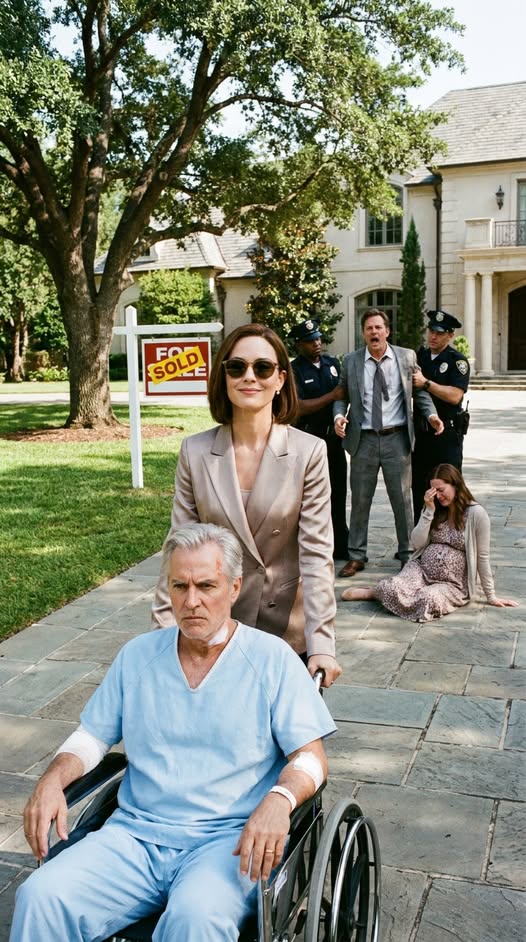
asphalt. I stood on the porch, my heart hammering in my throat, staring at Richard. He looked utterly exhausted, the adrenaline leaving his body. There was a secret rotting beneath the sawdust, and I was about to dig it up. Chapter 5: The Rot Beneath the Wood The moment Ethan’s taillights vanished down the road, Richard’s legs buckled. I caught him under the arms just before he hit the wooden floorboards, absorbing his weight. He began to sob, his massive chest heaving with the force of a frightened child’s tears. “I loved him too much, Claire,” he wept into my
shoulder as I helped him back into his chair. “I spoiled him. I gave him everything.” “Loving your child wasn’t the mistake, Richard,” I said softly, brushing the damp hair from his forehead. “No,” he agreed, his voice hollow. “Not having limits was.” That night, after I ensured he had taken his pain
medication and fallen into a deep, restorative sleep, I took a flashlight and walked into the cavernous, dark expanse of the main workshop. The air was thick with the ghosts of unfinished projects. I moved past the table saws and lathes, heading toward the back wall.
Behind a heavy cedar cabinet that smelled of damp earth, I found it. A heavy, iron lockbox, secured with an old, rusted padlock.
I pulled the brass key with the faded blue ribbon from my pocket. My hands shook as I slid it into the lock. It turned with a satisfying, heavy click.
I opened the lid and shone the flashlight inside. What I found was a chilling archaeology of financial abuse.
There were stacks of bank receipts, highly leveraged loan documents, photocopies of Richard’s IDs, and dozens of contracts bearing shaky, obviously forged signatures. Ethan had used his father’s pristine credit and property as collateral to secure massive debts tied to a disastrous, failed tech venture in the city. Worse, I found ledgers showing Ethan had systematically sold off Richard’s most expensive, specialized workshop equipment—without permission—just to keep his own lifestyle afloat. Finally, at the bottom, I found the nursing home invoices. Ethan had intentionally stopped paying the Santa Clara facility five months ago.
The third twist stole the very breath from my lungs: Ethan hadn’t hidden his father away in that bleak facility simply because he was embarrassed or apathetic. He abandoned him because he had already systematically drained his bank accounts, stripped him of his dignity, and mortgaged a portion of his estate. He was waiting for him to die before the fraud could be discovered.
The next morning, I didn’t call the police. I called my mother, and then I called the sharpest estate attorney in the county. I didn’t want petty revenge; I wanted Richard surrounded by an impenetrable fortress of legal protection.
Within a week, formal complaints were filed. Every single legal authorization, power of attorney, and medical proxy Ethan held was violently revoked.
When Ethan was served with the explosive legal notices, I expected another screaming match at my door. I expected a lawsuit.
Instead, a bizarre, silent penance began.
The following Tuesday, I opened the front door to find two brown grocery bags sitting on the welcome mat. They were filled with artisanal bread, fresh fruit, and the expensive, out-of-pocket vitamins Richard required. There was no note.
For six straight weeks, Ethan repeated this ghost-like routine. He would arrive in the freezing pre-dawn hours, leave the supplies, and vanish into the mist before the sun came up.
Richard would sit by the window in his wheelchair, clutching a mug of coffee, watching his son’s shadowy silhouette retreat down the driveway, never saying a word.
Then, one frosty morning in late November, I opened the door and found a small pharmacy bag containing a highly specific, expensive blood pressure medication Richard’s insurance had recently refused to cover.
I brought it inside and set it on the kitchen table. Richard stared at the small white bag for a very long time. He closed his eyes, leaning his head back against the chair.
“It looks like guilt has finally found its way home,” he murmured.
“Do you want me to unlock the door when he comes tomorrow?” I asked gently. “Do you want to let him inside?”
Richard slowly shook his head, staring out at the frost-covered grass. “Not yet, Claire. A silent apology can’t magically erase a lifetime of selfishness. But… maybe it can begin to clean out the infection in the wound.”
Meanwhile, the town’s rumor mill had reached its final verdict. Not because I spoke a word of it, but because Olivia, in a desperate bid to save face, had tried painting me as a vicious gold digger at a country club luncheon. It backfired with spectacular, catastrophic precision. A loose-lipped nurse from Mercy General revealed to a patient that Ethan had explicitly refused to fund his father’s surgery. Two of Richard’s former workshop apprentices publicly confirmed Ethan had pawned the antique tools. Finally, the attorney released a brief public statement confirming Richard had transferred the deed voluntarily, completely without my knowledge.
Ethan became a pariah. His local business deals evaporated overnight. Olivia abruptly deleted her social media accounts after being mocked for posting pictures of caviar while her father-in-law ate hospital gelatin.
Even Madison, the perpetually absent sister, couldn’t hide from the fallout. She showed up unannounced one afternoon, her face puffy and stained with tears. She bypassed me entirely, throwing herself onto her knees beside Richard’s chair, sobbing into his lap.
“Dad, I am so sorry,” she wailed. “I’m so sorry I hid behind my own stupid problems while you were hurting.”
Richard didn’t yell. He didn’t lecture. He simply rested his large, weathered hand on her trembling head, his eyes full of a sad, profound grace.
“Don’t come back here looking for a piece of the house, Maddie,” he said softly. “Just come back for me.”
And slowly, awkwardly, she did.
But Ethan… Ethan was a different story. The winter had to thaw before he could find his courage.
Chapter 6: The Architecture of Forgiveness
It happened on a damp, rain-washed evening in early spring.
I heard a timid, hesitant knock on the workshop door. When I opened it, Ethan was standing on the porch. The arrogant executive was entirely gone. He was wearing faded jeans and a simple, unbranded sweater. He looked exhausted, older, and deeply humbled. He was clutching a grease-stained paper bag filled with pastries from the bakery Richard used to take him to as a child.
“Claire,” Ethan said, his voice stripped of all its former armor. He couldn’t even look me in the eye. “I am not here asking for money. I am not here asking for the property. I just… I just want to see him. Please.”
I stepped aside and let him enter. Because while the deed to this house was locked in a safe with my name on it, the terrible, beautiful burden of this pain still belonged solely to Richard.
I watched from the kitchen doorway as Ethan walked into the main room. He didn’t speak. He just walked over to his father, dropped the bag of pastries onto the table, and sank to his knees beside the chair, resting his forehead against the armrest.
“Dad,” Ethan choked out, his shoulders shaking with the force of his suppressed weeping. “I became a terrible, terrible person.”
Richard stared down at the top of his son’s head. The silence in the room was so heavy it felt pressurized.
“You were my son, Ethan,” Richard finally said, his voice cracking, carrying the weight of a thousand broken dreams. “And that… that is what hurt the most. Not the money. Not the leg. You.”
Ethan broke down entirely, sobbing openly, a harsh, ugly sound of total surrender. “I know. I know. I don’t know how to fix any of this. I broke it all.”
Richard reached out, his hand hovering over Ethan’s shoulder for a long second before finally letting it rest there.
“You start fixing it,” Richard whispered, “by showing up when there is absolutely nothing left for you to inherit.”
Richard never legally gave the house back to his children. He never reversed the revocation of the power of attorney, and he forced Ethan to slowly repay the forged loans to clear his own conscience. But he did allow Ethan to visit on Sunday afternoons.
I learned something profound watching them rebuild their fractured dynamic. Sometimes, forgiveness doesn’t mean handing back the keys to the castle. Sometimes, forgiveness only means cracking a window open just enough to let the fresh air circulate in a stagnant room.
Months melted into years. Under my management, the workshop was resurrected. We opened a small, funded carpentry program for at-risk teenagers in the neighborhood. Richard, vibrant and purposeful once more, sat proudly in a tall, custom-built chair, teaching a new generation of kids how to measure twice, cut once, and deeply respect the dignity of honest work. My mother, Grace, would bring thermoses of coffee and trays of fresh bread, while I sat at the very same workbench where the fraudulent documents were once hidden, managing the program’s flourishing finances.
One golden afternoon in late October, the three of us were sitting beneath the great maple tree in the yard. The leaves were a brilliant, fiery orange.
Richard reached into his pocket and pulled out the old brass key with the frayed blue ribbon. He reached over and placed it gently into my palm, folding my fingers over it.
“Do you finally understand what this key really opens, Claire?” he asked, his blue eyes twinkling with a quiet, profound wisdom.
I looked at the heavy metal, then at the bustling workshop behind him. “A workshop?” I guessed. “A future?”
He smiled softly and shook his head.
“No, sweetheart,” he said. “It opens a family.”
A hot tear slipped down my cheek, and I didn’t bother wiping it away.
For the longest time after my divorce, I genuinely believed that a judge’s gavel had permanently erased my place in this narrative. But life, in its infinite, chaotic wisdom, taught me that sometimes the deepest, most authentic love only reveals itself after the legal contracts are burned to ash.
Ethan was my husband, and he betrayed me. Richard stopped being my father-in-law on paper, yet somehow, through the crucible of fire and sawdust, he became my truest father anyway.
Today, I still live in the little sunlit apartment above the roaring table saws of the Southwood workshop. I stay not out of greed, and not out of spite, but because of the sanctity of memory. Every single morning, when I throw open the heavy glass windows and breathe in the scent of fresh-baked bread, cut cedar, and rain-soaked earth drifting up from below, I am reminded of the greatest truth I have ever learned.
The most valuable inheritances in this world are never measured in dollars, deeds, or bloodlines.
They are measured by who is willing to stay by your side when there is absolutely nothing left to gain.