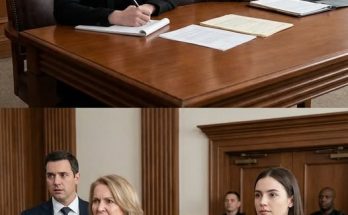
The probate lawyer closed the file, looked up, and said, “That is the entire estate.” That was the moment my mother, Margaret Mercer, smiled. Not a wide, obvious grin. Just that small, polished smile she deployed when a situation had unfolded exactly according to her design—and she believed no one in the room possessed the audacity to call it what it was. The hearing room felt sterile in a way that transcended the harsh fluorescent lights above. It smelled of bleached paper, warm copier toner, and burnt coffee that had been reducing on a hot plate since early morning. It was the kind of environment where raw human emotions were supposed to be boxed up and filed away alongside the legal paperwork. My father, Daniel Mercer, sat beside her. His hands were folded neatly on the table, his posture already relaxed. That was the detail that twisted my stomach. It wasn’t just relief radiating from him—it was absolute confidence. It was the posture of a man who had walked into the room already knowing exactly how the story would end. Their lawyer had everything orchestrated in a pristine black binder. Color-coded tabs. Highlighted
notes. Pre-written responses. He didn’t so much as glance in my direction a single time. Across from their united front, I sat entirely alone. At my feet rested my grandfather’s old canvas overnight bag. Frayed at the edges. Faded green fabric. It was the exact same bag he used to pack when he would visit me during my college years, always overstuffed with things he arbitrarily decided I needed—toolkits, obscure books, and once, a heavy cast-iron pan heavily wrapped in the Sunday newspaper. Now, that bag held everything I had left of him that wasn’t about to be legally
handed over to the people sitting across from me. Two years. That is how long it had been since he first got sick. Two years of agonizing hospital visits, endless stacks of paperwork, quiet, desperate conversations, and verbal promises that ultimately turned out to be worth less than the air it
took to speak them. And now, all of it—every naive assumption of fairness I had carried in my heart, every unspoken “of course they will do the right thing”—was being ruthlessly translated into cold legal fact right before my eyes.
The lawyer began reading.
His voice was smooth. Deeply practiced. It was neutral in a highly calibrated way that made even the most devastating theft sound perfectly reasonable.
“Primary residence located at Willow Creek Road…”
My grandfather’s house.
Gone.
“…conveyed in full to Daniel and Margaret Mercer.”
My parents.
Of course.
Next came the truck. The acreage. The south field. The heavy equipment. The savings accounts. The lucrative timber rights. Even the antique gun cabinet my father had already started talking about as if it were his own before my grandfather’s funeral had even concluded.
Every single item followed the exact same, monotonous pattern.
Read. Assigned. Finished.
Them.
Always them.
It was a clinical, hyper-efficient process. It would have been almost elegant, if you could successfully ignore the fact that it felt exactly like watching someone strip a beloved life down to a sterile inventory list.
I didn’t interrupt.
That was precisely what they expected me to do.
They were waiting for the emotion. The tearful protest. Maybe even a dramatic scene. They wanted something they could easily dismiss, something they could point to later at a dinner party and say, “She was just so unstable. She didn’t understand the legalities.”
So, I sat perfectly still.
And I listened.
Then, the lawyer turned a crisp white page.
His tone didn’t shift, but there was the faintest, almost imperceptible pause—just enough time for the words to register as a total afterthought.
“A detached recreational structure situated on non-income acreage, known informally as the west cabin, is conveyed separately to granddaughter Eliza Mercer.”
My mother let out a quiet, breathy laugh.
It wasn’t loud enough to be explicitly called rude. But it was just loud enough to land exactly where she aimed it.
The west cabin.
That was what I got.
I didn’t react externally. But inside, something fundamental shifted.
Because I knew that cabin.
Twelve minutes off the main highway, down a rutted dirt road that surrendered to the weather a little more every year. Past a rusted cattle gate that barely hung onto its hinges. Through a dense, suffocating stretch of cedar trees that blocked out most of the afternoon sunlight.
One single room.
No indoor plumbing.
No central heat.
Warped, drafty windows.
Rust coating everything metal.
My grandfather used it occasionally during hunting season. Later in life, he used it when he simply wanted to be alone—which, translated from his specific language, meant when he didn’t want anyone from our family asking him for anything.
My father used to call the structure useless.
My mother called it an eyesore of sentimentality.
Their high-priced lawyer had just legally defined it as “of little market consequence.”
And suddenly, that useless consequence was mine.
When the formal reading concluded, heavy wooden chairs shifted against the floor. Papers were neatly stacked. The room began to exhale, as if it had been holding its collective breath for a dramatic explosion that never came.
My mother stood up first.
“Well,” she sighed, delicately smoothing the sleeve of her blouse. “I hope now you can finally move on.”
Move on. She said it as if my grief were just a tacky hobby I had been dragging out for far too long. As if I hadn’t spent the last twenty-four months watching the two of them circle my dying grandfather’s life like vultures convinced the carcass was already theirs.
My father casually picked up the truck keys from the polished table—my grandfather’s truck keys—and slipped them into his pocket without so much as looking in my direction.
“It’s all perfectly legal, Eliza,” he said, his voice flat. “Don’t start building wild conspiracies in your head just because you’re disappointed.”
Disappointed. That word hit me harder and deeper than anything else said that day.
Disappointed. As if I had been sitting there expecting a larger financial gift. As if this had ever been about the money for me.
I looked at him.
I really looked at him.
And for the very first time in my thirty years of life, I understood something clearly enough that it didn’t even hurt anymore.
They thought they had won.
They hadn’t just won the estate. They had won everything.
The family narrative. The financial control. The final, unquestionable word.
Their lawyer slid a thin manila envelope across the table toward me.
Inside lay the cabin deed, a crumpled county parcel map, and a single, lonely key ring bearing a rusted brass tag.
There was no accompanying letter.
No explanation.
No basic human acknowledgment that I had ever been anything more to this family than a minor line item to be quickly resolved.
My mother glanced down at the rusted keys and offered that small smile once again.
“He always did know you liked old, broken things.”
I said absolutely nothing.
Because I knew if I opened my mouth in that exact moment, everything would spill out all at once—the crushing grief, the boiling anger, the bitter humiliation—and I utterly refused to hand them that victory.
That was the moment I learned the most vital lesson of the entire agonizing day.
They were meticulously prepared for my emotion.
They were prepared for my tearful accusations.
They were prepared for me to completely fall apart.
But they were not prepared for my silence.
So, I stood up.
I picked up my canvas bag.
I took the envelope.
And I walked out of that sterile room with significantly less than my grandfather used to tip his favorite waiters at Christmas.
The drive to the west cabin took much longer than I remembered.
Or perhaps it just felt that way because there was literally nowhere else left in the world for me to go.
The smooth highway eventually gave way to cracked county roads. The county roads surrendered to loose gravel. The gravel quickly turned into deeply rutted dirt.
By the time my tires reached the rusted cattle gate, my cell phone had completely lost its signal.
The lock on the front door stuck twice before the brass key finally gave way.
The heavy wooden door groaned in protest when I pushed it open, sounding like it hadn’t been moved in months.
The smell of the place hit me first.
Dry cedar dust. Cold, damp stone. Old, musty canvas.
It wasn’t a comforting scent. But it was an honest one.
The cabin didn’t pretend to love me while simultaneously reaching into my back pocket.
Inside, everything was exactly where I remembered it being.
The heavy cast-iron stove sat in the far corner.
A narrow, unforgiving bed frame against the wall.
A cracked enamel sink that hadn’t seen running water in a decade.
My grandfather’s cluttered workbench situated directly under the main window.
A faded, dusty landscape painting hung slightly crooked on the back wall.
Three rusted tins of nails sat on a wooden shelf beside an oil lantern and a box of matches that looked decidedly older than I was.
It was in much worse condition than I remembered.
And yet, somehow, it was better.
Because absolutely nothing in this room was fake.
That first night, I slept fully clothed in my winter coat, shivering under two scratchy army blankets. I woke up just after dawn with my teeth physically aching from the bitter cold.
On the second day, I swept decades of mouse droppings out of the cupboards and found two old coffee mugs wrapped securely in yellowed newspaper.
On the third day, I drove back into town for basic survival supplies—lamp oil, canned soup, heavy batteries.
On the fourth day, I found my grandfather’s battered green thermos shoved under the bed frame.
On the fifth day, I noticed something strange.
One specific section of the back wall sounded… different.
It wasn’t immediately obvious. It was just a slightly hollow resonance whenever the harsh wind battered the cabin from the west.
I purposefully ignored it at first.
Because I simply wasn’t emotionally ready to go looking for things I didn’t quite understand yet.
By the sixth night, the heavy rains came.
It was hard. Relentless. The kind of torrential downpour that makes an already isolated place feel suffocatingly small.
I couldn’t sleep.
So I got up, struck a match, lit the oil lantern, and started fixing things.
That’s when my attention finally locked onto the landscape painting.
It had been quietly bothering my periphery since the very first day.
Not because it was crooked.
Because it was wrong.
The tilt wasn’t a natural shift from gravity or time. One side sat far too low, resting at an aggressive angle, exactly like someone had taken it down and hurriedly put it back in the dark.
I stood there in the flickering lantern light for a long moment, just staring at it.
Then, I reached up and carefully lifted the frame off the iron hook.
Behind it—
There was a perfectly square recess cut deep into the wooden wall.
And sitting inside that recess—
Was an envelope.
Thick.
Cream-colored paper.
My grandfather’s unmistakable handwriting scrawled across the front.
It bore my name.
And beneath my name, there was one single, terrifying sentence.
Open this after they think they’ve won.
My heart slammed against my ribs. I stared at the sealed flap, the sound of the rain suddenly deafening in the tiny room. What had he done?
I sat down hard on the edge of the narrow bed. The lantern flickered between my knees, throwing jittery shadows across the cabin’s rough walls. Outside, the rain continued hammering the tin roof like it was trying to break in. In my trembling hands, the envelope felt substantially heavier than paper should ever be allowed to feel.
My grandfather’s handwriting stared back up at me: Open this after they think they’ve won.
I broke the heavy wax seal. Inside was a four-page handwritten letter, a folded survey map, and a small silver key taped to an index card bearing three words: Not the cabin.
I unfolded the thick pages of the letter.
“Eliza,” it began. “If you are reading this after Daniel and Margaret walked out of the probate hearing smiling, then the proceedings went exactly the way I expected them to. Let them have the loud things. The big house. The shiny truck. The open fields they think they understand. The cabin was never the actual gift. It was the cover.”
I stopped breathing for a second. This rusted, leaking cabin wasn’t just a dead-end inheritance. It was a masterfully crafted disguise. A quiet decoy placed so everyone else would confidently stop looking.
“Three years ago, I quietly moved the only thing that actually mattered entirely out of probate. Lift the stove plate. Take the tin box.”
My pulse steadied into a hyper-focused calm. I crossed the wooden floorboards to the ice-cold cast-iron stove. I knelt down and pulled the heavy metal plate on the right-hand side. It resisted, then lifted with a sharp, echoing metallic scrape.