The metallic taste of blood is a flavor you never truly forget. It’s sharp, coppery, and overwhelmingly distinct—distinct enough to cut through the haze of a Sunday dinner that was supposed to be a celebration. It started like a thousand other Sundays in suburban Connecticut. The air was crisp, the leaves were turning a bruised shade of purple and gold, and I had just parked my beat-up, ten-year-old sedan in front of the two-story colonial house that loomed in my memory like a fortress of solitude. The driveway was already dominated by a gleaming, silver vehicle—a brand-new BMW. Madison’s car. Of course. I took a deep, shuddering breath, the kind that rattles in your chest when you know you are about to step onto a battlefield without any armor. I turned the brass knob and stepped inside. The atmosphere in the house was suffocatingly perfect, a sterile museum of a family that only existed in photographs. My mother, Eleanor, was meticulously arranging the dining room table with the “good china”—the delicate, translucent porcelain with the painted gold rim that I had never been allowed to touch as a child. My father, Robert, sat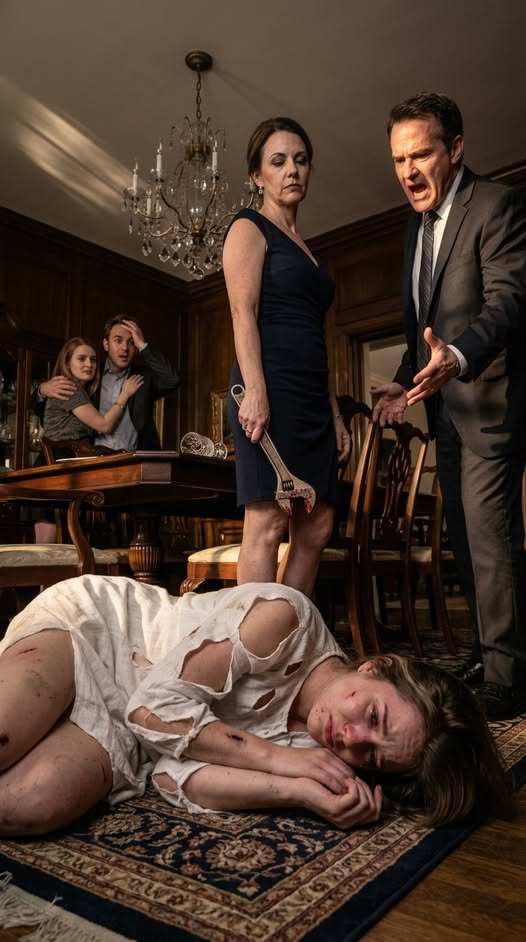
entrenched in his worn leather recliner, the roar of a televised football game filling the heavy, suffocating silence between us. As I took off my coat, he offered me a low, guttural grunt, his eyes never once leaving the glowing screen. It was the standard, expected greeting for the invisible daughter. Then, she swept in. Madison, my sister, two years older and lightyears ahead in our parents’ estimation. She was glowing, her hair perfectly blown out, dragging a man behind her by the hand who looked like he had just stepped out of a high-end catalog for the American Dream.
“Everyone, this is Travis Mitchell,” Madison announced, her voice vibrating with a shrill pride that bordered on manic desperation. “He’s a senior investment banker at Goldman Sachs.” My mother practically melted into the polished oak floorboards. Even my father, a man whose affection
was as scarce as water in a desert, immediately stood up to shake Travis’s hand with genuine, eager enthusiasm. It was a warmth, a sudden spark of life in his eyes, that I had never felt, not once, in my twenty-four years of existence. We sat down. I took my usual spot at the far, drafty end of
the table—the exile’s seat. The pot roast—Madison’s absolute favorite, entirely disregarding my three years of vocal, ethical vegetarianism—sat in the center of the table like a steaming monument to their indifference. I pushed buttered peas around my plate with a heavy silver fork, trying
my best to shrink, to disappear, to simply be the ghost they already treated me as. But Travis kept looking at me.
It wasn’t a kind look. It wasn’t polite curiosity. It was deeply calculated and predatory. Throughout the meal, as Madison droned on endlessly about her boutique marketing firm and their upcoming, lavish trip to Bali, Travis’s cold, blue gaze kept flickering toward my end of the table. It was unsettling, the way a hawk watches a field mouse.
“So, Emily,” Travis said suddenly, his voice slicing through Madison’s monologue with the precision of a scalpel. “What exactly do you do?”
The entire table went dead silent. The barometric pressure in the dining room seemed to drop instantaneously.
“I’m a social worker,” I said, my voice sounding incredibly small and fragile in the cavernous, echoing room. “I work with at-risk youth in New Haven.”
“Oh, that’s… interesting,” Travis said, leaning back in his antique chair, a cruel, mocking smirk playing on his lips. “Why on earth would you choose that field?”
I opened my mouth, a sudden, unfamiliar spark of passion igniting in my chest. “Well, it’s incredibly rewarding. The system is broken, but we make a difference. Just last month, I helped place a sixteen-year-old girl who had been—”
“Don’t waste Travis’s time with your depressing, boring stories, Emily.”
My mother’s voice was a literal whip crack across the table. Her eyes glared at me with a venom that made my stomach clench. “He’s just being polite. Nobody wants to hear about those people while we are trying to eat.”
The shame was familiar, a heavy, cold cloak I wore daily in this house. But that night, as the scent of the pot roast mingled with the suffocating tension, something inside my ribcage finally snapped. Maybe it was the arrogant smirk on Travis’s face, or the way my father aggressively nodded in agreement with my mother’s cruelty.
“Actually, Mom,” I said, my voice trembling violently but completely audible. “It’s not boring. It matters. It actually helps people. Unlike planning overpriced vacations to Bali just to take photos for strangers on the internet.”
I didn’t see the movement coming.
One second, I was looking directly at my mother’s sneering face, feeling a momentary rush of triumph. The very next second, the entire world exploded into a blinding, flashing white light and a wave of absolute, unadulterated agony.
CRACK.
The physical impact was sickening, a sound that I would hear echoing in my nightmares for years. A heavy iron wrench—one of my father’s industrial tools that he had carelessly left sitting on the mahogany sideboard for a loose radiator valve—connected squarely with the left side of my face.
The immense, brutal force of the blow tipped my heavy wooden dining chair violently backward. I crashed onto the unforgiving hardwood floor, my skull hitting the oak planks with a dull, wet thud that vibrated straight through my teeth and down my spine.
Through a sudden, terrifying haze of swimming black spots and ringing ears, I looked up. The ceiling fan spun in a lazy, mocking circle. Standing directly over me was my mother, Eleanor. She held the heavy, blood-stained iron wrench in her trembling hand. Her chest was heaving, but her face was not twisted with maternal regret or shock at what she had just done. It was contorted into a mask of pure, unadulterated, psychotic rage.
“That’s exactly what you get for talking back in my house!” she hissed, her face leaning in close, a drop of my own blood splattered on her pearl necklace. “Embarrassing your sister in front of Travis! You ungrateful, miserable little bitch!”
I desperately tried to speak, to beg, to ask why. But my jaw… my jaw simply didn’t work. The bones ground together with a sound like crushed gravel. Blood, hot, thick, and fast, bubbled over my lips and spilled down my chin, soaking into the collar of my blouse.
And then, the sound that truly broke my soul began.
Laughter.
“At least now you’re finally pretty!” Madison shrieked, clutching her stomach as she leaned over the table to look down at me. “Oh my god, Travis, did you see her face? She looks like a Picasso!”
I rolled my good eye toward Travis. The polite, polished investment banker? He was laughing too. A deep, genuine belly laugh, leaning against the doorframe as if my shattered bones and my choking on my own blood were the punchline to the world’s greatest joke.
“I really think one hit wasn’t enough,” Madison smirked, wiping a tear of mirth from her heavily mascaraed eye. She stepped out from behind the table, the heels of her expensive boots clicking sharply against the floorboards.
My mother smiled—actually, genuinely smiled—and casually tossed the heavy iron tool to my sister. “Well, Maddie, you have a go. Teach her some manners.”
Terror, cold, ancient, and completely primal, flooded my veins like ice water. I scrambled backward, my heels slipping on my own blood, desperately trying to raise my trembling arms to shield my shattered head. But a massive shadow suddenly fell over me, blocking out the light of the chandelier.
My father.
He didn’t reach down to help me up. He didn’t pull his phone from his pocket to call 911. Instead, his massive, calloused hands clamped down like steel traps around my frail wrists, aggressively pinning my arms to the hardwood floor so I couldn’t protect my face.
“Hold still, Emily,” Robert said, his voice terrifyingly calm, as if he were holding down a piece of timber for a saw.
I looked up, screaming a silent, agonizing scream through a broken, ruined jaw, as my golden-child sister raised the heavy iron wrench high above her head, aiming directly for the center of my skull.
The fluorescent lights of the emergency room were aggressive, searing through my bruised eyelids long before I could even manage to open them. The chaotic sounds of the trauma ward—the rhythmic, panicked beep of heart monitors, the urgent squeak of rubber soles on linoleum, the hushed voices of terrified families—felt as though they were happening entirely underwater.
“Miss Harper? Emily? Can you hear me?”
A nurse with incredibly kind, sorrowful brown eyes hovered in my limited field of vision. I tried to nod, to acknowledge her existence, but a jagged lance of pure fire shot straight through my skull, so intensely agonizing that the edges of my vision instantly went black again.
“Please, don’t try to move, sweetheart,” she whispered gently, her warm fingers lightly restraining my hand as my frantic brain tried to reach for my ruined face. “You’ve sustained a complex fractured orbital bone, a severe Grade 3 concussion, and massive, comminuted damage to your jaw and left cheekbone. We had to perform emergency surgery. Your jaw is currently wired shut.”
Wired shut. The words floated heavily in the sterile air, terrifying and absolute. I was trapped inside my own head.
“The police are waiting outside,” the nurse added softly, her voice dropping to a sympathetic whisper. “They need to know exactly what happened to you.”
Police. The heavy narcotic fog in my brain cleared just enough for the horrific memories to rush back in a violent, unyielding flood. The cold iron wrench. The hysterical laughter. My father’s crushing, inescapable grip on my wrists.
A tall woman in a sharp, tailored blazer stepped into view, her badge catching the harsh overhead light. Detective Sarah Chen. She pulled up a plastic chair beside my bed, her expression grim, focused, and completely uncompromising.
“Take your time, Miss Harper,” Detective Chen said, opening a small, leather-bound notebook. “I know this is incredibly hard. But I need you to tell me everything. From the beginning.”
Speaking was an exercise in pure torture. Every syllable was slurred, forced through swollen, ruined lips and the rigid metal wires holding my bones together. But I told her. I told her about the Sunday dinner. I told her about the decades of being the family’s punching bag and disappointment. I told her about the neighbor, Mrs. Rodriguez—a sweet, elderly woman who I learned later had been watering her hydrangeas, seen the brutal assault through the open dining room window, and frantically dialed 911, ultimately saving my life before Madison could deliver the final blow.
“They… they laughed,” I wheezed, hot tears leaking from my one good eye, tracing paths through the dried blood on my skin. “My own family. They held me down. They did this to me.”
Detective Chen’s pen abruptly stopped moving across the paper. She looked down at me, a fierce, protective determination hardening her features. “We have the crime scene photographs. We have your blood-soaked clothes in evidence. We found the wrench. And most importantly, we have Mrs. Rodriguez’s sworn witness statement. I promise you right now, Emily, they are not getting away with this.”
The very next morning, explicitly against the attending doctor’s frantic advice, I dragged myself out of bed. Clutching my IV pole for support, I shuffled painfully to the small bathroom mirror.
The face staring back at me was a horrifying stranger’s. It was a canvas of deep purple, sickly yellow, and swollen, distorted flesh, stitched together like a discarded ragdoll. A jagged, angry line of black nylon sutures ran vertically across my cheek where the skin had split open to the bone. My left eye was completely swollen shut, a grotesque bulb of bruised, traumatized tissue.
I stood there and stared at myself for a long time. I should have felt entirely broken. I should have felt terrified of them.
But as I looked deeply into my one open, bloodshot eye, I felt something else entirely. A cold, hard, indestructible knot of fury. They had desperately tried to break me. They had tried to permanently erase me from the world.
I walked slowly back to my hospital bed and picked up my cracked smartphone. My fingers trembled, not from the lingering concussion or fear, but from pure, unadulterated adrenaline. I scrolled through my contacts and dialed a number I had secretly saved years ago, just in case the emotional abuse ever turned physical.
“Daniel Krauss, Family Law and Civil Litigation,” a deep, gravelly voice answered on the second ring.
“Mr. Krauss,” I mumbled heavily through the metal wires of my jaw. “My name is Emily Harper. I need to hire you. I don’t just want them in jail. I want to completely destroy them. I want to take absolutely everything they have.”