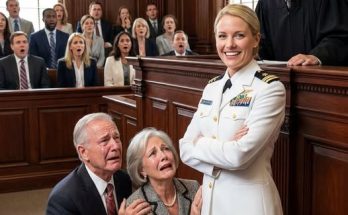
“Before I sign, Your Honor, I’d like to submit one final piece of evidence.” My request was soft, barely rising above the low, mechanical hum of the courtroom’s industrial air conditioning, yet it possessed the gravity to stop the world on its axis. The courtroom plummeted into a dead silence. It wasn’t an empty quiet; it was heavy, pressurized, like the static charge in the air seconds before a tornado touches down. My wife, Lenora, was already smiling. It was that victorious, porcelain smirk she’d been wearing for the past eight months, ever since she slapped the divorce papers on our granite kitchen island next to my morning coffee. It was the smile of a woman who had played the long game, manipulated the pieces, and checkmated her opponent before he even knew the match had started. Her lawyer, a four-hundred-dollar-an-hour shark named Desmond Pratt, sat with his manicured hand extended, a black Montblanc pen hovering in the air like a weapon. He was waiting for me to sign the final decree. The document that would effectively end our fifteen-year marriage. The document that would grant Lenora the colonial house in the suburbs, both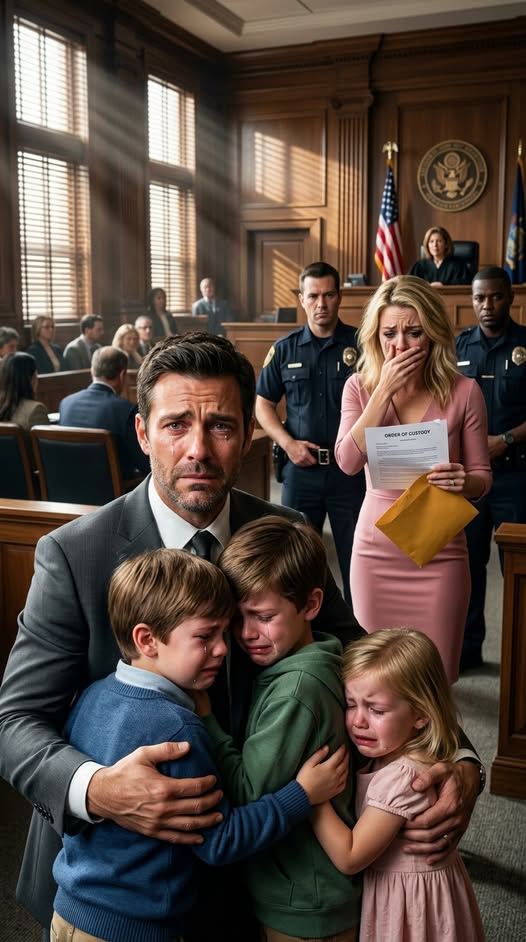
luxury SUVs, the entirety of our 401(k), full physical custody of our three children, and—the absolute kicker—$4,200 a month in child support for the next eighteen years. Do the math. That is over nine hundred thousand dollars. A lifetime of labor, sweat, and missed holidays, signed away in permanent ink. I was supposed to sign. I was supposed to accept defeat with the grace of a martyr. I was supposed to walk out of this courthouse a broken man, a cautionary tale of a logistics supervisor who worked too hard to provide a lifestyle his wife eventually outgrew. That was the
script they had written. That was the ending they expected. But that is not what happened. Judge Rowan Castellan leaned forward, his gray eyebrows knitting together in palpable irritation. He looked like a man who desperately wanted his lunch break, not a third-act plot twist. “Mr.
Chandler,” the judge intoned, his voice gravelly and worn from years of listening to domestic squabbles. “You have had months to submit evidence during the discovery phase. This hearing is for final signatures only. We are at the finish line.” “I understand, Your Honor,” I said, keeping my
voice steady, though my heart was hammering against my ribs like a trapped bird desperate for the sky. “But this evidence only came into my possession seventy-two hours ago. And I believe the court—and Mrs. Chandler—needs to see it before any binding documents are executed.”
Lenora’s smirk flickered. Just for a microsecond. A tiny, spiderweb crack in the mask of the grieving, wronged wife. She adjusted her silk scarf, her eyes narrowing.
“This is ridiculous,” Pratt said smoothly, waving a dismissive hand as if swatting away a gnat. “Your Honor, my client has been more than patient. Mr. Chandler agreed to these terms during mediation. He can’t simply stall because he’s getting cold feet about the financial reality of his obligations.”
“I can if the terms were based on fraud,” I said.
That word landed in the center of the room like a live grenade with the pin pulled.
Fraud.
Lenora’s face went from confident to confused, and then to something approaching primal fear in the span of three heartbeats. She shifted in her seat, her designer blazer suddenly looking two sizes too tight.
“What are you talking about?” she demanded, her voice shrill, losing its carefully cultivated softness. “What fraud?”
I didn’t answer her. I didn’t even look at her. If I looked at her, I might lose the nerve to destroy the life we built. Instead, I reached into the inner pocket of my cheap, off-the-rack suit jacket and pulled out a manila envelope. It was brown, unremarkable, the kind you buy in a pack of fifty at an office supply store.
Inside was the truth.
I walked toward the judge’s bench, my footsteps echoing on the linoleum like hammer strikes. My own lawyer, a tired public defender named Hector Molina who had advised me to “just sign and rebuild,” was staring at me with his mouth slightly open. I hadn’t told him. I hadn’t told anyone.
Some secrets you keep until the trap is perfectly, irrevocably set.
“Your Honor,” I said, placing the envelope on the high wooden bench. “This envelope contains DNA test results for all three of the minor children listed in this custody agreement. Marcus, age twelve. Jolene, age nine. And Wyatt, age six.”
Judge Castellan took the envelope, weighing it in his hand. He didn’t open it immediately. He looked over the rim of his spectacles, assessing my sanity.
“For what purpose, Mr. Chandler?” he asked. “To establish paternity?”
The silence that followed was absolute. I could hear the buzz of the fluorescent lights, the scratch of the stenographer’s chair, and Lenora’s sharp intake of breath.
“Paternity?” her voice was a whisper now, trembling. “Crawford, what are you doing?”
I looked the judge dead in the eye.
“I am establishing, for the record, that I am not the biological father of any of the three children you are ordering me to pay for.”
The judge’s fingers tore the seal. He pulled out the first page. Then the second. Then the third. His face, usually a mask of judicial boredom, changed. It hardened into granite. He looked up from the papers and turned his gaze to Lenora. It was an expression I can only describe as controlled, professional disgust.
Then, he said three words that obliterated her world.
“Is this true?”
Thirty-six hours earlier, I was sitting in a roadside diner off Interstate 10, staring at the same documents the judge was now reading.
The coffee in front of me had gone cold, a stagnant pool of black water reflecting the flickering neon sign in the window. The scrambled eggs I’d ordered sat untouched, congealing on the plate like yellow plastic. Nothing seemed real anymore. The waitress laughed with a trucker in the corner, cars rushed by outside in the rain—but I was frozen in a bubble of catastrophic revelation.
Three children. Fifteen years of marriage. My entire adult life.
A lie.
The private investigator sitting across from me was named Clyde Barrow. Yes, like the outlaw. He’d heard all the jokes. He was sixty-three years old, with a face like weathered leather and eyes that had seen too much human misery to be surprised by anything. He smelled of old tobacco and rain.
“I’m sorry, Crawford,” he said, his voice rough like sandpaper dragging across concrete. “I know this isn’t what you were hoping to find.”
“I wasn’t hoping to find anything,” I whispered, my voice sounding foreign to my own ears. “I was hoping you’d tell me I was paranoid. That the rumors were wrong. That my wife wasn’t…”
I couldn’t finish the sentence. The word was too ugly.
“The DNA tests are conclusive,” Clyde said, tapping the folder with a nicotine-stained finger. “Marcus, Jolene, and Wyatt. None of them share your genetic markers. Zero percent probability of paternity across the board. It’s a clean sweep, kid.”
I looked at the documents again. Charts. Graphs. Scientific terminology. It all boiled down to one simple, brutal truth: The children I had raised, the children I had sacrificed my career for, the children I had walked the floor with at 3:00 AM when they had fevers—they were strangers. Biologically, at least.
“Do you know who the fathers are?” I asked. My voice sounded hollow, like it was coming from the bottom of a well.
“Fathers,” Clyde corrected gently. “Plural.”
He pulled out a second folder, thicker than the first.
“Based on my investigation and cross-referencing genetic markers available in public ancestry databases, we have matches.”
He slid a photo across the chipped Formica table.
“Marcus appears to be the biological child of Victor Embry. He was a personal trainer your wife was seeing in 2012.”
Victor Embry. The name hit me like a physical blow to the solar plexus. I remembered him. Lenora had insisted on “getting in shape” after we got married. Personal training sessions three times a week. I paid for every single one. I paid the bill for the sessions where my wife conceived another man’s child. I remembered shaking his hand, thanking him for helping Lenora with her “confidence.”
“Jolene’s biological father is likely Raymond Costa,” Clyde continued, sliding another photo onto the pile. “He was your wife’s boss at the marketing firm where she worked from 2014 to 2016.”
Raymond Costa. The man who gave her a promotion. The man who took her on “business trips” to San Francisco. The man I had invited to our house for a Christmas party, pouring him my best wine while he looked at my daughter—his daughter—playing on the rug.
“And Wyatt?” I asked, bracing myself against the table edge. “Who is it?”
Clyde hesitated. He took a sip of his coffee, looking at me with something that transcended pity. It was sorrow.
“This one… this one is going to be difficult to hear, Crawford. More difficult than the others.”
“Tell me.”
“Wyatt’s biological father appears to be Dennis Chandler.”
The world stopped spinning. The diner noise vanished. The blood drained from my face so fast I felt dizzy.
Dennis.
My younger brother. My best man. The uncle who came to every birthday party, every Christmas. The man I had trusted more than anyone on earth except Lenora herself. The man who had sat on my porch drinking beer with me, complaining about being single, while his son was sleeping in my guest room.
“You’re certain?” I choked out, fighting the bile rising in my throat.
“The genetic markers don’t lie, Mr. Chandler. I’m sorry.”
I sat there for a long time. Fifteen years. Three children. Hundreds of thousands of dollars. An entire life built on a foundation of sand and betrayal. And Lenora—she had the audacity, the sheer, unmitigated gall—to demand child support. She wanted me to finance the results of her infidelity for another two decades. She wanted me to pay for my brother’s child.
“What do I do now?” I asked.
Clyde leaned back in his chair, folding his arms. The neon light cast deep shadows across his face.
“That’s up to you. You could sign those divorce papers, pay the money, and be the victim. Or,” he leaned in, his eyes gleaming with a hard, cold light, “you could walk into that courthouse with these documents and watch her entire scheme fall apart.”
“She’ll say I’m abandoning the kids,” I said, the thought tearing at my heart.
“You’ll say she committed paternity fraud,” Clyde countered. “Which is a crime in this state. That is grounds for annulment of support obligations and potential criminal charges.”
Criminal charges. Against the woman I had loved. Against the mother of the children who called me Dad.
“I need to think about this,” I said.
“You have thirty-six hours before that final hearing,” Clyde said, dropping a twenty on the table for the check. “Think fast, Crawford. Once you sign that paper, the truth doesn’t matter anymore.”
Back in the courtroom, the temperature seemed to drop ten degrees as Judge Castellan read the reports a second time. His face remained neutral, professionally composed, but I could see the shift in the air. The sympathy for the “abandoned wife” had evaporated, replaced by a cold, hard scrutiny.
“Mrs. Chandler,” the judge’s voice was ice. “Do you have any response to these documents?”
Lenora was standing now. She was gripping the edge of the defendant’s table so hard her knuckles were bone-white. Her carefully maintained composure—the grieving mother, the wronged wife—had shattered into dust. She looked at me, then at the judge, then at her lawyer, searching for a lifeline that wasn’t there.
“Those tests are fake,” she stammered, her voice high and thin, bordering on hysteria. “He’s lying! He’s just trying to avoid his responsibilities! He’s cheap! He hates that I’m moving on!”
“These tests were conducted by Geneva Diagnostics, a certified laboratory with AABB accreditation,” Judge Castellan interrupted, holding up the documents with two fingers as if they were contaminated. “They show a zero percent probability that Mr. Chandler is the biological father. Zero. Mrs. Chandler, I am going to ask you once more, and I remind you that you are under oath. Is there any possibility that these results are accurate?”