Chapter 1: The Hollow Hierarchy. “There was no room for her,” my mother said, her tone as breezy and detached as if she were discussing a misplaced winter coat rather than her only granddaughter. She didn’t realize that by closing the heavy oak door on my child, she was permanently sealing the fate of the very roof over her own head. My name is Sarah Thorne, and for the entirety of my adult life, I operated under a crippling, unspoken family contract: my sweat purchased their comfort. The fluorescent lights of the Chicago Medical Center ER hummed with a headache-inducing, mechanical buzz as I applied pressure to the jagged laceration of a trauma patient. The air smelled sharply of iodine, copper, and bleach. My hands were perfectly steady, moving with the clinical precision of a veteran trauma nurse ten hours into a grueling double shift. But my heart wasn’t in trauma bay three. It was thirty miles away, nestled in the manicured, affluent suburbs at the Thorne Family Estate, where I pictured my ten-year-old daughter, Maya, joyfully hunting for pastel eggs on the sprawling lawn. I had sent Maya there early that morning, dressed in a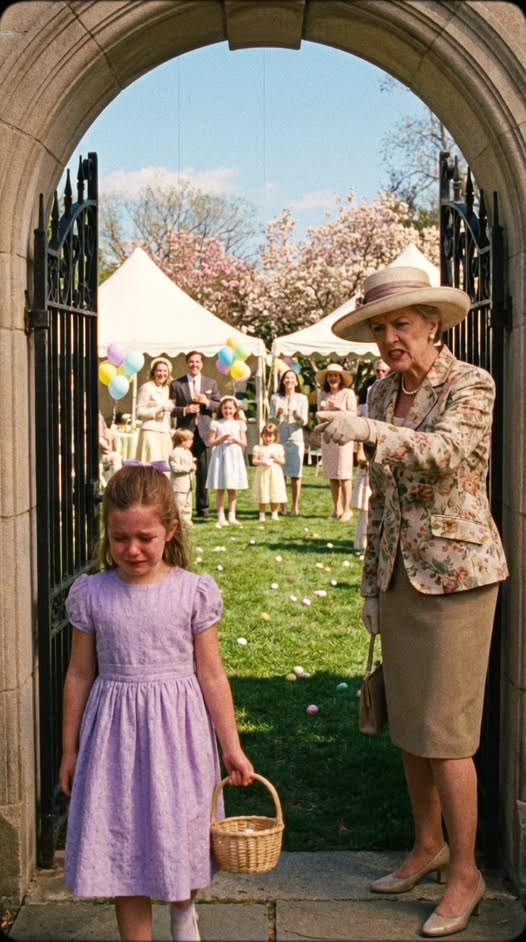
lavender sundress I had stayed up until 2:00 AM hand-sewing, her small heart swelling with the hope of finally being included. I was working this brutal holiday shift for a very specific reason: the time-and-a-half pay was earmarked to fund the upcoming “family” summer vacation to Martha’s Vineyard—a trip my parents had planned, but I was quietly subsidizing. During a brief, three-minute lull, I pulled off my latex gloves, washed my hands until the skin was raw, and checked my phone. The family group chat was a digital museum of performative perfection.
My mother, Eleanor, was rapidly uploading photos of a dining table set to accommodate twelve. It was an aesthetic masterpiece of sparkling crystal goblets, towering arrangements of white lilies, and a massive, honey-glazed ham taking center stage. My younger sister, Grace—the
undisputed, perpetually unemployed “golden child” of the family—was posing at the head of the table. Grace’s two children, clad in matching bespoke linen outfits, were positioned front and center, smiling like tiny royals for the camera. I scrolled through fourteen photos. I zoomed in on the
background of each one. Maya wasn’t in a single frame. A cold prickle of unease crawled up the back of my neck, a sensation entirely disconnected from the aggressive hospital air conditioning. I quickly typed out a text to my sister. Beautiful table. Where’s Maya? Did she find the golden egg
yet?
Three ellipses danced on the screen for a moment before Grace’s reply popped up, blunt and utterly dismissive: She’s around. Too much noise today, Sarah. We’re busy. Call you tomorrow.
I stared at the glowing screen, the knot in my stomach tightening into a hard, dense stone. The intercom blared, calling me to incoming ambulances, and I shoved the phone back into my scrub pocket, forcing the dread down into the dark basement of my mind. I spent the next four hours resetting bones and pushing IVs, trying to convince myself that I was just being a paranoid mother. I told myself my family loved her. I told myself the sacrifices I made for them trickled down to her.
Just as my shift was finally ending at 11:00 PM, I pulled my battered sedan up to my modest apartment building. Through the freezing drizzle of the Chicago spring night, I saw a small, shivering silhouette. I slammed the car into park and ran through the rain. I found Maya sitting alone on our concrete front stoop in the pitch dark. She was still wearing the handmade Easter dress, now stained with mud at the hem. Her small, rolling suitcase was tucked tightly under her arm, and her eyes were swollen and red from hours of crying.
Chapter 2: The Severed Bond
I wrapped my heavy winter coat around Maya’s trembling shoulders, scooped her into my arms, and carried her inside. I drew a hot bath, made her a cup of chamomile tea, and sat on the edge of the tub, brushing the damp, tangled hair from her face.
“What happened, baby?” I asked, my voice terrifyingly calm, though my pulse was hammering against my ribs like a trapped bird.
Maya looked down at the soapy water, her lower lip quivering. “Grandma said that since Aunt Grace’s in-laws brought their cousins, there were too many people,” she whispered, her voice fragile and broken. “She said I wouldn’t understand the grown-up talk anyway. She told me to call an Uber or wait in the playroom, but then Grace came in and said the playroom was for the ‘babies’ to nap. So I just… I just left, Mom. I walked to the bus stop. I had enough allowance for the fare.”
A white-hot fracture spiderwebbed across my chest. It wasn’t just a miscommunication. It was a deliberate, calculated eviction. My family had looked at a table full of food, a house with eight bedrooms, and decided there was no room for my child. The “table” wasn’t just a piece of mahogany; it was a visceral symbol of our lineage, of who mattered and who was disposable. Maya was the forgotten accessory, quietly discarded to make room for Grace’s wealthy in-laws.
I kissed Maya’s forehead, tucked her securely into my bed, and walked into the kitchen. I didn’t cry. I didn’t scream. I felt a sudden, profound atmospheric shift within my own psychology. The dutiful, exhausted daughter evaporated. In her place, a cold, methodical strategist took a deep breath of the quiet apartment air.
I picked up my phone and dialed Eleanor’s number. She answered on the fifth ring, her voice slurred with expensive Chardonnay, the faint sound of a jazz record playing in the background.
“Sarah, darling, it’s awfully late,” Eleanor sighed.
“Maya took a city bus home alone in the dark, Mother,” I said, my voice flat, devoid of any emotional inflection.
“Oh, Sarah, don’t be so dramatic,” Eleanor groaned, the sound of ice clinking in her glass echoing through the speaker. “It was a terribly tight squeeze today. Maya is such a quiet, withdrawn child anyway; we honestly thought she’d prefer the peace of your apartment. Family gatherings are about harmony, and we just didn’t have room for her at the table this year. We’ll make it up to her at Christmas, I promise. Now, I simply must go, my head is pounding.”
She hung up.
I stood in the dim light of my kitchen, listening to the dial tone. I didn’t throw the phone. I simply placed it gently on the counter. The biological bond of loyalty, stretched thin over thirty years of micro-aggressions, finally snapped with a silent, liberating finality.
Sarah hung up the phone without another word. She sat down at her laptop, the screen illuminating her unblinking eyes, and opened a heavily encrypted, hidden desktop folder she hadn’t touched in nearly ten years. It was labeled: Thorne Family Trust & Property Deeds – Sole Owner: Sarah Thorne.
Chapter 3: The Reclamation
I watched the pale, bruised purple of the sun rise over the jagged Chicago skyline. A neat stack of freshly printed, notarized legal documents sat perfectly aligned on my cheap laminate kitchen table.
For ten years, I had allowed my parents to live in a sprawling, $4 million mansion that didn’t belong to them. My grandfather, Elias, a self-made industrialist with a razor-sharp judge of character, had seen straight through Eleanor’s vain greed and my father Richard’s chronic, entitled laziness. On his deathbed, Elias had bypassed them entirely. He left the estate, the property, and the majority of his liquid inheritance in a discretionary trust, naming me as the sole beneficiary and absolute owner.
He had handed me the keys and whispered, “They will bleed you dry if you let them, Sarah. Keep the house as leverage, or sell it and run. But never forget who holds the deed.”
I had chosen to be the martyr. I played the role of the lowly, struggling nurse to keep their fragile egos intact. I quietly paid the exorbitant property taxes from the trust. I funded the roof repairs. I even paid off Grace’s mounting, catastrophic credit card debts, funneling the money through “anonymous” trust disbursements, all because I believed the fundamental lie that family takes care of each other. I thought my financial servitude would eventually buy Maya a seat at their table.
I was wrong. They had forgotten who actually provided the floor beneath their feet.
While my family slept off their gluttonous Easter feast in their silk sheets, I had spent the night on the phone with Marcus, a ruthless corporate attorney and a friend whose life I had saved in the ER five years prior. By 4:00 AM, the legal architecture of their ruin was drafted, reviewed, and finalized.
I sat with a heavy cream envelope and a black fountain pen, drafting the final, personal cover letter. I didn’t write an emotional plea. I didn’t ask for apologies. I wrote a termination of services.