Brooke looked at the hallway leading to the patio, listening to the laughter of her friends. She didn’t want to deal with a sick, crying child. She wanted the party to be aesthetically perfect. The temptation to simply hand the “problem” off was overwhelming. “Are you sure?” Brooke asked, her tone softening slightly, the suspicion fading into relief. “I hate to ruin your afternoon.” “I’m a grandmother, Brooke. Taking care of sick kids is what I do,” I smiled warmly. Brooke nodded, convinced. “Okay. Let me just tell Adam.” She turned her head toward the sliding glass doors. “Adam!” she called out shrilly. A moment later, Adam walked into the hallway. He was holding a half-empty bottle of imported beer, smelling strongly of charcoal smoke and expensive cologne. “What’s wrong? We need more ice,” he said, not even glancing down at Maisie. “Mom’s taking Maisie back to her place,” Brooke explained quickly. “She threw up in the sink. She has a stomach bug.” Adam’s face registered a flicker of annoyance, followed immediately by profound relief. He didn’t ask if she had a fever. He didn’t bend down to ask his daughter how she felt. He simply looked at me.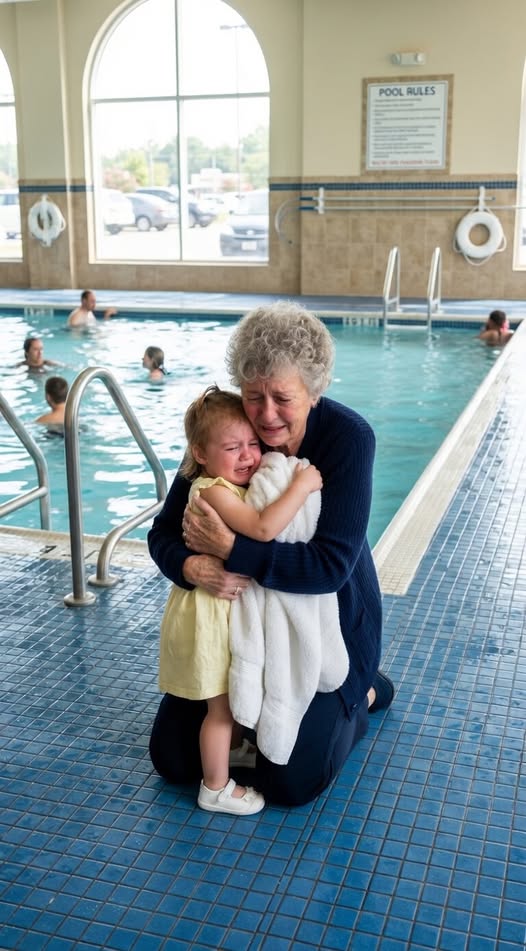
“Okay, Mom. Thanks for taking the bullet,” Adam chuckled lazily, taking a sip of his beer. “Keep her hydrated. We’ll swing by and pick her up tomorrow morning after we clean up the house.” He turned his back on his abused daughter and walked right back out to his party. “I’ll carry her to the car so she doesn’t ruin the rugs,” I said to Brooke. I bent down, scooped Maisie’s small, incredibly light body into my arms, and walked out the front door. Every step I took toward the driveway felt like walking through thick mud. My heart was pounding so hard against my ribs I thought the
sheer force of it would crack my sternum. I expected them to realize I was lying. I expected Adam to run out the front door and drag us back inside. I reached my sedan. I opened the rear door, gently placed Maisie into her booster seat, and buckled the heavy five-point harness securely
across her chest. “You’re safe now, baby,” I whispered to her.
I shut the rear door. As I walked around to the driver’s side, I glanced over the tall privacy fence. I could see the top of Adam’s head. He was throwing his head back, laughing loudly at a joke someone had told by the grill.
I got into the driver’s seat. I inserted the key, started the engine, and immediately pressed the central locking button on the door panel. The heavy clunk of all four doors locking simultaneously was the most beautiful sound I had ever heard.
I put the car in drive and pulled out of the manicured suburban neighborhood.
I wasn’t driving to my house. I wasn’t driving to a pharmacy for Pepto-Bismol.
I merged onto the highway, pressing my foot heavily onto the accelerator. I was driving straight to the emergency room of the county hospital.
Chapter 4: The Medical Mandate
I bypassed the crowded, chaotic waiting area of the county hospital emergency room entirely. I carried Maisie, who had buried her face in my shoulder, straight past the rows of people waiting with sprained ankles and coughing fits, marching directly up to the triage desk.
The triage nurse, a stern-looking woman in blue scrubs, looked up, annoyed by the line-jumping. “Ma’am, you need to take a number and wait—”
“My four-year-old granddaughter has been severely, physically abused by her father,” I stated. My voice was not loud, but it possessed a terrifying, diamond-hard clarity that cut through the ambient noise of the ER. “I need a pediatric trauma doctor, and I need you to call the police, right now.”
The nurse’s annoyance vanished instantly, replaced by immediate, clinical urgency. She took one look at my pale face, and the trembling child in my arms, and hit a button on her desk.
Within ninety seconds, we were ushered through heavy double doors into a private, brightly lit trauma room.
A pediatric specialist, a kind-eyed man named Dr. Evans, entered the room. I set Maisie gently on the crinkling paper of the examination table. I held her hand while Dr. Evans softly, gently lifted the heavy navy dress.
When the bruised, battered skin of her stomach and thighs was exposed to the harsh surgical lights, the room went dead silent. The attending nurse gasped audibly, bringing a hand to her mouth.
Dr. Evans’s jaw tightened. He didn’t ask how it happened. He didn’t ask if she fell. The medical evidence written on her flesh was undeniable, horrific, and absolute.
“The bruising pattern is consistent with extreme, blunt force trauma inflicted by a large hand, likely occurring twenty-four to forty-eight hours ago,” Dr. Evans said quietly to the nurse, documenting the injuries with a clinical camera. He looked at me, his eyes filled with a grim, shared understanding. “I am mandated by state law to report this immediately, Mrs. Vance.”
“Please do,” I said, my voice steady.
Thirty minutes later, the trauma room felt crowded. A social worker from Child Protective Services, a woman with a weary but sharp demeanor, stood by the wall with a clipboard. Sitting in a plastic chair across from me was Detective Miller, a seasoned investigator from the Special Victims Unit.
I sat beside Maisie’s bed, holding her hand while she finally drifted into an exhausted, medically-assisted sleep, the painkillers taking the edge off her agony.
I told them everything.
I told them about the spilled juice. I told them about Adam’s violent temper that I had willfully ignored for years. I told them about Brooke forcing Maisie to wear the heavy dress to hide the evidence at a pool party. I told them about the threat—the horrific, psychological torment of telling a four-year-old that the truth would cost her her grandmother’s love.
I didn’t try to protect my son. I didn’t try to mitigate his guilt. I handed the police the absolute, unvarnished truth, handing them the keys to his total destruction.
Suddenly, my purse, resting on the floor by my feet, began to vibrate violently. It buzzed against the linoleum, a loud, angry sound.
I reached down and pulled my phone out. The bright screen illuminated the dimly lit room.
Incoming Call: Adam.
Detective Miller looked at the screen, then looked up at me, his expression unreadable. “Do you want me to answer it, ma’am? I can handle him.”
I looked at the phone. I looked at the man who had beaten my granddaughter.
“No,” I said, my voice completely devoid of emotion. “I will.”
I swiped the green button, accepting the call, and immediately pressed the speakerphone icon so the detective and the social worker could hear every word.
“Hey Mom,” Adam’s voice echoed into the quiet trauma room. He sounded incredibly casual, the words slurred slightly at the edges, a clear indication he was several beers deep into his pool party. In the background, I could hear the heavy bass of pop music and the laughter of his guests. “Did you make it back okay? Did Maisie finally settle down? Brooke wants to know if we need to swing by and pick her up tonight, or if you can just handle her until tomorrow.”
I looked across the room at Detective Miller, who had quietly pulled out his notepad. Then, I looked down at my granddaughter, sleeping safely in the hospital bed, far away from the monsters who had hurt her.
“No, Adam,” I said, my voice turning as cold and hard as a glacial ice sheet. “You won’t be picking her up tonight. You won’t be picking her up tomorrow. You won’t be picking her up ever again.”
The laughter in the background of his phone seemed to fade. The casual slur vanished from his voice, replaced by sudden, sharp confusion.
“What? Mom, what are you talking about?” Adam asked, a hint of irritation creeping in. “Did she break something at your house? Stop being dramatic.”
“I’m not at my house, Adam,” I stated, staring blankly at the wall. “I’m at the county hospital.”
“The hospital? Why the hell are you at the hospital?”
“Because the pediatric specialist here just finished photographing the massive, hand-shaped bruises across your daughter’s stomach,” I said, dropping the hammer with surgical precision.
The silence on the other end of the line was absolute, profound, and deafening.
“And Adam?” I added, leaning closer to the microphone. “The police are already on their way to your house.”
Chapter 5: The Arrest at the Party
I didn’t hang up the phone. I kept the line open, placing the device on the small hospital tray table next to the bed. I wanted to hear it. I needed to hear it.
For ten agonizing seconds, there was nothing but the muffled sound of the pool party continuing in the background of Adam’s phone. His friends were still drinking, still laughing, completely oblivious to the fact that the host of their idyllic suburban gathering was a monster whose world was about to end.
“Mom… Mom, listen to me,” Adam finally whispered. The arrogant confidence was entirely gone, replaced by a raw, pathetic, hyperventilating panic. “Mom, you don’t understand. She fell! She fell off her bike! I swear to God! You have to tell them she fell!”
“She told me about the purple juice, Adam,” I replied, my voice dead.
“Brooke!” Adam suddenly screamed away from the phone, his voice cracking in sheer terror. “Brooke, get over here! Right now!”
I heard the rustle of movement, followed by Brooke’s voice, sounding annoyed. “What is it, Adam? I’m serving the—”
“My mom is at the hospital! She showed them the bruises! The cops are coming!”
I heard Brooke let out a sharp, piercing gasp. “Oh my god. Oh my god, what do we do? Tell them to leave! Tell them it’s a mistake!”
“You did this!” Adam roared at his wife. “I told you we shouldn’t have let her leave! I told you she would snoop!”
“You’re the one who hit her, you psycho!” Brooke shrieked back, instantly turning on him the second their perfect facade was threatened.
And then, I heard it.
Faintly at first, then growing rapidly louder, the piercing, unmistakable wail of police sirens bled through the speaker of the phone. It was a beautiful, terrible sound.
I heard the heavy, chaotic commotion on Adam’s end. The music was abruptly cut off. The casual chatter of the partygoers turned into shouts of confusion and alarm.
“Adam Vance! Brooke Vance!” a deep, authoritative voice boomed over the phone, cutting through the panic. It was the voice of a uniformed police officer using a bullhorn. “Step away from the guests! Keep your hands where we can see them and walk toward the front gate!”
“Mom! Mom, please!” Adam screamed into the phone, the sound of sheer, cowardly desperation echoing in the trauma room. “Tell them it’s a mistake! I love you! Mom, please don’t do this to me!”
“I don’t have a son,” I said.
I reached out and pressed the red button, severing the connection, plunging the hospital room back into a quiet, sterile peace.
According to the official police report I read weeks later, the arrest was a scene of absolute, catastrophic humiliation. In front of twenty horrified neighbors, college friends, and relatives who had been enjoying burgers just minutes prior, Adam and Brooke were separated by armed officers.
Adam, wearing nothing but his expensive swim trunks, was slammed against the side of a squad car and handcuffed. Brooke, wearing her flawless white sundress, collapsed onto the pristine lawn, sobbing hysterically, screaming at the officers that it was all Adam’s fault, that he had a horrible temper, and that she was just a victim trying to protect her family’s image.
They tore each other apart like rabid animals before they were even placed into the back of the cruisers. The pristine facade of their perfect suburban life was violently, publicly shattered, leaving nothing but the ugly, rotten truth for everyone to see.
Back at the hospital, the chaos of the outside world faded away.
The social worker, having finished her calls, walked over to me and handed me a thick stack of manila folders.
“Mrs. Vance,” the social worker said gently, offering a tired but genuine smile. “Given your quick, decisive action today, the clear physical evidence, and your spotless background check, a family court judge has expedited the process and signed an emergency placement order.”
I looked down at the paperwork, tears finally welling up in my eyes, blurring the legal text.
“What does that mean?” I asked, my voice trembling for the first time all day.
“It means,” she replied softly, “that Maisie is coming home with you tonight.”
An hour later, I carried Maisie out of the sliding glass doors of the emergency room. I had wrapped her securely in a warm, soft hospital blanket. The heavy, dark navy cotton dress she had been forced to wear was sitting in a biohazard bin in the trauma room, exactly where it belonged.
She was fast asleep in my arms, her breathing finally steady, deep, and unburdened by fear.
Chapter 6: A Different Kind of Love
Six months later.
The late afternoon sun cast a warm, golden glow over the backyard of my modest, quiet home. The pool was still, the water reflecting the blue sky, save for the gentle ripples emanating from the shallow end.
“Grandma, look! I’m a dolphin!”
I looked up from my book, sitting in a comfortable patio chair. Maisie was splashing happily in the two-foot water. She was wearing a bright, neon-pink swimsuit covered in cartoon flamingos.
The heavy, dark bruises that had once marred her tiny body had faded away months ago, leaving behind flawless, healthy skin. The dark circles under her eyes were gone. She had gained weight, her cheeks were rosy, and her laughter was a constant, beautiful melody that filled the empty spaces of my house.
The legal machinery had moved with swift, merciless efficiency.
Adam, terrified of facing a jury after the photos of Maisie’s injuries were entered into evidence, had accepted a plea deal. He was currently serving a five-year sentence in a state penitentiary for felony child abuse. Brooke, citing her complicity, failure to protect, and the severe emotional endangerment she inflicted by attempting to cover up the crime, was permanently stripped of all parental and custody rights.
I never visited him in prison. I never answered his letters.
The son I had loved, the boy I thought I had raised, had died in my heart the exact moment I saw those horrific, hand-shaped marks on my granddaughter’s skin. I mourned the idea of him, but I felt absolutely no guilt for destroying his life.
Maisie climbed out of the pool, her bare feet slapping wetly against the concrete. She grabbed a fluffy, oversized towel I held out to her, wrapping it tightly around her shivering shoulders, and practically tackled me with a wet, chlorine-scented hug.
“I love you, Grandma,” she smiled, looking up at me with bright, fearless eyes.
“I love you too, sweetheart,” I said, leaning down to press a kiss against her warm forehead. “More than anything in the whole wide world.”
I held her close, looking out over the quiet, peaceful yard.
I thought back to that dark, terrifying moment in the guest bathroom six months ago. I remembered the terrified little girl who had looked up at me, trembling, and whispered that if she told the truth, I wouldn’t love her parents anymore.
She had been right, in a way. The truth had cost them my love entirely.
But looking down at her bright, unbruised smile in the sunlight, feeling the solid, safe weight of her in my arms, I realized a profound truth.
Society tells us that a mother’s love for her child must be unconditional, that blood is an unbreakable bond that must be preserved at all costs. But that is a lie designed to protect monsters.
Sometimes, the truest, purest form of love isn’t found in holding onto the people you raised. Sometimes, love is the strength required to completely destroy them, to let go of the monsters hiding in plain sight, to make room for the miracle that needs saving.
Maisie giggled, breaking my reverie, and asked if we could have ice cream before dinner.
I smiled, stood up, and took her hand. “Absolutely.”