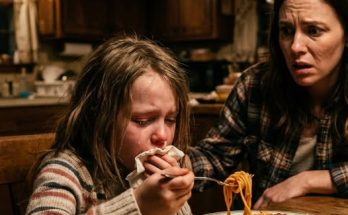
Chapter 1: The Stranger at the Spigot: I returned home after twelve grueling years of building freshwater wells in East Africa, only to find my daughter, Natalie, mucking horse stalls in the very barn I had constructed with my own hands. She paused, wiping sweat from her brow with a grime-caked sleeve, and handed me a dented tin cup of water from the outdoor spigot. She thought I was just another drifting vagrant looking for a day’s wages. She did not recognize her own mother. She could not see that the weathered, sun-baked old woman standing quietly in the Montana dust was not a broken vagabond, but a ghost carrying $340 million in hidden mining royalties and a terrifying, burning hunger for justice. Before I tear their stolen kingdom down to the bedrock, let me tell you how it all started. My name is Helen. I am sixty-seven years old. For the past twelve years, the world generally believed I was either dead from a horrific bout of malaria or permanently lost somewhere deep in the bush of Tanzania. My younger sister, Victoria, ensured that narrative took root. She told everyone in our county that I had gone entirely mad, abandoned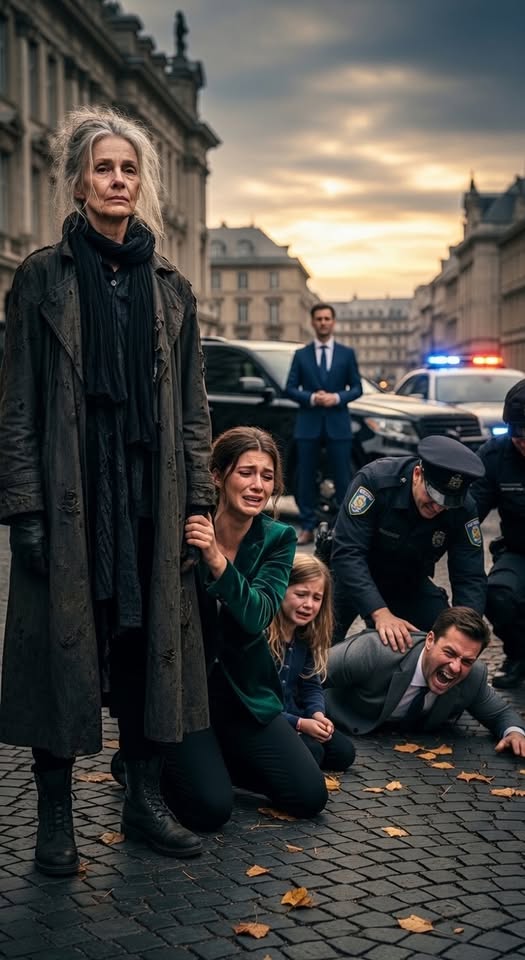
my family, and vanished into the African wilderness like some tragic, broken fool chasing a ridiculous redemption. She was half right. I did chase redemption. But I was never broken. I was building something. And while I designed complex water systems for remote villages that had never tasted clean water, I also stumbled into a geological miracle. During a separate survey project on a private parcel of land I owned, I discovered a massive lithium deposit that would eventually make me one of the wealthiest women in the American West. But I did not know that while my
fortune was silently multiplying beneath the earth, my family was being systematically destroyed above it. The afternoon I finally returned to Montana, the sky was the exact color of bruised iron. A biting October wind swept down from the plains, carrying the sharp scent of pine needles
and impending snow. I stood at the perimeter fence, looking at the sprawling ranch I had purchased two decades ago. It was three thousand acres of pristine, rugged land nestled aggressively against the Absaroka Mountains.
I had paid $3.2 million in cash back when I was still a highly lucrative civil engineer securing massive government contracts. I bought this ranch specifically for my daughter, Natalie, to give her a tangible legacy. A fortress that would shelter her future children for generations.
The main house was violently different now.
Someone had installed a grotesque, ostentatious marble fountain in the front yard. Fleet luxury SUVs were aggressively parked in the circular gravel driveway. A woman I did not recognize was casually lounging by a massive, heated swimming pool that certainly had not existed when I boarded my flight twelve years ago.
I adjusted the brim of my dusty, faded hat. My clothes were deliberately threadbare, purchased from a thrift store two towns over. My gray hair was long, wild, and tied back with a piece of twine. I looked exactly like what I needed them to see: a wandering old woman, perhaps a former ranch hand down on her luck, looking to sweep floors for a hot meal.
I had learned during my time in Africa that the absolute best way to diagnose a situation was to observe from the tall grass. A predator never announces its arrival to the prey.
I shuffled up the gravel path toward the main barn. A woman was inside, mechanically pitching heavy hay into a stall. She was thin. Terrifyingly thin. Her flannel shirt hung off her frame like rags draped over a scarecrow. Her hair was unkempt, and there were dark, bruised circles beneath her eyes that spoke of years devoid of restful sleep.
My lungs seized. It was Natalie. My daughter.
She was forty-two now, but she looked sixty. The vibrant, fiercely strong young woman I had left behind to manage the estate had been completely hollowed out, reduced to a mechanical shell.
She looked up when she heard my heavy boots scraping against the concrete.
“Excuse me, ma’am,” she said. Her voice was coarse, grating, barely projecting above a whisper. “If you’re looking for work, you need to go talk to the foreman up at the main house. I’m just the stable hand.”
I opened my mouth to say her name, to scream it, but the words caught violently in my throat. I stared at her. I looked at her hands—calloused, cracked, and bleeding at the knuckles from the biting cold. I looked at her eyes, the same piercing hazel eyes her father had, but they were entirely empty now. The spark was gone.
“I just need some water,” I managed to say, forcing my vocal cords to remain steady and low. “Long walk from the highway.”
Natalie offered a slow, exhausted nod. She set down the heavy pitchfork, walked over to a rusted spigot on the exterior wall, filled a dented tin cup, and brought it to me.
As she extended her arm, her flannel sleeve rode up. My blood turned to ice.
I saw a cluster of bruises gripping her forearm. Yellow, purple, old, and new.
“You should really move along before they spot you,” she whispered urgently, her eyes darting nervously toward the sprawling main house. “My aunt does not like strangers lingering on the property. She will have the sheriff out here in ten minutes.”
“Your aunt,” I repeated, the syllables tasting like ash.
“She owns this place,” Natalie said, dropping her gaze to her scuffed boots. “My mother left it to her when she died. At least… that is what the lawyer told us. I work here to pay off the massive debts she left behind.”
The words hit me with the blunt force of a sledgehammer.
“Debts?” I breathed. “What debts?”
Natalie shrugged, a microscopic movement, but I saw the deep, burning shame flush her cheeks. “My mother was not a good woman, ma’am. She embezzled money. She borrowed heavily from everyone. She left us with nothing but a mountain of bills and a ruined name. Aunt Victoria and Uncle Richard took us in. They graciously let us stay here, but we have to earn our keep.”
Us? I thought, my mind racing.
“Who else?” I asked.
“My daughter,” Natalie whispered, her voice finally cracking. “Emma. She is eight years old. She helps out in the main kitchen.”
A granddaughter.
I had an eight-year-old granddaughter I had never met, and she was scrubbing pots in the kitchen of my own goddamn house like an indentured servant.
“Where is your husband?” I asked gently.
Natalie’s face went completely blank. “He left,” she said flatly. “Three years after you… I mean, after my mother disappeared. He couldn’t handle the aggressive debt collectors. He couldn’t handle my Aunt Victoria. He just packed a bag one night and vanished. Took nothing. I haven’t heard a single word from him since.”
I felt the tin cup trembling in my grip. Not from age, and not from weakness. From a pure, unadulterated, volcanic rage.
“And your father?” I asked, my voice barely audible. My husband, David. The gentle, quiet man I had loved for thirty years. “What happened to him?”
Natalie looked at me strangely, her brow furrowing, perhaps wondering why a drifting stranger would pry into such intimate tragedies.
“He died,” she said quietly. “Five years ago. Massive heart attack. The doctors said it was the chronic stress. He spent years obsessively trying to clear my mother’s name. He truly believed she was innocent. He believed she would come back to us. But she never did. And it killed him.”
David was dead.
My husband, my anchor, was dead, and I had not been there to hold his hand. I had been digging trenches in Tanzania while he died desperately defending my honor against a lie.
“I am so deeply sorry,” I managed to choke out. “I am sorry for your loss.”
Natalie shrugged again. It was the pathetic, broken shrug of a human being who had been beaten down so relentlessly they had entirely forgotten the mechanics of standing tall.
“It is what it is,” she muttered. “Look, you really need to go. If Aunt Victoria catches me talking to vagrants, she will dock my pay again. And Emma desperately needs her medicine this month.”
“Medicine?” I asked, my maternal instincts screaming.
“She is diabetic,” Natalie explained, her eyes filling with tears. “Type one. The insulin is incredibly expensive. Victoria controls the family trust account. She dictates exactly when Emma gets her shots.”
I felt something cold, sharp, and lethal twist violently in my gut.
“She controls her insulin,” I repeated, making sure I heard the atrocity correctly.
Natalie nodded, wiping a tear from her dirt-streaked cheek. “It keeps us in line,” she whispered, her voice trembling. “If I complain about the hours, if I try to pack a bag to leave, if I do a single thing they do not approve of… Emma doesn’t get her medicine. Do you understand? They own us. They own every single breath we take.”
I understood perfectly.
My own sister had taken my daughter and my granddaughter hostage, weaponizing a child’s chronic illness as the chains.
I set the tin cup gently on a bale of hay. “Thank you for the water,” I said softly.
I turned and walked out of the barn. I walked down the long gravel path, past the grotesque fountain, past the gleaming luxury cars. I walked until I reached the paved county road, where a heavily tinted black SUV was idling on the shoulder.
The rear door opened. My attorney, a formidable, sharp-eyed man named Gideon, looked at me with deep concern.
“Did you see her?” he asked.
“I saw her,” I said, climbing into the leather seat. “And I saw exactly what they have done to her.”
“What is the play, Helen?”
I looked back through the tinted glass at the sprawling ranch, at the jagged mountains, at the empire I had bought with my own blood and sweat.
“We are going to take every single thing back,” I said, my voice cold as ice. “But first, I need to understand the exact architecture of the lie my sister built on my grave.”
Chapter 2: The Architecture of the Lie
We drove in silence to a discreet, high-end hotel in Bozeman. Gideon had explicitly booked an entire floor to ensure absolute operational security. In the expansive main suite, he had constructed what he affectionately referred to as the ‘War Room.’
Monitors dominated the walls. Stacks of forensic financial documents covered every available surface. He had been quietly, aggressively investigating for six months—ever since I had miraculously resurfaced in Nairobi and contacted his firm.
“Show me the math,” I demanded, shrugging off my dusty coat.
Gideon pulled up a complex, color-coded timeline on the primary monitor.
“Twelve years ago,” he began, tapping a laser pointer against the screen, “you departed for Tanzania on a humanitarian contract. You formally signed a power of attorney granting your husband, David, limited access to the ranch’s operating finances for emergencies. You explicitly told no one—not even David—about the lithium discovery because you wanted the geological surveys to confirm the deposit’s true magnitude first.”
“Correct,” I confirmed, pouring myself a glass of water.
“Six months after you departed, your sister, Victoria, filed a formal missing person’s report with the county,” Gideon continued. “She produced a ‘final letter’ claiming you were disappearing forever. The letter stated you could no longer handle the crushing guilt of massive, undisclosed corporate debts, and that you were fleeing the country to avoid federal prosecution.”
“I never drafted a single letter of that nature,” I growled. “I sent handwritten letters to David every single month.”
Gideon nodded grimly, pulling up a scanned document. “We found them. Victoria illegally intercepted every piece of international mail that arrived at the ranch. David never received your letters. He never knew you were actively writing. He died believing you had abandoned him in disgrace.”
I closed my eyes. The image of David, sitting alone in his study, waiting for a word from me, shattered my heart into a million irreparable pieces.
“Two years after your ‘disappearance’,” Gideon pressed on, “Victoria petitioned the probate court. She produced a newly discovered, heavily notarized will. The document claimed you had left the entirety of your estate to her in the event of your death or prolonged incapacity. The judge, presented with the forged suicide note and the will, ruled in her favor. The ranch, the liquid accounts, the assets—everything legally transferred to Victoria and her husband, Richard.”
“Forged,” I spat. “My own sister forged my final will.”
Gideon pulled up a microscopic forensic analysis on the screen. “We secured the original document for expert review. The signature was expertly traced from one of your old engineering contracts. It is a visually perfect forgery. However, we can scientifically prove it is fake. The specific chemical composition of the ink utilized by the notary was not commercially manufactured until two years after the document was supposedly signed by you.”
I stared at the screen, the reality sinking into my bones. My own sister had systematically erased me from existence.
“What about Natalie?” I asked, my voice thick. “Why didn’t she fight the ruling?”
Gideon sighed heavily, rubbing the bridge of his nose. “Natalie was twenty-nine when you vanished. She was grieving. She trusted Victoria. They all did. Victoria manipulated them, claiming you had tearfully confessed to massive corporate embezzlement before you fled. She convinced them that federal agents were actively hunting you, and that the only conceivable way to save the family ranch from government seizure was to let Victoria take total legal control and ‘make it right.’”
“Lies,” I whispered. “Every single syllable, a calculated lie.”
“But Natalie believed her,” Gideon said gently. “David believed her at first, too. But after a few years, David started asking dangerous questions. He started digging into the finances. That is precisely when Victoria aggressively changed her tactics.”
“What did she do?”