Chapter 1: The Hollow Hearth: I survived twenty-two months in a grueling overseas deployment, enduring the suffocating desert heat, mortar fire, and the kind of bone-deep exhaustion that permanently rewires a man’s nervous system. Through every dangerous patrol and every satellite phone call that dropped due to poor connection, the only thing that kept my sanity anchored to the earth was the mental image of my front porch in Texas. I pictured my wife, Vanessa, standing there with her bright, welcoming smile. I pictured my ten-year-old daughter, Lily, running into my arms, and my little boy, Noah, burying his face in my uniform. I returned on a sweltering Tuesday afternoon, the heavy straps of my olive-drab duffel bag biting into my shoulder. I walked up the cracked concrete driveway, expecting the chaotic, joyous symphony of a homecoming. Instead, I found the heavy oak front door unlocked, and a house swallowed by a suffocating, graveyard silence. There was no warm dinner waiting. No music playing from the kitchen radio. The air conditioning was dead, and the stagnant oxygen inside smelled of dust, dampness, and quiet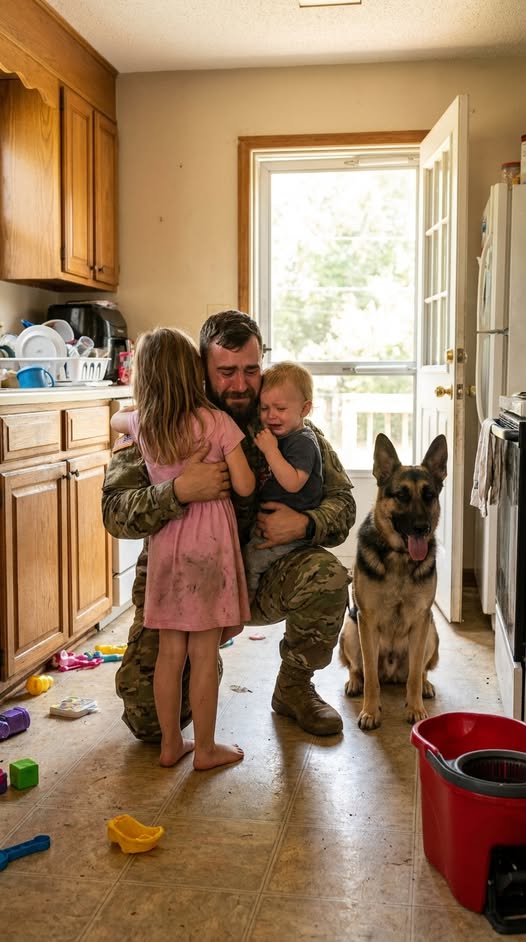
desperation. “Vanessa?” I called out, my voice sounding unnaturally loud in the narrow foyer. “Lily? Noah?” A low, vibrating growl echoed from the shadows of the living room hallway. Rex, our aging German Shepherd, limped into the fading light of the entryway. My heart physically staggered in my chest. The majestic, muscular dog I had left behind was gone, replaced by a frail, trembling creature with prominent ribs and cloudy, cataracts-veiled eyes. He positioned himself squarely in the center of the hall, teeth bared in a defensive snarl, guarding the closed door to
the children’s bedroom. He looked like a solitary, battered soldier who had spent the last year defending a forgotten outpost. “Rex,” I whispered, dropping to one knee and extending an open palm. “Hey, buddy. It’s me. Stand down.” The old dog’s ears twitched. He sniffed the stagnant air,
caught the familiar scent of my boots and sweat, and let out a pathetic, high-pitched whine. His back legs gave out, and he collapsed onto the hardwood, thumping his tail weakly against the floorboards. The bedroom door clicked open. Lily stood in the doorframe. She was wearing a faded,
unwashed school uniform that was at least a size too small. Her usually bright hair was tangled and matted at the nape of her neck. But it was her eyes that shattered me. They were dark, hollow, and painfully old—the eyes of a combat veteran trapped in a ten-year-old’s skull. She was
clutching Noah tightly against her hip, shielding him from the world.
My heavy duffel bag slipped from my grasp, hitting the floor with a dull thud.
“Lily…” My throat closed up. I took a hesitant step forward. “Sweetheart, where’s your mom?”
My daughter didn’t run to me. She didn’t cry. She just stared at my boots, her small shoulders slumping under an invisible, crushing weight.
“She left, Dad,” she stated, her voice terrifyingly flat and devoid of the emotion a child should have. “A long time ago. She said she couldn’t handle raising us anymore. She wanted a different life. I thought maybe she was just mad and she’d come back… but she never did.”
A cold, paralyzing numbness radiated from my chest outward, freezing the blood in my veins. I had endured the terror of night raids and the bloody aftermath of IED explosions, but absolutely nothing prepared me for the sight of my daughter’s cracked, unlotioned knuckles and the kind of profound exhaustion no child should ever carry.
I moved past her into the kitchen. The sink was piled high with crusty, unwashed plates. On the counter sat a pot of dried, hardened rice and a stack of stiff, stale tortillas wrapped in cheap plastic. I yanked the refrigerator door open. A half-empty gallon of spoiled milk, a jar of mustard, and a single, bruised apple stared back at me.
On the dining table, amidst a scattering of junk mail, lay Lily’s school notebook. It was opened to a crayon drawing titled, My Family. She had drawn herself in the dead center, her stick-figure arms stretched impossibly wide, holding Noah on one side and Rex on the other. Standing far off in the top corner of the page, separated by a vast expanse of white paper, was a man in an army helmet.
I clamped my hand violently over my mouth, biting down on my own knuckles to stifle the gut-wrenching sob threatening to tear its way out of my throat. I would not fall apart. Not in front of them.
I forced myself to swallow the bile and turned back to my daughter. “Lily… who has been feeding you?”
She tightened her fragile grip on her brother. “Sometimes Mrs. Gloria next door brought us black beans. Sometimes I sold homemade pudding cups to the older kids at school. Rex scared away the bad people who came knocking on the door asking for money.”
Noah, barely old enough to articulate his own trauma, peeked out from behind his sister’s worn skirt. “Mommy said Lily was big enough now,” he whispered.
That sentence sliced through my heart like a serrated combat knife.
I spent the next three hours in a blur of hyper-focused triage. I scrubbed the bathtub, filled it with warm water, and gently bathed the grime from my children’s skin. I cooked a massive plate of scrambled eggs using groceries I sprinted to the corner store to buy. I tucked them into fresh, clean sheets, and I sat in the wooden chair beside their beds until the sun crested the horizon, because every time Noah shifted in his sleep, he whimpered in terror of being alone. Rex slept directly across the threshold of the door, letting out a deep, contented sigh, finally relieved of his solitary watch.
The immediate bleeding was stopped. But the true war was only just beginning.
Chapter 2: The Paper Trail of Betrayal
The morning sun filtered through the dusty kitchen blinds. After making sure the kids had a hot breakfast, I walked them to the local elementary school.
As we approached the main office, the principal spotted me. Her expression instantly morphed into a complex tapestry of profound relief and simmering anger.
“Sergeant Brooks,” she breathed, ushering me into her private office and closing the frosted glass door. “We have been trying to reach your wife for months. Your daughter has been arriving at this campus at six-forty-five every single morning. She drops Noah off at the municipal preschool three blocks away, gets herself here before the bell, and falls asleep at her desk by third period. When we asked where her mother was, she just smiled politely and said she was ‘busy’.”
The principal reached into her desk drawer and slid a manila folder across the polished wood. Inside were dozens of unpaid lunch account notices, unreturned permission slips, and a piece of lined notebook paper folded into a tight square.
“Lily handed this to the school counselor three months ago,” the principal said softly.
I unfolded the paper. In Lily’s careful, rounded cursive, the message read: Please don’t tell my dad about the late slips. He’s busy saving people from bad guys. If you tell him I’m messing up, he’ll be sad.
A hot, stinging tear broke free and tracked down my cheek. I wiped it away savagely. “It won’t happen again, ma’am. I promise you. I am home.”
I left the school with my jaw clenched so hard my molars ached. But when I returned to the house, I found a bright, neon-yellow envelope taped securely to my front door.
I tore it open. My stomach plummeted. It was an official writ of possession from the county sheriff’s office. An eviction warning, effective in exactly seventy-two hours, tied to a massive property lien I had never authorized.
I spent the entire afternoon tearing through the house, locating every hidden piece of mail Vanessa had shoved into drawers before she vanished. I spread them across the kitchen table. It wasn’t just a late fee. It was a comprehensive chronicle of financial slaughter.
Unpaid utilities. Defaulted personal loans. Missed car payments for a luxury vehicle I had never seen, let alone driven. Everything carried my name.
At first, I stubbornly believed there had to be a catastrophic clerical error. Then I found the photocopies of my military identification, the forged signatures perfectly mimicking my own handwriting, and loan agreements stamped and dated months after my boots were already on the ground in a foreign desert.
Someone had been weaponizing my identity while I bled for this country.
At sunrise, I put on a crisp, clean shirt, dropped Lily and Noah off with Mrs. Gloria next door, and drove straight to the bank.
The teller assisting me, a nervous woman with thick glasses, began sweating profusely the moment she pulled up my account matrix on her monitor.
“Mr. Brooks,” she stammered, clicking her mouse frantically. “According to our authenticated branch records, you approved all of these subprime loans jointly with your wife, Mrs. Vanessa Carter.”
“I wasn’t even in the state,” I stated, leaning over her desk, letting my sergeant’s voice bleed into the small cubicle. “I did not sign those documents.”
The clerk swallowed audibly. “There… there is also a secondary, external account linked to your primary military direct deposit. Bi-weekly wire transfers have been siphoning your salary for the last fourteen months. The withdrawals were made locally.”
A blinding, roaring fury ignited in my chest. Vanessa hadn’t merely cracked under the pressure of parenting and run away. She had systematically, ruthlessly bled my accounts dry, financing her escape while my children survived on cold leftovers and charity.
I drove back to my neighborhood, my hands gripping the steering wheel until my knuckles turned white. As I pulled into my driveway, Mrs. Gloria was waiting by my mailbox, wringing her hands in a floral apron.
“Daniel,” she whispered, looking nervously up and down the quiet suburban street. “I didn’t want to interfere with the authorities before… I was so afraid they would put those sweet babies in the foster system. But now that you’re back, you need to know.”
I stepped out of the car. “Know what, Gloria?”
“About the man,” the old woman confided, her voice dropping to a harsh whisper. “His name is Tyler. He owns that sleazy used-car dealership on the highway. At first, he just picked Vanessa up in his black pickup truck late at night. Then, she stopped coming home for days at a time.”
Gloria wiped a tear from her wrinkled cheek. “The final night… she packed a hard-shell suitcase. Lily was begging her to stay. Lily ran out onto the porch crying, screaming, ‘Mom, please, Noah has a fever!’ And your wife… she just fixed her lipstick in the truck’s mirror, looked at your ten-year-old daughter, and said, ‘Figure it out. You’re old enough already.’ Then she drove away.”
I literally forgot how to breathe.
“I called Child Protective Services,” Gloria admitted, shame coloring her face. “But when the caseworker arrived, Lily cleaned the house, dressed Noah in his Sunday best, and lied through her teeth. She told them everything was perfect.”
I thanked Gloria, walked into my house, and sank onto the living room sofa. I didn’t ask Lily why she lied. I already understood the heartbreaking truth.
My ten-year-old daughter had been tactically protecting the only fragile remnant of a family she still had left.
Chapter 3: The Trenches of Bureaucracy
The next three weeks transformed into a completely different theater of war. I traded my Kevlar vest for legal pads and an endless, maddening symphony of automated hold music.
I launched a full-scale siege against the bureaucratic machine. I sat in bleak, fluorescent-lit police precincts filing identity theft reports. I aggressively cornered regional bank managers until they froze the fraudulent lines of credit. I hired a relentless family attorney to untangle the devastating mess Vanessa had anchored to my social security number.
Proving that a legally married spouse had committed comprehensive financial fraud and child abandonment was a brutal, uphill battle. Vanessa had carefully weaponized my deployment, using my physical absence to explain away the digital signatures and the redirected mail.
But amidst the chaotic storm of legal filings and fraud investigations, a profound, quiet miracle was taking place inside the walls of our heavily mortgaged home.
Life was finally taking root again.