At my wedding, my mother-in-law grabbed the microphone and called me a gold digger in front of 200 guests — what my father did next made the entire room go silent. I knew Russell’s mother, Deborah, didn’t like me. She never said it directly. Women like her say things like, “That dress is brave,” or “You must be relieved to marry into stability.” Russell came from old money. Portraits in hallways. Family lawyers. Secrets with locks on them. I came from my father’s repair shop and a two-bedroom house behind a gas station. Dad raised me alone after my mother left. He fixed
engines by day and packed my lunches at night. So when Russell proposed, his mother looked at my ring like it proved something ugly. Still, I tried. I sent thank-you notes. Invited her to dress fittings. Let her choose flowers she hated anyway. On the wedding day, I told myself none of it
mattered. Russell loved me. Dad walked me down the aisle with tears in his eyes. For one hour, I believed we might be happy. Then came the reception. Two hundred guests filled the ballroom.
Crystal glasses. White roses. A cake taller than my niece.
I was dancing with Dad when Deborah stood.
She took the microphone and tapped it twice.
The room quieted.
She smiled at me.
“I think someone should finally say what we’re all thinking.”
Russell went pale.
“This girl did not marry my son for love,” she said. “She married him for our money.”
Gasps moved through the room.
Then Deborah laughed and added, “I suppose spending a few years pretending to be in love is easier than spending a lifetime working at a repair shop.”
A few people shifted uncomfortably in their seats.
Others looked away.
I felt my face burn.
Then suddenly, my father rose from his table.
And the words he said next made Deborah go pale.
I knew Deborah didn’t like me before Russell ever told me she didn’t.
Women like her don’t say things plainly. They say things like, “That dress is very brave of you,” or “You must feel so relieved to finally have some stability.”
They smile when they say it. They make you wonder afterward if you imagined the blade.
Deborah didn’t like me.
I tried for three years to change her mind. I sent thank-you notes after every dinner.
I invited her to the dress fitting twice.
I let her weigh in on the flowers, even though she chose something she complained about at every subsequent meeting.
Russell told me to stop trying so hard.
I told him I was raised to try.
I tried for three years to change her mind.
Russell came from old money. The kind with portraits in hallways and family attorneys on speed dial. The kind where the house has a name, and the furniture has a history, and everyone at Christmas dinner knows which topics require a subject change.
I came from my father’s repair shop and a two-bedroom house behind a gas station on Route 9.
My dad, Jimmy, raised me alone after my mother left.
He fixed engines by day and packed my lunches at night and never once made me feel like we were missing anything, even when we were.
Russell came from old money.
He kept a worn leather folder tucked into a large, customized pocket he’d had stitched into the inside of his jacket years ago because he didn’t trust important papers to his truck.
Insurance documents, old receipts, the occasional photograph.
That folder went with him everywhere.
I should have noticed it sooner.
I was too busy trying to survive the wedding.
I should have noticed it sooner.
***
The ceremony itself was beautiful.
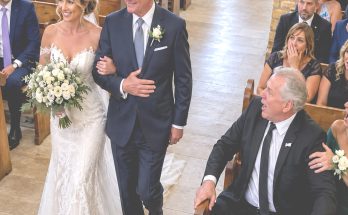
Dad walked me down the aisle with his jaw set in that way he has when he’s trying not to cry, and halfway down he reached into his jacket with his free hand and touched the leather folder, the way he does sometimes without seeming to think about it, just checking it was there.
Then his hand came back and found mine again.
Russell watched me come toward him with an expression that made everything else fall away. For one hour, I believed we were going to be just fine.
The ceremony itself was beautiful.
***
Then came the reception.
Two hundred guests filled the ballroom. Crystal glasses, white roses, a cake taller than my niece. I was sitting with Dad.
That’s when Deborah rose from her seat at the family table.
She picked up the microphone. She tapped it twice.
The music faded. The room turned.
She smiled at me.
She tapped it twice.
***
“I think someone should finally say what we’re all thinking.”
Russell went still across the table.
“This girl did not marry my son for love,” Deborah added, her voice clear and unhurried, perfectly comfortable at the center of attention. “She married him for our money.” She let that land for a moment, then laughed lightly. “I suppose spending a few years pretending to be in love is a great deal easier than spending a lifetime in a repair shop.” She smiled at the room with the ease of someone who has never once questioned their right to speak. “Some people are very talented at looking grateful!”
“This girl did not marry my son for love.”
Gasps moved through the room. A few people looked at their plates. A few looked at me.
I felt my face go hot. I felt my father’s hand tighten slightly on my arm.
Then he let go.
***
And he stood up.
He didn’t move fast. Dad never moves fast. He pushed his chair back and straightened his jacket, the one he’d had pressed specially for today, and he looked at Deborah across the ballroom with an expression I recognized.
He didn’t move fast.
He used it when someone brought him an engine they’d let run too long without oil and expected him to tell them it was fine. Patient. Honest. Done with the pretense.
He walked toward the microphone.
I grabbed his sleeve.
“Dad. Please.”
He covered my hand with his and smiled at me in a way that made me feel twelve years old in the best possible sense.
“Let me talk about my daughter for a minute,” he said.
I grabbed his sleeve.
***
The room was quiet when Dad took the microphone.
People who had been shifting uncomfortably in their seats went still.
“I’d like to ask you something,” Dad said, looking at Deborah. His voice was completely calm, which anyone who knows him understands is more formidable than shouting. “How much do you actually know about my daughter?”
Deborah lifted her chin. “I know enough.”
“I wonder,” Dad said.
“How much do you actually know about my daughter?”
He reached into his jacket and put his hand on the leather folder, the one he’d had in his pocket every day for as long as I could remember, but he didn’t open it yet.
***
“Let me tell you about when Orra was sixteen,” he said. “When our neighbor, Mrs. Evelyn, got her diagnosis. Mrs. Evelyn lived with her young grandchildren who’d lost both their parents in a car crash. Her husband had been gone for years. And when the insurance company came back with what they’d cover, it wasn’t nearly enough.”
Mrs. Evelyn had been sitting at Dad’s table all evening without drawing much attention. Small, white-haired, with the careful posture of someone who had once been taller.
I hugged her and moved on because there were a hundred things to manage.
He didn’t open it yet.
Dad paused.
“I remember finding Orra sitting on the kitchen floor that night. I thought something had happened to her. She was just crying. She said she couldn’t figure out how it was fair that someone could do everything right and still end up losing.”
The ballroom was the quietest place with two hundred people I had ever heard.
***
“Deborah mentioned the repair shop,” Dad said. “She’s right that Orra worked there. She worked there after school. She babysat on weekends. She cleaned offices on the nights we didn’t have a job. And I want you to know what for.”
The ballroom was the quietest place with two hundred people.
He finally opened the leather folder.
Inside were papers I hadn’t seen in years. Receipts. Payment confirmations. Handwritten notes in my own sixteen-year-old handwriting. Donation records with my name printed across the top of each one.
“Not for a car,” he said. “Not for clothes. Not for college.” He looked around the room. “Every paycheck she earned for two years went into an envelope. Every single one. I found out six months after she had started. She hadn’t told me. She hadn’t told anyone.”
“That’s ridiculous,” Deborah said from across the room. Her voice had lost a little of its earlier confidence, but not all of it. “You’re expecting two hundred people to believe that?”
He finally opened the leather folder.
***
Dad looked at her. Then he reached into the folder and held up another receipt.
“No, the receipts can do that.”
He held up the folder.
“I’ve carried this with me since the day I found it. Not because I was waiting to use it. I carry it because it’s the best thing I’ve ever had in my pocket.”
He began passing the receipts to the nearest table.
“It’s the best thing I’ve ever had in my pocket.”
They moved through the room the way things move when people suddenly need to see for themselves.
Dad looked at Deborah one last time.
“If Orra wanted money,” he said, “she chose the slowest possible way to get it.” He paused. “Character doesn’t come with a bank account. I’d have thought a family like yours would know that by now.”
Then he set the microphone down and walked back to his seat.
“Character doesn’t come with a bank account.”