She talked about it in the same way I talked about the dress. The irony of this had not escaped me. What had escaped her, apparently, was that the rest of the family had also been listening to her tell that story for years. Our family reunion was scheduled for the following month. It was an annual event at Marcus’s aunt’s property, where three generations of the family gathered for a weekend. I had been asked to organize a small presentation celebrating family history. I agreed to that because it was something I had done before and enjoyed doing. I began quietly and
contacted family members one by one, asking for photographs and stories — old weddings, inherited objects, family recipes, and things passed down through generations. Everyone was enthusiastic. Everyone had something to contribute. I also included the story of the wedding dress.
I told it completely and without editorial comment — the grandmother who sewed the buttons, the mother who wore it in October 1974, the daughter who wore it in June, and the granddaughter who had grown up hearing the story and hoped to continue it.
I included photographs at every stage. The final image was the empty shelf in the storage room.
I did not name Evelyn in the presentation. I did not need to.
The reunion arrived on a warm Saturday.
Families spread across the lawn with folding chairs and food, and in the early afternoon, everyone gathered in the barn for the presentation.
I had put it together carefully, and it was genuinely moving because of old photographs, voices of relatives sharing memories, and the accumulated evidence of what a family carries with it through time.
Then came the wedding dress segment.
The room went quiet as they saw the presentation.
Sophie, sitting beside me, told the story herself in her own words, which she had asked to do and which I had agreed to immediately.
She talked about the buttons her great-great-grandmother had sewn. She talked about the story her mother had told her since she was small. She talked about the hope she had carried that someday the dress would be hers.
Then she said, simply and without drama, that the dress was gone now.
She said it was sold by someone who had decided it wasn’t important.
Everyone was still quiet.
Then, someone asked, gently, what had happened. Marcus explained. He had not been fully willing to do this in smaller settings, but in this room, faced with four generations of his family and his daughter’s composed, 12-year-old voice still in the air, he told the truth.
No one attacked Evelyn. No voices were raised.
But the faces of people who had heard her tell the story of her grandmother’s jewelry box for years said everything that needed to be said without anyone needing to say it.
One of Marcus’s aunts, a woman in her 70s, who had known Evelyn for decades, looked at her and said quietly, “Would you want someone to decide your grandmother’s jewelry box wasn’t important, Evelyn?”
Evelyn did not answer.
For the first time in the entire months-long ordeal, she looked ashamed.
Four days after the reunion, my phone rang.
It was the woman who had bought the dress. She had seen something and had called to say that she was sorry. I still don’t know if someone had shared the presentation with her or whether the story had reached her another way, but she sounded very apologetic.
She said she couldn’t return the dress because the alterations had already been made and the wedding was two weeks away.
But she wanted to do something.
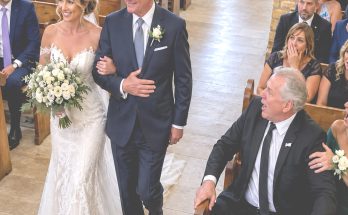
She hired a photographer and sent me a full set of professional photographs of herself wearing it on her wedding day, along with a handwritten letter describing what the dress had meant to her and promising that she would tell its history to her own daughter someday.
A few days later, Sophie and I spent a weekend building a memory book. It had my grandmother’s photographs, my mother’s wedding photographs, my own, and now, at the end, a stranger’s wedding photographs.
The dress was gone, and it was not coming back. But the story had survived, which is the part that was always going to outlast the fabric anyway.
Sophie put the last photograph in the book, closed the cover, and said, “I’ll tell my daughter about this one too.”
I think my grandmother would have found that entirely satisfactory.