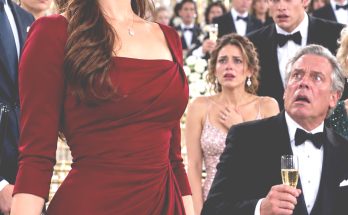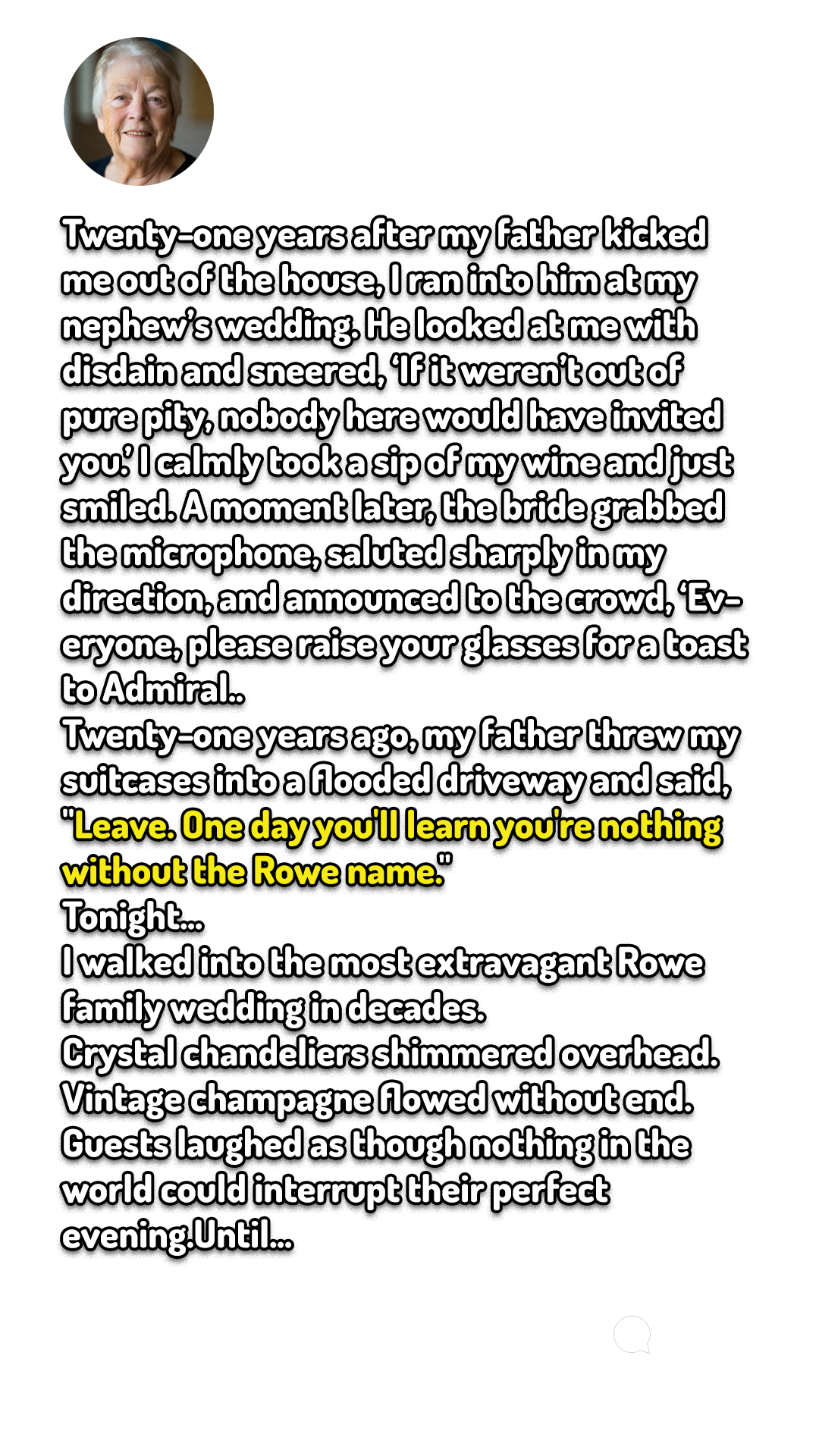
Chapter 1: The Scent of Erased History… The first thing that hit me when I crossed the threshold into the St. Aurelia Hotel ballroom wasn’t the blinding glare of the crystal chandeliers, but the smell. It was the distinct, heavy perfume of generational wealth. It wasn’t the crisp scent of new money or the clean, sterile odor of modern luxury. It was something far denser. It smelled of aggressively bubbling vintage champagne, hundreds of white orchids wilting under the heat of beeswax candles, polished marble, and the faint, buttery ghost of lobster drifting from silver trays hovering along the walls. Hundreds of guests occupied the cavernous room, moving with the practiced, languid grace of people who knew the evening had been meticulously staged solely for their comfort. Women in whispering silk gowns laughed, their heads thrown back in synchronized
displays of amusement. Men in bespoke tuxedos stood in tight circles, nursing amber drinks they barely touched. Staff in white gloves glided through the gaps, offering beluga caviar and delicate canapés I couldn’t begin to identify. I stood near the heavy brass doors, an invisible woman in a plain, off-the-rack navy dress, scuffed black heels, and zero jewelry, save for a single, thin silver bracelet hidden beneath my long sleeve. For a sharp, agonizing second, I considered turning around and walking right back out into the Chicago night. Then, I saw my nephew. Calder Rowe stood
beneath a towering arch of woven white roses, his new bride by his side, speaking to a cluster of guests near the head table. He had his mother’s striking green eyes, but none of her inherent weakness. When his gaze swept the room and locked onto me, his entire expression fractured and reformed in an instant. It was relief. Pure, unfiltered relief, as if he had been holding his breath since the invitations were mailed.
“Aunt Maren,” he mouthed silently over the sea of heads.
I lifted my hand, just an inch, returning the signal.
It had been twenty-one years since I had last inhaled the air of a Rowe family event. I had missed the milestone birthdays, the corporate galas, the extravagant funerals. I hadn’t even attended my own grandmother’s memorial. Instead, I had stood across the street in the freezing rain, listening to the muffled eulogies leaking through the heavy oak doors of the cathedral.
The last time I saw my father, Alden Rowe, he was standing in the doorway of the family estate, my two packed suitcases resting in a puddle at his feet. A brutal autumn storm was washing out the gutters. My mother hovered behind him in the foyer, pressing a monogrammed handkerchief to her mouth, looking infinitely more embarrassed by the neighbors watching than devastated by my departure. My older brother, Griffin, leaned casually against the banister, a cruel, satisfied smile playing on his lips, watching the scene unfold like a play he had written himself.
I was nineteen years old.
“You are a total disgrace to this family,” my father had declared, his voice cutting through the sound of the rain. “You were meant to marry Easton Bell. That was your sole responsibility.”
“I don’t love him,” I had pleaded, my voice trembling but defiant.
“You were not raised to chase something as useless as love, Maren. You were raised to fulfill a duty.”
“I won’t do it. I won’t be sold.”
That was the exact moment I saw the vault inside my father lock permanently.
He kicked my bags further into the rain. “Then go,” he sneered. “Become nothing. And don’t you dare come crawling back when the world finally shows you exactly how little you are worth.”
Griffin had actually laughed. A sharp, barking sound.
“You’ll never be anything without this name,” my father added, his final curse.
I didn’t cry. I just turned and walked into the storm.
For twenty-one years, those words had lived inside my chest. Not as an accepted truth, but as a heavy, cold weight I had learned to carry on long runs and through sleepless nights.
Now, I was back.
This wedding was a monument to everything my father worshipped: cake accented with edible gold, towering ice sculptures weeping onto linen, a string quartet playing Vivaldi, and a guest list curated from the pages of financial times and political registers. Alden Rowe had constructed his entire existence around the validation found in rooms exactly like this.
I navigated the perimeter, finding my assigned seat near the back, shadowed by a massive decorative palm and a speaker disguised with hydrangeas. Table 42. A space deliberately designed for the forgotten.
My place card read simply: Maren Rowe.
No honorific. No plus-one. No acknowledgment of a life lived beyond that night in the rain.
It was perfect.
I had barely pulled out my chair when I felt the atmospheric pressure in the ballroom shift. Conversations nearby suddenly softened into murmurs. Heads turned on swivels. A distinct, buzzing whisper began to spread like a virus.
I followed the collective gaze.
My father stood across the dance floor.
Alden Rowe still carried himself with the dense gravity of a man who fully expected the earth’s rotation to adjust to his schedule. He had silver hair, a flawless tuxedo, and a crystal highball glass resting in his palm. But when his eyes finally found mine across the room, the polished veneer fractured, just for a microsecond.
Shock.
Then, the iron control snapped back into place.
Griffin materialized beside him, his cruel smile already securely in place.
“Well,” Griffin announced, his voice carrying far too loudly over the music. “It seems the ghost actually showed up.”
My father didn’t smile. His eyes dragged over my plain dress, measuring me, categorizing me.
“Maren,” he said smoothly as they approached. “I wasn’t entirely sure Calder’s youthful sentimentality would extend this far into the past.”
I lifted my water glass. “Hello, Alden.”
A woman at the next table gasped audibly at my use of his first name.
Griffin chuckled, shaking his head. “Still relying on theatrics, I see.”
My father took a slow step closer, invading my space so his voice would only reach me—though I knew the surrounding tables were leaning in, desperate for the bloodsport.
“Pity is the only thing that got you through those doors tonight,” my father whispered, his voice like crushed glass. “Nothing else. You do not belong in this room.”
Silence gathered around our table, sharp, heavy, and expectant.
I looked up at him. For a fleeting second, the chandeliers vanished. I was back on the wet asphalt, staring at my ruined suitcases, a nineteen-year-old girl being erased from existence.
Then, I took a slow, deliberate sip of my water. It was cold. Bitter. Perfectly ordinary.
I smiled.
And for the very first time in his life, my father had absolutely no idea what he was looking at.
Chapter 2: The Anchor of a Memory
Griffin laughed first, mostly because he had always required permission from his own ego before being openly vicious.
“Still putting on a dramatic performance,” Griffin said, adjusting his cuffs. “I told Calder sending that invitation was a massive mistake. Weddings are supposed to be about happiness, not dredging up ancient history.”
A portly man in a gray tuxedo standing near them chuckled dutifully into his linen napkin. A woman dripping in South Sea pearls let her gaze drop from my unadorned neckline to my bare ring finger, as if a woman’s entire net worth could be calculated by fabric and diamonds.
I set my glass down on the table, aligning it perfectly with the knife.
“Calder invited me,” I said, my voice completely devoid of defense. “So, I came.”
My father made a faint, dismissive sound in the back of his throat. “Calder is young. Sentiment makes young men exceptionally careless.”
“He’s thirty years old, Alden,” I replied.
“He is still young enough to foolishly believe that shared blood excuses decades of absence,” he countered.
That specific line landed much closer to the bone than I anticipated. Not because it was an accurate assessment, but because Calder had asked me a very similar question in a letter I had kept folded in my desk drawer for months.
He had tracked me down through an obscure, forwarding P.O. Box I maintained for formal correspondence I never intended to answer. His first letter had been handwritten. Thick, textured paper, careful blue ink, devoid of any corporate polish.
Aunt Maren, the letter began. I don’t know what actually happened between you and my father, but nobody in this house will tell me the truth.
I had read that opening sentence twice, sitting in my sterile office.
He wrote that his only vivid memory of me was from a humid Tuesday afternoon when he was six years old. I had taken him to a public park because his mother was incapacitated by a migraine, and the men were locked in a board meeting. He remembered the rusted chains of the swing set. He remembered eating a blue popsicle that stained his lips. And he remembered my voice telling him: Never confuse loud people with strong ones.
He remembered it. I had completely forgotten.
His letter concluded with a simple, desperate request: He was getting married in July, and he wanted at least one person in the room who understood that the Rowe family name and the Rowe family truth were not the same thing.
That was the sole reason I was sitting at Table 42.
I hadn’t come for my father. I hadn’t come for Griffin. I certainly hadn’t come for forgiveness, or to reclaim a legacy that had been violently stripped from me.
I came because a child had held onto a single sentence for twenty-four years, using it as a shield.
My father knew none of this. He only saw a perceived vulnerability.
“So, do tell us,” Alden said, lifting his champagne flute slightly, mocking a toast. “What exactly do you do now? Secretarial work? Some bleeding-heart nonprofit? Teaching? I heard a vague rumor years ago that you took some low-level government job.”
Griffin leaned his weight onto the table, looming over me. “She always loved pretending that following the rules made her important.”
I could have answered them.
I could have rattled off a list of deployments and duty stations that would have fundamentally altered the atmospheric pressure of the entire room. I could have named secure facilities, covert operations, and command briefings. I could have listed decisions I had made in absolute, crushing silence, in rooms where applause was a liability, and failure meant flag-draped coffins.
Instead, I looked at my brother and said, “I keep busy.”
Griffin snorted. “That is exactly what unemployed people say to save face.”
“No,” I replied, my voice a calm, flat line. “It’s what busy people say.”
His cruel smile tightened into a thin, angry line.
My father studied me with renewed intensity. I could feel the shift in his gaze. It was the distinct irritation of a man trying to shove a file into a cabinet, only to realize it didn’t fit the label. He had fully expected me to be broken. He expected me to be small, defensive, and pathetically grateful just to be allowed in the building.
He had not prepared for this quiet, unshakeable steadiness.
Alden leaned in again, dropping his voice. “Do not confuse Calder’s pity invitation with a family reconciliation, Maren. You made your choice. You chose to abandon this family.”
“You threw my bags into a flooded driveway,” I corrected him.
“You flatly refused your responsibility.”
“You tried to sell my life to a business partner,” I said, my tone as even as a metronome.
A few guests at the neighboring table shifted awkwardly, pretending to suddenly be fascinated by their silverware.
Griffin’s voice dropped to a menacing growl. “Careful, Maren.”
“I am always careful,” I said.
My father’s jaw clenched hard, as though he were swallowing a jagged stone. Then, his eyes flicked down to my wrist.
The thin silver bracelet had slipped out from beneath my navy sleeve.
It was plain, unpolished, and engraved with a string of longitudinal coordinates that would mean absolutely nothing to anyone in this ballroom.
Except him.
His gaze locked onto the silver.
“What is that?” he asked, his voice suddenly hollow.
“A reminder,” I said.
“A reminder of what?”
“That storms eventually end.”
For the very first time in twenty-one years, Alden Rowe had no immediate, crushing reply.
A sudden burst of loud, joyful laughter erupted from the head table, shattering the localized tension. Calder was leaning close, whispering something to his bride, Liora Vance, and the room’s attention gratefully drifted back to the couple.
Liora was a striking woman. Not in the manufactured, polished way the Rowe family usually demanded, but in the way she commanded stillness. She didn’t perform for the crowd. She didn’t project softness or status. She simply existed within her own quiet control, like someone deeply accustomed to a pressure that didn’t originate from wedding planners or wealthy in-laws.
I recognized that posture.
Not from galas or country clubs.
I recognized it from brutally bright briefing rooms. Sterile, fluorescent lights. Early morning debriefs. The stance of a young officer standing entirely alone while superiors actively tried to bury her voice under the weight of an authority she refused to blindly accept.
My hand tightened fractionally around the stem of my water glass.
Suddenly, Liora turned her head, scanning the back of the room.
Her eyes met mine.
At first, there was no recognition. Just a bride looking at a stranger.
Then, everything in her demeanor violently changed.