PART 1: “I want you to bathe her in our tub, and please, don’t call the staff, so do it yourself,” my husband said firmly. I thought my husband had lost his mind when he uttered those words. My name is Sabrina, I am thirty-six years old, and until that afternoon I believed I knew the man I had been married to for fifteen years completely. My husband, Lucas, owned several construction companies in Phoenix, so he had plenty of money and a habit that sometimes drove me crazy: once he fixed on an idea, no one could change his mind. That week he had decided to support a
community kitchen near the central bus station. He said he was tired of writing checks just for photographs and wanted to meet the people who received the help in person. I did not share his enthusiasm at all. “There are people who really need help,” I told him casually, “but there are also those who simply prefer to live like this.” How easy it was to say that from my air-conditioned home, with a personal cook preparing breakfast and a driver waiting outside. Back then I truly did not understand the reality of the world. That afternoon I returned from lunch with friends and
found Lucas in the living room with a woman who looked as if she had been living on the street for years. Her hair was tangled, her face covered in dust, and she wore an old jacket that smelled so strongly I instinctively covered my nose. For illustration purposes only “What is she doing here?” I asked in absolute shock.
The woman lowered her gaze nervously.
Lucas answered with calm that irritated me. “Her name is Hope.”
“Is that her actual name, or did you just decide to call her that?” I snapped.
“She doesn’t remember her real name,” Lucas explained softly.
I thought he was joking.
The woman said she had been living among train stations, parks, and abandoned buildings for about twenty years. She remembered waking one morning among the rubble of a construction site, but nothing before that—no family, no last name, no address.
“I want to help her recover her documents and find a place where she can live,” Lucas said warmly. “In the meantime, she will stay here with us.”
My blood boiled at once.
“At our house?” I screamed. “And what’s next, are you going to turn the guest rooms into a public shelter?”
The woman took a step toward the front door and murmured, “I don’t want to cause any problems, so I can just leave right now.”
But Lucas stopped her immediately.
“You’re not going anywhere,” Lucas insisted, then turned his eyes straight to me. “Sabrina, I was just about to fill the tub, so go help her take a bath.”
I stood frozen.
“Me?” I gasped. “We have employees for these things.”
“Exactly,” Lucas countered. “If you truly believe that helping someone is important, start by treating them as a person and not as something someone else has to clean up.”
The words cut deep because I knew they were aimed at my attitude.
I went upstairs with Hope, muttering complaints the entire way.
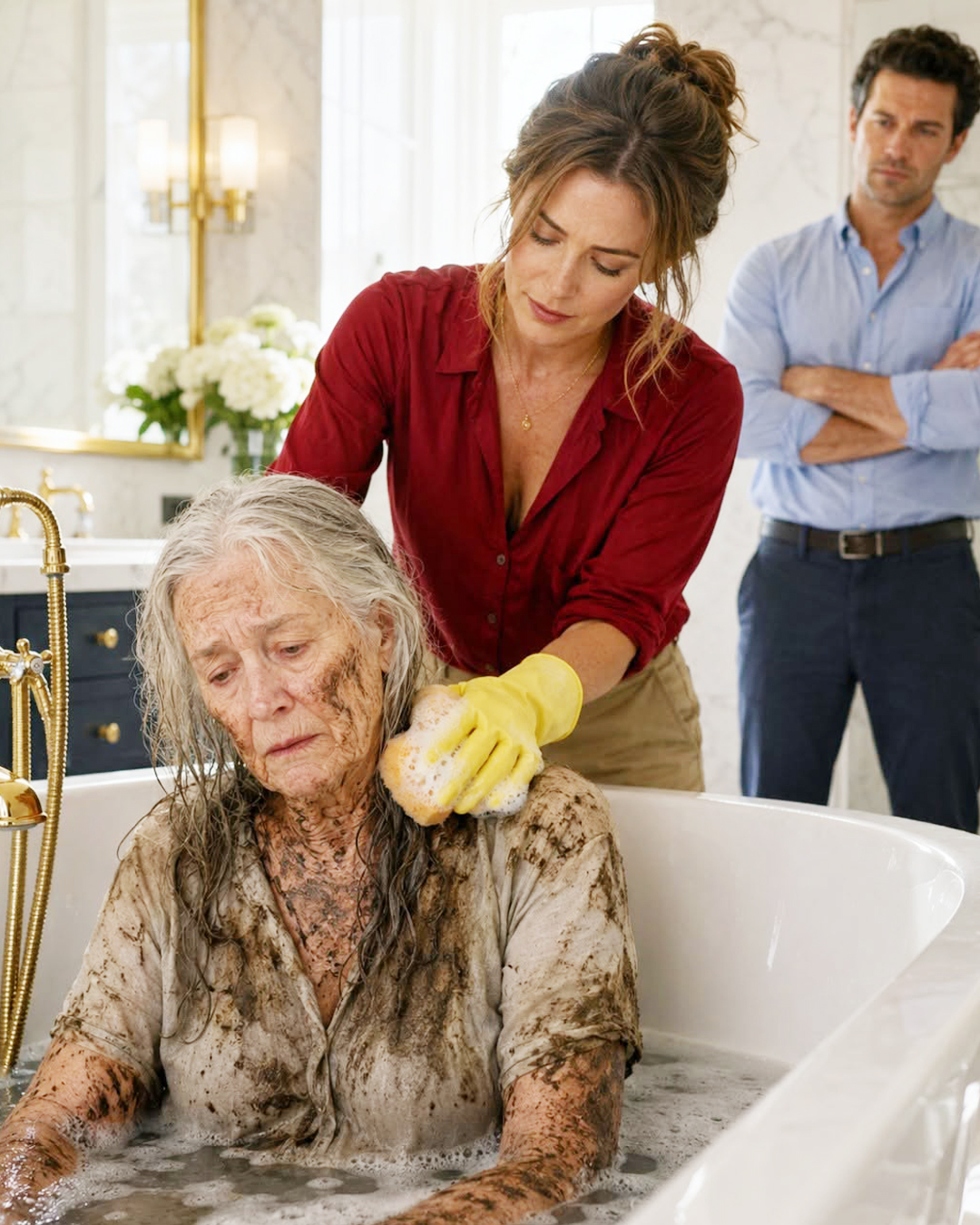
I put on thick cleaning gloves before entering the bathroom.
“Take off those clothes and put them in the bag, because we are going to throw them away,” I ordered stiffly.
“I can bathe by myself,” she replied in a surprisingly polite and gentle voice.
“I prefer to make sure I don’t break anything,” I retorted coldly.
Even now the shame I feel when I recall how rudely I spoke to her still burns.
Hope stepped into the tub, and the warm water slowly turned dark.
I took a sponge and, forcing myself to hide my disgust, cleaned her right shoulder.
Then something miraculous appeared beneath the dirt.
It was a small crescent-shaped birthmark on her skin.
The sponge fell straight from my hand onto the floor.
All the air seemed to leave the bathroom.
“Turn around right now,” I commanded hastily.
“What’s happening?” she asked, looking thoroughly confused.
I cleaned her face almost desperately with the wet towel.
Beneath years of neglect an aged, tired woman appeared, unrecognizable to anyone else.
But she was not unrecognizable to me.
I began to tremble from head to toe.
I ran to my dresser drawer, took out an old silver locket I had kept for two decades, and opened it right in front of her.
Inside was a tiny photograph.
A young woman smiled warmly as she hugged a ten-year-old girl in the sunlight.
“That woman was my mother,” I whispered with shaking lips. “She had the exact same mark on her shoulder.”
Hope looked closely at the photograph in my hand.
Then she looked at herself in the mirror with confusion.
And I spoke a name I had not dared say aloud for twenty years.
“Mom, your real name is Mary,” I sobbed openly.
But what I discovered minutes later about her tragic disappearance made everything feel even worse than before.
For illustration purposes only
PART 2
Mary did not hug me tightly.
She did not cry tears of joy or scream.
She simply held the photograph with trembling hands and stared at it.
“I’m sorry,” she murmured softly, “but I don’t remember that little girl.”
It felt as if something precious had been torn from my chest.
For twenty years I had been told that my mother died in the fire that destroyed our house in Flagstaff. The firefighters never found her body, but the place was reduced to ashes, so everyone assumed no one could have survived.
I was only ten years old then.
After that night I was raised entirely by my aunt.
I met Lucas when I was twenty and never stopped wondering what had really happened that night.
Now my mother stood in front of me, alive and breathing.
Yet to her I was nothing more than a stranger.
When we went downstairs together, Lucas was waiting anxiously in the hallway.
“You knew something about this, didn’t you?” I accused him with tears in my eyes.
He shook his head gently.
“I wasn’t sure at all,” he answered.
Then he confessed that while serving food in the dining hall he had noticed two things: Mary’s approximate age and a faint scar on her left wrist. Years earlier I had told him my mother had burned that hand while cooking when she was young.
“I thought it might just be a strange coincidence,” Lucas explained softly. “That’s why I brought her here, because I wanted you to see her before you got your hopes up.”
I hugged him tightly while crying on his shoulder.
The very next day we took Mary to a private neurologist.
After several detailed studies the doctor explained that the extreme trauma suffered twenty years ago could have caused severe long-term amnesia.
“Don’t pressure her too hard,” the doctor warned carefully. “Photographs, familiar places, smells, or old songs can act as a stimulus related to her past life to open a door.”
For several weeks afterward I turned our house into a living museum of my childhood.
I searched the attic for old photo albums.
I prepared the exact homemade pancakes she used to make for me every Sunday morning.
I played the smooth jazz songs she always listened to while cleaning.
I even took her to the small public park where she used to buy me fruit popsicles after school.
Nothing seemed to work.
Mary smiled politely at everything, yet she simply did not remember.
One afternoon she pointed to a photograph in which she stood beside a handsome man.
“Who is this man?” she asked curiously.
A massive lump formed in my throat.
“That’s my dad,” I answered quietly.
“Where is he now?” she inquired further.
I could not answer right away.
“Sabrina,” she insisted firmly, “what happened to him?”
“That can wait for another time,” I said, quickly brushing the question aside.
Her gentle expression turned serious.
“Everyone talks to me about my past except him,” she said, “so why is everyone hiding him from me?”
I stood up at once and put the photograph far away in a drawer.
I honestly did not want her to remember him.
Because my father had died entirely because of me.
At least that was the tragic truth I had believed since I was ten.
A few days later I decided to take Mary to the land where our old home had once stood. Now a busy pharmacy and several shops occupied the ground.
She observed everything without recognizing a single detail.
“Maybe I will never remember anything,” she whispered sadly.
“Don’t say that, Mom,” I pleaded gently.
We walked slowly toward the nearby park across the street.
Suddenly I heard a loud horn and the brutal screech of tires on asphalt.
A massive pickup truck had lost control and driven straight onto the sidewalk.
I froze in horror as the vehicle sped toward us.
Mary reacted instantly, running to me and pushing me with all her strength.
I fell hard onto the rough pavement.
The heavy truck passed inches from us before crashing violently into a metal utility pole.
When I looked up through the dust, my mother was kneeling on the ground, breathing heavily in shock.
Then she began to cry uncontrollably.
It was not because of the terrifying accident that had almost killed us.
She looked at me in a way I had never seen since she returned.
“Sabrinita,” she wept softly.
My heart stopped for a moment.
No one had called me by that affectionate childhood nickname for twenty full years.
Mary put both hands to her head as tears streamed down her cheeks.
“I know what happened to your dad now,” she cried out.
And the truth that was about to be revealed had been buried deep underground for two decades.
PART 3
“Your dad didn’t die because of you at all,” those were the first words my mother uttered when she fully regained her memory.
I was still sitting on the bench with scraped knees and a racing heart from the truck that had nearly crushed us.
“Mother, what are you saying?” I gasped.
Mary held my face gently in her hands.
Her eyes had completely changed.
It was no longer the insecure look of the lost woman who needed to ask who appeared in each old photograph.
It was truly her.
It was my loving mom.
“You were only ten years old back then, and you were just a helpless child,” she said softly.
Then she remembered every detail of that tragic day.
Twenty years ago my father, Thomas, had picked me up from elementary school on a bright afternoon.
I was desperate to cross the busy avenue because I had seen my mom waiting on the other side.
The pedestrian light changed.
I moved forward excitedly onto the road.
A distracted driver ignored the red light and sped toward me.
My father saw the oncoming car before I did.
He ran with all his speed.
He pushed me out of the way just in time.
I hit my head hard on the sidewalk and lost consciousness at once.
He took the full impact of the speeding car.
He died before the ambulance could arrive.
My mother had watched the entire horrific event happen before her eyes.
For twenty years I had replayed that scene differently, convinced my impatience had directly caused my father’s death.
Mary wrapped her arms around me and hugged me tightly.
“Your father chose to save you because you were his precious daughter,” she comforted me, “and he would never have wanted you to use his love to punish yourself for the rest of your life.”
I cried heavily on her shoulder as I had not cried since I was a little child.
Yet something major still needed explanation.
“And what about you?” I asked through my tears. “How did you end up living on the street?”
My mother closed her eyes as the painful memories returned.
After my father’s death she fell into deep depression, though she still tried to work and care for me.
She was not home the night of the fire because I had gone to sleep at my aunt’s house while she worked the late shift.
She had returned earlier than scheduled.
She found thick black smoke pouring from the kitchen windows.
She ran inside the burning house because she thought she had left a special wooden box containing important documents, old photographs, and the few physical memories of my father.
A sudden gas explosion threw her violently against the wall.
She somehow escaped through a back window, completely disoriented and suffering severe burns.
Then she walked aimlessly into the dark night.
A long-distance truck driver found her lying unconscious near the highway leaving town and took her to a small rural clinic.
She carried no identification.
When she woke days later she remembered nothing of who she was.
She spent several days hospitalized, then wandered away before anyone could identify her.
From that moment her life became a chain of bad decisions, overwhelming fear, and total abandonment.
She survived in temporary dormitories, crowded shelters, and occasional low-paying jobs.
She suffered around cold people who took advantage of her vulnerable state.
She spent twenty long years moving from city to city without knowing what she was searching for.
Until she eventually returned to Phoenix, without understanding the force pulling her back.
“Perhaps something deep inside my soul knew you were still here,” she told me with a tearful smile.
I could not stop looking at her face.
Twenty whole years had passed.
We had lived less than an hour apart for several seasons without ever knowing we were still searching for each other.
When we finally returned home that evening, Lucas was pacing the living room, desperate about where we had gone.
When he saw us walk through the front door he ran toward us at once.
“What happened to you two?” he asked anxiously.
I could barely respond through my tears. “She returned.”
“Who returned?” Lucas asked, looking puzzled.
I looked proudly at my mother.
She smiled brightly and said, “Mary. Mary has finally returned.”
Lucas understood instantly.
He stepped forward and hugged her as deeply as if she were his own biological mother.
During the following days everything in our household changed.
Mary slowly began to recover tiny memories that would have seemed insignificant to anyone else.
She remembered that I hated cilantro in my food as a child.
She remembered the soft lullaby she used to sing whenever I was sick.
She remembered hiding shiny coins inside an old metal cookie tin to buy me new shoes at the start of every school year.
And through her recovery I discovered something deeply painful about myself.
The arrogant woman who years earlier had heartlessly judged those who slept on the street was actually the daughter of a woman who had survived exactly that way for two decades.
I began to feel immense shame for many horrible things I had said in the past.
One morning soon after I voluntarily went with Lucas to the community dining hall.
I wore no elegant designer clothes.
I brought no photographers.
I posted nothing on social media.
I simply tied a clean apron around my waist and began serving hot beans, rice, and fresh stew to the people in line.
An elderly woman held out her plastic plate.
Her hair was visibly dirty and unwashed.
Instinctively I remembered the cruel gesture I had made when I first saw my mother enter my living room weeks earlier.
The memory hurt deeply.
“Would you like some more rice?” I asked her with a genuine smile.
The woman smiled back kindly.
“Yes, my dear, if it’s possible,” she replied softly.
I served her a generous double portion at once.
Lucas looked at me proudly from the other side of the long serving table.
He said nothing.
It was unnecessary; his proud eyes said everything.
Yet my mother still had one major debt of gratitude to repay.
One night during dinner she suddenly left her spoon on the plate and looked up at us.
“I need to find someone very important,” she stated firmly.
“Who do you need to find, Mom?” I asked curiously.
“Teresa,” she answered softly.
I had no idea who she meant.
Mary explained that for the past few years a kind woman named Teresa had cleaned the public bathrooms at the central bus station.
She earned very little.
She lived alone in a tiny rented room with damp, moldy walls.
Sometimes she barely had enough money for food.
And yet she constantly helped Mary survive on the streets.
She regularly saved extra bread rolls for her.
She allowed Mary to sleep hidden for a few warm minutes in a small cleaning-supply closet on freezing nights.
She frequently brought her a cup of hot coffee.
And it was Teresa who had told Mary about the community dining hall where Lucas eventually met her.
“If she hadn’t urged me to go to that dining hall, I would never have met your husband,” my mother said emotionally, “and I might still be sleeping outside on the pavement tonight.”
Lucas put down his fork at once.
“Then let’s go find her right now,” he said without hesitation.
The very next day we returned to the central bus station together.
I felt extremely nervous walking through the crowded terminal.
My mother was not nervous at all.
She walked confidently through the long corridors, recognizing every corner of that difficult life I secretly wished I could erase from her memory.
Suddenly she pointed toward an older, gray-haired woman pushing a heavy yellow cleaning cart.
“Teresa!” she shouted happily.
The woman raised her head in surprise.
She looked closely at my mother for several long seconds.
She did not recognize her at first because of the clean hair and nice clothes.
Mary started laughing warmly.
“What, you don’t recognize the dirty woman who used to beg you for hot coffee anymore?” she joked.
Teresa instantly dropped her mop onto the floor in utter shock.
“Hope?” she gasped.
She ran toward my mother as fast as she could.
They embraced tightly right in the middle of the busy hallway.
Teresa was crying tears of joy on my mother’s shoulder.
“I thought something terrible had happened to you,” Teresa wept, “I went looking everywhere for you for weeks.”
“Something wonderful happened to me,” Mom replied with tears in her eyes. “I found my lost daughter.”
Teresa turned and looked directly at me.
“Are you really her daughter?” she asked in disbelief.
I nodded gently with a warm smile.
The poor woman put her trembling hand over her mouth in complete shock.
Then she looked at Lucas standing beside me.
“So the kind gentleman from the community dining hall is…” she trailed off.
“He is my husband,” I finished softly.
Teresa crossed herself devoutly.
“May the heavens bless you all,” she whispered in deep awe.
She told us she had often imagined Mary finding a loving family again, but she had never expected anything as miraculous as this.
Lucas stepped forward and smiled at her.
“Now we want to properly thank you for everything you did,” Lucas offered kindly.
Teresa’s gentle expression changed at once into firm defense.
“No, absolutely not,” she refused right away.
“You don’t even know what we want to do for you yet,” Lucas countered gently.
“If you are coming here to give me a handout of money, then no,” she said proudly.
My mother burst out laughing at her predictable reaction.
“I told you she would react exactly like this,” Mom said to Lucas.
Lucas had actually been quietly investigating Teresa’s situation for several weeks. He had learned that her lifelong dream was to sew clothes professionally. Since she was young she had constantly mended clothes for her poor neighbors, but she had never owned enough money to buy professional machinery.
He had also discovered she was several months behind on her room rent.
Lucas did not simply hand over an insulting wad of cash.
Instead he presented a real business proposal.
There was a small retail shop available inside a popular shopping plaza in Mesa.
He rented the space for her for an entire year upfront.
He purchased two brand-new industrial sewing machines and set them up inside.
In addition he secured a guaranteed contract with a local company that manufactured school uniforms.
When Teresa saw the fully equipped shop for the first time she genuinely thought it was an elaborate joke.
“I cannot possibly accept such a massive gift,” she sobbed, holding her hands to her chest.
My mother looked her directly in the eyes.
“Of course you can accept it, Teresa,” Mom urged softly.
“Mary, this is too much,” Teresa protested.
“You used to selflessly share a simple bread roll with me when you barely had enough money to buy food for yourself,” my mother reminded her gently. “Now, please let me share what I have with you.”
Teresa sat down and wept tears of profound relief.
Yet Lucas still had one more surprise prepared.
He did not buy her an absurd mansion, but he secured a small, cozy apartment near her new sewing workshop and paid for her entire first year of rent.
Teresa sat in a soft chair and began to cry quietly with her face buried in her hands.
“I didn’t do anything extraordinary to deserve this,” she whimpered.
My mother crouched gracefully in front of her chair and took her hands.
“You chose to do something kind when no one else was watching,” Mom said firmly, “and that is worth more than anything else in this world.”
That powerful phrase completely changed my understanding of human life forever.
I had grown up arrogantly thinking that poverty was always a simple consequence of bad personal decisions.
My mother taught me that a person’s entire life could collapse in a single catastrophic night.
An unexpected accident, a sudden disease, a devastating loss, or a single moment of confusion could strip everything away.
And then twenty long years could easily pass before someone finally extended the right helping hand.
Several months later we organized a large family meal at our house.
It was not an elegant, stiff party for wealthy high society.
My mom wanted to cook a traditional feast with rich savory stews, yellow rice, and freshly made warm tortillas.
Teresa arrived at the front door wearing a beautiful custom blouse she had designed and sewn herself in her shop.
The elderly lady who coordinated the community dining hall came as an honored guest as well.
While we all sat around the table eating together, Lucas raised his glass for a toast.
“I have to confess something to everyone here,” he said with a playful grin.
We all looked up attentively.
“When I first met Mary at the shelter, I foolishly thought my new charity project would be a quick adventure of a few weeks,” Lucas admitted honestly.
My mom laughed out loud at his confession.
“And wasn’t it a short adventure?” she teased him.
“It ended up completely changing my entire family,” Lucas replied sincerely.
Then he turned his affectionate gaze directly toward me.
“It changed my wife most of all,” he added softly.
Everyone around the dining table broke into warm laughter.
I playfully threw my cloth napkin straight at his face.
“Don’t exaggerate my story, Lucas!” I called out, blushing slightly.
“I’m not exaggerating at all,” Lucas laughed, dodging the napkin. “The same woman who almost kicked me out of the house for bringing home a homeless stranger now wants to open a full support center.”
It was completely true.
With Lucas’s full financial and structural help we had officially started a dedicated assistance center for undocumented individuals and homeless senior citizens in our city.
We did not want to limit our efforts to simply distributing free warm food once a day.
We sought to help them recover lost birth certificates, official government identifications, proper medical care, and reestablish lost contact with missing family members.
Because if there was one core truth I had learned from my mother, it was that feeding someone for one night could save their day, but restoring their identity could save their entire life.
My mother never wanted to hide or feel ashamed of her difficult past on the streets.
At first I foolishly tried to buy her dozens of expensive designer dresses, fancy shoes, and gold jewelry.
One afternoon she gently took my hands and asked me to stop.
“I don’t need twenty years of luxury to compensate for twenty years of living on the streets,” she explained softly.
“I just want to pamper you and give you everything you missed,” I argued gently.
“Then simply sit down and have breakfast with me every morning,” she replied warmly.
That simple request broke my heart and opened my eyes completely.
For so long I had naively believed that money could fix any problem in human existence.
Yet my mother did not want to spend her remaining years inside expensive shopping malls.
She simply wanted genuine conversations with her daughter.
She wanted to spend quiet Sundays together in the garden.
She wanted to learn about all my childhood memories she had missed.
She wanted me to tell her the sweet story of how I first met Lucas.
She wanted to know what small things made me scared in life.
She wanted to watch me attempt to cook her old family recipes she had once forgotten.
One calm afternoon I asked her what she regretted most about her lost two decades.
I fully expected her to talk about the freezing cold nights, the hunger, or the fear of living on the streets.
That was not her answer at all.
“I only regret not being there to protect you and watch you grow up into a woman,” she answered softly.
“It wasn’t your fault or your decision, Mom,” I reminded her gently.
“I know that now,” she smiled peacefully. “That’s precisely why I’m not going to waste another single minute regretting the past.”
A full year later we decided to walk back together to the exact spot where the runaway truck had almost struck us.
We stood quietly side by side next to the wooden park bench.
“Right here on this spot, I finally recovered my lost memory,” she said, looking around the peaceful street.
“And we almost lost our lives right here too,” I reminded her with a soft chuckle.
“No, my dear,” she corrected me gently, taking my arm, “we truly recovered our lives right here.”
She held my hand tightly in hers.
For the very first time I completely understood the deep meaning of what she meant.
My father had died saving my life from an oncoming vehicle.
My mother had lost her identity and memory while simply trying to survive a tragedy.
Lucas had walked into a humble shelter looking to give deeper meaning to his wealth.
Teresa had selflessly shared her last piece of food without ever expecting anything in return.
And I had initially received my own biological mother by holding my nose in disgust.
We had all made profound mistakes in our lives.
We were all carrying heavy emotional baggage from our pasts.
The true difference in life was what we chose to do after we finally discovered the truth.
Before we walked back to the car, my mom wrapped her arms around me and hugged me deeply.
“Sabrinita,” she whispered softly near my ear.
“Yes, Mom?” I answered.
“Do you remember the very first time you bathed me in your luxury tub?” she asked with a subtle smirk.
My face turned completely red with instant embarrassment.
“Please don’t remind me of that awful moment,” I pleaded quietly.
She started laughing lightheartedly.
“You wore thick rubber gloves,” she teased gently.
“Mother, please stop,” I groaned playfully.
“And you grumbled that I was going to use up all your ridiculously expensive shampoos,” she added, laughing louder.
“I have already apologized to you a hundred times for how I acted!” I laughed back.
“Well, one hundred and one times is never too much,” she teased fondly.
We both ended up laughing out loud together right in the middle of the sidewalk.
Lucas, who was patiently waiting for us by the parked car, called out with a smile, “What are you two laughing about over there?”
My mother called back loudly, “I’m laughing at your wife, who finally discovered that the dirty stranger she didn’t want to touch was the exact same woman who carried her in her body for nine months!”
I felt deeply embarrassed all over again by her words.
However, this time I smiled warmly right alongside her.
Because some truths hurt us deeply when we first face them.
Other truths are embarrassing to admit to ourselves.
And a precious few truths arrive just in time to wake our sleeping souls up to what truly matters.
That poor woman who walked into my wealthy house dirty, exhausted, and nameless did not need my hollow pity or arrogance.
She simply needed someone to look at her with enough love and patience to figure out who she truly was underneath the dust.
And ever since that life-changing experience, every single time I see a person sleeping alone on a park bench, begging for food outside a station, or walking through the cold in worn-out clothes, I instantly remember the timeless lesson my mother taught me:
We never truly know what complex story lies buried beneath the dirt, what loving family is still desperately searching for that missing soul, or what sudden tragedy brought them to the pavement in the first place.
Sometimes a single warm meal is enough to change a fate.
Sometimes it only takes a simple phone call.
Sometimes it takes opening a closed door without judgment.
Or sometimes, it takes a simple tub full of warm water so that a precious life everyone thought was lost forever can finally find its way back home.