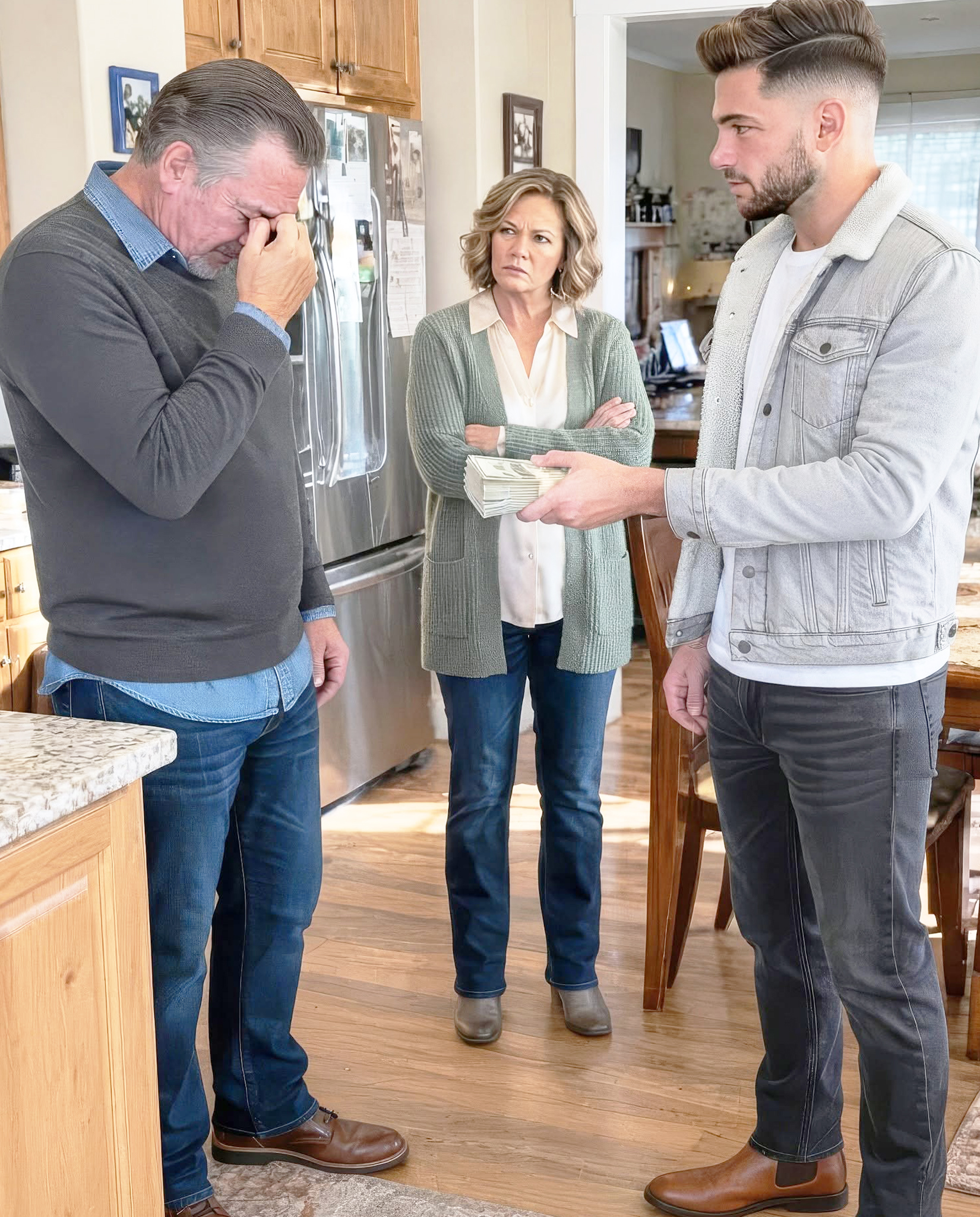
Part 1: The Thousand Dollars My Father Never Asked For: Three days before my father was rushed into emergency surgery, he appeared at my house and asked to borrow a thousand dollars. The request immediately unsettled me because Raymond Mercer had spent his entire life finding ways to survive without asking anyone for help. Dad had worked construction for more than thirty years, carrying lumber before sunrise, pouring concrete through freezing winters, and climbing roofs beneath brutal summer heat. When I went to college, he quietly sold his motorcycle to
help pay my tuition, and years earlier, he had sold the only good suit he owned because I needed decent shoes for school. He never told me about either sacrifice. Other relatives did, because that was the kind of man my father was: he gave quietly and then behaved as though whatever he had surrendered had cost him nothing. So when he stood in my kitchen with his hands clasped together and his eyes fixed on the floor, I knew this wasn’t an ordinary financial problem. “I need to borrow a thousand dollars.” Before I could ask why, my wife Natalie answered from across
the room. “Tell him to get another job. We’re not a bank.” Dad didn’t defend himself. His hands only trembled slightly, and somehow his silence bothered me more than Natalie’s words. “That’s enough.” I took Dad outside, where he kept rubbing his palms together despite the warm weather. “I didn’t come here to cause trouble between you two. If you can’t help, I understand.” Hearing him apologize nearly broke me. This was the man who had spent his life helping me, and now the one time he needed something, he was worried that asking would create problems in my marriage. “What do you need the money for?” Dad glanced toward the house before answering. “The money isn’t exactly for me.” He explained that he needed certified records, legal assistance, and some kind of test. When I pressed him for details, he finally mentioned old adoption documents. “Whose adoption?” His eyes shifted toward the house again, directly toward where Natalie was standing. “I need proof before I explain everything.”
“Proof of what?”
Dad hesitated.
“Because otherwise someone might say I’m confused. Or accuse me of trying to interfere with your marriage.”
He never mentioned Natalie by name, but he didn’t need to. Something about his voice carried an urgency I had rarely heard from him, possibly even fear.
Then Dad rested one rough hand on my shoulder.
“I’m trying to give you something I should have given you a long time ago.”
I still didn’t understand what he meant, but I remembered every time he had helped me without demanding that I first prove I deserved it. I decided I could give him the same trust.
“I’ll get the money.”
Relief crossed his face.
“I’ll pay you back.”
“You don’t have to.”
I opened the safe beneath my office desk and counted out the cash. Natalie appeared in the doorway and immediately questioned why I was giving him money without discussing it with her first.
“He has never asked me for money before.”
“That doesn’t mean it won’t become a habit.”
“He’s my father.”
“And this is our house.”
Her words stayed with me because Dad had helped make that house possible. Years earlier, he had sold the last parcel of land inherited from his mother and used most of the proceeds toward our down payment, something Natalie knew perfectly well.
I handed Dad the envelope anyway. His fingers trembled as he took it, and unlike every other visit, he left without hugging me.
For three days, I kept thinking about his strange list: certified records, adoption papers, legal help, and a test.
Then the hospital called.
Dad had collapsed that morning with an aortic aneurysm and had been taken directly into emergency surgery. Before being sedated, however, he had left a sealed envelope for me and arranged for an attorney named Priya Desai to be waiting at the hospital.
Then the caller gave me one final instruction from my father.
I was not to discuss the contents of that envelope with Natalie until I had spoken privately with his attorney.
Suddenly, every time Dad had nervously looked toward my house made sense.
Whatever truth he had spent a thousand dollars trying to uncover, he had been afraid of what would happen once my wife learned about it.
Part 2: The Secret Inside the Envelope
At the hospital, a nurse handed me the sealed envelope Dad had left behind. My name, Grant, was written across the front in his familiar handwriting, and nearby stood a woman in a gray blazer who introduced herself as Priya Desai, my father’s attorney.
Priya explained that Dad had contacted her about six weeks earlier after his name surfaced while her office was settling another estate. Before she told me anything else, however, Dad had insisted that I read his letter.
My hands shook as I opened the envelope. Inside were several documents and a handwritten letter, but the very first sentence stopped me cold.
“Grant, I need you to understand one thing before anything else. I am your father. Nothing in these papers changes that.”
As I continued reading, the story of my childhood transformed before my eyes.
Dad explained that I had actually been born to his younger sister, Eleanor, a woman I had always known only as a distant relative. She had been seventeen when she became pregnant, while Dad was twenty-six and already married to the woman I had grown up calling Mom.
Dad and Mom had been unable to have a child of their own. When Eleanor became pregnant, the family quietly decided that they would raise her baby as theirs, and Eleanor was sent away until after the birth.
That baby was me.
The arrangement was handled privately through an old family attorney, but the adoption was never properly finalized through normal court channels. Eleanor eventually returned home, nobody discussed the pregnancy again, and Dad and Mom raised me as their son in every way that mattered to them.
Then came the reason Dad had suddenly begun searching for records.
Eight weeks earlier, Eleanor had died. She had never married or had another child, and in her will she left everything she owned to the son she had given up in 1989.
Me.
Because the adoption records contained legal gaps, Dad had been afraid that his word alone wouldn’t be enough to establish the truth. That was why he needed certified documents, legal assistance, and the mysterious test he had mentioned in my backyard.
It was a DNA test.
Before Eleanor died, she had left a sample with her attorney, and Dad later submitted his own. Combined with the surviving hospital records and other documents, the evidence established conclusively that Eleanor Mercer was my biological mother.
I lowered the letter and looked at Priya.
“What exactly did she leave me?”
“A house in Marsh Hollow. No mortgage.”
Then she told me about a savings account containing a little over sixty thousand dollars and several personal belongings.
I thought that was everything.
“There’s one more thing.”
Priya explained that Eleanor had left behind a box of letters. Beginning when I turned eighteen, she had written one to me every year on my birthday, but she had never mailed any of them.
A woman I barely remembered had spent years writing to the child she had surrendered, knowing every page would remain unread.
Then I remembered Dad’s warning.
“Why didn’t he want Natalie to know?”
Priya carefully explained that my father wanted the inheritance legally established as my separate property before anyone else learned about it. He feared that revealing the information too early could unnecessarily complicate the situation.
Immediately, I remembered Natalie standing in our kitchen.
“This is our house.”
The house Dad had helped us buy.
I remembered how quickly she dismissed him when he needed one favor and how angry she became when I handed him a thousand dollars. Dad had never directly accused my wife of anything.
He had simply been paying attention.
An hour later, the surgeon finally emerged.
“Your father made it through.”
My knees nearly gave way. The operation had been difficult, but Dad was stable.
The next morning, I sat beside his hospital bed. He looked pale and exhausted, but the first thing he wanted to know had nothing to do with himself.
“Did you read it?”
“I read it.”
He studied my face nervously.
“And?”
I took his hand.
“Apparently I have a whole box of birthday letters to read.”
His shoulders finally relaxed.
Then I looked directly at the man who had raised me.
“You should have told me.”
“I know.”
“You should have told me about Eleanor thirty years ago.”
“I know.”
But there was still one question left.
Why had my father suddenly become so desperate to reveal a secret he had successfully carried for my entire life?
Part 3: What My Father Had Been Afraid Of
There was another detail in Dad’s letter that explained why he had suddenly become so determined to uncover the past. Six weeks earlier, he had suffered a brief memory lapse, and although his doctors found nothing definitive, the experience frightened him enough to imagine what might happen if his memory eventually failed.
He was terrified that if he waited much longer to tell me the truth about Eleanor, there might come a day when he could no longer explain it clearly. Worse, people might dismiss his story as the confusion of an aging man.
So Dad had done what he had always done when facing a problem: he prepared.
He collected old records, tracked down legal documents, arranged the DNA testing, and hired Priya. By the time he came to my house asking for a thousand dollars, he wasn’t searching for the truth anymore. He was assembling enough evidence to make the truth impossible to deny.
“I was afraid you’d look at me like I didn’t know what I was talking about,” he whispered from his hospital bed.
“You gave me proof before I even had the chance to doubt you.”
Dad managed a weak laugh.
“That was the idea.”
Over the following days, Natalie became increasingly impatient about the envelope and my conversations with Priya. She repeatedly demanded to know what Dad had written and why an attorney was involved.
I didn’t lie to her. I explained that Dad had been arranging something involving legal and financial matters, and I promised to tell her everything once the paperwork was completed.
That answer only made her angrier.
“You’re keeping secrets from me now. Just like your father.”
“It’s not a secret. It’s a process.”
“How convenient.”
That word stayed with me.
Convenient.
My father had nearly died. A woman I had just discovered was my biological mother had died without ever truly knowing me, and everything I understood about my birth had changed almost overnight.
Yet Natalie seemed most interested in whatever financial consequences were hidden inside those documents.
Two weeks later, Priya confirmed that everything had been finalized. Only then did I sit down with Natalie and tell her the entire story, including the private adoption, Eleanor’s identity, the house in Marsh Hollow, the savings account, and the box of birthday letters she had written but never sent.
Natalie listened until I finished.
Her first question wasn’t about Eleanor.
She didn’t ask how it felt to discover that the woman I had known as a distant relative was actually my biological mother. She didn’t ask how Dad was coping after carrying that secret for decades or whether I was struggling to understand any of it.
Instead, she asked one question.
“How quickly can we sell the house?”
I stared at her.
“What?”
“We could use the money to get out of this starter house and buy something better.”
Something inside me shifted in that moment. Suddenly, Dad’s insistence on protecting the inheritance made far more sense than it had when Priya first explained it.
“It’s not our money.”
Natalie frowned.
“We’re married.”
“It’s separate property.”
Her expression immediately hardened.
“Your father did that deliberately.”
“Yes.”
“To cut me out.”
“No.”
I held her gaze.
“He did it to protect me.”
Four months later, Natalie and I separated.
There was no explosive confrontation and no dramatic revenge. Instead, we had a long series of increasingly difficult conversations that gradually exposed how differently we had understood our marriage, our responsibilities, and even the meaning of what belonged to each of us.
Meanwhile, Dad slowly recovered from surgery. His doctors eventually concluded that the memory problems he feared were only mild age-related changes, nothing close to the decline he had imagined.
Still, he began carrying a notebook.
“Just in case.”
Two months after his operation, I finally drove to Marsh Hollow to see Eleanor’s house for myself.
It was smaller than I expected, quiet and carefully maintained despite the garden having grown wild during her illness. Her shelves were crowded with worn mystery novels, and mismatched mugs collected over decades filled the kitchen cabinets.
Then I entered her bedroom.
Inside the bedside drawer was a shoebox.
I opened it and found envelope after envelope, each sealed and addressed in the same careful handwriting.
There was one for every birthday beginning when I turned eighteen.
Across each envelope, Eleanor had written the same words:
Happy Birthday, Wherever You Are.
I sat on the edge of the bed and opened the first letter.
Then the second.
Then the third.
By the fifth, tears blurred the words so badly that I could barely continue reading.
The woman I had never been allowed to know had been quietly watching my life from a distance for years.
Part 4: The Letters She Never Sent
As I continued reading Eleanor’s letters, I began discovering how much she had known about me despite never being part of my life. She knew when I graduated from high school, she had seen my wedding announcement, and relatives had quietly passed along small pieces of information about me over the years.
Eleanor had honored the promise she made never to contact me. She had stayed away, but the letters made one thing painfully clear: staying away had never meant forgetting me.
Every birthday, she had sat down and written to a son who didn’t even know she was his mother. She sealed each envelope knowing she couldn’t send it, then placed it away with all the others.
By the time I finished reading, the house felt different. It was no longer simply an unexpected inheritance worth money. It was the only place I had where I could begin understanding a woman whose entire relationship with me had existed quietly from a distance.
I decided not to sell it.
Instead, I began restoring Eleanor’s home one weekend at a time. I worked on the neglected garden, repaired loose boards, repainted rooms, and slowly brought the property back to life.
The work wasn’t about increasing its value. Each repair gave me another reason to remain in a place that had once belonged to someone whose story had been hidden from me for most of my life.
When Dad became strong enough to travel, I brought him to Marsh Hollow.
He walked through Eleanor’s house quietly, carrying memories I could only imagine. When we reached the kitchen, he stopped and remained there for a long time before finally speaking.
“I should have brought you here thirty years ago.”
“Maybe.”
“I thought I was protecting everyone.”
“I know.”
Dad looked around the kitchen.
“I’m not sure I protected anyone very well.”
For years, he had believed silence was the safest choice. Keeping Eleanor’s identity hidden had allowed our family to continue without confronting the complicated circumstances surrounding my birth, but that silence had also cost Eleanor the chance to know her son and me the chance to understand who she really was.
I looked toward the garden outside.
“You fixed it before you ran out of time.”
Dad nodded.
There was nothing else I needed him to say.
That was enough.
The thousand dollars suddenly seemed almost absurd when I thought about everything Dad had been trying to accomplish that afternoon at my house. He hadn’t needed money because he had made some reckless mistake or because asking me for help was becoming a habit, as Natalie had suggested.
He needed certified documents. He needed legal assistance. He needed evidence strong enough to survive questions about his age, his memory, and the unusual adoption arrangement that had remained hidden for decades.
Most of all, he needed enough time to finish what he had started.
His emergency surgery had made me understand how close he came to losing that chance. If the aneurysm had taken him before Priya received the records or before the DNA results confirmed Eleanor’s identity, I might have spent the rest of my life without knowing why my father had suddenly appeared at my house asking for money.
Instead, he survived.
And because he had prepared everything before entering that operating room, I received more than an inheritance. I received the truth about my birth, the letters of a mother I never knew, and a new understanding of the father who had raised me.
Dad had spent his life sacrificing quietly for me.
Even when he finally asked me for something, he was still trying to give me something in return.
Something far more valuable than a thousand dollars.
Part 5: What the Thousand Dollars Was Really Worth
Today, Dad is doing much better. He moves more slowly and pays closer attention to his health than he did before the surgery, but he is still here, and after coming so close to losing him, that simple fact means more to me than I can explain.
He calls me every week now.
Not because he needs money, a ride, or help solving some problem. Most of the time, he calls simply because he wants to talk, and I have learned not to treat those ordinary conversations as ordinary anymore.
I still return to Eleanor’s letters too. Every year on my birthday, I take them out and read them again, slowly working my way through the words of a woman who had spent decades loving me from a distance.
I keep those letters beside the certified adoption record, the DNA results, and the original folder Dad assembled when he feared his memory might eventually fail him. Together, those documents tell a story that had been hidden for most of my life, but they also remind me how desperately two people had tried to love me in completely different ways.
Dad protected me by raising me as his own.
Eleanor protected me by staying away.
Neither choice was perfect, and both carried consequences that lasted for decades. But after reading her letters and standing beside Dad in her kitchen, I stopped thinking only about what should have happened and began appreciating that the truth had reached me while there was still time to ask questions.
I continued restoring Eleanor’s house instead of selling it. With every repaired board, cleared patch of garden, and freshly painted room, the property became less like an inheritance and more like a bridge to the part of my history I had never been allowed to know.
The sixty thousand dollars mattered far less than I initially imagined it would. What stayed with me were the smaller things: her worn mystery novels, the mismatched mugs in her kitchen, the handwriting on each birthday envelope, and the evidence that she had quietly followed my life even when she couldn’t participate in it.
My separation from Natalie eventually became another part of that transformation. There had been no spectacular revenge or single argument that ended our marriage, only the realization that the inheritance had revealed differences between us that had probably existed long before Eleanor’s will brought them into the open.
Dad had noticed those differences before I was willing to see them.
That was why he had asked Priya to establish everything as my separate property before Natalie learned about it. He hadn’t been trying to destroy my marriage or punish my wife. He had simply spent enough years watching the people around me to understand that the truth needed protection before it was exposed.
Sometimes I think back to that afternoon when Dad stood in my kitchen asking for a thousand dollars. His hands were trembling, his eyes kept moving toward the house, and he apologized for needing help as though he had somehow failed me.
At the time, I thought I was giving something to him.
Now I understand the opposite was true.
The thousand dollars I handed my father three days before his emergency surgery was the smallest part of what he had been carrying that day. He wasn’t really asking me for money.
He was trying to give me the truth.
It took an aneurysm, an emergency operation, a sealed envelope, DNA evidence, and decades of unopened birthday letters for me to understand what that truth was worth.
Dad had spent his entire life quietly giving me whatever he could.
That afternoon, he almost gave me the one thing I never knew I was missing too late.
Instead, he survived long enough to watch me finally receive it.