My 9-year-old daughter called me, crying: “Mommy, I can’t move my leg.” I rushed home and found her on the patio with a concrete block pinning her leg. My husband had dropped it on her. His mom sat nearby, sipping coffee. “It’s only one leg,” she said. I didn’t argue. I took out my phone—and made one call. The Weight of Concrete: Chapter 1: The Ring at 2:14 PM: The commercial copy machine in the third-floor administrative annex possessed a rhythmic, subterranean thrum that had, over seven years of employment, become my internal metronome.
It expelled thermal-warm collation sheets into a plastic tray—inventory tallies, regional transit rosters, schedules of mundane civic life—with a methodical sigh. Outside, an overcast autumn Tuesday was slowly bruising into slate. I was thirty-six years old. I believed, with the quiet arrogance of people whose lives have merely frayed rather than shattered, that calamity announced itself with thunderclaps. I thought tragedy arrived wearing a distinct face, preceded by sirens or late-night knocks on mahogany doors. It did not. It arrived as a vibration against my right hip.
My cellular display illuminated: Sophie. My nine-year-old daughter was not an anxious caller. She was an introspective, watercolor-stained child who spent her late afternoons cataloging dried beetle wings in glass jars or constructing miniature cardboard libraries. Her school bus delivered her to our driveway at 1:45 PM; her father, Daniel, who ran an independent residential remodeling service out of our two-car garage and finished shop, was invariably on-site. The unspoken pact of our household dictated that Mommy’s hours at the regional water district belonged to municipal spreadsheets until five o’clock sharp.
I swiped the icon, keeping my voice hushed to spare the surrounding cubicles. “Hello, sweetheart. Did you find your sketch pad?”
Silence answered. Not the dead acoustic of a disconnected line, but the wet, shallow friction of air dragged through constricted tissue.
“Sophie?” I stepped out of the print room, the heavy fire door easing shut behind me. “Mommy’s here. What is it?”
Then came the sound that dismantled my life. It was a sob that didn’t rise from the throat, but seemed wrenched from the bone marrow—raw, gasping, and stripped of pride.
“Mom,” she managed. Her cadence was splintered into tiny, jagged splinters. “I… I can’t move my leg.”
The low ceiling of the fluorescent corridor seemed to dip downward three inches. The hum of the ventilation shafts vanished. “What do you mean, you can’t move it? Did you trip on the porch? Are you bleeding?”
“The… the block,” she whimpered, the syllables hitching on an intake of air so sharp I felt it strike my own sternum. “It’s on me. Mom, it won’t move.”
My fingers went bloodless against the glass casing of the handset. “What block, Sophie? Where are you?”
“The backyard. By the patio steps. Dad’s gray blocks.”
A cold, greasy nausea rose from the pit of my stomach. Daniel had spent the weekend clearing forty-pound split-face concrete retaining blocks to rebuild the sunken flowerbed border along our cedar fence line. They were coarse, aggregate-dense slabs manufactured to hold back metric tons of wet hillside.
“Where is your father?” My voice had abandoned its professional modulation; several colleagues looked up from their screens as I bolted toward the elevator lobby. “Sophie, is Dad right there?”
A ragged pause. “He’s… he’s standing by the hose.”
That single detail struck me with far more violence than if she had told me she was alone. Abandonment was neglect; proximity without intervention was an abyss.
“Put him on the phone. Sophie, give the phone to your father right now.”
There was a fumbling scuffle, the harsh rasp of an internal microphone scraping against denim, and then the distant, irritated timbre of a man attempting to manage a situation that was slipping through his calloused fingers.
“Elena, don’t hyperventilate,” Daniel’s voice came on, not beside the ear, but held at a slight remove, as though he were speaking to an intrusive neighbor over a garden hedge. “Just wrap up whatever you’re filing and drive home.”
“What is on our daughter?” I shrieked, entirely uncaring that the department director was stepping out of the executive suite directly across from me. “Daniel! Is a retaining block on her leg?”
“She wasn’t looking where she was walking,” he snapped, his default reflex—deflection masked as authority—flaring instantly through the speaker. “I had them staged. I told her twice to take the path around the garage. It shifted. It slipped off the pallet.”
“Is it off her? Have you lifted it?”
“I’m looking at the angle!” His voice spiked, frayed with that familiar, volatile edge that usually made me lower my chin and smooth the air between us. “If I yank it wrong, the corner could tear the muscle. I don’t need three different people barking orders while I’m assessing the load. Just get in your car.”
“Call an ambulance!”
“She is completely conscious, Elena! Stop turning this into a theatrical production. Get here and help me brace her shoulder while I lever it off. We don’t need paramedics crawling all over the grass.”
In the background, cutting through the tinny speaker like a rusted scalpel, another voice drifted in from the kitchen patio. It was high, dry, and calcified with irritation. It was my mother-in-law, Marjorie.
“The girl needs to control her hysterics,” the elder woman remarked to the empty yard. “Carrying on like that only works the heart up.”
The elevator doors parted before me, empty and metallic. I did not step inside. I turned toward the emergency stairwell, taking the concrete risers three at a time, my sensible office flats slapping against the tread with the sound of gunshots, my purse swinging wildly against my ribs.
“I am calling 911 from the dashboard,” I said into the phone, my voice dropping into a register I barely recognized—low, vibrational, and devoid of the deference I had spent eleven years cultivating.
“Elena, do not call the county,” Daniel commanded, the warning unmistakable. “You do that, and we have emergency vehicles blocking the whole cul-de-sac over a garden mishap. Elena? Elena!”
I severed the connection with my thumb, pushed through the heavy basement crash bar into the cold air of the parking deck, and ran toward my vehicle with the absolute certainty that if I did not keep my tires on the asphalt, my daughter was going to be erased by the very people who claimed to shelter her.
Chapter 2: The Weight of Silence
The transit from downtown to our suburban perimeter usually spanned fourteen minutes of predictable parkway driving. That afternoon, the traffic lights seemed to harbor a personal, malicious grudge, holding their amber warnings until the exact millisecond my front bumper approached, then snapping to a solid, implacable red.
I left my cellular device connected to the hands-free audio system, but Sophie did not speak again. I could hear only her erratic, high-pitched panting, punctuated by the occasional scrape of gravel as someone shifted their boots near the patio tiles.
“Sophie? Baby, Mommy is three miles away. I’m on Crescent Avenue.”
Nothing. Then, a small, bird-like whimper: “Mommy… my toes feel cold. Like they aren’t mine.”
“Keep your eyes on the clouds, Soph. Tell me what shapes you see. Look up, sweetheart, don’t look down.”
From the periphery of the phone’s microphone, Marjorie’s voice drifted down again, carrying the cool, dispassionate authority of a woman who had spent forty years managing a household through strategic indifference. “Stop encouraging her to dwell on it, Elena. A child takes her cues from the mother. If you perform an opera, she will sing the lead.”
I did not waste oxygen answering. I punched the emergency button on my steering wheel console, patched a secondary line through to the regional dispatcher, and recited our address between teeth clamped so hard my molars groaned.
When my sedan rounded the turn onto Maplewood Lane, the cul-de-sac was deceptively tranquil. Autumn leaves skittered across manicured lawns; Mrs. Henderson was pruning her hydrangea bushes three houses down. Our two-story craftsman stood with its customary front-porch symmetry—the potted ferns, the brass hardware, the wreath I had woven with dried eucalyptus leaves. A picture of stability. A monument to containment.
I left the driver’s side door swinging open, the engine still idling, and sprinted down the narrow flagstone walkway flanking the western wall of the garage.
The air in the backyard smelled of turned earth, damp limestone, and the faintly metallic sting of impending rain.
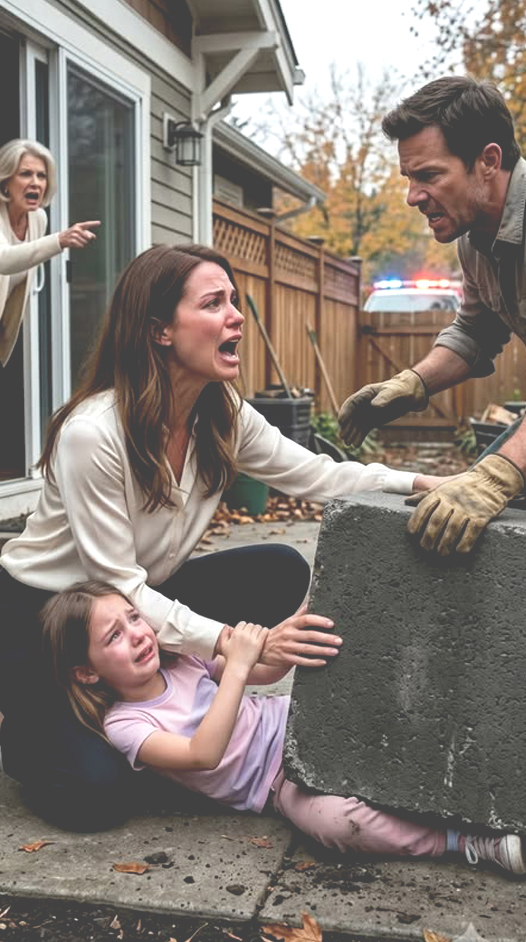
Sophie was lying on her side on the poured-concrete lower patio, her cheek pressed against the rough, mossy aggregate. Her left leg—the long, slim limb of a child who loved hurdle races and tree-climbing—was pinned beneath the brutal, charcoal-gray corner of an eight-inch-thick retaining block. The slab looked immense, an industrial artifact dropped onto porcelain. Her skin had turned the color of skimmed milk, her lips mottled with a bluish, bruised tint.
Daniel stood thirty inches away. His thick, yellow cowhide work gloves were still strapped to his wrists. His canvas work trousers were spattered with limestone dust, but his arms hung straight down at his sides. He wasn’t straining. He wasn’t searching for a pry bar. He was simply… standing sentinel over her agony.
Marjorie leaned against the door jamb of the sliding glass threshold, her cashmere cardigan pulled tightly around her thin frame, her arms folded across her chest in an attitude of mild, long-suffering endurance.
“Mom,” Sophie breathed, her tiny hand reaching blindly into the grass.
I fell. My knees slammed into the cold concrete so hard the shock wave rattled through my jaw, but I didn’t feel it. I gathered her small, ice-cold hand into both of mine, pressing it against my throat. “I’m here. I’m right here, Sophie. Don’t look at it. Look at my eyes.”
“I told her three times,” Daniel said immediately. His voice was entirely devoid of inquiry. He didn’t ask how I had made the drive so swiftly. He didn’t ask if the dispatcher was notified. He simply entered his defense into the backyard air like a defendant entering a plea before the charges could be read. “I was dry-stacking the second tier. I explicitly instructed her to take the side gate if she needed to go between the kitchen and the trampoline. She walked straight into my staging lane.”
I looked up at him. The man I had shared a bed with for over four thousand nights. His jaw was clenched in that familiar, square configuration—the expression that meant his pride had been nicked, which meant everyone else needed to mind their footing.
“Why haven’t you moved it?” I asked. My voice sounded flat, hollowed out by adrenaline.
“Because it weighs sixty-five pounds, Elena,” he said, gesturing with a gloved hand in a short, exasperated arc. “If I lift it straight up, the uneven base might grind against the bone. I was going to fetch the two-by-four from the truck bed to shimmy it up gradually. But you started screaming into the telephone.”
“You left it on her,” I whispered.
“I didn’t leave it on her!” His voice rose, sharp and commanding, carrying across the wooden fence into the neighbors’ perimeter. “I was managing the physics of an unstable load! Stop looking at me like I orchestrated this!”
“It was an absolute mishap,” Marjorie offered from the threshold, her voice level, reasonable, and utterly devoid of mercy. “Daniel was working. The child was careless. Children are resilient, Elena. In my day, boys fell out of haylofts and walked it off by Sunday. For heaven’s sake, it’s only one leg.”
The sentence hung between the cedar fence posts like a length of barbed wire.
It’s only one leg.
Sophie felt the tremor that passed through my arms. She squeezed my index finger with her tiny, sweat-slicked digits, her breathing coming in thin, reedy chirps. “Mommy… I’m sorry. I came outside again. I’m sorry.”
The child was apologizing. Pinned beneath sixty-five pounds of cured masonry, her circulation failing, her future mobility hanging in the balance, and her first instinct was to beg pardon for existing in her father’s perimeter of vision.
“Do not say you’re sorry,” I told her, leaning down until my forehead touched her damp hairline, smelling the sweet, strawberry scent of her morning shampoo underneath the dust. “You will never apologize for this. Never.”
“Elena,” Daniel warned, taking a step toward us, the leather of his gloves creaking as he curled his fingers. “Drop the drama. Help me take the corners. We lift on three.”
“Don’t touch her,” I said.
He froze, his boots planted in the turf. “Excuse me?”
“If you lay one hand on that stone before the sirens get here, Daniel, I swear to God I will use your own shovel to drive you off this concrete.”
His face went through three distinct transformations in the space of two seconds: disbelief, followed by a dark, sulfurous rage, and finally, a cold, calculating mask of domestic grievance. “You’ve lost your mind,” he muttered, turning his back on us to walk a small, furious circle around the fire pit. “You have completely, embarrassingly lost your mind.”
Far off, slicing through the suburban stillness like an iron wedge, the two-tone wail of a county rescue squad turned onto the lower boulevard.
Chapter 3: The Sterile Corridor
The paramedics from Engine Company 4 did not engage in the conversational negotiations that usually defined our household.
They moved with a heavy, purposeful efficiency that treated the concrete patio not as Daniel’s workshop, but as an active extraction zone. A lead paramedic named Marcus—a broad-shouldered man with ink-stained forearms and eyes that took in the geometry of the backyard in a single sweep—dropped his tackle kit immediately beside Sophie’s head.
“Hey there, little lady,” Marcus said, his voice dropping into a rhythmic, calming rumble. “My name is Marcus. This is Terry. We’re going to take that heavy pillow off your ankle, all right?”
Sophie nodded once, her eyes wide, glassy, and fixed entirely on my chin.
Daniel stepped into the inner ring of activity, his chest puffed against his fleece vest. “I was doing retaining wall restoration. The stone has an irregular face; when she clipped the corner, the center of gravity tripped forward. I felt it was structurally wiser to wait for stabilization gear than to risk a secondary shear injury.”
Marcus did not lift his head from Sophie’s pulse point. He didn’t even blink. “Understood, sir. Please clear the primary approach. Terry, let’s get the pneumatic bag under the western edge. On my mark, slow release.”
Daniel’s mouth snapped shut. His chest remained expanded, but his eyes darted toward the fence line, where our neighbor, Mr. Henderson, was now openly leaning over the cedar pickets, watching the emergency uniforms work. Daniel’s jaw worked silently—the unmistakable agitation of a man whose audience was no longer clapping.
“Brace her shoulders, Elena,” Marcus told me.
“I have her,” I said.
The lifting of the block took less than four seconds. But when the sheer, dead mass cleared the crushed skin of her lower calf, Sophie released a sound that I will carry to my grave. It was not a cry; it was an animal shrieking through metal mesh, a primal rejection of the agony that rushed into the reopened capillaries.
“I’ve got her, I’ve got her,” I chanted, pressing my entire upper body over hers, taking the flailing strike of her small fists against my collarbone, letting her tear into my silk work blouse. “Mommy’s got you, Sophie. Look at me, look at the sky, look at Mommy.”
“I want to go inside,” she screamed, her eyes rolling back beneath fluttering lids. “Mom, please! Don’t let him be mad! I want to go inside!”
Marcus’s eyes shifted from the exposed, horribly warped contour of the child’s shinbone up to my face. The look was brief, sharp as a diamond scribe, and heavy with professional recognition. Paramedics hear many things when bones shatter; they rarely hear nine-year-olds beg for forgiveness instead of morphia.
A county sheriff’s deputy, Officer Ruiz, had followed the gurney down the flagstone lane. She stood near the hydrangea border, a leather-bound field book resting against her hip, her gaze resting not on the medical drama, but on the three adults in the background: Daniel, still pacing the grass with his fists jammed into his pockets; Marjorie, still framed by the kitchen slider like a decorative porcelain plate; and me, covered in suburban mud and child’s sweat.
“Ma’am,” Ruiz said gently as they hoisted the gurney toward the side gate. “Are you riding with the unit?”
“Yes,” I said, not releasing Sophie’s uninjured foot.
“Elena,” Daniel called out, his boots crunching on the gravel. He reached out to catch the sleeve of my cardigan as I passed the garden shed. “I’ll follow in the truck. Tell the triage desk I’m the primary subscriber on the insurance. Don’t sign anything about private facility fees until I look at the network riders.”
I looked down at his hand on my wool sleeve. It was the same hand that had held a dry-erase marker when we drew up our five-year mortgage plan. The same hand that had slammed into the cedar studs of our garage three summers ago during an argument over our checking overdraft.
I pulled my arm away. I didn’t jerk it; I simply walked forward through the gate until his fingers ran out of cloth to hold.
The emergency room at St. Jude’s Memorial was an acoustic vacuum of linoleum, institutional disinfectant, and the relentless, digital chirping of telemetry monitors.
They took Sophie behind the heavy, motorized swing doors for diagnostic imaging almost immediately, leaving me marooned in an alcove that smelled of stale coffee and industrial floor wax. My work clothes were ruined—the right knee was shredded from the patio aggregate, and a gray smudge of masonry dust was stamped across my sternum like an ash cross.
“Elena.”
I turned. Daniel was walking toward me down the corridor. He had changed his clothes.
He had taken the twelve minutes between our backyard and the hospital to stop in the master suite, wash his face, and slip into an ironed navy polo shirt and clean deck shoes. He looked like an attentive, upstanding father who had just been summoned from an executive conference. The cowhide gloves, the dust, the defensive sneer—all of it had been neatly deposited into the laundry hamper.
“How is she?” he asked, sitting beside me on the vinyl bench and dropping his face into his palms. “God, Elena. The sound she made when they lifted it. It felt like someone took a rasp to my ribs.”
Eleven years of marriage had conditioned me to respond to this posture. It was the “remorse phase” of the cycle—the soft underbelly Daniel revealed only after the storm had blown through the house, leaving pictures tilted on the walls and Sophie hiding under her duvet. For over a decade, this specific display of vulnerability had been my cue to say: I know you didn’t mean it. We’re both tired. We’ll try harder tomorrow.
I looked at his clean, manicured fingernails.
“Her lower tibia has a spiral displacement,” I said, quoting the emergency doctor who had spoken to me through the curtains five minutes earlier. “The soft tissue has swelled so aggressively they’re concerned about compartment syndrome. If the pressure doesn’t ease within six hours, they’ll have to perform a fasciotomy to prevent nerve death.”
Daniel didn’t flinch, but his shoulders tightened beneath the cotton of his shirt. “Dr. Patel said that?”
“Yes.”
“He’s overstating the risk to cover his liability,” Daniel said, his voice dropping into that familiar, authoritative murmur that was designed to soothe me while dismantling my grasp on reality. “Emergency docs always paint the darkest mural so when the cast goes on normally, you think they’re miracle workers. It was a low-velocity impact, Elena. The block tilted; it didn’t drop from a second-story scaffold.”
“Why did Sophie say she was sorry?”
The corridor was long, narrow, and quiet save for an overhead paging call for respiratory therapy.
Daniel leaned back against the beige wall, closing his eyes. “What?”
“When she was pinned there. When her leg was being crushed. Why was her only concern whether or not you were going to yell at her for coming outside?”
“Because she’s an emotional kid, Elena,” he sighed, sounding genuinely weary, as though he were the one who had spent forty minutes under thirty kilograms of concrete. “She knew she broke a rule. I had the chop saw out earlier; there were extension cords everywhere. I set a firm boundary to protect her, she ignored it, and she suffered the consequence. She felt guilty. That’s a normal developmental reaction.”
“A consequence,” I repeated. The word tasted of tin.
The elevator at the end of the hall chimed. The doors slid open to reveal my best friend, Tasha.
She did not look like an executive; she was wearing an oversized wool coat over her dental hygienist scrubs, carrying an insulated travel mug, a spare phone charger, and a gray cardigan she had grabbed from her own closet because she knew the air-conditioning in St. Jude’s was notoriously merciless.
She saw Daniel sitting on the vinyl bench. She did not greet him. She did not offer a polite, suburban nod. She walked straight to where I sat, bent down, and wrapped her arms around my neck. Her hair smelled of spearmint and autumn rain.
“I’m here,” she whispered into my ear. “I’ve got the charger. My mom has the boys. I’m not leaving until she’s in a room.”
Daniel cleared his throat, sitting up straighter. “Tasha. Thanks for coming, but we really have things under control. It was an unfortunate landscape accident. Elena’s just a little overwhelmed by the ER intake.”
Tasha slowly straightened her spine. She turned her head, looking at Daniel with a flat, unwavering appraisal that made the hair on the back of my arms stand up.
“I wasn’t speaking to you, Daniel,” she said softly. “I was speaking to my friend.”
Before Daniel could formulate the sharp, cutting retort that was already gathering behind his nostrils, the double doors swung open, and Officer Ruiz stepped into the corridor, her clipboard in her hand.
Chapter 4: The Anatomy of an Accident
The private consultation room smelled of laminated brochures and institutional carpet. It was furnished with four gray fabric chairs, a low table bearing an unopened box of facial tissues, and a dry-erase calendar that had not been updated since the preceding Thursday.
Officer Ruiz sat across from me. She had removed her utility belt, setting it with a muffled clatter on an adjoining table, but her uniform remained crisp, her posture upright and neutral.
“Elena,” she began, her tone conversational yet deliberate. “The child services liaison, Ms. Vance, will be here shortly to sit in on Sophie’s intake statement. Because the injury occurred on residential property during an informal remodeling project, county protocol requires a secondary household assessment.”
“I understand,” I said. My hands were folded tightly in my lap, anchoring each other to prevent the tremors from becoming visible.
“Has your husband ever exhibited difficulty managing frustration around Sophie?”
The question was direct, unvarnished, and dangerous.
For eleven years, my response would have been an automatic, finely tuned choreographic performance. I was an artist of mitigation. I knew how to paint Daniel’s fury as “passionate engagement.” I knew how to describe his brooding silences as “artistic exhaustion.” I knew how to explain the shattered hallway mirror from 2021 as “a slip while hanging a heavy brass frame.”
“He works hard,” I heard myself start to say—the old script rattling in my throat like a dried pea in an empty pod.
Officer Ruiz didn’t interrupt. She simply held my gaze, her dark brown eyes entirely empty of judgment, waiting for the performance to exhaust itself.
I stopped. I looked at the gray industrial carpet. I thought about the way Sophie’s small body had curled inward like a scorched leaf while the paramedics lifted that stone.
“Three years ago,” I said, each word feeling like an extraction performed without lidocaine, “we were arguing about the interest rate on the second mortgage. Sophie was six. She was sitting at the breakfast nook eating apple slices. Daniel wanted me to sign the equity draw. I wanted to wait until the winter contracts were finalized. He took his fist and drove it through the drywall between the refrigerator and the pantry.”
Ruiz’s pen moved across her yellow pad with a steady, rhythmic scratching sound. “Did he repair it?”
“The next morning,” I whispered. “Before eight o’clock. He spackled it, sanded it, matched the eggshell latex, and hung a calendar over the patch. By noon, he made sourdough pancakes and played three games of Chutes and Ladders with Sophie on the living room rug.”
“And Sophie?”
“She didn’t eat apples for four months,” I said, the realization hitting me with such sudden, sickening force that I had to catch the edge of the table. “I thought it was a sensory phase. She said the skins were too sharp. But that was the morning she dropped her bowl when the wall broke. She wasn’t avoiding the skin. She was avoiding the memory of the plate hitting the linoleum.”
The door opened with a soft click, and Ms. Vance entered. She was an older woman with iron-gray hair cut into an efficient bob, carrying a soft leather portfolio. She gave Ruiz a brief nod before looking at me.
“Mrs. Mercer? Your daughter is back from radiology. The sedation has worn down to a maintenance drip. She was able to answer three or four questions about the yard.”
My heart hammered against my ribcage like an imprisoned crow. “What did she say?”
Ms. Vance sat down, opening her portfolio with practiced gentleness. “She corroborated that she was drawing with sidewalk chalk on the lower patio flags. She stated her father had instructed her to stay on the grass. She went inside to fetch an eraser, realized she had left her blue pastel near the retaining wall, and returned to retrieve it.”
“And the block?”
Ms. Vance consulted her notes, her face remaining entirely inscrutable. “Sophie stated that when her father saw her reaching for the chalk, he shouted. She said he picked up one of the capstones from the top tier. She quoted him as saying: ‘Maybe you’ll finally listen to what an instruction means when you feel the weight of what I’m moving.’“
The room went entirely devoid of sound. Even the faint hum of the air circulation system seemed to fail.
“He carried it toward her?” I asked. My voice did not sound like my own; it sounded like dry leaves scraping over concrete.
“She stated he stepped toward her with the block held at chest height,” Ms. Vance continued, reading with clinical precision. “She became frightened and backed into the corner of the deck steps. She states he dropped the stone onto the flagstones directly in front of her sneakers to—in her words—‘make a big boom so I would run inside.’ But the edge struck the riser of the bottom step, rotated forty-five degrees on its axis, and caught her left lower leg against the concrete apron.”
He dropped it to make a boom.
The phrase was childish, innocent, and completely monstrous. Daniel hadn’t experienced a structural accident. He hadn’t been an unfortunate laborer wrestling with an unpredictable load. He had used a sixty-five-pound weapon of intimidation to demand absolute compliance from a forty-pound child, and when the physics of terror failed to obey his precision, he had left her pinned beneath his own temper while he washed the limestone dust off his knuckles.
“Elena?” Ruiz asked, her hand resting lightly near my forearm on the laminate. “Did you hear what Ms. Vance just read?”
“I heard it,” I said.
I stood up. I didn’t feel dizzy; I felt an awful, crystalline lucidity, as though someone had taken an abrasive cloth to a window I had spent eleven years fogging with my own breath.
I walked out of the consultation room.
Daniel was standing near the nurse’s station, attempting to persuade the unit coordinator to validate his parking stub. When he saw me emerge, his face assumed that wounded, long-suffering expression that had kept me captive for more than a decade.
“Elena, listen,” he said, moving toward me with his palms open in supplication. “The social worker went in there without my legal representation present. I don’t know what kind of leading nonsense they put into Sophie’s head, but you know how she exaggerates when she’s stressed. I was demonstrating the mass of the material. I was showing her why the perimeter was dangerous.”
“You dropped it,” I said. The corridor seemed to narrow around us, nurses slowing their strides as they passed, sensing the distinct atmospheric drop that precedes a public destruction.
“I didn’t drop it on her!” he hissed, leaning down, his teeth bared in a furious, confidential whisper. “I set it down hard to emphasize the lesson! The step was uneven! Do you know what kind of liability these county leeches are trying to manufacture out of a household disciplinary boundary? They’re talking about an exclusionary order, Elena! For me! In my own home!”
“You tried to terrify her,” I said. “Because she wanted her blue chalk.”
“I was being a father!” he snarled, his control finally fracturing, the dark, familiar veins standing out along the curve of his neck like blue cordage. “A father who is sick to death of being undermined by a mother who treats every boundary like a human rights violation!”
“She’s nine, Daniel.”
“And she needs to learn that when I say a zone is closed, it is closed!”
“She knows,” I said, my voice dropping so low he had to incline his ear toward my mouth to catch the words. “She knows you better than I did. She knew your boots were angry before the stone ever left the ground.”
Chapter 5: The Geography of Fear
Sophie was moved to the pediatric orthopedic surgical wing at nine that evening.
The room was vast, dim, and dominated by the skeletal metal frame supporting her elevated left leg. A white plaster splint extended from the tips of her toes to the midpoint of her thigh, wrapped in heavy elasticized bandaging. A small, clear line ran from an intravenous pump into the back of her left hand, taped down with medical adhesive printed with tiny yellow bumblebees.
Tasha had gone downstairs to fetch clean water and two sandwiches from the night cafe.
I sat in the adjustable vinyl recliner beside the bed, holding Sophie’s right hand between both of mine. The child’s skin was warm now, the mottled blueness having yielded to the dull, post-trauma flush common to pediatric surgical patients.
Her eyelids fluttered, then opened. She looked at the television mounted near the ceiling—it was turned off, a black rectangle reflecting the green LED digits of the pulse oximeter.
“Mom?”
“I’m here, my love. Right here.”
“Is Grandma still at the house?”
The question surprised me. “I don’t know, Soph. She probably went back to her apartment. Why?”
Sophie shifted her shoulder against the pillow, wincing as the traction shifted the weight of her thigh. “Before the ambulance came… when you were driving… Grandma went into my room.”
I went very still. “What did she do in your room?”
“She took my drawings off the desk. The ones where I drew the monster with the big gray hands.”
A cold wire seemed to twist through my gut. Sophie had spent the previous month drawing a series of narrative sketches—she called them the Stone Men—depicting a family of tall, faceless figures made of masonry blocks whose mouths were filled with broken brick. I had thought it was a creative outlet derived from a fantasy book she was reading.
“Did Grandma say why she took them?”
“She said… she said investigators look at things like that to find reasons to break families apart.” Sophie’s fingers twitched against my palm. “She put them in her purse. And then she told me that if I told the police that Dad threw the rock, the state would take me to a brick house where they don’t have trampolines or watercolors.”
I sat in the dim, green-tinted silence of that hospital room, listening to the regular, rhythmic beep… beep… beep of my daughter’s heart monitor, and I felt the last lingering fragment of my domestic cowardice dissolve into ash.
“Sophie,” I said, leaning over the safety rail, looking directly into her wide, hazel eyes. “Look at me.”
She looked.
“Your father dropped that block because he could not control his anger. It was not a lesson. It was not your fault. You did not deserve to be frightened, you did not deserve to be hurt, and nobody—not your grandmother, not your father, not anyone on this earth—is ever going to tell you what truth you are allowed to speak again.”
A tear slipped from the corner of her left eye, running sideways across the bridge of her nose into the white cotton of the hospital pillow. “Are we going home tomorrow?”
“No,” I said.
She didn’t cry harder. She didn’t ask where we were going. She simply let out a long, shuddering exhalation that smelled faintly of the hospital ginger ale, closed her eyes, and slipped back into the narcotic-aided dark.
At seven-thirty the following morning, the door to Room 412 swung open without a prior knock.
Marjorie stood on the threshold. She was dressed with her customary, calculated sobriety: an emerald-green wool coat, a silk scarf knotted at the clavicle, and her silver hair set in rigid, unyielding waves. She carried a leather handbag with a brass latch—the kind of bag that held mints, checkbooks, and, evidently, the confiscated interior life of an injured child.
“Elena,” she said, her voice dropping into that conspiratorial, scolding hum she reserved for domestic emergencies that threatened the family ledger. “We need to talk in the lounge before the social worker returns.”
I stood up from the vinyl chair. I had not slept. I had washed my face in the stainless-steel sink of the patient bathroom; my hair was tied back with a rubber band from the supply cart; my work blouse was still stained with gray aggregate dust. I looked like a woman who had survived a collapse.
I stepped into the hallway, pulling the heavy fire-rated door behind me until the latch clicked shut with an absolute, mechanical finality.
“Give me the drawings,” I said.
Marjorie blinked, her patrician features stiffening into a mask of wounded aristocratic grace. “Excuse me?”
“The papers you removed from Sophie’s desk while she was lying on the concrete patio. Open that purse, take them out, and place them in my hands.”
“I have no idea what hysterical fiction the child has invented to deflect from her disobedience,” she said, clutching the leather bag more tightly against her ribs. “Daniel is currently at the county precinct being questioned by a detective who looks like he failed high school twice. His business depends on municipal permits, Elena! If this nonsensical domestic incident makes the blotter, the remodel on the bank president’s carriage house will be cancelled by noon!”
“He dropped a sixty-five-pound block at her feet to terrorize her, Marjorie.”
“He was disciplining his child!” she spat, her voice dropping an octave into a harsh, rusted whisper that revealed the iron framework beneath the suburban polish. “My husband took a belt to Daniel when he was seven years old because he left an iron rake in the driveway! Daniel didn’t run to the sheriff! He learned where the rake belonged! You have spent nine years turning that girl into an exquisite, fragile little doll who thinks an instruction is the beginning of a committee meeting!”
“How many doors did Daniel break when he was seventeen?” I asked.
The corridor was completely still. A cleaning cart rumbled past thirty feet away, its yellow plastic wheels squeaking against the linoleum.
Marjorie’s mouth remained slightly open, a tiny fleck of dried crimson lipstick showing against her porcelain crown. “What?”
“You told me once, during our first Thanksgiving at the lake house, that Daniel had ‘growing pains’ after his father left,” I said, my voice steady, rhythmic, and cold as river ice. “You laughed about it. You said boys have a season of iron and wood. What did he break, Marjorie?”
“That was thirty years ago,” she whispered, her gaze darting toward the nurse’s station. “It has no bearing on this family.”
“Did he break the television?”
“Elena—”
“Did he break the kitchen cabinet doors? Did he put his boot through his sister’s stereo?”
“His father had just abandoned us with three mortgages!” she hissed, her face mottling with an ugly, dark magenta flush that matched her son’s when the drywall cracked. “He was the man of the house! He was carrying an unbearable burden! I managed my son’s development with dignity, Elena! I didn’t air our laundry to state bureaucrats who want to turn every masculine impulse into a psychological defect!”
“And you cleaned it up,” I said. “You bought the new doors. You told the neighbors the screen had an electrical short. You trained him to believe that if you just wash the dust off your hands and speak in a level voice the next morning, the terror you caused didn’t exist.”
“You are destroying your daughter’s legacy over a broken bone,” she said, her voice trembling with an ancient, calcified rage. “She will have a limp, and she will have no father.”
“She will not have a limp,” I said. “And she will never, for the rest of her natural life, have to listen to the weight of his boots to decide if she is allowed to breathe.”
I reached out my hand. “The drawings. Or I will ask Officer Ruiz, who is currently parked at the emergency bay, to search that leather satchel for evidence tampering in an active child welfare investigation.”
Marjorie stared at me. For the first time in the eleven years I had known her—since the afternoon Daniel introduced me as “a quiet girl from the water administration”—she saw me without the soft lens of my deference.
Her fingers moved to the brass clasp. She snapped it open, withdrew a folded sheath of heavy watercolor paper, and shoved it against my chest.
“You will die a very lonely woman, Elena,” she said.
“That may be,” I told her, tucking my daughter’s drawings into the pocket of my ruined sweater. “But my daughter will live.”
Chapter 6: The Dismantling
We did not return to Maplewood Lane.
The regional water district maintained three small, furnished corporate apartments on the northern fringe of the city—monotonous, functional units reserved for visiting hydrologists and seasonal infrastructure engineers. They were carpeted in low-pile commercial nylon the color of dry oats; the furniture was heavy, indestructible oak veneer; the walls were painted an unoffensive institutional biscuit.
It was the most beautiful place I had ever seen.
Tasha arrived on Thursday afternoon with four cardboard boxes containing our essentials. She had entered the Maplewood house while Daniel was at his mandated preliminary bail hearing, accompanied by a civil standby deputy who stood in our foyer with his thumbs tucked behind his utility belt while Tasha systematically cleared Sophie’s winter wardrobe, her paints, her books, and my legal files from the master desk.
“He left a letter on the island,” Tasha said, dropping a heavy plastic storage bin full of Sophie’s shoes onto the laminate floor of the corporate apartment.
“Did you read it?” I asked, cutting open a box of kitchen supplies with a butter knife.
“Of course I did,” she said, leaning against the counter and pulling an apple from her pocket. “It’s four pages of single-spaced, self-pitying theology. He’s booked three sessions with an anger counselor who works out of a church basement in Oakhaven. He claims he has ‘unlocked the generational origin of his spatial reactivity.’ He wants a supervised mediation session by next Friday.”
“He doesn’t want mediation,” I said, setting three mismatched ceramic mugs into the particleboard cupboard. “He wants an audience. He wants to explain the difference between a dropped block and an aggressive block until the listener gets so tired of the vocabulary that they give him his keys back.”
Sophie came out of the bedroom, her metal crutches making a rhythmic clack-thump… clack-thump across the low-pile carpet. Her splint had been replaced with a heavy, fiberglass walking boot colored royal blue—the exact shade of the chalk she had gone outside to retrieve.
She looked around the tiny, sterile living room. There was no garden. There was no cedar-fenced lawn. There was only a three-seat sofa, a brass floor lamp, and a window overlooking an empty asphalt drainage basin.
“Mom?”
I stopped with a stack of plates in my hands. “Yes, baby?”
“Is this our whole house now?”
I felt an old, familiar guilt lurch in my chest—the toxic impulse to apologize for the diminished scale of our life, to promise her that the craftsman house with the bay windows and the double garage would be restored to her once the adults had finished their bureaucratic scuffle.
“It’s our place for right now,” I said. “It’s small.”
Sophie hopped forward on her good leg, the rubber tips of her crutches biting into the carpet. She looked at the blank, cream-colored wall above the small laminate dining table.
“It’s quiet,” she said.
She didn’t say it with sadness. She said it with the profound, luxurious relief of a soldier who has finally been moved out of artillery range.
The legal mechanics of dissolution do not move with the sharp, clean trajectory of dramatic fiction. They crawl through months of calendared hearings, financial affidavits, forensic psychological assessments, and temporary protective orders.
Daniel complied with the initial terms of the court’s sixty-day cooling-off decree with a meticulous, aggressive obedience that was almost terrifying. He attended his weekly anger management modules; he submitted clean drug panels; he wrote three checks from the joint business account to cover Sophie’s physical therapy co-pays, each annotated in the memo line with identical, tidy penmanship: For Sophie’s Healing.
He called me every Tuesday at 6:00 PM, the single weekly contact window permitted by the magistrate for parental logistics.
“The doctor’s report from Tuesday indicates full bone re-apposition,” he said during our eighth call. His voice was smooth, stripped of all overt hostility, operating in the calibrated frequency of a corporate executive negotiating an amicable corporate severance. “Patel expects her out of the boot by December. That’s ninety days ahead of the initial prognosis, Elena. It confirms what I told the officers from the start: the impact was peripheral.”
“The impact fractured her leg in two places, Daniel.”
A brief, icy silence crackled over the digital connection. “I have completed eight hours of cognitive behavioral restructuring,” he said, the words sounding like wooden blocks stacked upon one another. “I understand that my choice of instructional demonstration was inappropriate for her age category. I have owned that. I have stated it under oath. What I need to know now is when you intend to stop using a single behavioral miscalculation to liquidate our family’s entire estate.”
“I am not liquidating our estate, Daniel.”
“You filed for sole physical residential custody this morning,” he said, the razor edge finally flashing through the therapeutic polish. “You think you can turn me into an every-other-weekend visitor who writes support drafts while you live in an apartment that smells of institutional cleaning fluids? I built that patio with my bare hands! I built the cedar pergola you sat under every Sunday morning!”
“You did,” I said. “You built the pergola. And then you dropped sixty-five pounds of stone on our child’s shin to prove that you owned the space it was built on.”
“It slipped!” he roared—the therapeutic vocabulary instantly vaporizing, the old, feral frequency blasting through the phone so loudly that I pulled the receiver three inches from my ear. “It slipped, you self-righteous bitch! It slipped, and you know it!”
I didn’t flinch. I didn’t cry. I didn’t reach for an apology to lower his blood pressure.
I simply looked at the digital display, saw the timer reach 3:42, and pressed the red button to terminate the call.
Chapter 7: The Curbs We Learn to Clear
By the following May, the grass in the drainage basin behind our apartment had turned an unkempt, vibrant green, dotted with wild mustard flowers and dandelions.
Sophie’s boot was gone. Her left calf was noticeably thinner than her right—a pale, slightly flattened stretch of skin marked by a faint, three-inch surgical shadow where the orthopedic surgeon had monitored her internal pressure during those first forty-eight hours. She walked with a tiny, imperceptible hitch when she was tired, an asymmetry that only a mother’s eye would ever register.
The final decree of dissolution had arrived three weeks earlier in a manila envelope sealed with red county tape.
Daniel retained the house on Maplewood Lane; he had remortgaged the property to buy out my community equity, a transaction that Marjorie had financed through an inheritance trust. He had supervised visitation every other Saturday at a children’s recreational center in North Park—two hours in a public room with an attendant taking notes while they built Lego towers together. He had missed the last two sessions, citing a major framing contract on the river road.
We had signed a two-year lease on a small, two-bedroom garden duplex four miles from my office. It had no garage, no craftsman moldings, and no sunken landscaping. The patio was made of simple red bricks, slightly uneven, bordered by wild mint that smelled like summer whenever the wind blew from the south.
On a warm Saturday afternoon, Sophie and I walked down to the small municipal library on Fourth Street. She was carrying a cloth tote bag containing three books on marine biology and a fresh set of oil pastels.
As we reached the corner of Fourth and Elm, she stopped.
The city had recently replaced the concrete curbing along the crosswalk, pouring a high, squared-off barrier that stood nearly nine inches above the asphalt gutter. Six months ago, before the patio, she would have bounded off the ledge without breaking her conversational stride, landing on both sneakers with the noisy grace of an athletic child.
Now, she stood on the brushed concrete edge, looking down at the nine-inch drop.
Her weight shifted back onto her right heel. Her left hand went unconsciously to the seam of her shorts, her fingers catching the fabric and twisting it into a small knot.
I felt my right arm begin its familiar, eleven-year-old migration. The maternal reflex: to step forward, to take the elbow, to lift her over the difficulty, to smooth the surface until she didn’t have to feel the jar of the impact.
I stopped my hand. I jammed it deep into the pocket of my linen trousers.
“You have the angle,” I said softly, looking straight ahead across the intersection, not down at her feet.
Sophie didn’t look at me. She looked at the gray concrete below her sneakers. Her breathing was steady—not the sharp, bird-like chirping from the hospital corridor, but a quiet, rhythmic measurement of mass, distance, and her own bone.
“It looks higher than the old one,” she whispered.
“It is higher,” I told her. “They poured it for the bus route.”
She stood there for four seconds. The light changed across the street, glowing a steady, digital white: WALK.
She didn’t ask for my hand. She didn’t look back to see if an adult was going to command her movement. She simply bent her knees slightly, shifted her center of gravity forward, and stepped down into the street.
Her left sneaker struck the blacktop with a solid, dry thwack.
The bone held. Her knee dipped, absorbed the shock, and straightened.
She didn’t leap. She didn’t celebrate. She simply looked up at me, her small, freckled nose wrinkling in the midday sun, a tiny, hard spark of self-ownership flashing in her hazel eyes.
“It didn’t hurt,” she said.
“I know,” I answered, falling into step beside her as we crossed the white lines of the crosswalk together.
We walked the rest of the way to the library in the quiet warmth of the afternoon. For years, I had believed that love was an architectural enterprise—that my job was to build a fortress large enough, thick enough, and silent enough to keep everyone safe inside its perimeter, no matter how much the walls bowed under the strain.
I was wrong. Love is not the fortress. Love is the refusal to live inside the rubble when the fortress collapses on your children. Love is the willingness to be the one who calls the sirens, who names the stone, and who stands on the curb until they find their own footing to step down.