My Husband Introduced His Secret Son at His Mother’s 75th Birthday Party and Told Me to Give Up Our Home and Company Shares. But Before I Could Answer, Our 10-Year-Old Daughter Walked Onto the Stage, Held Up a USB Drive, and Said, “Dad, I Think Everyone Deserves to Know What You’ve Been Hiding.” The Birthday Party That Changed Everything I had spent eleven years trying to become the kind of wife my husband’s family would approve of. On the evening of his mother’s seventy-fifth birthday, I finally understood that no amount of patience could make
people value someone they had already decided was beneath them. The celebration took place at an elegant country club outside Boston, Massachusetts. Nearly 120 guests filled the ballroom, surrounded by white roses, silver decorations, and tables arranged with expensive crystal. My husband, Preston Hargrove, had insisted that everything be perfect. His mother, Eleanor, was turning seventy-five, and the Hargrove family never missed an opportunity to remind people of its importance. I was standing beside Eleanor, helping her adjust the shawl around her shoulders,
when she glanced toward the entrance. “Where is Preston? He knows how important tonight is.” “He said he had something to take care of,” I answered. She sighed. “That man works too hard. A wife should make his life easier, Audrey.”
I smiled politely, although I had organized the entire celebration while Preston contributed little beyond approving the guest list.
My name is Audrey Hargrove. I was thirty-eight years old, and until that evening, I had been married to Preston for eleven years.
We had a ten-year-old daughter named Willa.
Willa was the center of my world. She had been born with serious breathing difficulties and had spent much of her childhood attending medical appointments. Although her condition had improved, she still needed regular care.
To me, she was a remarkable little girl who loved astronomy, books, and solving complicated puzzles.
To Eleanor, however, Willa had always been a disappointment.
She frequently spoke about the importance of having a healthy grandson to continue the Hargrove name.
I had learned to ignore those remarks, but I knew my daughter heard more than anyone realized.
That evening, Willa sat at a nearby table with my parents, wearing a beautiful powder-blue dress.
When she caught my eye, she smiled.
I smiled back, unaware that within minutes, my daughter would become the bravest person in the ballroom.
The Unexpected Guests
At precisely seven thirty, the ballroom doors opened.
Preston entered wearing a tailored navy suit, looking unusually pleased with himself.
Beside him walked a beautiful blonde woman in a fitted burgundy dress.
Between them was a little boy, perhaps three years old, holding Preston’s hand.
The conversations around us gradually stopped.
I recognized the woman immediately.
Her name was Sabrina Lowell.
I had seen her photograph on a phone Preston believed I knew nothing about.
Three days earlier, while searching his home office for an insurance document, I had discovered a second phone tucked behind several folders.
It contained photographs, messages, financial transactions, and a video of a small boy calling Preston his father.
I had spent the following days consulting an attorney and trying to understand how much of my marriage had been built on secrets.
I had not confronted Preston because I wanted to protect Willa and understand my legal position first.
Apparently, Preston had made a different plan.
He approached the birthday table and placed his hand on the little boy’s shoulder.
“Mom, I wanted to give you something special for your birthday.”
Eleanor looked confused.
Preston smiled.
“This is Hudson. He’s my son.”
A collective gasp moved through the ballroom.
For a moment, Eleanor seemed unable to speak.
Then her eyes filled with tears.
“My grandson?”
“Yes, Mom. Your grandson.”
She immediately reached toward the little boy.
“Come here, sweetheart. Let Grandma look at you.”
I watched her embrace him with a tenderness she had rarely shown Willa.
Preston then turned toward me.
“Audrey, I think it’s time everyone knows the truth.”
I folded my hands in front of me.
“Then tell them, Preston.”
He seemed surprised by my calm response.
“Sabrina and I are building a life together. We have a son, and I intend to give him the future he deserves.”
He paused before continuing.
“Our marriage has been over for a long time. I want a divorce, and I expect you to handle this maturely.”
Several guests looked away.
Preston wasn’t finished.
“You can take your personal belongings, but the house and the company shares need to remain with the Hargrove family. I already have the documents prepared.”
Eleanor nodded approvingly.
“Audrey, please don’t make this difficult. Preston has finally given this family the grandson we’ve been waiting for.”
I looked at the woman I had driven to medical appointments, helped through difficult recoveries, and treated like my own mother.
She was smiling at the child whose existence had just exposed her son’s dishonesty.
I opened my mouth to respond.
But someone else spoke first.
The Little Girl With the Microphone
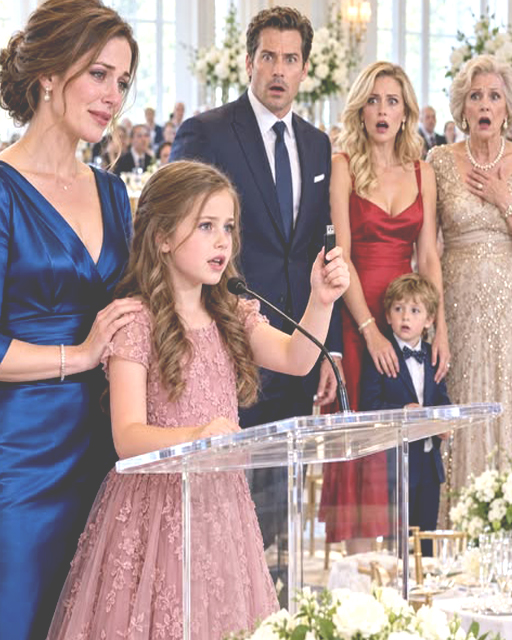
“Excuse me. I have something to say.”
Every head turned.
Willa had risen from her chair.
Before I could reach her, she walked toward the stage and carefully climbed the three steps.
She was small for her age, with light-brown hair falling over her shoulders.
Her hands trembled slightly as she picked up the microphone.
Preston frowned.
“Willa, go sit with your grandparents.”
She looked directly at him.
“Dad, you said tonight was about telling the truth.”
“This is an adult conversation.”
“Then why did you bring me here to watch you embarrass Mom?”
The room became completely silent.
My daughter reached into the pocket of her little cardigan and removed a black USB flash drive.
“I found something on your other phone, Dad.”
Preston’s expression changed.
“Willa, put that away.”
“You told Mom she couldn’t keep the house or her company shares. But that’s not what Grandpa wanted.”
I felt my breath catch.
Willa continued.
“Grandpa left those shares to Mom because she helped build the company. I found messages where you talked about getting her to sign them away.”
Preston started walking toward the stage.
“That’s enough!”
I stepped between them.
“Don’t come any closer until she’s finished speaking.”
He stared at me.
“Control your daughter, Audrey.”
I looked him directly in the eyes.
“She’s our daughter, Preston. And for once, you might want to listen to her.”
Willa swallowed nervously.
“There’s more on this drive. Dad was planning to make Mom feel so embarrassed tonight that she would agree to anything just to leave.”
She looked toward me.
“Mom, I didn’t want you to think you had to give up everything.”
My heart tightened.
I had spent years believing I was protecting my daughter by keeping family disagreements away from her.
Yet she had been watching everything.
I walked onto the stage, placed an arm around her shoulders, and gently took the microphone.
“Thank you, sweetheart. You’ve done enough. I’ll take care of the rest.”
The Secret Behind the Company Shares
Preston’s father, Walter Hargrove, had founded a successful logistics company decades earlier.
When I married Preston, the company was expanding rapidly, but its reputation had suffered from several difficult business decisions.
I had a background in corporate communications and spent years rebuilding relationships with major clients.
I worked through weekends, canceled vacations, and attended countless meetings.
Walter appreciated my contribution.
Four years before the birthday celebration, he had passed away, leaving me a significant minority ownership stake in Hargrove Logistics.
Preston had never accepted that decision.
He believed everything connected to the family business should belong to him.
Over time, he began asking me to consolidate our shares under his name.
I refused because Walter had made his wishes clear.
Now I understood why Preston had recently become so insistent.
He wasn’t simply leaving our marriage.
He was trying to leave with everything.
I faced the guests.
“My husband is entitled to end our marriage. He is not entitled to pressure me into surrendering property that legally belongs to me.”
Preston shook his head.
“You’re making this sound much worse than it is.”
“Then perhaps you’d like to explain the messages about tonight’s announcement.”
He said nothing.
“Or the transfers from company accounts that my attorney is already reviewing?”
His face lost its color.
Several executives exchanged concerned looks.
Sabrina slowly stepped away from him.
“Preston, what transfers?”
He ignored her.
Eleanor stood.
“This is a private family matter. We should discuss it somewhere else.”
I turned toward her.
“It was private until your son decided to announce it in front of 120 people.”
She lowered her eyes.
For the first time in eleven years, I did not feel obligated to make everyone else comfortable.
The Question That Broke My Heart
My parents helped us leave the ballroom.
My father carried Willa’s small handbag while my mother walked beside her.
Nobody tried to stop us.
Outside, the evening air was cool and quiet.
As soon as we entered my parents’ car, Willa began crying.
I pulled her close.
“Sweetheart, what’s wrong?”
“I didn’t want Dad to make you leave our house.”
“He isn’t going to do that.”
She wiped her cheeks.
“Grandma always says our family needs a strong boy. She says Hudson can carry the family name now.”
I felt a familiar ache in my chest.
“Your grandmother is wrong.”
Willa hesitated.
Then she asked the question I would remember for the rest of my life.
“Mom, did Dad want another child because I wasn’t healthy enough?”
I held her face gently between my hands.
“Listen carefully, Willa. There is absolutely nothing wrong with you. Your father’s decisions have nothing to do with your worth.”
“But Grandma seems happier with Hudson.”
“That tells us something about Grandma, sweetheart. It doesn’t tell us anything about you.”
She leaned against me.
“I just wanted you to be okay.”
I kissed the top of her head.
“You never have to fix grown-up problems for me. That’s my responsibility. Your job is to be a child and know that you’re loved.”
That night, Willa fell asleep beside me in my parents’ guest room.
I stayed awake thinking about everything she had heard over the years.
I had mistaken keeping the peace for protecting my daughter.
Now I understood the difference.
What the Evidence Revealed
The following morning, I met with my attorney, Caroline Mercer, and a financial specialist.
We examined the contents of the USB drive alongside the information I had already discovered.
Willa had copied photographs and messages from Preston’s phone after finding it unlocked in his study.
Some records suggested he had used company resources for personal expenses.
Other messages showed discussions about persuading me to transfer my shares.
One exchange was particularly revealing.
Preston had written that publicly announcing his new family might pressure me into signing the documents quickly.
Caroline looked across her desk.
“Audrey, don’t sign anything he gives you. We’ll review every document and protect your interests through the proper legal process.”
I nodded.
“I don’t want revenge. I want a fair resolution and a stable future for my daughter.”
“Then that’s what we’ll work toward.”
The following weeks were difficult.
Preston hired his own attorneys and initially denied making any improper financial decisions.
The company’s board authorized an independent review.
Eventually, the records confirmed several questionable transactions that required repayment and further corrective action.
Preston stepped away from his executive position while the company reorganized its leadership.
Our divorce proceedings continued separately.
I retained my ownership stake, and the court approved arrangements designed to protect Willa’s stability.
The family home remained available to Willa and me under the final settlement.
But the greatest relief had nothing to do with money.
For the first time in years, I could make decisions without wondering whether Preston or Eleanor would approve.
The Woman in the Burgundy Dress
About six months after the birthday party, I received an unexpected email from Sabrina.
She wanted to apologize.
I almost deleted it.
Instead, I read her message.
She explained that Preston had told her our marriage had effectively ended years earlier.
She had believed him.
When she learned about the financial issues and the plan to pressure me publicly, she began questioning everything else he had said.
Eventually, she moved with Hudson to be closer to her parents.
She wrote that she regretted attending the birthday celebration and allowing her son to become part of such a painful moment.
I didn’t know whether every explanation was true.
But I knew Hudson was innocent.
I replied briefly.
“Thank you for acknowledging what happened. I hope Hudson grows up surrounded by people who love him for who he is, not for what he might inherit.”
She responded with a simple thank-you.
We never became friends.
We didn’t need to.
Sometimes closure means accepting an apology without inviting someone into your life.
The Father Who Wanted Another Chance
Almost a year after our separation, Preston asked to meet me at a quiet café in Cambridge.
He looked older than I remembered.
His once-perfect appearance had become less carefully maintained, and the confidence he used to carry into every room was gone.
“How’s Willa?” he asked.
“She’s doing well. Her doctors are pleased with her progress.”
He nodded.
“I miss her.”
“Then keep showing up for your scheduled visits and let her decide how quickly she feels comfortable.”
He looked down.
“I know I handled everything badly.”
I waited.
“I thought I was doing what was best for the family.”
“You were doing what was easiest for yourself, Preston.”
He didn’t argue.
After a long silence, he asked whether I could ever forgive him.
I considered my answer carefully.
“I hope we can eventually remember our marriage without anger. But forgiveness isn’t something you can request on a schedule.”
He nodded slowly.
“You seem different.”
“I am different. I finally understand that being patient doesn’t mean accepting everything.”
When I left the café, I didn’t feel victorious.
I simply felt free.
Building Something of My Own
Two years after the divorce, I began developing a charitable program through Hargrove Logistics.
I wanted to support families whose children required long-term respiratory care.
I remembered sitting beside Willa’s hospital bed, watching other parents struggle with medical expenses, transportation, and missed work.
Some had traveled hundreds of miles for specialist appointments.
Others were balancing multiple jobs while trying to remain close to their children.
With support from the board, we established the Clear Skies Children’s Foundation.
The foundation helped families access transportation, temporary accommodation, and educational resources.
At our first fundraising gala, I stood before a room filled with donors, physicians, and community leaders.
Willa sat in the front row.
She was twelve now, healthier and increasingly confident.
After my speech, she ran toward me.
“Mom, you were amazing!”
I laughed.
“I was nervous the whole time.”
“You didn’t look nervous. You looked happy.”
Then she said something that stayed with me.
“You look like yourself again.”
I hugged her tightly.
For years, I had shaped my life around avoiding conflict.
Now I was building something that reflected my own values.
And my daughter could see the difference.
The Grandmother Who Finally Understood
Eleanor initially tried to reconnect with Willa by sending expensive presents.
There were designer clothes, jewelry, and elaborate birthday gifts.
Willa thanked her through handwritten cards but declined invitations.
Eventually, Eleanor began sending letters instead.
In one, she acknowledged how unfairly she had treated her granddaughter.
She admitted that she had confused physical health with personal strength and family traditions with genuine love.
When Willa was fourteen, she agreed to meet Eleanor at a public garden.
I stayed nearby while they talked.
Eleanor had become frail and now used a walker.
She began crying when Willa approached, but she didn’t reach for a hug.
“Thank you for coming, sweetheart.”
Willa sat beside her.
“Grandma, I need you to understand something.”
“Anything.”
“I don’t want you comparing me to Hudson anymore. He’s not better than me because he’s a boy, and I’m not less important because I needed medical care.”
Eleanor wiped her eyes.
“You’re right. I was wrong, and I’m sorry.”
They spoke for nearly half an hour.
When Willa returned to the car, she seemed thoughtful.
“I think Grandma really regrets what happened.”
“She might,” I said.
“Does that mean I have to visit her every weekend?”
“No, sweetheart. An apology can be meaningful without creating an obligation.”
Willa smiled faintly.
“Then maybe I’ll visit again sometime.”
I was proud of her.
She was learning that kindness and boundaries could exist together.
The Birthday Dinner That Meant More Than a Grand Celebration
By the time Willa turned eighteen, our lives had changed in ways I could never have imagined.
She had grown into a thoughtful young woman with a passion for psychology and helping children.
Her health had improved significantly, and she enjoyed hiking, playing piano, and volunteering with younger patients.
For her eighteenth birthday, she requested a small dinner at home.
No country club.
No speeches.
No elaborate decorations.
Just a homemade meal and the people she wanted around her.
She invited Preston herself.
He arrived carrying a carefully wrapped package.
Inside was a vintage astronomy book Willa had been searching for.
“I remembered you mentioning it,” he said.
Willa smiled.
“Thank you, Dad. I love it.”
He didn’t make a speech about becoming a better father.
He didn’t ask everyone to recognize his efforts.
He simply listened while Willa talked about college and her plans for the future.
Watching them, I realized that genuine change often looks ordinary.
It appears in small promises kept, conversations handled with care, and the willingness to accept that trust takes time.
Later that evening, Willa helped me clear the dishes.
“Mom, are you okay with Dad coming here?”
“Of course. He’s your father, and you have the right to build your relationship with him.”
She nodded.
“I’m glad we don’t have to pretend everything was perfect.”
I smiled.
“So am I.”
The Graduation Photograph
Four years later, Willa graduated from college with a degree in psychology.
The ceremony took place on a beautiful spring afternoon.
I sat beside my parents, while Preston occupied a seat nearby.
Eleanor attended with assistance, looking older and quieter than the woman who had once dominated every family gathering.
When Willa’s name was announced, I stood and applauded until my hands ached.
She crossed the stage with the same determined expression I remembered from that birthday party years earlier.
Only now, she wasn’t standing up to defend me.
She was celebrating something she had accomplished for herself.
After the ceremony, we gathered outside for photographs.
Willa took pictures with her grandparents, friends, and father.
Then she approached Preston and me.
“Can I have one picture with both of you?”
We exchanged a glance.
“Of course,” I said.
Preston stood on one side of her, and I stood on the other.
The photographer raised his camera.
“Everybody smile!”
We did.
It wasn’t a photograph of a perfect family.
It was a photograph of three people who had learned to move forward without pretending the past had never happened.
Afterward, Willa wrapped her arms around me.
“Mom, do you remember that night at Grandma’s birthday party?”
“I’ll never forget it.”
She smiled.
“I used to think I had to save you.”
I brushed a strand of hair from her face.
“You helped me find my courage, sweetheart. But I should never have allowed you to carry that responsibility.”
“You did find it, though.”
I nodded.
“And I’ve never stopped being grateful.”
The Life I Finally Chose
Today, I live in a peaceful home filled with books, photographs, and memories that belong entirely to us.
I still serve on the board of Hargrove Logistics, and the children’s foundation continues helping families facing difficult medical journeys.
Willa is pursuing her dream of working with children and families.
Preston remains part of her life, although their relationship continues to develop at a pace she chooses.
Eleanor has learned to respect boundaries she once dismissed.
As for me, I no longer measure my worth by whether everyone around me is pleased.
I have friends who know the real me, work that gives me purpose, and a daughter who understands that love should never require someone to become smaller.
Sometimes I remember the moment Preston entered that ballroom holding Hudson’s hand.
I remember Eleanor’s delighted expression and the uncomfortable silence of the guests.
But most clearly, I remember Willa standing on that stage with a microphone in one hand and a USB drive in the other.
If I could return to that evening, I would reach her before she climbed those steps.
I would kneel beside her and say:
“Sweetheart, you don’t have to protect me. I’ve got this.”
I cannot change what happened.
But I changed what happened afterward.
I stopped believing that keeping everyone comfortable was more important than respecting myself.
I stopped confusing loyalty with endless sacrifice.
And I made certain my daughter would never again feel responsible for rescuing me from an adult’s decisions.
Preston’s choices ended our marriage, but they did not end our future.
In many ways, they gave me the opportunity to discover the woman I had forgotten I could be.
I once believed that being a good wife meant holding everything together, even when I was the only person trying.
Now I know that sometimes the most loving thing a mother can do is show her child how to walk away from a life that no longer treats her with respect.
Because the most important thing I recovered that evening wasn’t my house, my company shares, or my reputation.
It was my voice.
Ten Lessons About Love, Family, and Self-Respect
A family should never measure a child’s value by gender, physical health, or the ability to continue a family name, because every child deserves to feel equally loved and accepted simply for being who they are.
Sometimes the people who demand the greatest sacrifices from us are the very people who have become accustomed to receiving our kindness without offering the same respect in return.
Remaining silent may temporarily prevent disagreements, but when silence allows unfair treatment to continue, speaking up becomes an important act of self-respect.
Children often notice far more than adults realize, which is why the way we treat one another teaches them lessons about love, dignity, and relationships long before we intentionally explain those ideas.
A person’s worth cannot be determined by a marriage, a family reputation, a bank account, or another person’s approval, because genuine confidence begins with understanding that our value already exists.
Forgiveness can bring peace, but it should never be confused with forgetting what happened, surrendering healthy boundaries, or allowing someone to repeat the same behavior without accountability.
When a relationship ends, the greatest achievement is not proving that the other person lost something valuable, but creating a future in which happiness no longer depends on their choices.
True parental love means allowing children to grow without burdening them with adult responsibilities, while showing them through our actions that they deserve relationships built on honesty and respect.
People can learn from their mistakes and rebuild damaged relationships, but meaningful change requires consistent actions, genuine accountability, and patience rather than expensive gifts or carefully chosen apologies.
The most beautiful new beginning often arrives when someone finally understands that protecting their peace is not selfish, choosing dignity is not unkind, and finding their own voice can change the future of an entire family.