Part 1: My Mother Blamed Me for My Sister’s Drunk Hit-and-Run—Three Weeks After I Gave Birth: At four in the morning, police arrived at my mother’s house to arrest me for a drunk hit-and-run. My younger sister had taken my car two hours earlier, crashed it, and told the officers she was me. When I denied driving, my mother stepped forward. “I saw Marisa leave around two,” she said. “She’s been exhausted since having the baby. She hasn’t been herself.” I stared at her. I’d given birth just three weeks earlier. Now my own mother was helping my sister blame me for a
crime I hadn’t committed. My name is Marisa Dunleavy. I’m thirty, a payroll specialist in Peoria, Illinois, and a new mother to a little boy named Arlo. My husband, Ryan, serves in the National Guard. Shortly after Arlo was born, he left for a three-week training assignment. Mom insisted I stay with her until he returned. “You need someone looking after you,” she said. I agreed, although living with my twenty-four-year-old sister, Kenzie, wasn’t easy. Kenzie was studying nursing, didn’t own a car, and had been borrowing mine all week. Mom had always favored her, excusing
behavior she’d never tolerate from me. That night, I fed Arlo around midnight and put him in the bassinet beside my bed. My car keys were in my purse on the kitchen counter. Around two, I woke up to pump breast milk. My lactation consultant had asked me to track every session using the pump’s companion app.
Afterward, I stored the milk and went back to sleep.
Then came the pounding at the front door.
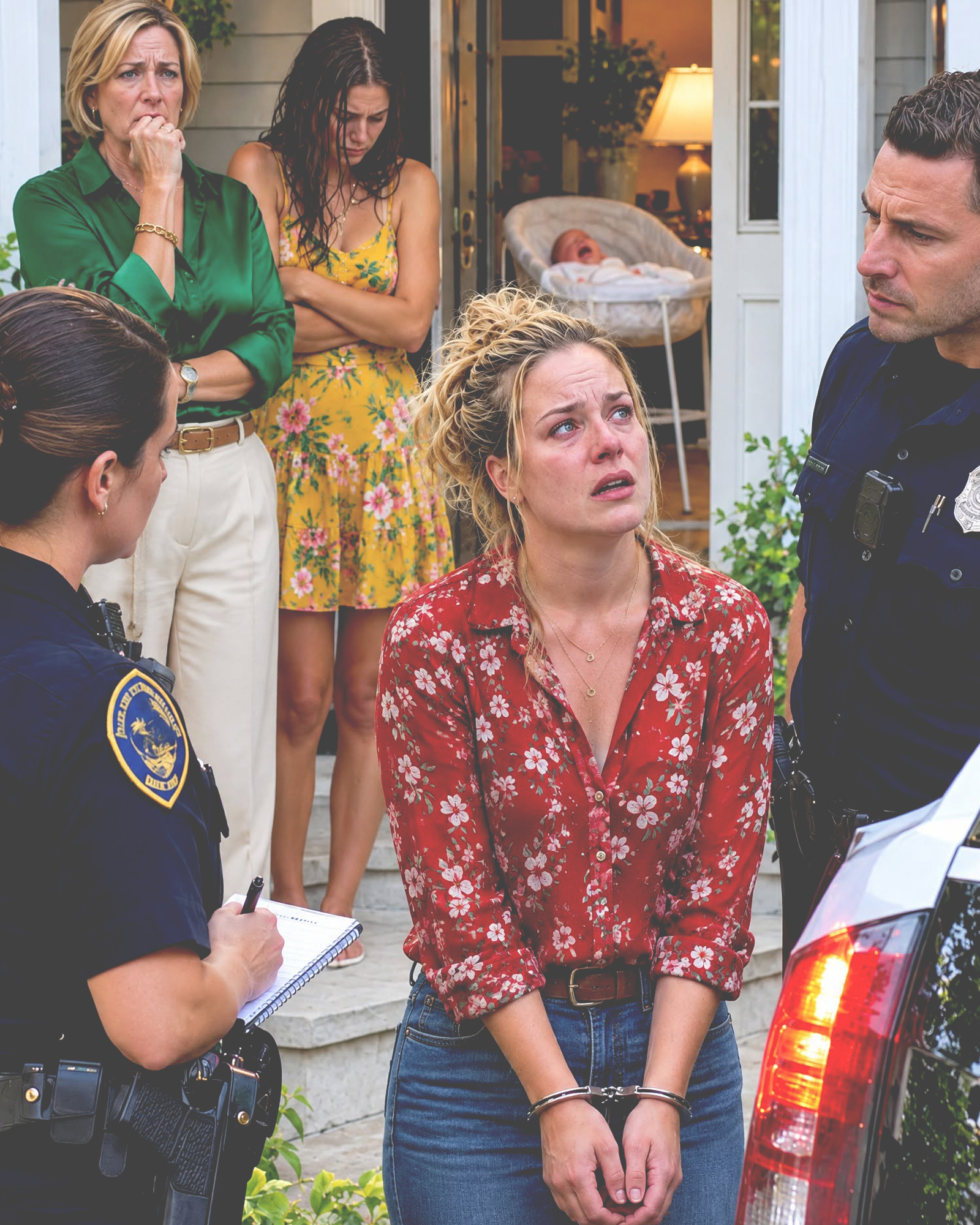
Two officers stood outside. Mom was wearing her bathrobe, and Kenzie stood behind her with damp hair.
“Are you Marisa Dunleavy?” one officer asked.
“Yes.”
“Your vehicle struck a mailbox and a parked car on Knoxville Avenue around 2:15 a.m. The driver left the scene.”
I immediately looked at Kenzie.
She stared at the floor.
“I haven’t left the house,” I said. “I’ve been upstairs with my newborn.”
Mom interrupted.
“Marisa was driving. I saw her car leave.”
“Mom, that’s a lie!”
She shook her head sadly.
“She’s been terribly sleep-deprived, officer. I’m worried about her.”
Kenzie added, “I was asleep. She took the car.”
The officers asked me outside for further questioning.
I explained that I hadn’t consumed alcohol. A breath test showed 0.00, but the officers still needed to establish who had been driving.
While one officer spoke over his radio, Mom leaned close.
“Just cooperate, Marisa. Kenzie has her nursing exams coming up. A DUI could ruin her future.”
I couldn’t believe what I was hearing.
“You want me to take the blame for her?”
“Don’t destroy your sister’s life.”
Inside, Arlo started crying.
I wanted desperately to return to him, but I knew I needed to prove where I’d been.
“Officer, may I show you something on my phone?”
I opened my breast pump app.
Session started: 1:58 a.m.
Session ended: 2:24 a.m.
Milk expressed: 4.5 ounces.
“The accident happened at 2:15,” I explained. “I was pumping milk in the guest bedroom.”
The officer examined the record. It wasn’t conclusive proof by itself, but it gave him a timeline he could investigate.
He turned toward Kenzie.
“We need to establish who actually had access to that vehicle tonight.”
Her expression changed.
Then his radio crackled again.
He listened carefully before looking back at us.
“The parked car wasn’t empty,” he said. “A seventeen-year-old girl was inside when it was struck.”
I felt sick.
He explained that she’d been rushed to the hospital with critical injuries.
Kenzie stopped looking at the ground.
For the first time that morning, I saw genuine fear on her face.
And I realized my mother hadn’t simply tried to protect Kenzie from a damaged-car accident. She’d been willing to let me take responsibility for a collision that could cost an innocent girl her life.
Part 2: My Mother Tried to Make Me Take the Blame—Then My Sister Admitted What Happened
My mother wanted me to accept responsibility for my sister’s drunk hit-and-run, even after police revealed that a seventeen-year-old girl had been seriously injured.
“Don’t ruin Kenzie’s future,” Mom whispered.
I looked at her in disbelief.
Three weeks after giving birth, I was standing outside in my pajamas, trying to prove I hadn’t committed a crime while my newborn cried inside the house.
And my mother was still protecting the daughter who’d caused the accident.
The officer who’d received the hospital update turned toward Kenzie.
“Have you driven your sister’s vehicle tonight?”
Kenzie shook her head.
“No. I told you, I was sleeping.”
“Then why did you initially identify yourself as Marisa when officers contacted you about the vehicle?”
Her mouth opened, but nothing came out.
Mom stepped between them.
“My younger daughter gets confused when she’s frightened. You shouldn’t pressure her.”
The officer calmly asked Mom to move aside.
I showed him the breast pump record again, explaining that I’d been using the device between 1:58 and 2:24 a.m.
He asked where the pump was located and whether the app retained earlier sessions.
“In the guest bedroom,” I said. “It records the start and end times automatically.”
He documented the information and asked another officer to examine the room with my permission.
Then he questioned Kenzie about the car keys.
She claimed she hadn’t touched them.
But when he asked whether she’d been drinking that evening, her expression changed.
“I had a couple of drinks,” she admitted.
Mom immediately grabbed her arm.
“Kenzie, stop talking. You need a lawyer.”
My sister began crying.
“I didn’t know anyone was inside that car.”
The officer became still.
“What car?”
Kenzie covered her mouth.
Mom looked horrified.
“I only meant to drive around,” Kenzie whispered. “I didn’t see the parked car until it was too late.”
I felt my knees weaken.
She’d known about the collision all along.
The officer stopped questioning her about the incident and explained her rights before proceeding.
Kenzie was taken into custody for further investigation, while officers arranged to preserve evidence from my damaged vehicle.
The investigators would still need to establish who had been driving and whether alcohol had contributed to the crash.
But my sister’s admission had changed everything.
I was finally allowed to return to Arlo.
I held him against my chest while another officer took my statement.
My hands trembled as I described the borrowed car, the missing keys, and Mom’s false accusation.
When he asked whether my mother had actually seen me leave, I answered carefully.
“No. I was upstairs pumping milk. She knows that.”
Mom stood in the kitchen, refusing to meet my eyes.
After the officers left, she approached me.
“You didn’t have to let them take your sister away.”
I stared at her.
“She hit a car with a child inside.”
“It was an accident.”
“And then she tried to blame me.”
Mom folded her arms.
“You have a husband and a baby. Kenzie has her whole career ahead of her.”
I looked down at Arlo, sleeping against my shoulder.
“What about my life, Mom? What would have happened to my son if I’d been charged?”
She had no answer.
That morning, I called Ryan and told him everything.
He immediately contacted his unit about returning home because of the family emergency.
I also contacted an attorney, who advised me to preserve my pump records, messages, and any information showing where I’d been that night.
Later that afternoon, a detective called.
Investigators had recovered Kenzie’s phone from my vehicle. They were also examining the driver’s seat position, interior evidence, and nearby surveillance footage.
Then he explained that the injured girl’s condition remained critical.
Her name was Nyla.
She’d been waiting in her mother’s parked car while her mother finished a hospital shift.
The collision had caused serious internal injuries and a head injury requiring emergency surgery.
I sat beside Arlo’s bassinet after the call, unable to stop thinking about her.
My sister had walked away from that wreck and returned home to shower.
My mother had tried to protect her by sacrificing me.
But somewhere in a hospital, another mother was waiting to find out whether her daughter would survive.
And unlike mine, that mother had done nothing to deserve what was happening to her family.
Part 3: My Sister Blamed Me for a Hit-and-Run—Then Police Found Evidence Inside My Car
Three days after my sister tried to blame me for a drunk hit-and-run, a detective called with news about the evidence recovered from my car.
“We’ve obtained surveillance footage from a business near the collision,” he said. “It shows someone matching your sister’s appearance leaving the vehicle.”
I sat down beside my newborn son’s bassinet.
“Does that mean they know I wasn’t driving?”
“The investigation is still ongoing, but the evidence supports your account.”
For the first time since police had arrived at my mother’s house at four in the morning, I felt I could breathe.
My name is Marisa Dunleavy. Three weeks after giving birth to my son, Arlo, I’d nearly been blamed for an accident caused by my twenty-four-year-old sister, Kenzie.
She’d taken my car without permission, struck a parked vehicle, and fled.
A seventeen-year-old girl named Nyla had been sleeping inside that vehicle.
She was now fighting for her life.
The detective explained that investigators had also recovered Kenzie’s phone from beneath the driver’s seat.
They were examining the vehicle’s interior and arranging laboratory testing of relevant evidence.
The breast pump records I’d provided helped establish my timeline, while the surveillance footage and Kenzie’s own statements gave investigators independent evidence to examine.
My mother, meanwhile, had stopped speaking to me.
She blamed me for allowing police to question Kenzie rather than accepting responsibility myself.
On the fourth morning, I found her sitting at the kitchen table.
“Your sister could lose everything,” she said.
I was holding Arlo, who’d finally fallen asleep after a difficult night.
“Mom, a teenage girl is in intensive care.”
“I know that.”
“Then why are you only talking about Kenzie’s future?”
She looked away.
“Because she’s my daughter.”
I waited for her to say that I was her daughter too.
She didn’t.
That afternoon, Ryan returned from his National Guard training after receiving permission to leave early.
He walked into the house, took one look at my exhausted face, and pulled me into his arms.
“We’re going home,” he said.
Mom protested as we packed.
“You can’t take my grandson away because of one misunderstanding.”
Ryan stopped beside the doorway.
“Your daughter was nearly blamed for a serious crime while recovering from childbirth. That wasn’t a misunderstanding.”
We left before dinner.
For the first time in weeks, I slept in my own bed without worrying about someone taking my keys.
But I couldn’t stop thinking about Nyla.
Her mother, Denise, worked as a nursing aide at a nearby hospital. Nyla had been waiting in the car for her shift to end when Kenzie struck it.
Through the detective, I learned that Nyla had undergone emergency surgery and remained unconscious.
I wanted to help, but I didn’t know whether her family would welcome hearing from me.
Instead, I asked the hospital’s family liaison whether I could leave a short note expressing my concern.
I made it clear that I didn’t expect a response.
A week after the crash, the detective contacted me again.
Investigators had reviewed additional footage, witness accounts, and evidence from the car. The case against Kenzie was moving forward.
He also explained that my mother’s statements were being examined because she’d repeatedly claimed to have seen me driving.
I remembered her standing on the porch, telling police I was unstable from sleep deprivation.
She hadn’t merely stayed silent.
She’d actively tried to make me responsible for my sister’s actions.
That evening, Aunt Patricia, my mother’s older sister, called.
“Marisa, your mother says you turned Kenzie in because you’ve always resented her.”
I closed my eyes.
“Did she tell you about Nyla?”
There was a pause.
“Who’s Nyla?”
I explained the collision, the injured teenager, and the false accusations.
By the time I finished, Aunt Patricia sounded shaken.
“Your mother never mentioned a girl was hurt.”
I looked toward the nursery, where Ryan was rocking Arlo to sleep.
My mother was still rewriting what happened to protect Kenzie.
But this time, the truth wasn’t hers to control.
The police had evidence, the prosecutor was reviewing the case, and Nyla’s family was waiting for news that mattered far more than my mother’s excuses.
Part 4: My Mother Lied to Protect My Sister—Then the Prosecutor Revealed What She Was Facing
My mother told our relatives I’d deliberately destroyed my younger sister’s future. She claimed I’d convinced the police to arrest Kenzie because I’d always been jealous of her.
But she left out one important detail.
Kenzie had driven my car into a parked vehicle, seriously injured a seventeen-year-old girl, and tried to make me take the blame.
And my mother had supported her lie.
Three weeks after the accident, I received a call from Detective Harris.
“The prosecutor has approved charges against your sister,” he explained. “We may need you to testify about the vehicle and what happened that morning.”
I was sitting in our living room while my husband, Ryan, fed our newborn son, Arlo.
“What charges?”
“Aggravated driving under the influence causing great bodily harm and leaving the scene of an injury accident. Additional charges are being reviewed.”
My stomach tightened.
“Have they determined what happened?”
He explained that surveillance footage, witness statements, vehicle evidence, and Kenzie’s admissions supported the case against her.
Investigators had also examined her activities before the crash, including evidence concerning her alcohol consumption.
Then he mentioned my mother.
“We’re reviewing the statements she gave officers. There are serious inconsistencies.”
I remembered Mom standing on the porch, telling police she’d watched me drive away.
She’d known I was upstairs with my baby.
Yet she’d still tried to sacrifice me to protect Kenzie.
Aunt Patricia called later that week.
“Your mother is telling everyone the police misunderstood her,” she said.
“That’s not what happened.”
“I know. I told her she needs to stop blaming you.”
For the first time, someone in my family was refusing to accept Mom’s excuses.
Meanwhile, I kept asking about Nyla.
She’d suffered severe injuries and remained hospitalized. After several difficult days, doctors had begun reducing her sedation, but her recovery was uncertain.
I sent another message through the hospital’s family liaison.
I didn’t want Nyla’s mother to feel obligated to speak with me.
I simply wanted her to know that I cared.
Several days later, Denise contacted me.
She asked whether I’d be willing to meet in the hospital’s family waiting area.
Ryan offered to accompany me, but I decided to go alone.
Denise looked exhausted when she approached.
Her daughter had been unconscious for nearly a week, and she’d spent most of that time at the hospital.
“Are you Marisa?” she asked.
I nodded.
She sat beside me.
“The detective told me your family tried to blame you.”
My throat tightened.
“I’m so sorry about what happened to Nyla.”
“You weren’t driving.”
“I know. But it was my car.”
Denise gently shook her head.
“You didn’t cause this.”
I looked down at my hands.
“I wish I could’ve prevented it.”
For a moment, neither of us spoke.
Then Denise reached for a tissue.
“Nyla opened her eyes yesterday,” she said.
I looked up.
“She recognized me. She’s still very weak, but the doctors are encouraged.”
Relief washed over me.
Denise gave a small, tired smile.
“This morning, she asked whether she could have pancakes.”
I laughed through tears.
It was the first hopeful news I’d heard since the accident.
Before leaving, I promised Denise I’d cooperate fully with investigators.
Over the following months, Kenzie’s case moved toward a plea hearing.
Her attorney negotiated with prosecutors, and Kenzie eventually agreed to plead guilty to serious charges connected to the collision.
The court still had to determine her sentence.
My mother’s situation was also worsening.
Investigators had documented her conflicting statements, and prosecutors were considering charges related to her attempts to mislead police.
Then Mom called me for the first time in weeks.
“Marisa, you need to tell them I was confused that morning.”
I felt my chest tighten.
“Were you confused?”
She hesitated.
“Your sister was terrified.”
“That’s not what I asked.”
Mom began crying.
“If I get charged, I could lose my job.”
I looked toward the nursery, where Arlo was sleeping peacefully.
My mother had nearly cost me my freedom, my reputation, and precious time with my newborn.
Now she wanted me to protect her from the consequences of her own choices.
I ended the call without making any promises.
The next morning, I forwarded a written account of that conversation to my attorney.
For the first time, I wasn’t just defending myself against my family’s lies.
I was making certain they couldn’t use me to hide the truth again.
Part 5: My Mother Tried to Send Me to Prison for My Sister—But the Truth Changed Everything
My mother called me from her attorney’s office six months after she tried to blame me for my sister’s drunk hit-and-run.
“Marisa, you destroyed this family,” she said.
I was sitting beside my son’s crib, listening to the woman who’d nearly cost me my freedom.
“No, Mom. Kenzie injured an innocent girl. You lied to protect her. I told the truth.”
Then I ended the call.
By that point, the criminal cases had moved through months of investigation, court appearances, and negotiations.
My sister, Kenzie, had pleaded guilty to aggravated DUI causing great bodily harm and leaving the scene of an injury accident.
The evidence included surveillance footage, witness statements, records of her drinking, and information recovered from my damaged car.
Her attempt to blame me had also become part of the prosecution’s account of what happened after the crash.
At sentencing, the judge considered the seriousness of Nyla’s injuries, Kenzie’s decision to flee, and her eventual guilty plea.
Kenzie received a four-year prison sentence.
Her plans to become a nurse were effectively derailed, and her criminal conviction created substantial barriers to professional licensure.
For years, Mom had insisted that Kenzie was destined for an extraordinary future.
Now she was facing the consequences of choices no one else could undo.
My mother also faced charges for deliberately misleading investigators.
She eventually accepted a plea agreement that included probation and community service.
Her employer, the local school district, terminated her employment after reviewing the case.
Aunt Patricia told me Mom spent weeks insisting that everything could have been avoided if I’d simply cooperated.
But I knew what cooperation would have meant.
I would have been accused of driving intoxicated, abandoning an accident scene, and seriously injuring a teenager.
My newborn son could have spent his first months without his mother while I fought to establish my innocence.
I refused to feel guilty for preventing that.
Ryan and I had moved back into our own house immediately after he returned from National Guard training.
We changed the locks because Mom still had a spare key, and I made sure Kenzie no longer had access to my vehicle.
For a while, I struggled whenever someone knocked unexpectedly.
I remembered the officers on the porch and Arlo crying while my mother accused me of something I hadn’t done.
Ryan encouraged me to speak with a counselor, and gradually those memories became easier to manage.
But the most important news came from Nyla’s family.
After six days unconscious, Nyla had awakened.
She spent months recovering from her injuries, followed by intensive physical rehabilitation.
Her mother, Denise, occasionally sent me updates.
Some days were encouraging. Others were painful and frustrating.
Nyla had to relearn movements she’d once taken for granted.
Yet she continued working toward returning to school.
I visited when Denise invited me, sometimes bringing Arlo.
Over time, we developed a friendship neither of us could have imagined before the accident.
One afternoon, Denise showed me a video of Nyla walking several steps without assistance.
I cried watching it.
Months later, she sent another message.
Nyla is graduating in June. We’d love for you and your family to come.
I immediately accepted.
On graduation day, Ryan and I sat in the bleachers with Arlo on my lap.
Denise had saved seats for us.
When Nyla’s name was announced, the entire section rose to its feet.
She walked across the stage without a cane.
Her steps were careful, but her smile was enormous.
Arlo clapped his little hands along with everyone else.
He was too young to understand why I was crying.
But I knew how much that walk meant.
I thought about the night my sister abandoned the wrecked car and came home to hide what she’d done.
I thought about my mother asking me to sacrifice my future because Kenzie’s nursing career mattered more.
And I remembered the small record on my phone that had helped investigators question their story.
A breast pump session.
Twenty-six minutes.
Four and a half ounces.
Something so ordinary had helped me defend myself when the people closest to me refused to tell the truth.
I haven’t spoken to Kenzie since the court proceedings, and my relationship with Mom remains broken.
Perhaps someday that will change.
But forgiveness, if it ever comes, won’t require me to pretend their actions were harmless.
As Nyla returned to her seat with her diploma, Denise reached across and squeezed my hand.
I squeezed back.
My mother had once told me that protecting family meant taking the blame for my sister.
Watching Nyla celebrate her graduation, I understood something different.
Protecting people sometimes means refusing to participate in a lie, even when the people demanding your silence are the ones who raised you.