Part 1: I Came Home Early After a Stroke—And Discovered My Wife Had Sent My 7-Year-Old Son Away: I returned home five days early from stroke rehabilitation, expecting to surprise my seven-year-old son. Instead, I found his bedroom completely empty, and my wife calmly informed me that she’d sent him to a facility for children with disabilities. “He’s somewhere better suited to his needs, Roland,” she said. “You can barely take care of yourself anymore.” My name is Roland Bennett. I’m sixty-two years old, and I spent thirty years coaching high school wrestling in
Springfield, Missouri. My son, Kellan, is seven. He has Down syndrome, a smile that can brighten the worst morning, and an endless love for country music. He likes sitting beside our old dog, Rex, singing along to songs he barely knows. Every night, he insists that I read his favorite picture book before he goes to sleep. Kellan’s mother died when he was two. For the next year, I raised him alone, learning everything I could about his developmental needs while trying to keep our little family together. Four years ago, I married Luann, a widow I’d met through church. She seemed
kind and patient with Kellan. She helped him with his shoes, prepared his favorite meals, and told me she loved him as though he were her own child. I believed her. Then, in September, I suffered a stroke. I spent two weeks in the hospital before being transferred to a rehabilitation center in Kansas City. My right side was weak, my speech was sometimes unclear, and even holding a fork required concentration. The doctors expected me to spend six weeks in therapy. Before I left, Luann promised that Kellan would be safe with her. “Don’t worry about anything at home,” she told me. “Just concentrate on getting stronger.”
For the first three weeks, I called every evening.
Kellan would excitedly tell me about school, Rex, and the songs he’d heard on the radio.
“Daddy, when you coming home?”
“Soon, buddy. I’m working hard so we can take Rex for walks again.”
But during the fourth week, something changed.
Whenever I called, Luann had an excuse.
“Kellan’s already asleep.”
“He’s taking a bath.”
“He’s busy playing. I’ll have him call tomorrow.”
Tomorrow never came.
I worried, but Luann insisted everything was fine.
In my fifth week of rehabilitation, my therapist told me I’d recovered enough to return home five days ahead of schedule.
I asked my younger brother, Thomas, to drive me back to Springfield.
I didn’t tell Luann. I wanted to see Kellan’s face when I walked through the door.
Thomas helped me up the porch steps while I leaned heavily on my cane.
I opened the front door.
“Kellan! Daddy’s home!”
Nothing.
Rex came running from the kitchen, wagging his tail, but my son didn’t appear.
I slowly made my way down the hallway.
Kellan’s bedroom door was open.
His little bed had been stripped. His country music posters were missing, and the shelves where he kept his toy trucks and picture books were bare.
Even his favorite blue blanket was gone.
I stood in the doorway, struggling to understand what I was seeing.
Luann appeared behind me.
“Roland? You’re home early!”
I turned toward her.
“Where’s Kellan?”
She hesitated, then folded her arms.
“I found a residential care program for him. It’s called Sunny Acres. They specialize in children with disabilities.”
My stomach tightened.
“You sent my seven-year-old son away?”
“You were hospitalized, Roland. I couldn’t manage everything alone.”
“Why didn’t you tell me?”
“Because I knew you’d react like this.”
I gripped my cane.
“Where is he?”
She reluctantly gave me an address on Route 13.
Thomas was still waiting outside.
I walked past Luann without another word and asked my brother to help me back into the truck.
As we pulled away, I remembered the last time I’d spoken to Kellan.
He’d asked when I was coming home.
I’d promised him it would be soon.
Now I was going to find out where he’d spent the weeks since that call—and why my wife had worked so hard to keep me from speaking to him.
Part 2: I Found My 7-Year-Old Son Working in the Rain—And the Man Running the Facility Refused to Let Him Leave
My brother Thomas drove down Route 13 while I sat beside him, gripping my cane so tightly that my fingers began to ache.
I kept calling Luann, hoping she’d explain why she’d sent my seven-year-old son away without telling me. She ignored every call.
After nearly forty minutes, Thomas slowed beside a narrow gravel driveway.
A weathered wooden mailbox stood near the road. Someone had painted the words Sunny Acres across its side, but there was no official sign identifying it as a children’s care facility.
At the end of the driveway stood an aging farmhouse with peeling paint, damaged windows, and a sagging front porch.
Thomas stared at the building.
“Roland, are you sure this is the address?”
I checked the message Luann had finally sent me.
“It’s the place.”
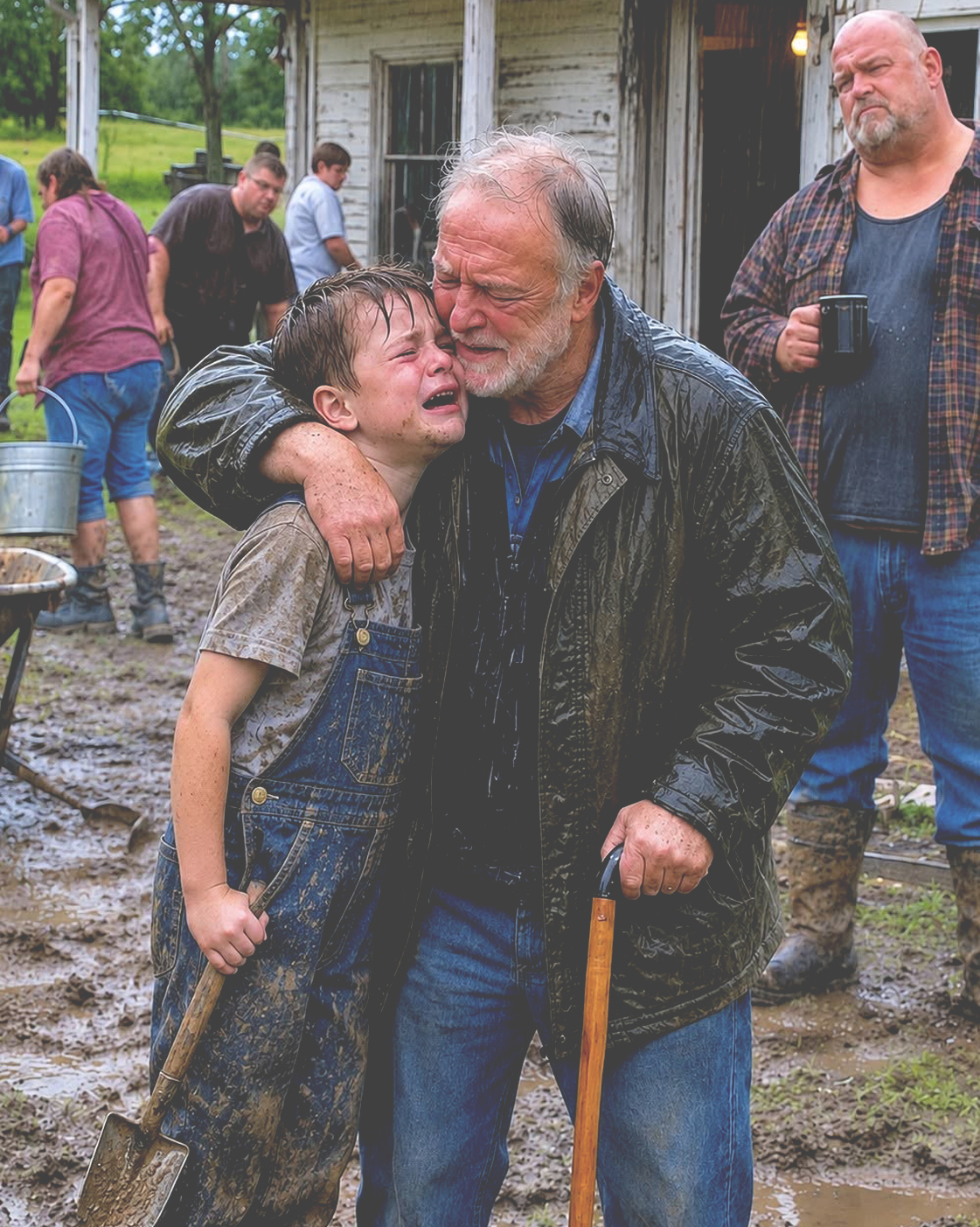
Rain had turned the yard into thick mud. Several children were standing near an old barn, moving small buckets of dirt while an adult watched from the porch.
None of them wore raincoats.
Then I saw a little boy in a faded blue shirt struggling to lift a bucket that was clearly too heavy for him.
My heart nearly stopped.
It was Kellan.
His hair was soaked, his shoes were covered in mud, and his small hands were trembling as he tried to drag the bucket across the yard.
“KELLAN!”
He lifted his head.
For a moment, he simply stared.
Then his face changed.
“DADDY!”
He dropped the bucket and ran toward me.
I barely managed to steady myself before he wrapped his arms around my waist.
“Daddy, you came!”
I held him against me, feeling how cold his clothes were.
“I’m here, buddy. I’m taking you home.”
Kellan pressed his face into my jacket.
“I was good, Daddy. I did my work.”
I knelt carefully, using my cane for support.
“What work, sweetheart?”
He pointed toward the muddy yard.
“Mr. Cecil says we gotta help. If we finish, we get supper.”
I looked at Thomas.
His expression had gone rigid.
Before I could ask another question, the farmhouse door opened.
A broad-shouldered man with a shaved head stepped onto the porch, holding a coffee mug.
“What’s going on out here?”
I stood slowly.
“I’m Roland Bennett. This is my son, Kellan. I’m taking him home.”
The man looked from me to Kellan.
“Your wife enrolled him here. I’m Cecil, the owner.”
“He’s seven years old. His father never authorized this.”
Cecil shrugged.
“Your wife signed the placement agreement. She said you were medically incapable of caring for him.”
“That doesn’t give her the right to take my child.”
He descended the porch steps.
“Listen, old man. We provide food and shelter. The children help with chores. That’s how things work here.”
I looked toward the barn.
Two other children were still carrying buckets through the rain.
“Those children shouldn’t be working out here.”
Cecil’s expression hardened.
“Nobody asked for your opinion.”
Kellan tightened his grip around my leg.
“Daddy, I wanna go home.”
I placed a hand on his shoulder.
“You are going home.”
Cecil moved closer.
“Not until the paperwork is sorted out.”
“My wife isn’t his legal parent. She never adopted him, and she has no court order giving her custody.”
For the first time, Cecil hesitated.
Then he gave a short laugh.
“Your wife told me you wouldn’t be a problem. Said you could barely walk after your stroke.”
I kept my voice steady.
“Thomas, take Kellan to the truck.”
Cecil stepped sideways, blocking the path.
“Nobody’s leaving until I say so.”
Thomas pulled out his phone.
“Then we’ll let the sheriff decide.”
Cecil looked at the phone, then back at me.
“You don’t understand what you’re getting involved in.”
I didn’t answer.
Instead, I took out my own phone and called the sheriff’s office.
I explained that my seven-year-old son had been placed in a questionable facility without my consent and that the owner was preventing us from leaving with him.
The dispatcher asked us to remain in a safe location while deputies responded.
Thomas guided Kellan toward the truck, and I stayed beside them.
Cecil returned to the farmhouse, slamming the door behind him.
As we waited, Kellan climbed into the back seat and curled beneath the jacket Thomas gave him.
He looked at me through the open door.
“Daddy, can Rex sleep with me tonight?”
My throat tightened.
“Of course he can.”
Then Kellan said something that made me look back toward the farmhouse.
“Are the other kids coming home too?”
I turned toward the children still standing near the barn.
Until that moment, I’d been focused entirely on finding my son.
Now I understood that whatever had happened to Kellan might be happening to every child on that property.
And I wasn’t leaving until the deputies knew about all of them.
Part 3: The Sheriff Found Nine Children Inside the Farmhouse—Then Discovered My Wife’s Name in a Payment Ledger
The first sheriff’s deputy arrived twenty minutes after I called, followed by two patrol cars.
By then, Kellan was sitting in my brother’s truck, wrapped in Thomas’s jacket. He refused to let go of my hand whenever I leaned through the open door.
“Daddy, don’t leave me here.”
“I’m not going anywhere, buddy.”
A deputy named Harris approached us and asked me to explain what had happened.
I told him about my stroke, my unexpected return from rehabilitation, and how Luann had secretly placed my seven-year-old son at Sunny Acres.
Then I explained that Luann was my wife, not Kellan’s biological or adoptive mother, and that I had never authorized anyone to transfer his care.
Harris listened carefully before turning toward the farmhouse.
“Stay here with your son, Mr. Bennett. We’re going to speak with the owner.”
Cecil appeared on the porch before the deputies reached the steps.
He insisted Sunny Acres was a private residential program and claimed that every child had been placed there with permission from a responsible adult.
When Harris requested the facility’s license and enrollment records, Cecil’s confidence began to disappear.
“I keep everything inside,” he muttered.
The deputies entered the farmhouse.
Several minutes passed.
Then one of them came outside and asked another officer to request emergency medical assistance and contact Missouri’s child protection authorities.
I felt my stomach tighten.
Thomas stood beside me, watching the front door.
“What did they find?” I whispered.
We received an answer when Harris returned.
“Mr. Bennett, there are nine children with disabilities living inside that house. We’re arranging medical evaluations and safe temporary care for all of them.”
He explained that the children had been sleeping on thin mattresses spread across two crowded rooms.
The bathroom was in poor condition, clean clothing was scarce, and the kitchen refrigerator had been secured with a padlock.
Several children appeared exhausted and needed medical attention.
I looked toward the farmhouse, remembering Kellan struggling with that bucket in the rain.
“How long has my son been here?”
“We’re still checking the records.”
A paramedic examined Kellan in the truck.
My son had lost weight and was dehydrated, but he remained alert and responsive. The paramedic recommended taking him to the hospital for a full examination.
Kellan watched the ambulance with frightened eyes.
“Daddy, am I in trouble?”
I carefully brushed his damp hair away from his forehead.
“No, sweetheart. You haven’t done anything wrong.”
He leaned against me.
“Mr. Cecil said I had to work.”
“You don’t have to work for him anymore.”
While the paramedics prepared to transport Kellan, Harris returned carrying a small notebook sealed inside an evidence bag.
He asked whether I recognized the name Luann Bennett.
“That’s my wife.”
He glanced at the notebook.
“We found a ledger recording payments connected to the children staying here. Your wife’s name appears more than once.”
My hands began to shake.
“What kind of payments?”
“According to the entries, Cecil paid her three referral fees of six hundred dollars each.”
I stared at him.
“Eighteen hundred dollars?”
“That’s what the ledger indicates. We’re investigating whether those payments were actually made and whether any benefits belonging to the children were diverted.”
I remembered Luann telling me she couldn’t manage caring for Kellan while I recovered.
She’d made it sound as though placing him somewhere else had been an exhausting but necessary decision.
Now the deputies had found records suggesting she might have received money for bringing children to Cecil.
“Three referrals?” I asked. “But Kellan is the only child in our house.”
Harris nodded.
“That’s one of the questions we’ll need her to answer.”
He also told me that the investigators were examining financial documents found inside the farmhouse, including records of disability-related payments associated with several residents.
I thought about the weeks when Luann refused to let me speak to Kellan.
She’d known exactly where he was.
And she’d let me believe he was safe at home.
The ambulance crew helped Kellan onto a stretcher, wrapping him in a warm blanket.
He reached for my hand.
“Daddy, come with me.”
I climbed into the ambulance with assistance, my cane resting beside the seat.
As we pulled away, I saw deputies escorting Cecil toward a patrol car while other emergency workers helped the remaining children out of the farmhouse.
I held Kellan’s hand throughout the drive.
For the first time since leaving rehabilitation, I wasn’t thinking about my weakened leg or the difficulty of speaking clearly.
I was thinking about the payment ledger.
Because if the deputies were right, my wife hadn’t simply abandoned my son while I was recovering.
She may have helped Cecil turn vulnerable children into a source of income.
Part 4: My Wife Took Money for Sending My 7-Year-Old Son Away—And the Police Found the Evidence
Kellan fell asleep holding my hand in the ambulance.
Even after the paramedics covered him with another blanket, his fingers remained wrapped around mine. Every time the vehicle slowed, he stirred and whispered, “Daddy?”
“I’m right here, buddy.”
At the hospital in Springfield, doctors examined him for dehydration, poor nutrition, and signs of neglect. They recommended observation overnight and follow-up appointments to make sure he recovered properly.
I sat beside his bed, still wearing the clothes I’d traveled home in.
My brother Thomas brought me coffee and helped contact the social worker assigned to Kellan’s case.
By the following morning, investigators had begun interviewing the families of the other children found at Sunny Acres.
Several parents had been told the farmhouse was a specialized residential program. Others believed their children were receiving supervised care while they dealt with medical or financial difficulties.
None had been told that children were being required to perform outdoor labor in exchange for meals.
Later that afternoon, Detective Harris visited the hospital.
“Cecil is in custody,” he told me. “We’re investigating suspected child neglect, financial exploitation, and the operation of an unlicensed care facility.”
I asked about Luann.
“We’ve located her. She’s being interviewed.”
He opened a folder containing copies of documents recovered from Sunny Acres.
Among them were enrollment forms bearing Luann’s signature.
She’d described herself as Kellan’s legal guardian and claimed that I was medically unable to make decisions.
“That’s false,” I said. “I was in rehabilitation, not declared incompetent.”
Harris nodded.
“We’re verifying the records and how Cecil accepted them.”
Then he showed me the financial entries.
The ledger listed three referral payments to Luann, each for $600. Investigators had also identified disability-related benefit payments that required further review.
I stared at her name.
For four years, I’d trusted that woman with my son.
Now I was looking at records suggesting she’d received money for placing vulnerable children with a man who neglected them.
Two days later, Harris called again.
Luann had been arrested in connection with the investigation.
When I later spoke to her through my attorney, she insisted she’d never intended to hurt Kellan.
“I was overwhelmed, Roland,” she cried. “You were gone, and I couldn’t manage everything.”
“You could have called Thomas. You could have asked the church for help. You could have told me.”
She said nothing.
“Instead, you sent my seven-year-old son somewhere he was afraid to sleep.”
“I didn’t know it was that bad.”
I thought about the payments in Cecil’s ledger.
“Then why did he pay you?”
Her crying stopped.
I ended the conversation.
My attorney helped me begin divorce proceedings and secure temporary court orders protecting Kellan from further contact with Luann while the investigation continued.
When Kellan was discharged, Thomas drove us home.
Rex nearly knocked over a chair when he saw him.
Kellan laughed for the first time since I’d found him at the farmhouse.
“Rex! I missed you!”
He hugged the dog for several minutes before asking to see his bedroom.
I followed him down the hallway.
The room was still empty.
Luann had removed his bed linens, toys, posters, and most of his clothes. We hadn’t yet recovered his belongings.
Kellan stood in the doorway, looking at the bare mattress.
“Where’s my music, Daddy?”
I swallowed.
“We’re going to get you some music.”
He looked up at me.
“And my blue blanket?”
“We’ll find you another one, sweetheart.”
He sat on the mattress and lowered his head.
I wanted to lift him into my arms, but my right side was still weak. Instead, I sat beside him and held him close.
That evening, after Kellan finally fell asleep beside Rex, I opened the old contact list from my coaching days.
For thirty years, I’d taught teenage boys how to wrestle, how to recover from defeat, and how to help teammates who were struggling.
I hadn’t asked most of them for anything since they graduated.
But now my little boy needed a bedroom that felt like home again.
I began making calls.
By noon the next day, eleven of my former wrestlers were standing in our driveway.
Some carried furniture. Others brought boxes, tools, and bags filled with things for Kellan.
And when my son peeked through the front window, he saw a familiar face carrying something wrapped in a bright blue blanket.
Part 5: My Wife Sent Our 7-Year-Old Son to an Abusive Facility—But Eleven Men I Once Coached Helped Bring Him Home
The man carrying the blue blanket was Marvin, one of my former wrestlers. Twenty years earlier, he’d been a shy fifteen-year-old who barely spoke during practice.
Now he owned a furniture store in Springfield.
He stepped into our living room carrying a small wooden bed frame, while two other men followed with a new mattress.
“Coach Bennett,” he said, smiling, “we heard Kellan needs his room back.”
I tried to answer, but my throat tightened.
Behind him stood ten more former students. There were mechanics, teachers, a firefighter, and a lawyer named Cash, all men I’d coached when they were teenagers.
Some carried boxes of toys and children’s books. Others brought new sheets, curtains, and country music posters.
Kellan stood beside Rex, watching them with wide eyes.
“All this for me?”
Marvin knelt in front of him.
“Every bit of it, buddy.”
Within two hours, the empty bedroom had changed completely.
A new bed stood against the wall, covered with a soft blue blanket. Country music posters decorated the walls, and a small stereo sat on a shelf beside Kellan’s favorite picture books.
Marvin also brought a comfortable chair and placed it near the window.
“For when you want to sit with your dad and watch the birds,” he explained.
Kellan climbed onto the chair and looked outside.
Then he turned toward me.
“Daddy, this is my room again?”
I nodded.
“Yes, sweetheart. And nobody is sending you away.”
He ran over and hugged me carefully, remembering that I still needed my cane.
I held him as tightly as I could.
That afternoon, the men stayed to help with repairs around the house. Someone fixed a loose porch railing, while another installed an extra handrail beside the steps so I could move more safely.
Cash, who had become an attorney, sat with me at the kitchen table.
He offered to help connect the families of the other eight children from Sunny Acres with legal assistance.
Over the following months, those families worked with investigators and attorneys to recover misdirected benefits and address the harm their children had suffered.
The state confirmed that Sunny Acres had been operating without the required authorization, and the farmhouse was closed.
Cecil faced criminal charges connected to the children’s treatment and the financial records investigators recovered.
Luann also faced charges related to her involvement.
The ledger, the referral payments, and the documents she’d signed became important evidence in the investigation.
My attorney handled our divorce while helping me protect Kellan’s custody arrangements.
I didn’t attend every hearing. Some days, my rehabilitation exercises left me too exhausted to do much beyond preparing dinner and helping Kellan with his bedtime routine.
But I followed the proceedings closely.
For once, I wasn’t going to let someone else make decisions about my son’s future.
Kellan’s recovery took longer than his physical examination at the hospital.
During his first few weeks home, he sometimes woke up frightened and called for me.
He worried that someone might take him away while he slept.
I placed a chair beside his bed and stayed with him until he felt safe.
His doctor helped us arrange counseling and additional support through his school.
Gradually, the nightmares became less frequent.
He started singing along to country music again.
He laughed when Rex stole one of his socks and carried it through the house.
And one morning, he asked whether he could go back to school.
His teacher welcomed him warmly, and the staff worked with us to help him settle into his familiar routine.
I watched him walk into his classroom carrying his little blue backpack, then sat in my car for several minutes before driving home.
I hadn’t realized how much I’d missed seeing him do ordinary things.
A year has passed since I found Kellan at Sunny Acres.
He’s eight now.
He still loves country music, picture books, and our stubborn old dog.
He attends school, receives the support he needs, and has returned to the cheerful little boy I knew before my stroke.
There are difficult days, of course. Sometimes he asks why Luann sent him away, and I explain as gently as I can that adults sometimes make harmful decisions, but none of it was his responsibility.
I remind him that he deserves to be safe and loved.
As for me, I still walk with a cane.
My right hand occasionally shakes, especially when I’m tired, and I continue doing the exercises my therapist taught me.
But every morning, Kellan and I take Rex for a short walk around our neighborhood.
We move slowly along the sidewalk, stopping whenever Rex finds something interesting to sniff.
At the corner, Kellan reaches for my arm before we step off the curb.
“Careful, Daddy.”
“I’ve got it, buddy.”
He smiles and holds on a little tighter.
“I got you, Dad.”
I look down at my son, remembering the frightened little boy I found standing in the rain outside that farmhouse.
For weeks, I’d been afraid my stroke would make me incapable of protecting him.
But when Kellan needed me, I found the strength to bring him home. And when I needed help, the young men I’d once coached reminded me that I didn’t have to manage everything alone.
We continue down the sidewalk together, with Rex trotting ahead.
One careful step at a time.