The House on Briar Hill Road: I was holding both of my children’s hands when I turned onto Briar Hill Road, walking so quickly that my son had to take two little skipping steps for every one of mine. My eight-year-old daughter, Sadie, kept glancing up at me, trying to understand why my eyes were wet when I was smiling, while five-year-old Miles swung our joined hands and asked whether we were going to have cake for dinner. I had just come from the offices of a law firm in downtown Hartford, where a patient, silver-haired attorney named Mr. Whitcomb had spent the
better part of an hour explaining what my aunt had left me. Twenty-four million dollars, most of it in carefully managed investments. A majority interest in a Manhattan office tower known as the Ashbury Building. And the deed to the broad, white-trimmed house where my family and I had lived for eleven years. It was the house my husband, Owen, referred to as his whenever he spoke about renovations, property taxes, or the neighbors. I had never corrected him. I had believed, as I believed many things then, that the title was some old arrangement connected to my aunt’s
trust and that Owen had worked it out years ago. I wanted to tell him the news in our kitchen, where we had shared late-night coffee and the occasional peaceful Sunday breakfast. I wanted to watch his face change as I explained that the worry over the mortgage, the overdue invoices from his consulting firm, and the broken furnace we had been postponing could finally be behind us. I pictured him lifting Miles into his arms and Sadie squealing as I told them we could take a real vacation, somewhere with a beach and no laptop in the hotel room.
For once, I had a piece of news that seemed large enough to turn a difficult season into a new beginning.
The attorney had also given me a sealed packet containing the documents about the house. I’d tucked it into my purse beside my phone and the children’s library books, telling myself I would go through it with Owen after dinner. Aunt Evelyn had always preferred quiet arrangements. She had never liked showing off, and she had been particular about keeping family matters within the family.
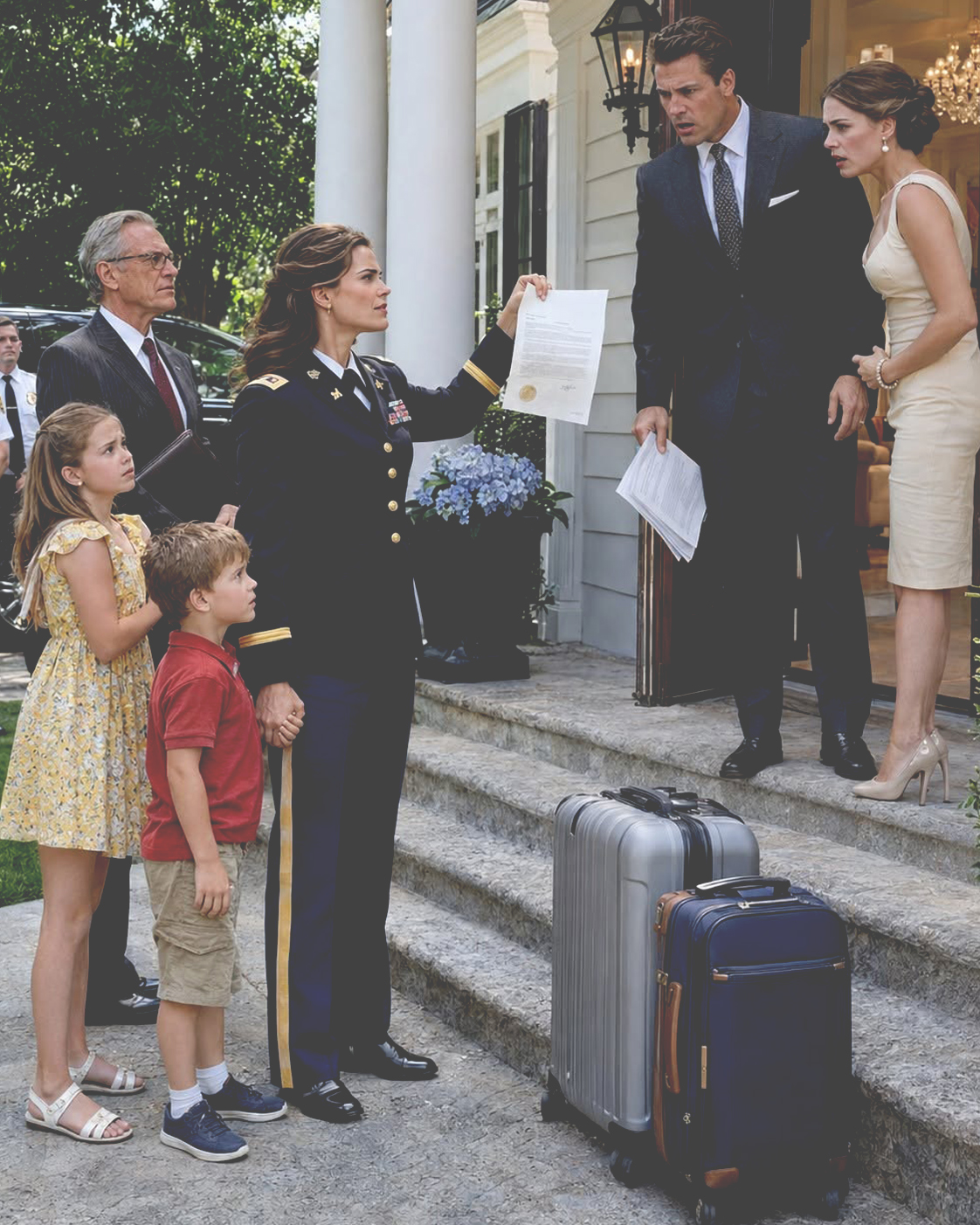
When we reached the house, I saw two suitcases standing on the porch.
One was mine, the navy case with the broken wheel I used for work trips. The other was the tan one I kept in the attic for longer vacations. Both were packed tightly enough that the zippers bowed.
Owen was standing near the front door in a charcoal suit, though it was barely four in the afternoon. Beside him was Paige, the head of client relations at his firm, wearing a cream-colored dress and the small pearl earrings I had last seen in my jewelry box. Her blond hair fell in loose waves around her shoulders, and she wore the easy, practiced smile of someone who had already decided the room belonged to her.
Sadie stopped walking. Miles’s fingers tightened around mine.
Owen looked at the children, then at me, and finally at the purse hanging from my shoulder. His expression did not change.
“We need to talk, Mara.”
I glanced at the suitcases. “What are those doing outside?”
Paige stepped down one stair, careful not to wrinkle her dress. “Owen has made a decision. You should take the bags and go somewhere else tonight.”
I looked at my husband. I waited for him to tell her to stop, or to explain that this was some awful misunderstanding, or even to say that we should talk privately before bringing the children into it.
Instead, he opened a manila folder and held out a set of papers.
“I’m filing for divorce. The kids can stay here while we work out the custody schedule.”
The edges of the folder seemed to blur for a moment. “You packed my things before I got home?”
Paige’s smile sharpened. “You’ve had a comfortable life here for a long time. It’s time you started standing on your own. There isn’t room in this house for someone who contributes nothing.”
For years, I had worked in a converted corner of our bedroom, editing patient education materials and medical transcripts for a regional hospital network. I took late assignments so Owen could focus on building his consulting firm. I had carried most of the school forms, dentist appointments, grocery lists, and bedtime routines. When his firm had been struggling to meet payroll, I had sold the gold bracelet my mother gave me and told him the money came from a tax refund.
I had signed papers Owen put in front of me more times than I could count. “Just a standard business form,” he would say, already looking toward his phone. If I asked what something meant, he would kiss my forehead and tell me he had it handled.
Now he stood on our porch while another woman wore my earrings and told me to leave.
I looked down at the children. Sadie’s chin had begun to tremble, and Miles was watching Owen with an anxious, searching expression. I felt my anger rise, but I kept it contained. The children did not need to see me give Paige the scene she seemed to want.
So I smiled.
Paige’s eyes narrowed. “What’s funny?”
I took the sealed packet from my purse. “I’m not sure you’ll find this as amusing as I do.”
Owen’s gaze flicked to the envelope. “What is that?”
I slid out the first page and held it toward him. The paper was heavy, stamped with the attorney’s seal and signed by the trustee.
“The deed to this house,” I said. “It belongs to me.”
He stared at the page, then at me. “That can’t be right. The house is in my name.”
“It isn’t.”
Paige reached over and took the document from his hand. She skimmed the first lines, then the next, and her smile disappeared. Owen leaned toward her, trying to read over her shoulder.
“The property was held by Aunt Evelyn’s trust,” I said. “She transferred it to me years ago. The trust kept the paperwork quiet until the terms were fulfilled.”
Owen’s face had gone still in the way it did when he was trying to buy time. “Mara, you don’t know what you’re looking at.”
“I spent an hour with the attorney who does.”
At that moment, a black town car pulled in behind us. Mr. Whitcomb stepped out, carrying a leather portfolio, followed by two uniformed property security officers who had been assigned to accompany him. They remained by the curb while he approached us, making no sudden movements and raising his voice only enough to be heard.
He nodded to me and then to Owen.
“Mr. Mercer, I’m Thomas Whitcomb, counsel for Mrs. Mercer and the Ashbury Trust. I’m here to deliver notice regarding the property and to make sure the children are not caught in the middle of a dispute.”
Owen’s eyes moved from the attorney to the security officers. “This is a family matter.”
“The family matter is for you and Mrs. Mercer to address through your attorneys,” Mr. Whitcomb replied. “The ownership documents are a separate issue. The house is held through the trust, and your occupancy has always been governed by a written agreement.”
Paige had read enough of the deed to understand that Owen had not told her the whole truth. She stepped away from him, the pearl earrings bright against her hair.
I looked at the children. “Sadie, Miles, I want you to go inside with Mr. Whitcomb’s assistant. I’ll be right behind you.”
They hesitated. I crouched as best I could without letting go of their hands.
“You’re safe,” I told them. “Go pick a book for me to read later.”
Sadie looked past me at her father. Then she nodded, and the children went through the front door with the attorney’s assistant, a calm young woman named Erin who had been waiting in the car.
Only when they were inside did Mr. Whitcomb open his portfolio.
“Mr. Mercer, you received a residential occupancy agreement through the trust when you moved into this property,” he said. “The trust has covered the ownership and maintenance costs. Mrs. Mercer is the beneficiary and now holds the right to manage the property. This notice gives you thirty days to arrange a move, unless you and your wife reach another agreement through counsel.”
Owen’s mouth opened, then closed. “I was told the house was part of my compensation package.”
“By whom?” I asked.
He looked away.
Mr. Whitcomb continued in the same measured voice. “The trust’s business interests also include the Ashbury Building, where your firm occupies office space. I understand your company has been relying on a credit arrangement backed by trust assets. That arrangement is now under review.”
Owen turned toward me, his composure finally giving way to something closer to fear. “What does the Ashbury Building have to do with my firm?”
“Your office lease was with the trust,” I said. “The lease ended last month. The firm has been operating under a short extension while the estate was settled.”
Paige stared at him. “You said you owned the office space.”
“I never said that.”
“You said you were the one who decided who could stay in the house.”
Owen’s jaw tightened. “This is not the time.”
She touched one earring, then the other, and unclasped them with shaking fingers. She placed them on the porch railing rather than handing them to me.
“You told me you were done with her, and that you were making a clean break because the house was yours,” she said. “You let me believe your business was secure.”
Owen lowered his voice. “Paige, stop.”
But Paige was already backing toward her car. She had no interest in staying to hear the details of an arrangement she had never been told about.
“I’m not part of this,” she said. “Don’t call me tonight.”
She hurried down the drive, and Owen called after her once. She did not turn around.
Then he faced me again.
“Mara, we can fix this. I was under a lot of pressure with the firm. You know how difficult things have been.”
I looked at the papers still in his hand. “You filed for divorce and packed my things before I got home.”
“I thought it was the best way to handle it.”
“For whom?”
He glanced toward the house. Behind the front window, I could see Sadie standing with Erin, holding a book to her chest. She was watching us.
“We’re a family,” he said. “You can’t just throw me out.”
“I’m not throwing you anywhere. Mr. Whitcomb gave you thirty days, and the attorneys can work out what happens next. You decided to end our marriage. We’ll let the court help us decide what that means.”
I picked up the suitcase with the broken wheel. The handle snagged in the porch railing, and Owen reached out as if to help me. I stepped past him before he could touch it.
As I crossed the threshold, I looked over my shoulder.
“You told me this house had no room for someone who contributed nothing,” I said. “I think we both know who has been carrying more than their share.”
A House Full of Quiet
I did not tell the children that evening that their father had asked me to leave. I told them only that the adults had a lot to work out and that they would stay in their own beds. Erin helped me make grilled cheese sandwiches while Mr. Whitcomb and Owen spoke outside, and I read the same chapter of Sadie’s book twice because she kept asking me to continue after I had reached the end.
Owen did not come inside until after the children were asleep. He stood in the doorway of the kitchen, still wearing the suit, though his tie had been loosened. There was a sadness in his face that might have been sincere, but I was no longer willing to make excuses for it.
“I didn’t know the trust had that much power,” he said.
“You didn’t know the house wasn’t yours?”
He rubbed his forehead. “I knew there was a trust. I thought it was an old family arrangement, nothing that would affect us.”
“You signed the occupancy agreement.”
“Years ago. Your aunt’s attorney said it was routine.”
“And you never thought to tell me?”
He looked down at the floor. “I didn’t want to complicate things.”
There it was again: the phrase he used whenever the truth might inconvenience him. For eleven years, he had made choices and called them simple. If I questioned him, I was overthinking. If I asked to see a document, I was being difficult. If I insisted on a conversation, he said there was no need to make everything complicated.
I had mistaken his confidence for competence and his silence for stability.
“You should speak with your attorney,” I said.
“I want to talk to you.”
“You had plenty of time to talk before you left those bags on the porch.”
He looked at me for several seconds. Then he went upstairs to the guest room.
The next morning, I called my sister, Laura, and told her what had happened. She drove over from West Hartford with coffee and a box of muffins, and she sat with the children while I met with Mr. Whitcomb in the breakfast room. He brought a folder that was twice as thick as the one from the day before.
Aunt Evelyn had been widowed young and had spent years building a modest portfolio of commercial properties. She had started with one small building in Connecticut, then invested in a few others as the city changed around them. The Ashbury Building was the largest and most valuable of them. She had also bought the house on Briar Hill Road when I was in college, after my mother’s health began to decline and our family could no longer manage the property we rented.
The house had been transferred to a trust, with the understanding that I could live there once I was married and had children, as long as the trust’s conditions were met. It was not intended as a secret test of Owen’s character, exactly, though Aunt Evelyn had wanted to see whether he treated the property as a gift to our family or as a possession he could use to impress people.
She had watched quietly from a distance. She had noticed that Owen had started describing the house as his before we were married. She had also noticed that I had signed the paperwork without asking what it meant, because I trusted him to explain it.
My aunt had not been trying to punish Owen. She had simply wanted me to have a safe place to stand if life took a turn I had not expected.
“She believed you were kind,” Mr. Whitcomb said, “but she also believed kindness should not require you to give up your judgment.”
I thought of the woman I had been at twenty-seven, sitting at our kitchen table while Owen filled out forms for his new firm. I had been so eager to support him that I had treated every question as a sign of mistrust. It was hard to admit that I had made myself smaller in the name of being a good wife.
The inheritance came with responsibilities, too. The trust had several employees, active leases, and a management team that needed direction. I would not be able to spend the money however I liked, and I would not be running a Manhattan building from my kitchen table. I would need to learn how the properties worked, review the accounts, and make decisions with people who had been managing the operation for years.
The attorney said there was no emergency. We could take our time.
For the first time in years, I had time to decide what I wanted before someone else decided it for me.
The Papers Owen Signed
Owen’s divorce filing arrived through his lawyer two days later. It asked for shared custody, temporary use of the house, and a division of marital assets that included the consulting firm and the office lease. His attorney also requested access to the financial records of the trust, arguing that Owen had contributed to the upkeep of the house and should receive some credit for improvements.
Mr. Whitcomb explained that the trust’s records would be reviewed in the proper setting, but that Owen had no claim to the Ashbury Building simply because his company had rented an office there. The lease was clear. So were the records showing that the trust had paid for the roof, the furnace, and the property taxes.
Still, there were real matters to sort out. Owen and I shared two children, household belongings, and years of memories that could not be divided by an attorney’s careful pen. I did not want to use the trust to humiliate him or make the children feel that their father had been stripped of everything. I wanted boundaries, honesty, and a plan that would let Sadie and Miles feel loved by both of us.
The financial review of Owen’s firm uncovered more than I expected. The company had been in trouble for months, not because of one bad contract but because Owen had expanded too quickly and relied on short-term borrowing. The trust had guaranteed a line of credit only because Aunt Evelyn had agreed to it years earlier, when the firm was small. That guarantee was not a gift, and the trust had not been responsible for the company’s regular expenses. It had simply made the loan easier to secure.
Owen had told me the firm was “doing fine” whenever I asked why we were postponing repairs or why he needed to move money from our joint savings. I had believed him because I wanted to believe him. The audit showed that the firm had been using our joint account to cover some expenses, including the furniture and electronics Paige had chosen for the office.
I stared at the transaction list in Mr. Whitcomb’s conference room, unable to make myself read another line.
“Did you know about these charges?” he asked gently.
“I knew he transferred money sometimes. He said it was temporary.”
“Did you approve them?”
I looked at the signature page. My initials were there, next to a short line acknowledging a business account update. I remembered the night Owen had brought the papers home while I was packing the children’s lunches. He had pointed to the signature tabs and said the bank needed them before the end of the day.
I could not prove that I had understood what the paperwork allowed. But I could remember how he had made it seem unimportant.
The review did not erase my responsibility for signing. It did, however, show that Owen had kept me from understanding what I was agreeing to, and that he had used my trust in him as a convenient shortcut.
When I told him I wanted the children to remain in the house while we worked out a parenting schedule, he agreed. He moved into a short-term rental near his office and began collecting his clothes from the house on Saturdays. The first time he came by, he stood in the doorway of the living room, watching Miles build a tower from wooden blocks.
“I can still come to their school events, right?” he asked.
“You’re their father. Of course you can.”
He seemed surprised by the answer. Perhaps he had expected me to use the same hard-edged certainty he had used on the porch.
“I don’t want them thinking I chose Paige over them.”
I did not know what to say. I did not want to soften the truth into something comforting, but I also did not want to turn the children into messengers between us.
“Then show them, every time you have the chance, that they matter more than your pride.”
He looked toward the blocks and nodded.
Paige did not come back. Owen’s firm lost its office in the Ashbury Building when the lease ended, though the trust allowed the employees a reasonable period to move their equipment. Owen’s company found a smaller space in Stamford. The bank replaced the old credit arrangement with a standard loan backed by the company’s remaining assets, and Owen had to sell a car he had leased through the business.
None of it happened in a single dramatic afternoon. There was paperwork, phone calls, moving boxes, meetings, and several weeks of Owen sounding angry at the people who had given him exactly the time the law required.
Learning to Hold the Keys
The first month after the papers arrived, I went to work in the same corner of the bedroom where I had been editing hospital transcripts. The house felt strange once Owen was gone. I kept hearing his key in the front door, even when the only sound was the old furnace clicking on. At dinner, I made enough food for four without thinking. When the children asked whether Dad would be joining us, I reminded them that he would see them the next day.
I had imagined money would feel like a warm door opening. Instead, the inheritance felt like being handed a ring of keys to buildings I had never entered, with a long list of people waiting to see whether I knew which door belonged to me.
I met with the Ashbury Building’s property manager, a woman named Jean Harper who had worked for Aunt Evelyn for nearly twenty years. She knew which tenants paid on time, which elevators needed work, which floors had the best light, and which old service agreements could be negotiated. She did not treat me as a child or as a savior. She expected me to listen, read the reports, and ask clear questions.
That was a relief.
I spent the first few weeks learning the basics: maintenance schedules, insurance, operating costs, and the names of the tenants who had been in the building for decades. My aunt’s wealth had not appeared from nowhere. It had been built through patience and careful choices, and I was determined not to confuse having money with knowing what to do.
I also kept my hospital editing work, at least for a while. The job gave my days a familiar shape. When I sat down to revise a patient guide about preparing for surgery, I could still focus on commas, clarity, and the difference between a helpful sentence and a confusing one. There was comfort in work that had a beginning and an end.
Laura asked me whether I planned to quit.
“I don’t know yet,” I told her. “I want to know what my days look like when I’m not just reacting to Owen’s plans.”
“That sounds like a good reason to wait.”
The children were the part I understood best. Sadie needed reassurance that she had not caused the separation by asking too many questions. Miles needed the same bedtime story in the same order each night. We met with a family counselor who helped us speak about the changes without making either parent the villain.
I never told them the details of Owen’s relationship with Paige. They knew their father had hurt my feelings and that the adults were separating. They also knew they could love him without needing to protect him from the consequences of his choices.
On Saturdays, Owen took them to the park or for pancakes. At first, he seemed stiff around me, as if he were waiting for me to make the children choose a side. I never did. I made sure their coats and favorite books were ready, and I told them what time he would bring them back.
One afternoon, Sadie lingered at the front door after he arrived. Owen had brought a new sketchbook for her, and she hugged it against her chest.
“Are you going to live somewhere else forever?” she asked him.
He crouched to her height. “I’m going to live at my apartment for now, but I’ll always be your dad, and I’ll always be there for you.”
She thought about it. “Even if you don’t live in this house?”
“Even then.”
She took his hand and walked to the car.
I watched them go, trying to hold on to the part of me that could still be glad my children loved their father. It was harder than I expected. I wanted to protect them from disappointment, but protecting them did not mean teaching them that love required pretending.
Six Months Later
By the time the leaves began to turn, the divorce was nearly finalized. Owen and I had agreed to a shared custody schedule that worked around school, and we had a written plan for holidays and vacations. The house remained mine through the trust, but I had asked for a formal appraisal and a clear accounting of the expenses we had both paid. I did not want the property to be a weapon. I wanted it to be what Aunt Evelyn had intended: a secure place for the children and me.
The trust also made an offer to Owen’s firm to settle the old guarantee and the remaining office expenses. The terms were fair, though not especially generous. Owen accepted them after his lawyer reviewed everything. He never apologized for the money he had moved from our joint account, but he did not fight the accounting either.
I had begun going to Manhattan once or twice a month to meet with Jean and the building’s management team. The first time I stood in the lobby of the Ashbury Building, I felt conspicuous in my winter coat, holding a folder while tenants hurried past with coffee cups and briefcases. The lobby ceiling rose several stories above me, and sunlight slipped through the tall windows onto the pale stone floor.
I thought of Aunt Evelyn, who had once shown me a photograph of the building when she first bought it. She had said she liked owning places where people came to do useful work, even if they never knew who paid the bills when the elevators needed repair.
My inheritance was not just a number. It was the result of decades of decisions, some careful and some fortunate. It came with obligations, and it required me to grow into a role I had never expected to hold.
At home, I changed the living room slowly. I did not replace everything or turn the house into a showpiece. I kept the kitchen table where the children did their homework and the old porch swing that creaked when the wind shifted. I did replace the furnace, repaint the hallway, and move my work desk into the small room at the back of the house. For the first time, I had a space where the children could come ask me a question without stepping around Owen’s boxes or a stack of his paperwork.
The suitcases were gone. The porch looked ordinary again.
On the day the divorce became official, Owen came by to pick up the last of his books. He paused beside the coat rack, where the children’s backpacks hung in a messy row.
“You’ve made the place feel different,” he said.
“It’s still the same house.”
“It doesn’t feel like the same house.”
I considered that. The rooms were familiar, but I was not standing in them the same way.
“Maybe we’re different.”
He nodded, and for a moment there was no anger between us, only the awkward quiet of two people who had spent years sharing a life and were now trying to be careful with what remained.
“I’m sorry about the porch,” he said at last. “The bags. The kids seeing it.”
It was not a full apology. It did not mention Paige, the lies, or the money. But it was the first time he had named what he had done without blaming pressure or circumstance.
“I wish you had thought about them before you made that choice.”
“I know.”
He collected the books and carried them to his car. When he left, I did not watch from the window.
That evening, Sadie asked if we could invite Laura over for dinner. Miles wanted pancakes instead of chicken, though it was a Tuesday. I made pancakes, and we ate them at the kitchen table with the windows cracked open to let in the cool air.
Afterward, I helped the children brush their teeth and tucked them into bed. Sadie held my hand beneath the blanket.
“Are you happy now, Mom?”
I thought about the question. I was not happy in the simple, shining way I had pictured when I ran up Briar Hill Road with the inheritance letter in my purse. I still had hard days. I still felt the sting of what Owen had done, and there were mornings when the future seemed too wide to cross.
But I had stopped waiting for someone else to tell me where I belonged.
“I’m getting there,” I said. “And I’m glad we’re here together.”
She smiled and turned onto her side. Miles had already fallen asleep, one hand curled around the corner of his blanket.
I left the bedroom door open a few inches and walked downstairs alone. The house was quiet, but it no longer felt like a place where I was waiting for someone to come home and decide what happened next. It felt like a place where my children could grow, where I could make mistakes and correct them, where the past did not have to dictate every choice I made.
On the porch, the old swing moved softly in the evening breeze. I stood there for a moment, looking down the street, and remembered the day I had come home carrying news that I thought would save my marriage.
It had not saved the marriage. It had shown me how much of myself I had been asking it to save.
Then I went back inside, turned off the kitchen light, and closed the door to the house that had been mine all along.