Final exams arrived and I was exhausted and underprepared, feeling like I was only one bad surprise away from falling apart completely. Mrs. Halloway noticed my stress before I said a word and pointed toward the kitchen table while telling me to sit down. “You are carrying too many bricks for one person,” she said as she studied my face like she was reading small print on a page. “I’m just tired from finals,” I told her, but she just shook her head and listed all the things I was doing. “Children should not have to earn their adulthood like this,” she said softly, and I laughed because I didn’t feel like a child anymore. “The debt is recorded, Leo, and I have not forgotten the money that I owe you for all your help,” she added. Something in my chest tightened because I had told myself I didn’t care about the money anymore, but hearing her say it made the frustration rise. “I never wanted to pressure you about it,” I said carefully, and she reached for her teacup with both of her hands. “You didn’t, and that may be exactly why I trusted you,” she replied, and that was enough to keep me from quitting the arrangement. Summer arrived heavy and damp, and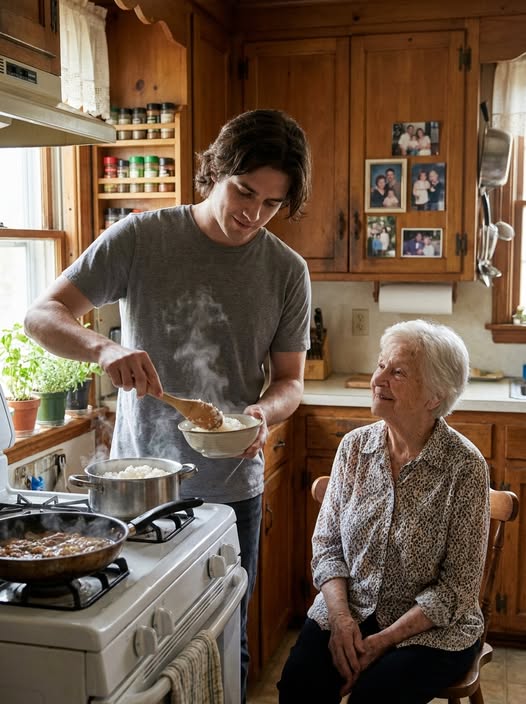
the house seemed to shrink even further in the heat while Mrs. Halloway’s health continued to worsen. One evening in July, after I had made her chicken and dumplings, she motioned toward the old piano bench and told me to open it. Inside, I found yellowing sheet music and an envelope with my name written on it in her careful, old-fashioned handwriting. “Not yet,” she said when she saw me reach for the envelope, and I pulled my hand back immediately without touching the paper. “Then why show it to me now?” I asked, and she looked at me and said, “So you know I am
not careless with endings.” A few days later, I found her struggling to carry a laundry basket and I took it from her before she could hurt herself. She gripped my wrist tightly and said, “Do not let them make you small, Leo, especially anyone who benefits from you being that way.” In August, I
started asking more direct questions about her lawyer and her papers because I knew she was getting closer to the end. She resisted at first but then told me about a lawyer named Kenneth O’Malley whose card was in the kitchen drawer. She told me the house was hers free and clear and
that there was a life insurance policy, but she warned me to leave the metal box alone. “Leave it until the silence becomes permanent,” she instructed me, and I nodded my head without making any verbal promises. Late one Friday, I got a call from her and her voice was so thin and breathless
that I knew I had to get there immediately. I left the diner in the middle of my shift and biked the three miles to her house until my lungs felt like they were on fire. When I arrived, she was in bed and clutching her chest, so I ignored her glare and called 911 to get her the help she needed.
They admitted her to the hospital for congestive heart failure and renal function issues, and the doctors spoke to me with very gentle voices.
“You know they will come if it looks like things are getting serious,” she said on the fourth day while the hospital lights hummed above us. Her daughter Felicia arrived first in expensive clothes and wearing a version of compassion that felt like it belonged to a manager.
She hugged the air near my shoulder and introduced herself to me as if I were a hired contractor who had been working on the house. When Mrs. Halloway opened her eyes and saw Felicia, she said, “What a long layover this must have been for you to visit.”
Brendan arrived the next morning with the polished fatigue of a man who knew how to look burdened in a way that would photograph well. He thanked me for helping his mother in a tone that suggested he was granting me a certificate for being a decent person.
Then he stepped into the hallway and took a phone call where I heard him talking about estate timing and the current market conditions. Suddenly, the old blue house on Oak Street did not feel forgotten anymore, but rather it felt like it was being targeted for profit.
The siblings stayed for two days and spoke in hushed whispers in the corners of the hospital room while they checked their mother’s bills. They never once asked what she had been eating or if she had been lonely during the long months when they didn’t call her.
On the third morning, Mrs. Halloway asked to see Kenneth O’Malley, and the lawyer arrived that afternoon with a leather folder in his hand. He spoke with her alone for a long time and then he stepped out into the hallway and asked to speak with me.
I stepped into the room while Felicia and Brendan watched me with frank irritation from their spots near the door. “Leo, Mr. O’Malley is here to witness that I am still capable of making my own decisions,” she said with sharp eyes.
“You are also going to witness it because I trust your memory more than I trust their intentions,” she added as Brendan started to protest. The lawyer shut him down with one raised hand, and then papers were signed and a conversation was recorded on a small device.
That night, Felicia cornered me by the vending machines and asked me exactly how long I had been involved with her mother’s life. “I clean her house and I help her with whatever she needs,” I replied, and Felicia folded her arms across her chest.
“My mother can be very impressionable at her age,” she said, and I felt a surge of anger at the way she was dismissing her mother’s mind. “She seems pretty clear to me,” I countered, and Felicia’s eyes sharpened as she warned me about helpers who expect things.
“Some people only show up when they think there is something left to sort through,” I said before I walked away from her. Mrs. Halloway was eventually discharged from the hospital and I brought her back to the house while her children left the very next day.
September arrived with an early cold snap and Mrs. Halloway grew weaker as she began receding from the world around her. Once, while I was peeling apples, she asked me if I knew the strange thing about dying, and I stopped what I was doing to listen.
“It makes everyone else reveal what they truly think life was for,” she said, and I asked her what she thought it was for in the end. “It is for leaving something behind that isn’t just a collection of objects,” she replied as she looked at the fading light.
In October, the silence finally became permanent when I found her in her armchair on a Thursday afternoon with her hands folded in her lap. The house was completely still and for a few seconds, my brain rejected what my body already knew to be true.
I knelt beside her and touched the back of her hand, which was cool to the touch, and then I called the lawyer and the emergency services. The next few hours were a blur of questions and doctors and then the arrival of Felicia and Brendan who looked at the house like an asset.
The funeral was small and felt strangely empty, and I sat in the back in my one decent black shirt feeling like an extra in a play. After the service, Kenneth O’Malley approached me and handed me a cream-colored envelope that he said contained instructions for me.
“She told me to give this to you and told me that you should read it tonight when you are alone,” he said with a kind look. Back in my apartment, I sat at the table while Jordan hovered nearby, and I opened the letter written in her blue ink.
“Leo, if you are reading this, then I have finally managed the one appointment that no one can ever cancel,” the letter began. I laughed through the tears because it was exactly the kind of dry line she would use to avoid being too sentimental.
The letter explained that she was paying me every dollar she owed me with interest, but it also said she had changed her will years ago. “I am leaving you my house on Oak Street because I know the difference between pity and a real investment,” she wrote.
Jordan asked what the letter said, and I had to hold up my hand because my heart was beating so fast I couldn’t speak. She wrote that she was recognizing my character because I had arrived needing money but had chosen to treat her like a human being anyway.
“If you keep the house, live in it fully and let laughter offend the dust,” the last page of the letter instructed me clearly. At the bottom, she signed it as Mrs. Halloway, and the legal fight with her children began almost immediately after the news broke.
Felicia and Brendan contested the will and claimed that I had used predatory dependency to manipulate their mother for financial gain. I was furious because powerful people were no longer ignoring me, but were instead trying to erase my existence entirely.
Kenneth O’Malley became my shield and presented a ledger that Mrs. Halloway had kept documenting every single thing I had done for her. She had recorded every grocery run and every hospital trip, proving that she was fully aware of our relationship and her own decisions.
The court battle lasted for months, but eventually, the judge ruled that the will was valid and that the children had lost their case. I moved into the house that summer and spent my weekends painting the rooms with Jordan’s help while my mother came to visit.
I kept the old piano and fixed the sagging porch rail, and the house began to change the way wounded things do when they are cared for. I went back to school and graduated the following spring, and I thought about her every time I sat at the kitchen table.
I turned down an offer to sell the house to a developer because I remembered her words about living in the house fully. I converted the front room into a study house for kids who needed a quiet place to work or help with their own college applications.
Years later, people would tell the story wrong and say that I was a saint or that she was secretly a millionaire testing my heart. But the truth was that we were both just people who found something in each other that the rest of the world had ignored.
On quiet nights, I sit in her old armchair and listen to the house creaking while the students work in the other room. She never did pay me on those Thursdays, but she paid me in the only currency that was actually large enough to change my entire future.
THE END.