First, he painted over the blue fence my dad had chosen. Then he moved me out of the bedroom my father built. Then he took down every photograph of Nathan Palmer until the only one left was hidden in my sock drawer.
He changed our phone number and told me my grandmother Vivian didn’t want me anymore. He opened all the mail before anyone else touched it. I believed him for fourteen years.
Then, four months before the storm, I found the envelopes.
They were stuffed in a shoebox behind Roy’s paint cans: life insurance statements in my father’s name. The policy listed me, Frances Palmer, as the beneficiary. I was supposed to receive it at twenty-five.
Instead, Roy had withdrawn $83,400 using a power of attorney my mother had signed.
For four months, I carried that truth like a blade beneath my tongue.
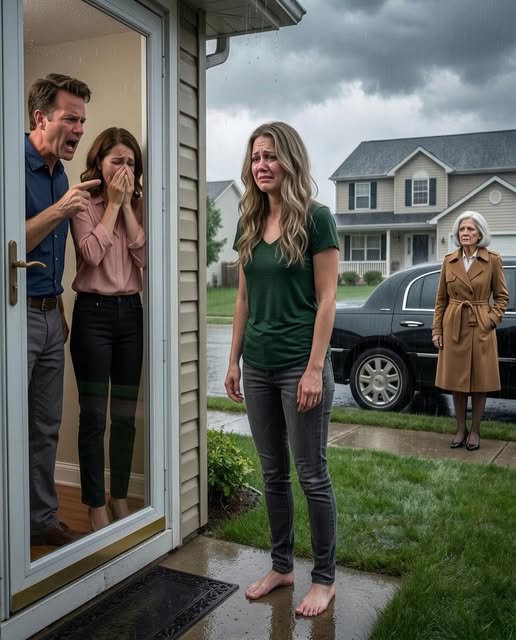
Now the rain struck my face sideways. I had no shoes, no jacket, and no one to call. My phone sat soaked in my pocket. Across the street, Mrs. Meredith’s curtain shifted. I thought I saw her watching.
Then headlights turned onto Maple Ridge.
A black limousine rolled through the storm and stopped at the end of our driveway. The rear door opened. My grandmother stepped out in a long black raincoat, her silver hair pinned tight, her expression hard as stone.
She looked at me. Then she looked at the house.
And she spoke a single word.
“Demolish.”
The driver opened an umbrella, but he held it over me, not her.
Vivian Palmer moved through the rain as if the weather were just another problem she had already solved. She guided me into the limousine, wrapped a wool coat around my shoulders, and handed me a white handkerchief that smelled faintly of almond cake.
Inside the car, I could barely speak. My teeth chattered—partly from the cold, mostly from shock.
“How did you know?” I asked.
“Meredith called me,” she said. “She saw them lock the door.”
“You still talk to Mrs. Meredith?”
“I spoke to anyone who could tell me whether you were alive.”
Her words hit harder than the rain. For fourteen years, I had believed my grandmother abandoned me. Roy said she was busy, then distant, then ashamed of me. I accepted every lie because he spoke them in the same calm tone he used to ask for salt.
Vivian took me to a hotel built like a fortress on higher ground. She had reserved a suite two days earlier when the storm intensified. Dry clothes were waiting on one bed: jeans, socks, shoes, a gray sweater in my size.
She had planned my rescue before I even knew I needed one. After I changed, she sat across from me with a yellow envelope in her lap. Outside, Hurricane Maren slammed into the coast. The windows trembled, but Vivian remained still.
“There is something Roy doesn’t know,” she said. “And something your mother chose not to tell him.”
I held a mug of tea so tightly my fingers burned.
“The house is not Diane’s,” Vivian said. “It never was.”
My mother’s name sounded strange spoken like a legal issue instead of a parent. Vivian explained everything in a calm voice that unsettled me. My father had bought the house with money she loaned him before I was born. The title was placed in the Palmer Family Trust. My father was the beneficiary while he lived. After he died, I became the beneficiary. My mother was granted only a conditional life estate.
“She could live there,” Vivian said. “She could not sell it, transfer it, borrow against it, or allow harm to come to you.”
I stared at her. “Roy thinks he owns it.”
“Roy believes many things because no one has ever forced him to read documents.”
The next afternoon, after the worst of the storm passed, Vivian’s attorney arrived. Mr. Callaway brought three folders.
The first contained the trust documents. The second held my father’s insurance records, including every unauthorized withdrawal Roy had made. The third made my hands turn cold.