The day my sister jettisoned my daughter into the gelid depths of an arctic lake, I finally grasped the grotesque truth of my lineage: my family did not possess strength; they merely practiced a sophisticated form of predatory cruelty. It was late November in Blackwood County, northern Minnesota. The world was a study in desolation. The skeletal remains of birch trees clawed at a leaden sky, and the air didn’t just chill you—numbing the skin and seizing the joints—it incinerated the very lining of your lungs. I had been coerced into this pilgrimage to my father’s isolated cabin by my mother’s practiced fragility. “Just one afternoon, Natalie,” she had pleaded over the phone, her voice a thin, wavering thread of manipulation. “Your father’s heart isn’t what it used to be. He needs the family together. One last harvest season.” That should have been my herald of disaster. In our family, “togetherness” was rarely a sanctuary; it was a theater for my father’s psychological warfare, a place where the weak were culled and the empathetic were ridiculed. My daughter, Hazel, was eight years old—a delicate, perceptive soul who seemed carved from a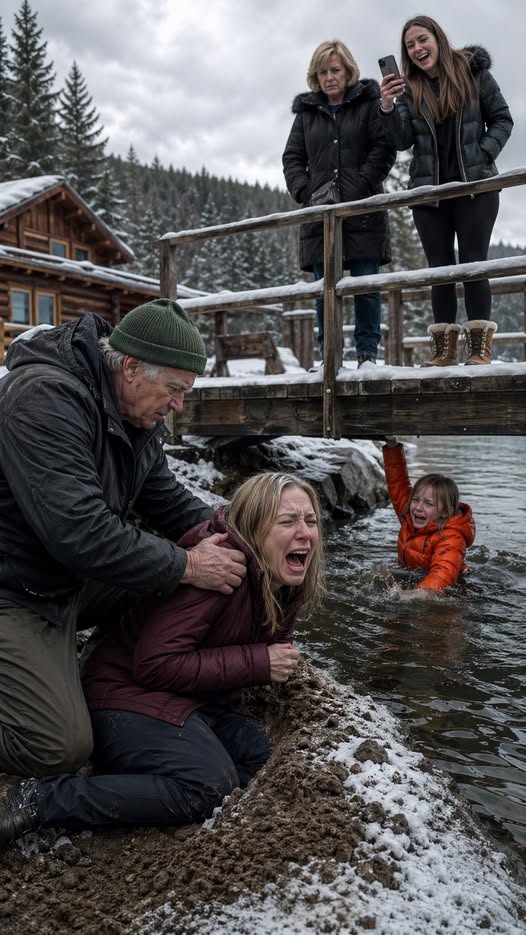
different, softer stone than the rest of us. That morning, she was a small splash of color against the grey landscape, bundled in a pale blue parka, her knit hat pulled down so low it nearly eclipsed her cautious brown eyes. Hazel harbored a visceral, bone-deep terror of deep water. Two
summers prior, a minor slip during a swimming lesson had sent her spiraling into the dark; she had emerged gasping, terrified, and forever changed. Since then, the mere sight of a vast horizon of water caused her to tether herself to my hand like a lifeline.
I never pushed her. I believed fear was a mountain to be scaled with patience, not a cliff to be shoved off.
Vanessa, my elder sister by five years, believed in the latter. She stood at the terminus of the frost-slicked dock, her expensive, fur-lined boots planted firmly as she watched Hazel tremble several feet behind her. Vanessa was the golden child of the Blackwood legacy—hard, ambitious, and utterly devoid of the “inconvenience” of pity.
“She’s eight, Natalie,” Vanessa remarked, her smirk cutting through the frigid air like a blade. “She’s not an infant. You’re coddling her into a state of permanent paralysis. You baby her, and then you have the audacity to wonder why she’s frightened of her own shadow.”
“She doesn’t have to prove her worth to you, Vanessa,” I replied, my voice tight, my fingers interlaced with Hazel’s small, gloved hand.
From behind us, the low, guttural rumble of my father’s laughter vibrated through the crisp air. Arthur Blackwood stood like a monolith of old-world toxicity, a glass of amber liquid in his hand despite the hour. “That’s always been the rot in this family,” he said, his voice flat and contemptuous. “Natalie insists on letting everyone be soft. In my day, we didn’t have the luxury of fear.”
I should have left. The thought hammered against my skull even then. But when you are raised in a house where making a scene is considered the ultimate sin, your internal alarm system is often muted by the desire for peace.
Vanessa crouched down, extending a gloved hand toward my daughter. Her expression had softened into something that, to the untrained eye, might have looked like kindness. “Come on, Hazel. Be a big girl. Just touch the surface. I promise, the lake isn’t going to swallow you whole.”
Hazel retreated, shaking her head with such frantic intensity that her hat slipped askew. “No. Please, Aunt Vanessa. It’s too cold.”
And then, the mask vanished.
CLIFFHANGER: The shift in Vanessa’s eyes was instantaneous—a predator identifying a moment of absolute vulnerability—and as she lunged forward, I realized with a jolt of pure adrenaline that she wasn’t reaching out to comfort my child, but to erase her.
The Sound of Shattered Ice
In a blurred sequence of motion that my brain struggled to categorize as reality, Vanessa’s hands slammed into Hazel’s small shoulders. With a calculated, forceful shove, she catapulted my daughter off the edge of the dock.
The splash was violent, a chaotic eruption of black water and crystalline ice shards. Hazel went under instantly. The Pale blue of her coat vanished beneath the surface of Lake Malice, and for three agonizing seconds, there was nothing but the ripple of the water and the sound of my own heart failing.
I screamed—a raw, animal sound that tore from my throat—and lunged toward the dock’s edge. But I never reached it.
My father moved with a speed that defied his age. He tackled me from the side, his massive frame slamming me into the frozen dirt of the shoreline. The impact knocked the wind from my body, the metallic taste of blood blooming in my mouth as my face hit the frost-hardened earth. He pinned me down, his forearm a heavy, unyielding bar across my shoulder blades.
“Let me go!” I shrieked, clawing at the dirt, my eyes fixed on the water where Hazel’s head had finally breached the surface. She was flailing, her pink gloves splashing uselessly against the frigid waves, her small mouth open in a silent, freezing scream. “She can’t swim, Arthur! She’s going to drown!”
My father’s breath was hot and smelled of cheap bourbon against my ear. His voice was a calm, terrifying whisper. “If she can’t swim, she’s a defect. If she dies, she was worthless to the Blackwood name anyway. Shut up and watch her find her spine, Natalie.”
I fought like a creature possessed. I bit, I scratched, I bucked against his weight, but he was a mountain of iron and misplaced conviction. On the dock, Vanessa stood frozen. Her bravado had evaporated the moment the water closed over Hazel’s head. She looked pale, stunned, her mouth hanging open as she realized that “tough love” was currently becoming a homicide.
Hazel’s movements were slowing. The hypothermia was likely already seizing her small muscles, the shock of the forty-degree water shutthing down her system. Her screams had devolved into pathetic, wet gasps.
That was the moment the Natalie I used to be—the daughter who sought approval, the sister who kept the peace—suffered a final, violent death. In her place, a witness was born. A mother who realized that her family was not a circle of protection, but a firing squad.
Just as my vision began to blur with tears of rage and oxygen deprivation, a new sound cut through the chaos. A whistle. Then, the frantic barking of a dog.
CLIFFHANGER: From the thicket of trees bordering the neighboring property, a figure emerged at a full sprint—a stranger who didn’t hesitate for a heartbeat before launching himself into the icy abyss.
The Stranger’s Mercy
The man hit the water like a depth charge. His name, I would later learn, was Mark Ellison, a local carpenter who had been walking his golden retriever along the shoreline. He didn’t waste time with a graceful dive; he simply surged through the shallows and swam with a powerful, desperate stroke toward the pale blue fabric that was now sinking for the second time.
My father finally released his grip on me. It wasn’t an act of remorse; it was the calculated retreat of a man who realized there was now an outside witness. I scrambled to my feet, my knees buckling, and staggered to the dock’s edge.
Mark breached the surface, gasping for air, with Hazel tucked under one arm. She was limp, her skin a terrifying shade of porcelain blue, her lips tinged with violet. He hauled her toward the dock, and I reached down, my fingers numbing instantly as they hit the water, to help pull her up.
I wrapped her in my own wool coat, pulling her against my chest. She was shivering with such violence that her teeth rattled, making tiny, broken, bird-like sounds.
“You need to get her inside and get those clothes off,” Mark barked, hoisting himself onto the dock, his own clothes dripping and heavy. He looked at Vanessa, who was trembling, and then at my father, who was straightening his jacket as if he hadn’t just held his daughter face-down in the dirt.
“What the hell happened here?” Mark demanded, his eyes narrowing as he took in the scene.
“An accident,” my father said, his voice regaining its practiced, booming authority. “The girl slipped. Family business, son. We appreciate the assist.”
“She didn’t slip,” I whispered, my voice sounding like it was coming from a great distance. I looked at Mark, a man I had never met, and I saw more humanity in his wet, shivering form than I had seen in my father in thirty years. “She pushed her. And he held me down.”
The silence that followed was absolute, broken only by the wind whistling through the pines. Mark looked at me, then at the bruises already forming on my face where the dirt had scraped the skin.
“You need to call the police,” Mark said, his voice low and dangerous. “Right now. Or I will.”
My father stepped forward, his eyes sparking with the old, familiar threat of violence. “I suggest you mind your own business, Mr. Ellison. You’re on private property.”
“I’m on a crime scene,” Mark countered, reaching into his pocket and pulling out a waterproof phone.
CLIFFHANGER: As my father moved to grab the phone, a low, ominous growl erupted from the golden retriever standing at the edge of the dock, and I realized for the first time that the power dynamic in this family had finally, irrevocably shifted.
The Architect of Recalcitrance
The arrival of the authorities was a blur of strobing red and blue lights against the darkening Minnesota woods. The ambulance crew worked with a practiced, quiet efficiency, whisking Hazel away to the Blackwood Memorial Hospital. I refused to leave her side, riding in the back of the rig while a sheriff’s deputy followed in a cruiser.
In the sterile, white-tiled reality of the emergency room, the true cost of my family’s “strength” was laid bare. Hazel was treated for stage-one hypothermia, acute respiratory distress from water inhalation, and significant bruising on her upper arms where Vanessa had gripped her.
A pediatric social worker, a woman with kind eyes named Elena, sat with me while Hazel slept fitfully under a mountain of heated blankets.
“Tell me what happened, Natalie,” Elena said softly, a tablet ready in her hand.
For the first time in my life, I didn’t minimize. I didn’t excuse. I described the sneer on Vanessa’s face. I described the weight of my father’s forearm on my back. I told her about the “worthless” comment. As I spoke, I felt the invisible chains of decades of gaslighting snap one by one.
By the time I was finished, Elena’s expression was one of grim professional determination. “We’ve contacted the District Attorney’s office. Based on Mr. Ellison’s statement and the physical evidence on your daughter, they are moving forward with child endangerment and felony assault charges.”
That night, my mother sent a text. Natalie, please. Your father is distraught. He says it was all a misunderstanding, a game that went too far. Don’t let a stranger ruin our family. Think of the legacy.
Legacy. That was the word they used to justify the scars.
The next morning, I didn’t call my mother back. Instead, I called Owen Pike.
Owen Pike was a litigation attorney known for his “scorched earth” approach to family law and domestic violence. He didn’t look like a lawyer; he looked like a weary college professor, but his mind was a steel trap. We met in a small coffee shop three blocks from the hospital.
“I don’t just want a restraining order, Owen,” I told him, my hands steady as I held my cup. “I want to dismantle the structures that let them think they were untouchable.”
Owen leaned back, his eyes sharp behind his glasses. “To do that, Natalie, we have to look at more than just the dock. We have to look at the Blackwood LLC. We have to look at the history.”
“There is a history,” I said.
I told him about the time Vanessa locked me in a windowless shed for ten hours when I was nine to “cure” my fear of the dark. I told him about the “barefoot in the snow” punishments. I told him about the way my father used the cabin as a tax shelter and a rental property, despite the dock having no safety railings, no life rings, and no insurance for seasonal guests.
CLIFFHANGER: Owen smiled then, a slow, predatory expression that mirrored the one I’d seen on Vanessa—but this time, it was on my side. “Natalie,” he said, “did you know your father tried to bribe Mark Ellison this morning to change his statement? And did you know Mark recorded the whole thing?”
The Anatomy of an LLC
The revelation of the recording changed the temperature of the entire case. My father, in his infinite arrogance, believed that every man had a price. He had approached Mark Ellison at a local hardware store, offering him five thousand dollars to say that Hazel had slipped on frost and that he—Arthur—had been trying to help me up, not hold me down.
Mark, a man of quiet integrity, had simply hit “record” on his smartphone.
When Owen Pike played the audio for me in his office, my stomach turned. Hearing my father’s voice—smooth, manipulative, utterly cold—discussing the “market value” of a child’s life was the final nail in the coffin of my grief.
“This moves us from a domestic dispute into the realm of witness tampering and racketeering if we can link it to the way he runs his businesses,” Owen explained. “We’re not just going after them for the assault. We’re going after the cabin. We’re going after the rentals. We’re going after the money that funds their cruelty.”
The next few weeks were a relentless march of legal filings. I obtained a permanent order of protection for myself and Hazel. When Vanessa was served at her high-end marketing firm in Minneapolis, she reportedly had a nervous breakdown in the lobby. She had spent her life believing she was the protagonist of a story where consequences were for other people.
My father, however, dug in. He hired a high-priced defense firm and began a campaign of character assassination against me. He leaked stories to our social circle about my “instability,” my “history of hysteria,” and how I was “using a tragic accident to extort my elderly parents.”
It was a classic Blackwood maneuver: flip the script until the victim becomes the villain.