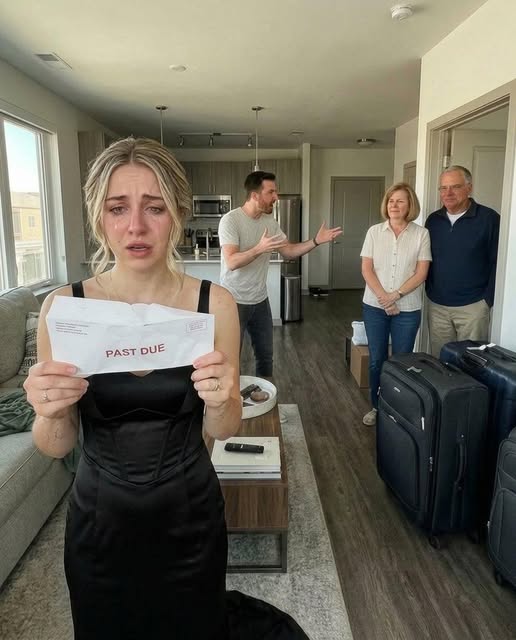
Brian’s face hardened immediately, as if my response had ruined a script he expected me to follow. “Because they’re family.”
“They sold their condo without talking to me. They moved into my house without asking. And now they’re handing me a bill?”
“Our house,” he snapped.
No. It was my house.
I had bought it five years before meeting Brian, after my first business sold and before I made the foolish, sentimental decision to add him to nothing except my heart. His name had never been on the deed. I paid the mortgage. I paid the taxes. I paid for the kitchen renovation his mother loved to brag about to her bridge club.
I placed the bill on the counter. “I’m not paying this.”
Ellen’s mouth dropped open. Richard muttered, “Unbelievable.”
Brian stepped closer. “How can you say no?”
“Very easily,” I replied. “No.”
That single word detonated the room.
His face turned red. “You are selfish. You have more than enough money and you act like everything is yours.”
“Because legally, this house is mine.”
Ellen gasped as though I had struck her.
Brian pointed toward the front door. “Then maybe you need time to think about what marriage means. Go. Spend a few nights outside; that’ll clear your head.”
I thought he would stop. I truly did.
Instead, he grabbed my overnight tote from the hall closet, stuffed it with whatever he could grab, and dropped it on the porch. Then he pushed me out after it and locked the door.
I stood there in my socks, without a coat, in the cold March wind beneath my own porch light, listening to my in-laws moving around inside my house.
At 6:12 the next morning, Brian opened that same front door—and the expression on his face told me the night had not ended the way he expected.
Because parked at the curb behind his father’s SUV were two sheriff’s cruisers, a locksmith van, and the attorney he used to laugh about for being “too aggressive.”
Mine.
Brian stepped onto the porch half-buttoned, barefoot, and pale.
He looked first at me, then at the deputies, then at the locksmith unloading his tools, and finally at Andrea Klein, my lawyer, who stood beside the mailbox in a camel coat holding a leather folder and a paper cup of coffee as if this were a routine closing rather than the collapse of my marriage.
“What is this?” Brian demanded.
Andrea answered before I could. “Good morning, Mr. Parker. My client requested civil standby while she re-entered her property after being unlawfully excluded from it.”
Richard appeared in the doorway behind him. “Her property?”
The older deputy, a broad-shouldered woman with a calm, clipped voice, said, “Sir, we need everyone to remain calm.”
Ellen pushed between them in her robe, still wearing last night’s makeup. “This is insane. She left.”
“No,” I said. “I was thrown out.”
Brian laughed once, too loudly. “You’re being dramatic.”
Andrea opened the folder. “The deed is solely in Claire Parker’s name—acquired before marriage, never transferred, never refinanced jointly.” She handed copies to the deputies and then to Brian. “The residence is her separate property under Illinois law, absent agreements or commingling sufficient to alter title, which do not exist here based on present documentation.”
Brian stared at the paper but didn’t seem to read it.
“That’s impossible,” Ellen said. “Brian lives here.”
“Yes,” Andrea replied. “At her permission.”
I had barely slept. After Brian threw me out, I drove—once I grabbed the spare keys from the magnetic box under the hydrangea planter I installed and he forgot about—to a hotel ten minutes away. I called Andrea from the parking lot shortly after midnight. By 1:00 a.m., I had emailed her the deed, tax records, security camera access, and the prenuptial agreement Brian signed with a joking smile three weeks before our wedding. He always believed documents were formalities meant for other people.
He was wrong.
“We’re married,” Brian said, finally finding his voice. “You can’t just show up with cops and throw my parents out.”
Andrea took a sip of coffee. “Actually, we’re not doing that yet. At the moment, my client is re-entering her home. After that, we’ll discuss whether your parents are guests or trespassers. And whether you remain here today depends largely on how you choose to speak to her after last night.”
The younger deputy glanced at me. “Ma’am, do you want to retrieve your belongings first?”
“I want inside,” I said.
The locksmith moved past Brian, who instinctively blocked the doorway until both deputies shifted forward together. He stepped aside. The locksmith replaced the front lock cylinder in under four minutes while my husband watched like a man observing his own obituary being written.
No one spoke when I walked back into my foyer.
The sailboat painting still leaned against the wall. Richard’s pill organizer sat on my entry table. Ellen’s monogrammed slippers were beside the couch. The bill they handed me the night before still lay on the counter where I left it, next to the carrots I never finished chopping.
My anger sharpened into something cleaner.
I turned to Brian. “You brought your parents into my home without my consent. You presented me with their expenses like I was an ATM. Then you physically removed me from this house and locked me out.”
“Oh, now it’s physical?” he snapped. “I did not hit you.”
The deputy’s expression shifted slightly at that. Andrea wrote something down.
“That is not the standard,” Andrea said calmly. “Forcing a spouse from a residence can matter in several legal contexts, particularly when combined with coercion, intimidation, and control over access.”
Richard scoffed. “Control? He’s her husband.”
“No,” I said, meeting his eyes. “He’s a man who confused access with ownership.”