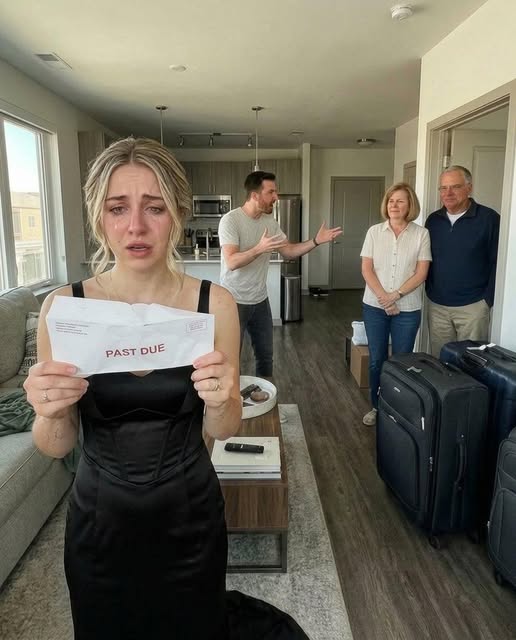
Richard spent the first hour insisting this was all a misunderstanding. Ellen cried in bursts—mostly about humiliation, occasionally about blood pressure, and once memorably about the cruelty of making seniors “feel unwelcome.” The deputies stayed until the luggage was back on the
Then he made the mistake that removed any remaining doubt.
As Richard loaded the last duffel bag into the trunk, Brian turned on him and shouted, “I did all this for you!”
The entire driveway went silent.
“For us?” Ellen said.
“Yes, for you,” he snapped. “You said if I didn’t handle this, you’d lose the storage unit, the medical equipment order, everything.”
Richard looked stunned. “We told you to talk to your wife.”
“You said she had money and that I should ‘act like a husband for once,’” Brian shot back.
That was when I understood the full picture. This had never been one bad decision. It was a slow conspiracy of entitlement. His parents believed my financial stability should naturally absorb their aging expenses. Brian believed marriage gave him the right to allocate my home, my money, and my labor without my permission. Each of them had built a story where I wasn’t a person making choices—but a resource to manage.
The divorce filing went in two days later.
Brian alternated between anger and apology with exhausting speed. One voicemail called me a vindictive narcissist. The next claimed he panicked, that his parents pressured him, that he loved me, that he only locked me out because he knew I “needed space.” Andrea told me to save everything and respond to nothing. So I did.
The legal process took eight months.
Because of the prenuptial agreement, because the house was clearly separate property, and because Brian’s financial transfers were documented, the outcome was far less dramatic than he feared and far more expensive than he deserved. He had to reimburse a large portion of the money siphoned from our joint funds, assume responsibility for several debts tied to his parents’ relocation costs, and vacate the house permanently within thirty days of the temporary order becoming final.
His parents never moved to Florida after all. The Sarasota condo they supposedly bought fell through when Brian couldn’t produce the second transfer he promised. They had sold their old place too quickly, betting on money that was never truly theirs. Richard blamed Brian. Ellen blamed me. Neither version interested me much.
What interested me was the morning, several weeks after the temporary possession order, when I walked into my kitchen and realized how quiet peace sounds. No commentary about how I loaded the dishwasher. No complaints about thermostat settings. No husband treating my boundaries like obstacles.
Just sunlight across the counters and the quiet hum of the refrigerator.
I changed the locks again. Then I renovated the guest room into an office with built-in shelves, a reading chair, and dark green walls. I donated the sailboat painting.
Months later, at a case management hearing, Brian saw me in the courthouse hallway and said bitterly, “You blew up a marriage over one argument.”
I looked at him for a long moment.
“No,” I said. “I ended a marriage because one argument revealed the truth.”
He shook his head as if I were still failing some test he designed. But he didn’t follow me. Maybe by then even he understood there was no way back to the version of me he preferred—the one who absorbed disrespect, signed checks, and called it compromise.
A year after the divorce was finalized, I heard through a mutual friend that Brian had moved into a two-bedroom rental with his parents in Mesa, Arizona. Apparently Ellen hated the dry air, Richard hated the stairs, and Brian hated “how everything turned out.”
I slept just fine.
People always think the shocking part of a story is the night someone gets kicked out.
For me, the real shock came the following morning, when Brian opened the door expecting me to be humbled, cold, and ready to apologize—and instead found deputies, a locksmith, and a lawyer waiting to inform him he had made a catastrophic mistake.
He thought a few nights outside would clear my head.
He was right.
By sunrise, I could see my marriage clearly enough to end it.