Chapter 1: The Quiet After the Storm: My eight-year-old son, Ethan, came home on a Tuesday afternoon with the weight of a grown man on his small shoulders. He didn’t slam the door. He didn’t run to his room to play with Legos. He simply walked into the kitchen, wrapped his arms around my waist, and pressed his face against my stomach. I could feel the heat radiating off him, the smell of sweat and stale air clinging to his clothes. “Dad,” he whispered, his voice dry and scratchy. “They ate at a restaurant while I waited in the car.” I froze. The dish towel in my hand stopped moving mid-wipe on the granite counter. “What did you say?” I asked, my voice dangerously calm. He pulled back, looking up at me with eyes that weren’t angry or tearful, but confused. “Grandma and Grandpa. They went into the Italian place. They left me in the parked car. I waited for two hours.” The silence that followed was heavy, suffocating. My brain tried to reject the information. It was ninety degrees outside today. A humid, stifling heat that made the asphalt shimmer. “Did they… did they leave the car running?” I asked, my hands beginning to tremble. “No,” Ethan said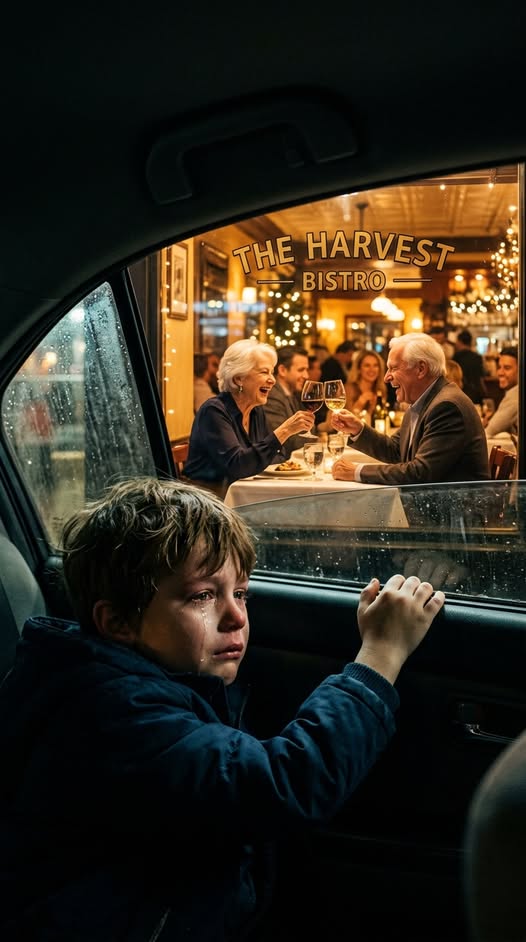
simply. “But they cracked the windows a little bit. Dad, I’m really thirsty.” I poured him a glass of water, watching him gulp it down with a desperation that turned my blood into ice. He didn’t cry. He didn’t throw a fit. He just drank the water and looked at me, waiting for me to make sense of a world that had suddenly turned cruel.
I didn’t ask any more questions. I didn’t want him to relive it yet. I told him to go sit in the living room and turn on his favorite cartoon.
As soon as he was settled, I grabbed my keys.
I didn’t think. I didn’t plan. I just drove.
The drive to my parents’ house—the house I had bought for them—took ten minutes. It was a beautiful colonial in a quiet neighborhood, a symbol of my gratitude for raising me. I paid the mortgage. I paid the property taxes. I paid the insurance. I had transferred the deed to their names privately to give them dignity, but the financial tether was entirely mine.
When I walked through the front door, the scene was maddeningly normal.
My mother was in the living room, folding a basket of warm, fluffy towels. My father was reclining in his leather armchair, a glass of condensation-slicked iced tea in his hand. The TV was murmuring in the background, some game show where people won money for answering trivia.
They looked up as I entered. They didn’t even look guilty. They looked comfortable.
“Hey, you’re here early,” my dad said, taking a sip of his tea. “Ethan get home okay?”
I stood in the entryway, my hands clenched into fists at my sides. I wasn’t sure if I was going to scream or vomit. The image of my son, sweating and alone in a stifling car while they sat in air-conditioned comfort, flashed in my mind.
“You have twenty-four hours,” I said. My voice sounded foreign, like it was coming from underwater.
My mom paused, a towel mid-fold. “What?”
“You have twenty-four hours to pack your things,” I repeated, louder this time, the rage finally bleeding through. “You are leaving this house.”
My dad laughed. It was a sharp, dismissive sound. “What the hell are you talking about? Is this a joke?”
“Do you think it’s a joke that you left your grandson locked in a car for two hours?” I stepped further into the room, my presence sucking the air out of the space. “Do you think it’s funny that he came home dehydrated and confused while you drank iced tea?”
The color drained from my mother’s face. It was the first time in years I had seen her look truly afraid.
“Is it true?” I demanded.
They didn’t deny it. They didn’t even try to lie.
“He didn’t want to come in,” my mom stammered, wringing the towel in her hands. “He was being fussy in the car. He threw a little fit about his shoes. We figured… we figured it would be better to let him sit and cool off.”
“Cool off?” I roared. “In a ninety-degree car?”
“We cracked the windows!” my dad shouted back, defensive now. “And we checked on him halfway through. It was only two hours, for God’s sake. Stop being dramatic.”
“Who were you with?” I asked. I already suspected the answer.
“We met your sister,” my mom said quietly. “And the grandkids.”
There it was. My sister, Sarah. Her two children. A table for five at a nice Italian restaurant. They hadn’t just forgotten him; they had actively excluded him. They had made a reservation that didn’t include him.
“You sat there,” I said, my voice shaking, “eating pasta, laughing with Sarah and her kids, while my son sat in a parking lot like a dog?”
“Sarah’s kids know how to behave,” my dad snapped. “Ethan has been… too much lately. He asks too many questions. He’s restless. If I want to have a nice meal, I shouldn’t have to babysit.”
That was the moment the bridge burned. I watched the ashes fall.
I had known about the favoritism for years. We all knew. They had sold their first home to fund Sarah’s boutique—a business that failed in eight months because Sarah didn’t like waking up before noon. When I confronted them then, they told me I was the strong one, the independent one. Sarah needs help, they said. You don’t.
So I helped. I paid their bills. I bought them cars when theirs broke down. I bought this house so they wouldn’t have to rent. I did everything a good son is supposed to do, thinking eventually they would see me.
But this wasn’t about favoritism anymore. This was cruelty.
“Get out,” I said.
“You can’t do this,” my dad sneered. “This is our house.”
“Check the title again,” I lied. Technically, the transfer was complete, but I held the power of attorney and the financial leverage that kept the lights on. “Twenty-four hours. Or I change the locks with your stuff inside.”
I turned around and walked out. I didn’t look back.
I drove home, my heart hammering against my ribs like a trapped bird. Ethan was on the couch, watching a sponge live in a pineapple, looking so small and breakable. I didn’t bring it up. Not yet. I just sat next to him and let him lean against me.
I thought that was the end of the immediate conflict. I thought the ultimatum would shock them into silence.
But the next morning, my phone rang. It wasn’t my parents. It was Sarah. And she wasn’t calling to apologize.
Chapter 2: The Paper Shield
“You are such a drama queen,” Sarah said the moment I answered. No hello. No ‘how is Ethan?’
“Nice to hear from you too,” I said, putting the phone on speaker as I made Ethan’s breakfast.
“Mom called me crying,” she continued, her voice shrill. “She said you burst in there screaming like a lunatic and threatened to make them homeless because of a misunderstanding. You need to grow up.”
“A misunderstanding?” I laughed, a cold, humorless sound. “Did she tell you they left Ethan in a car while they ate lunch with you? Did she mention that?”
“He was throwing a tantrum,” Sarah said dismissively. “Mom said he was unmanageable. Look, you can’t kick them out. They’re elderly. You’re overreacting.”
“Did you know?” I asked.
“Know what?”
“Did you know my son was in the car while you were eating your linguine?”
There was a pause. A beat of silence that told me everything.
“I thought he was with a sitter,” she lied. I could hear it in her tone. “Look, fix this. Apologize to Dad. He’s furious.”
“I’m not fixing anything,” I said. “And since you’re so concerned, maybe they can come live in that apartment I helped pay for.”
I hung up.
I didn’t go to work that day. Instead, I called a lawyer friend of mine. We drafted a Notice of Termination of Tenancy. Even though the deed transfer had happened, there was a clause—a beautiful, overlooked clause—about “gross negligence regarding family welfare” that was tied to the private annuity I paid them. It was a stretch legally, but as a threat? It was nuclear.
I printed the document. It looked official, sharp, and final.
I drove back to the house. I didn’t go inside. I put the envelope in the mailbox, took a photo of it with the timestamp, and texted my dad: Check the mail.
Within an hour, my phone exploded.
My mother sent screenshots of receipts from twenty years ago—money they had lent me for textbooks in college. Is this how you repay us? she texted. We sacrificed everything for you.
My dad tried a different tactic. Guilt. You are tearing this family apart. Over a lunch. You are letting a child dictate the hierarchy of this family.
I read the messages in the parking lot of my lawyer’s office. I didn’t feel guilty. I felt clarity.
This wasn’t just about the restaurant. That was just the symptom. The disease was decades old. It was the way they looked at Sarah like she was a porcelain doll and looked at me like I was a mule. It was the way they treated Ethan—bright, energetic, curious Ethan—like an inconvenience because he wasn’t as docile as Sarah’s kids.
I went back to the house at the twenty-four-hour mark.
Nothing was packed.
My dad was sitting on the edge of the couch, his cane resting between his knees. My mom was in the kitchen, aggressively scrubbing a pot that was already clean.
“You’re still here,” I said.
“We aren’t going anywhere,” my dad said, not blinking. “You’re bluffing. You wouldn’t do this to your own blood.”
“Do you understand why this is happening?” I asked one last time. I needed to know. I needed to hear if there was any remorse buried under the ego.
My dad looked me in the eye and said, “Your son brings this on himself. He acts out. He doesn’t listen. We weren’t going to reward bad behavior with a nice meal. Maybe next time you should teach him how to sit still if you want him included.”
The air left the room.
“That’s it,” I whispered.
“What?”
“That was the final nail,” I said. “I’m changing the locks tonight. If you aren’t out, I’m calling the sheriff to escort you off the property for trespassing. And don’t think I won’t. I have the receipts, Dad. I have the utility bills. I have the proof that you are guests in my investment.”
I walked out to the driveway where a white van had just pulled up. The locksmith.
My parents watched from the window as I shook the man’s hand. That was when the reality hit them. They saw the drill.
My dad rushed out the front door, stumbling a bit. “You can’t do this! This is insane!”
“It’s done,” I said to the locksmith. “Rekey everything. Front, back, garage.”
“You’re punishing us!” my dad shouted, spit flying from his lips. ” over a mistake!”
“Would you have done it to Sarah’s kids?” I asked quietly.
He opened his mouth to answer, but stopped. His eyes shifted away.
“That’s what I thought,” I said.
That night, my mom texted me the address of the Motel 6 they checked into. She added a message: I hope you explain to your son someday that he made his grandparents homeless.
I didn’t reply. Instead, I sat down with Ethan. “Buddy,” I said gently. “Tell me exactly what happened.”
And he told me the truth—a truth that was so much worse than I imagined.