Chapter 1: The Price of Illusion: For one hundred and fifty-six consecutive weeks, I functioned as a human ATM. My name is Claire Evans. I am thirty-four years old, a pediatric nurse at Cook County General in Chicago, and for three solid years, I wired exactly $750 every Friday morning to the two people who spent my entire childhood teaching me that affection was a commodity I had to purchase. The electronic transfer usually triggered during my fifteen-minute coffee break. I would be standing in the sterile glare of the staff breakroom, my scrubs smelling faintly of antiseptic and pediatric cherry syrup, exhausted from checking oxygen sats and comforting weeping parents whose lives were unraveling in the ICU. I literally bled empathy for a living, yet every Friday, I dutifully deposited a massive chunk of my salary into the checking account of two adults who had never once offered me a safety net. The morning my daughter, Lily, turned seven, I sat on the edge of my mattress and stared at the glowing confirmation screen of that week’s transaction. Then, I looked up at the frilly, sequined pink party dress hanging from the closet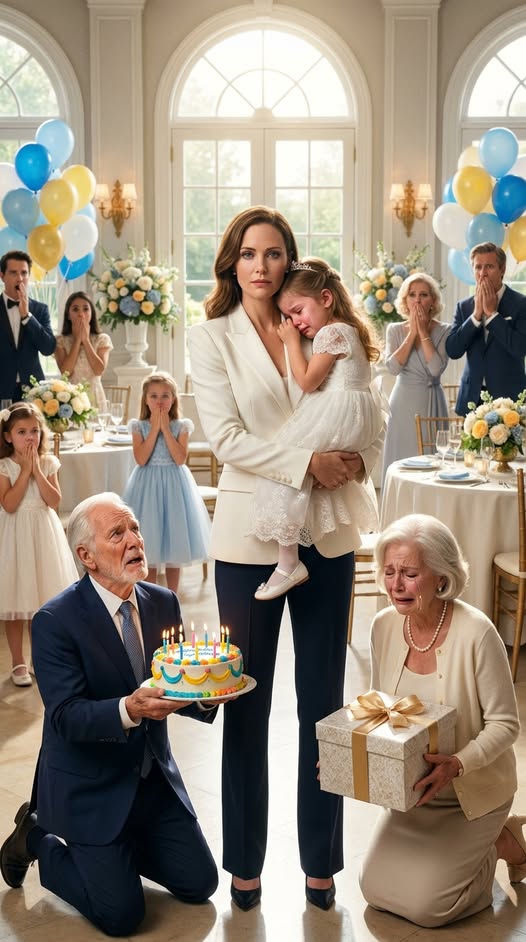
doorknob. For the very first time, the emotion swelling in my chest wasn’t my usual, dull resentment. It was a sharp, burning humiliation. I wasn’t embarrassed for them; I was mortified for myself. Because deep in the marrow of my bones, I already knew I was funding two people who couldn’t even
summon the basic human decency to pretend they cared about the little girl who had been vibrating with excitement all month just to see them.
Lily had spoken about her grandparents all week as if they were visiting dignitaries. She had meticulously set aside two specific cupcakes on a plastic platter. One was slathered in bright blue buttercream because she recalled my mother, Eleanor, once offhandedly mentioning that navy blue was an “elegant” color. The other was buried under a mountain of rainbow sprinkles because she mistakenly believed my father, Arthur, enjoyed “fun things.” I didn’t have the heart to tell her I couldn’t remember a single instance in three decades where my father smiled at anything that didn’t directly benefit his bank account.
I kept lying to myself. I kept whispering that they would show up today, because even the most profoundly narcissistic people can usually cobble together a two-hour performance when a child’s birthday is involved. But the phantom of my past knew better. I remembered every ballet recital they skipped, every holiday visit they abruptly canceled, every flimsy excuse that miraculously materialized the exact second their property taxes, car insurance, or grocery bills were due.
I wish I could claim I had a grand epiphany before that afternoon. But the ugly truth is that I saw the dynamic perfectly clearly. I just kept financing it anyway.
Lily’s party kicked off at three o’clock. By two-thirty, our cramped two-bedroom apartment looked as though a manic pixie had detonated a glitter bomb inside it. Crooked crepe-paper streamers sagged from the ceiling fans. Hand-cut silver stars were taped haphazardly to the drywall, and the cramped dining table was buckling under the weight of heart-shaped sandwiches, bowls of sliced strawberries, and a leaning, three-tier vanilla cake I had absolutely no business attempting to bake after pulling a double overnight shift.
But Lily had requested a “royal princess gala.” And when your child asks for something with her whole, unblemished heart, you manifest energy from a reserve tank you didn’t know existed.
She spun across the living room rug in her white ruffled socks and that carefully chosen pink dress, tightly clutching a faded Polaroid photograph from the previous year. In the picture, she was perched on my lap in front of a cheap supermarket sheet cake, wearing a paper crown. Visible in the background were two empty dining chairs she had stubbornly insisted we leave open, “just in case.”
She trotted over, holding the photo up to my face. “Do you think Grandma will wear pink today so we match?”
I forced a smile so wide my cheeks ached. “Maybe, bug. Maybe she will.”
Children do not process emotional abandonment the way adults do. They don’t analyze the subtext. They simply, stubbornly believe that the people designated by biology to love them will eventually step up to the plate. That pure, blind faith is what makes moments like that physically unbearable to witness.
The guests arrived in a chaotic, joyful wave. First came her loud, sticky-fingered classmates dragging colorful gift bags. Then the neighbors from 4B. Then my closest friend, Rachel, who burst through the door carrying a helium balloon arrangement the size of a small car and enough radiant warmth to heat the entire apartment block.
Every single time the intercom buzzer shrieked, Lily’s head snapped toward the door, her face illuminating with a desperate, glowing hope. And every single time the door opened to reveal someone who wasn’t Arthur and Eleanor, she masked her disappointment just a fraction of a second too quickly.
That micro-expression of suppressed heartbreak was agonizing. She didn’t pout. She didn’t throw a tantrum or ask Where are they? in front of her friends. She just kept glancing at the entryway with a tight, brave little smile.
At one point, I found her kneeling by the coffee table, her tongue poking out in concentration as she aggressively dragged a silver crayon across a piece of construction paper. She had drawn herself, me, a towering cake, and two disproportionately tall stick figures with gray hair.
“I’m making a map for Nana and Grandpa,” she murmured without looking up. “So when they get here, they know exactly where they’re supposed to stand.”
I have stabilized crashing infants in the ICU. I have calmly directed terrified parents while cardiac alarms shrieked in my ears. But that single, innocent sentence nearly buckled my knees.
Still, I kept moving. I poured pink lemonade. I sliced the leaning cake. I adjusted slipping paper tiaras. Outwardly, I was the picture of a joyful, exhausted mother hosting a perfect seventh birthday. Inwardly, I was a prosecuting attorney, logging every passing minute as damning evidence.
By the time the lights were flicked off and the candles were lit, casting a warm, flickering glow across Lily’s face, I knew with absolute certainty my parents were not coming.
Lily squeezed her eyes shut to make a wish. But right before she blew, her eyelids fluttered open, and she shot one final, desperate glance toward the locked front door. She was checking, just one last time, to see if love had merely gotten stuck in traffic.
The party eventually wound down. The final guest departed, leaving the apartment echoing with the soft, depressing squeak of deflating Mylar balloons. Lily walked quietly into the kitchen, holding the plastic plate with the untouched, blue-frosted cupcake.
She looked up at me, her eyes pooling with a quiet, devastating confusion. “Did they forget me, Mommy? Or are they just coming after dinner?”
That question was the exact moment the illusion shattered. It was no longer a matter of dealing with selfish parents. It was a brutal mirror held up to my own face, forcing me to decide what kind of mother I was going to be tomorrow. Would I be the mother who continued to sanitize and subsidize their cruelty? Or would I finally strike the match and burn the bridge to the ground?
Chapter 2: The Severed Wire
I gave Lily a warm bubble bath, read her two extra bedtime stories, and tucked her under her dinosaur quilt. I spent twenty minutes gently convincing her that grown-ups are sometimes hopelessly terrible at managing their schedules, but that their absence had absolutely zero correlation to how infinitely lovable she was.
When her breathing finally leveled out into the soft rhythm of sleep, I walked back into the kitchen.
The apartment looked like the aftermath of a riot. Shredded wrapping paper coated the floorboards. Smears of pink buttercream were hardening on paper plates. And sitting right beside the stainless-steel sink was that single, blue-frosted cupcake. The frosting was slowly caving inward, melting under the heat of the under-cabinet lighting. I stared at it as if it were a cryptographic puzzle waiting to be decoded.
At 9:42 PM, I picked up my phone and dialed.
My father answered on the fourth ring. His tone wasn’t apologetic; it was thick with the distinct, abrasive irritation of a man who felt his evening television viewing had been unjustly interrupted.
I didn’t yell. I didn’t unleash years of buried resentment. I asked one simple question, and I kept my voice terrifyingly soft.
“Why didn’t you come to Lily’s party?”
A heavy pause stretched across the cellular connection. I could hear the canned laughter of a sitcom blaring in the background. Then, my mother’s voice filtered through the audio, muffled but sharp. “Who is bothering us at this hour?”
Arthur answered her first. “It’s Claire.” He brought the receiver back to his mouth and let out a short, dismissive scoff—a sound that instantly violently catapulted me back to every single moment of childhood invalidation. “We weren’t needed there, Claire. It’s a child’s chaotic mess.”
I gripped the edge of the granite countertop so fiercely my knuckles turned ivory. “She waited for you. She checked the door all day.”
Another pause. I heard the rustle of the phone being aggressively snatched away. When my mother spoke, the absolute, chilling calmness of her voice was the most horrifying part. There was zero guilt. Zero maternal discomfort. Just that composed, clipped cadence she deployed whenever she wanted to reduce my bleeding emotions into an irritating logistical error.
“Claire, stop making a theatrical production out of this,” Eleanor commanded. “We are not restructuring our entire weekend around a first-grader’s sugar high. Lily means nothing to us in any real, practical sense. You made the choice to have a child. That makes her your burden, not ours.”
I didn’t react immediately.
My physical body did, though. Every muscle fiber in my back locked into place. My breathing turned shallow and rapid. I could hear the violent thud of my own pulse hammering in my eardrums like a tribal war drum.
I forced myself to ask the most humiliating, degrading question I have ever uttered to another living soul. “After everything I sacrifice to keep you afloat… that is really how you view my daughter?”
Arthur snatched the phone back. He was furious now, likely because he realized Eleanor had just callously spoken the quiet, unspoken contract out loud.
“Do not dare start throwing the money in our faces!” he barked, his voice echoing in my kitchen. “Sending a wire transfer does not purchase our total subservience! You provide financial assistance because it is your moral duty. We kept a roof over your head for eighteen years. You still owe us that debt. Do not expect us to play the role of doting, fairy-tale grandparents just because your kid is begging for a spotlight.”
Your kid. Not Lily. Not your daughter. Not our granddaughter. Your kid. He spat the words as if she were a stray dog I had recklessly dragged into their pristine living room.
And just like that, the dam broke. A torrential flood of ugly, repressed memories violently rearranged themselves in my mind. The time Lily had a 103-degree fever, and I called them from the ER begging for an hour of childcare so I wouldn’t lose my hospital job, only for Eleanor to sigh and say, “I do not subject my immune system to sick toddlers.” The Thanksgiving they arrived four hours late, ate my food, and spent the entire meal aggressively hinting that their winter heating bill was “catastrophic.” The birthday card they mailed Lily last year that contained no gift, no handwritten message—just a sticky note on the envelope asking me to cover their car registration.
Suddenly, the horrific architecture of our relationship was bathed in blinding, undeniable light.
I had not been compassionately supporting two struggling, emotionally stunted parents. I had been subsidizing two emotional extortionists who felt supremely entitled to the sweat off my back, while remaining aggressively indifferent to the piece of my soul sleeping in the next room.
That subtle distinction changed the entire molecular structure of my universe.
While Arthur was still ranting through the speaker, aggressively explaining the concept of “filial piety” as if I were a subordinate employee refusing a mandatory shift, I pulled the phone away from my ear. I opened my mobile banking app.
My hands were shaking with such violent tremors that FaceID failed twice. I typed in my passcode.
The recurring weekly transfer was sitting right there on the dashboard. Neat. Routine. Disgustingly parasitic. $750.00 – Arthur & Eleanor Evans. Frequency: Weekly.
I tapped ‘Manage’. I hit ‘Delete Series’.
Then, I scrolled down to the backup overdraft protection transfer I had established months ago, just in case my chaotic nursing shifts caused a primary payment to bounce. I annihilated that one, too.
Then, because something much deeper and darker than mere anger had seized the wheel of my brain, I calculated the exact sum of what would have been their next three months of funding. I transferred that entire block of capital into a newly opened, high-yield savings account. I typed Lily’s College Fund into the nickname box and slammed the confirm button before my deeply ingrained conditioning could intervene.
My mother’s voice was squawking from the phone speaker resting on the counter, accusing me of “hysterical dramatics.” But her voice sounded incredibly small now. Millions of miles away.
My entire nervous system was vibrating, but not from indecision or fear. It was the electric hum of absolute, crystalline clarity. Forty-five minutes after my parents explicitly declared my child meant nothing to them, the financial life support was severed.
Not reduced. Not paused pending an apology. Completely, irreversibly severed.
I tapped the red end-call button, silencing them mid-sentence. I stood alone in the quiet kitchen, staring at the blue cupcake. For the first time in my thirty-four years, I realized that aggressively cutting someone out of your life is not always an act of blind rage. Sometimes, it is simply the first honest boundary you have enforced in a lifetime of servitude. But as I finally dragged myself to bed, a dark certainty settled over me: people like Arthur and Eleanor do not surrender their primary revenue stream without declaring war.
Chapter 3: The Currency of Guilt
I woke up the next morning feeling as though I had been physically beaten by a hurricane. My sternum ached, my eyes felt like they were lined with sandpaper, and for one blissful, disorienting microsecond, my brain forgot the apocalypse of the previous night.
Then, my eyes locked onto the drooping pink Happy Birthday banner hanging above the television console, and the memories crashed over me like a tidal wave of ice water.
Lily padded into the kitchen a moment later. She was wearing her favorite fleece dinosaur pajamas, her blonde hair a chaotic bird’s nest, her voice raspy with sleep. “Mommy,” she mumbled, rubbing one eye. “Can we have chocolate chip waffles for breakfast? Because I think birthdays are supposed to last for at least two days.”
I dropped to one knee and pulled her into a fierce, bone-crushing hug. “Yes,” I whispered into her messy hair. “We can absolutely have waffles.”
If there was one universal truth I understood with painful, radiant clarity this morning, it was that childhood is desperately short, and it should never be forced to carry the toxic baggage of adult damage a single second earlier than necessary.
I manufactured a smile. I poured the batter, packed her favorite snacks into her lunchbox, carefully braided her hair into two neat French plaits, and drove her to school. I sat in the idling car and watched her walk through the heavy double doors, her pink sequined backpack bouncing against her spine, throwing her signature, trusting little wave over her shoulder before she vanished into the hallway.
I stayed parked in the school drop-off zone much longer than usual. I gripped the leather steering wheel, closed my eyes, and finally allowed myself to truly process the magnitude of what I had done.
The sheer lack of grief astonished me. I had braced myself for a tidal wave of crippling, programmed guilt. I expected a panic attack. Instead, my chest felt expansive. It felt as though a high-voltage wire that had been buzzing frantically under my skin for decades had finally been snipped.
At exactly 10:17 AM, my cell phone screen illuminated the dark cabin of the car.
It was a text from Eleanor.
Send the wire transfer today. The HOA special assessment is due at noon, and your father’s debit card has already been declined at the pharmacy.
I read the stark, black text twice. I scoured the glowing pixels for any trace of humanity. There was no mention of Lily. No feigned remorse. No backpedaling. Not even a manipulative “we shouldn’t have lost our tempers last night.” Just cold, hard logistics. A sheer, unadulterated demand for capital.
Less than forty seconds later, a second message materialized.
We are not discussing the unpleasantness of last night. We spoke out of frustration because you cornered us. Do not behave irrationally over mere emotions.
I actually laughed out loud in the empty car. It was a sharp, jagged sound that startled me.
Over mere emotions. She typed those words as if a seven-year-old girl sitting by a door all day waiting for grandparents who later explicitly declared she was “nothing” to them was just a hormonal misunderstanding I was blowing out of proportion. In their twisted reality, their total dependence on my nursing salary was a matter of urgent practicality, while my daughter’s shattered heart was simply irritating theatricality.
I stared at the keyboard. I typed out three highly aggressive, profanity-laced paragraphs detailing their psychological rot. I erased every single one. Engaging in emotional warfare with emotional terrorists is a losing game.
Instead, I typed the only response that felt clean, sterile, and impenetrable enough to stand on.
You made your position regarding my daughter crystal clear last night. I am making my position clear today. There will be no further financial transfers. Do not attempt to contact Lily. I wish you the life you have chosen.
I hit send.
The three gray typing dots appeared at the bottom of the screen almost instantaneously. They vanished. They reappeared. Before Eleanor could even formulate her rage into text, my phone began vibrating violently. Arthur was calling.
I let it ring until it went to voicemail.
Immediately, Eleanor called. Then Arthur again. Then an unrecognized number that I knew belonged to the local branch manager of the bank they used in their suburb. I tossed the phone onto the passenger seat, threw the car into drive, and felt something deep inside my ribcage calcify into an unbreakable shield.
By my lunch break at the hospital, Arthur had left a lengthy voicemail. His tone had drastically shifted. The abrasive arrogance was gone, entirely replaced by a thin, reedy thread of genuine panic.
“Claire, listen to me,” his recorded voice crackled through the phone speaker. “You do not have the right to execute something like this without a formal warning period! We budgeted our lives around that deposit! You cannot destabilize elderly people over one emotional overreaction to a conversation! Call me back before you make this situation significantly worse.”
Worse. I sat in the hospital cafeteria, staring at a lukewarm cup of coffee, letting that specific word marinate in my brain. Worse than what? Worse than actively teaching my innocent daughter that adults can insult her, neglect her, strip-mine her mother’s bank account, and still be rewarded with unlimited access simply because they share DNA? Worse than rewarding thirty years of emotional starvation with an automated direct deposit? Worse than watching a little girl look at a locked door while blowing out her birthday candles?
Around 2:00 PM, Eleanor deployed a different tactic. She sent a massive wall of text completely saturated with weaponized guilt and historical distortion. She practically itemized every meal I ate as a teenager. She preached that children who abandon aging parents over “one bad night” are cursed. She dramatically added, You know how much blood pressure trouble your father is dealing with right now. As if a medical diagnosis were a blank check for psychological abuse.
I didn’t reply. Instead, I opened my personal budgeting app. I deleted their $750 weekly line item and stared at the projected surplus.
It was almost offensive how radically my financial reality transformed. I could fully fund Lily’s 529 plan. I could build an actual, robust emergency fund. I could enroll her in that elite summer dance camp without secretly calculating which utility bill I would have to delay. I could finally afford the braces she would need next year without lying awake at 3:00 AM gripped by financial dread. I could breathe.
At 4:06 PM, a final, chilling voicemail arrived from Arthur. He had dropped the victim routine entirely.
“If you do not wire a minimum of five hundred dollars by six o’clock tonight, we are going to have severe problems, Claire. I mean it.”
There it was. The absolute, unvarnished truth.
They were not grieving the sudden loss of their daughter or granddaughter. They were grieving a disrupted revenue stream. And once I saw that ugly reality stripped bare, a profound sense of peace washed over me. Some people never confuse love with money, because to them, love has only ever been the most effective manipulation tactic to extract money.
I deleted the voicemails. But I knew Arthur. He wouldn’t stop at digital harassment. If I wanted to ensure this disease didn’t spread to my daughter, I had to sever the root of the infection in person.
Chapter 4: The Oak Park Confrontation
I never intended to drive out to their manicured suburb. But after three days of relentless, escalating digital harassment, the situation mutated. It wasn’t just Arthur and Eleanor anymore; their panic had activated the extended family network. My phone was flooded with guilt-drenched text messages from cousins and aunts I hadn’t spoken to in years, all dispatched as flying monkeys to bully the rogue ATM back into compliance.
I didn’t drive to Oak Park because I required “closure.” Closure is a luxury buzzword utilized by people who have never had to fight a bloody war for basic emotional truth. I drove there because I needed to deliver my final verdict looking them dead in the eye, stripping them of the ability to crop my text messages or manipulate my tone to their sycophantic friends.
Their upscale townhouse looked exactly as it had for the last decade. A pristine brass welcome plaque polished to a mirror shine. Impeccably trimmed boxwood hedges they routinely complained they couldn’t afford to maintain. It was the quintessential facade of upper-middle-class stability, broadcasting success to the neighborhood while the foundation underneath was completely rotting from financial and moral insolvency.
I marched up the brick pathway and knocked.
Eleanor threw the door open before my knuckles could strike the wood a second time. She was wearing a tailored cashmere cardigan, her hair perfectly coiffed. Her eyes immediately darted behind me, scanning the driveway. When she realized I had come alone, without Lily and without a checkbook, the mask of maternal concern instantly hardened into a sneer.
“So, you finally decided to stop throwing a tantrum and act like a responsible adult?” she scoffed, crossing her arms.
I stepped over the threshold. The first thing I noticed was a stack of final-notice utility bills shoved hastily under a decorative crystal bowl on the entryway credenza. That visual told me everything I needed to know about their current leverage.
Arthur emerged from the kitchen, his face flushed with rehearsed, self-righteous anger. “You have deeply embarrassed us, Claire,” he barked, pointing a thick finger at my chest. “Your Aunt Martha called this morning demanding to know why your mother was in tears. Do you have any concept of what that kind of stress does to people at our age?”
I stood in the center of their foyer and almost applauded the psychological technique. At our age. He weaponized his literal existence as an entitlement to my income.
“And what exactly did you tell Aunt Martha?” I asked, keeping my voice terrifyingly level. “Did you tell her that your daughter cut off your allowance because you missed one single party?”
Eleanor scoffed. “Which is the absolute truth!”
“No,” I fired back, my voice slicing through the air like a scalpel. “The truth is that you explicitly told me my daughter means absolutely nothing to you. The truth is that you have systematically siphoned three thousand dollars a month from my bank account while treating Lily like an irritating parasite. The truth is you arrogantly expected me to continue financing your luxury lifestyle after you said the quiet, sociopathic part out loud.”
Arthur took an aggressive step forward, trying to use his physical size to intimidate me. “You are deliberately blowing one frustrated sentence entirely out of proportion!”
“Which specific sentence, Arthur?” I asked, refusing to yield an inch of ground. “The part where you said my seven-year-old is a meaningless burden? Or the part where you demanded I pay you back for the basic legal requirement of keeping a roof over my head when I was a minor?”
That landed. A heavy, suffocating silence descended on the foyer.
Then, Eleanor executed her signature defensive maneuver. When cornered by undeniable facts, she escalated volume.
“You are a deeply selfish woman!” she screamed, the veins standing out on her neck. “You have always been selfish! The exact second you got pregnant with that child, everything in this universe became exclusively about your feelings, your exhausting nursing schedule, your pathetic life! We needed financial assistance! You had the disposable income to provide it! That is what family does!”
“No,” I said softly. The quieter I spoke, the more frantic she became. “That is what exploitation does. A family does not tell a little girl she is unwanted through their chronic absence. A family does not collect an extortion fee every Friday and still refuse to show up for a slice of cake.”
Arthur’s expression morphed from blustering outrage to something significantly uglier—the exact expression of a parasite realizing the host has definitively died.
“Do you understand the catastrophic damage this will do to us?” he hissed, his voice dropping into a menacing register. “We have mounting HOA fees. We have property taxes. We are severely behind because we expected—”
He choked on the word, snapping his mouth shut, but the damage was done.
Expected. There it was. The entire, twisted architecture of our bloodline summarized in a single, three-syllable word. Not appreciated. Not relied upon.
“You expected me to finance your illusions,” I finished for him. “And I expected you to love my daughter enough to sit in my living room for two hours. It appears we were both fatally wrong.”
Eleanor’s eyes narrowed into dark, hateful slits. “If you walk out that door over this, Claire, do not dare come crying back to us when Lily asks why she doesn’t have any grandparents.”
That threat was supposed to be the kill shot. Ten years ago, it would have shattered me. Today, it merely clarified my purpose.
“When Lily asks,” I replied, staring directly into my mother’s eyes, “I will tell her the absolute truth in a vocabulary a child can safely carry. But I will never, ever teach her that love is a commodity you have to purchase from people who resent giving it.”
I turned my back on them and walked out the door.
Arthur chased me out onto the porch, his desperation overriding his dignity. He hissed, loud enough for the neighbor watering her hydrangeas to hear, “Cutting us off financially at our age is the exact same thing as killing us slowly!”
I paused at the top of the brick steps. I looked back at the man who had traded his daughter’s love for a direct deposit.
“No, Arthur,” I said, the late afternoon sun warming my face. “I’m just refusing to die alongside you.”
I got into my car, locked the doors, and drove away. I watched him shrink in the rearview mirror, standing speechless on his pristine porch, realizing that for the first time in his life, I had left him absolutely no room to cast me as the villain. But as I merged onto the highway, my phone buzzed with a social media notification. The private war was over; the public smear campaign had officially begun.