The room went absolute zero. The beeping of the heart monitor seemed to amplify in the heavy silence. Dr. Thorne slowly raised an eyebrow. “Fixed what he… bought?” The sheer, venomous objectification of the statement hung in the air, a confession wrapped in arrogance. The bay doors hissed open. Two uniformed police officers strode into the room. They had already been briefed by the triage nursing staff about the highly suspicious bruising on my arms. They didn’t walk to the foot of my bed to ask how I was feeling. They walked directly to Caleb. “Sir, step away from the bed and keep your hands where I can see them,” the taller officer commanded. Dr. Thorne turned his back on the chaos. He leaned down over me, his face close to mine, blocking out Caleb, blocking out Lydia. “Maya,” he said softly. His eyes were anchors in the storm. “They can’t hurt you here. You are safe. Look at me. Tell me about the floor. Tell me about the bruises on your arms.” I looked past him. I saw the police officers forcing Caleb’s hands behind his back. I saw the man who had systematically tried to erase my mind, my body, and my motherhood, being reduced to a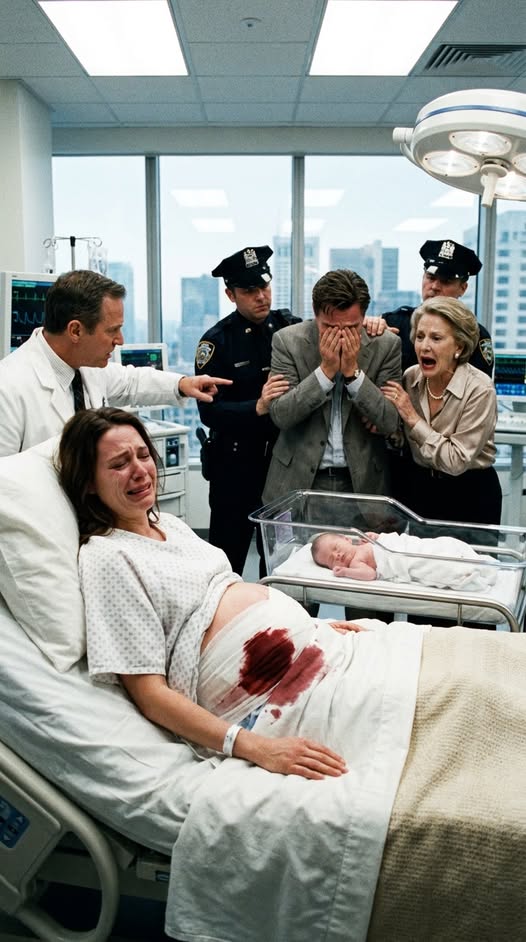
suspect in a sterile hospital room. For the first time in ten agonizing days, I drew a breath that didn’t taste like fear. The physical pain was excruciating, but the psychological chains were suddenly, violently gone. “They held me down,” I whispered. My voice was a rasp, but with every syllable, a piece of my soul snapped back into place. “Noah was crying. I tried to feed him. Lydia shoved me. Caleb grabbed my arms and twisted them behind my back. They held me down, and they watched me rip.” As the steel handcuffs ratcheted tightly around Caleb’s wrists with a sharp click, he
thrashed against the officers. His eyes were wide, feral, and locked onto mine.
“You think you’ve won?” he screamed, spitting the words across the room as they dragged him backward. “You think this changes anything? My mother already took the baby to the car before the ambulance arrived! You will never, ever find your son!”
5. The Reconstruction of a Life
The following months were a dizzying blur of sterile white hospital walls and the heavy, mahogany-paneled silence of state courtrooms.
I didn’t lose my son. Dr. Thorne had called the police dispatcher the moment he initiated the Code Gray. State troopers intercepted Lydia’s black SUV on the interstate just three miles from the state line. She was sitting in the back seat, holding Noah, her passport sitting on the dashboard. She was arrested on the spot for kidnapping and complicity in aggravated assault.
I had to learn to walk again. It wasn’t just a physical rehabilitation; it was an emotional excavation. I spent six weeks at a specialized postpartum trauma recovery center. My abdomen had to be reopened, the necrotic tissue excised, and the muscles painstakingly reconstructed. It was a brutal recovery, but this time, the wounds were healing under the care of doctors and nurses who actually listened, who didn’t dismiss my pain as a symptom of a “dark place.”
Caleb’s trial was a public spectacle. He arrived in court wearing his tailored suits, flanked by a phalanx of expensive defense attorneys who tried to paint me as a deeply disturbed, self-harming woman.
But forensic evidence does not care about high-frequency trading portfolios.
Dr. Elias Thorne took the stand. With clinical, devastating precision, he dismantled Caleb’s narrative. He projected the high-resolution photographs of the bruises on my arms for the jury, explaining the biomechanics of forced restraint. He explained the directional shearing of the surgical staples.
And then came the ultimate irony. The video Caleb had secretly recorded of me scrubbing the floor—the footage he intended to use to prove my “compulsive insanity” in a custody battle—backfired spectacularly. The prosecution subpoenaed his cloud storage. They played the video for the jury. They didn’t see a crazy woman. They saw a pale, terrified, post-surgical mother being psychologically tortured and treated like a slave in her own home. They heard Caleb’s chilling, calculating whisper.
Caleb’s “golden boy” life evaporated in that courtroom. He was convicted of domestic battery and reckless endangerment.
When I finally walked out of the heavy brass doors of the courthouse for the last time, the crisp autumn air hit my face like a blessing. I held Noah securely against my chest in a soft fabric carrier.
I saw Dr. Thorne standing near the bottom of the granite steps, holding a worn leather briefcase. I walked down to him. He didn’t offer a dramatic speech. He just looked at me, looked at my sleeping son, and gave a slow, respectful nod.
“You were right, Doctor,” I said, my voice steady, feeling the strength of the reconstructed muscles in my core. “It was a crime scene. But now, it’s just my past.”
I walked to my car, carefully buckling Noah into his car seat. I climbed into the driver’s seat, ready to start the engine, ready to start my life.
My newly replaced phone buzzed in the cup holder. It was a text message from an unknown number. I opened it.
It was a photograph. It was a picture of me, taken from a distance, standing on the courthouse steps talking to Dr. Thorne just moments ago. Beneath the image was a single line of text: “Caleb’s plans have allies you never knew about.”
6. The Architecture of Strength
Time, I learned, is the ultimate builder. It takes the shattered remnants of a foundation and shows you exactly where the new steel needs to go.
Three years later, the glass house in Westchester was nothing more than a bad memory, sold off to liquidate Caleb’s assets to pay for my civil restitution.
I stood in the center of a brightly lit stage in a massive auditorium in Chicago, looking out at an audience of hundreds of medical professionals, social workers, and lawmakers. I was no longer an architect of buildings. I was an architect of survival.
I had become a vocal advocate, fighting against the weaponization of maternal mental health, lobbying for stricter protocols when women reported pain that was too easily dismissed as “postpartum anxiety.”
“Postpartum is a time of incredible, raw vulnerability,” I told the silent, captivated room, my voice echoing clearly through the microphone. “But vulnerability is not the same as insanity. My stitches ripped because I fought for my life, and I am here standing before you today because one doctor chose to look at the bruises on my skin instead of listening to the lies of a powerful man.”
When the conference ended, I flew home. Home was no longer a cold monument of glass and steel. I had designed a new house on a small piece of wooded property. It was built of warm, honey-colored wood and natural stone. There were no hidden corners, no sweeping shadows. It was a place of absolute transparency and warmth.
I sat on the porch, a mug of tea warming my hands, watching a three-year-old Noah run through the grass, chasing a yellow butterfly. He was safe. He was mine.
I had recently finished writing my memoir. A thick, bound advance copy sat on the wooden table next to me. The title was embossed in simple gold lettering: The Struggle of the Stitch.
I knew Caleb would be eligible for his first parole hearing in a few years. I knew the ominous text message I had received outside the courthouse three years ago was likely sent by one of his former business associates, a desperate attempt to maintain his ghost of control.
But I no longer checked the news. I no longer looked over my shoulder. I had built a psychological fortress that he could never tear down. My self-worth was no longer tied to a man’s perception; it was a foundation stronger than any surgical thread.
I reached over and closed the cover of my book. As I did, the screen of my phone lit up with a notification. It was a direct message on my advocacy platform.
It wasn’t a threat from Caleb’s allies. It was a frantic, poorly typed message from a woman in Ohio.
I read your article, the message said. My husband took my phone. He tells the doctors I’m crazy. I have a c-section and he makes me carry the heavy boxes. I’m bleeding. Please. I don’t know how to get out of this house.
I read the words twice, feeling the familiar, cold echo of the glass house. But the fear didn’t paralyze me. It ignited me.
I smiled, a fierce, determined expression. I picked up my phone, grabbed my car keys from the hook by the door, and walked out into the sunlight. My own battle was over, but the war had just begun. I was no longer a victim; I was the rescue party.
If you want more stories like this, or if you’d like to share your thoughts about what you would have done in my situation, I’d love to hear from you. Your perspective helps these stories reach more people, so don’t be shy about commenting or sharing.