Harris holstered his weapon and stepped over the shattered ceramic. His dark eyes methodically processed the horrific scene: the severe, red blistering across my collarbone, my violently swollen throat, the spilled, lethal almond sauce pooling on the dining room table, and the raw, steaming burns on Margaret’s trembling palms. Harris looked down at Daniel, his expression entirely devoid of mercy. “Funny,” the detective noted, his voice dropping to a lethal chill. “Because the high-definition live video feed broadcasting to my precinct dashboard made it look exactly like premeditated attempted murder.” A paramedic dropped to her knees beside me, instantly ripping open a plastic sterile package. She didn’t hesitate. She jammed the thick needle of the heavy-dose epinephrine auto-injector directly through the fabric of my slacks and into my outer thigh muscle. The adrenaline hit my bloodstream like a bolt of lightning. The collapsed walls of my trachea violently snapped open. I sucked in a massive, ragged, agonizing gulp of oxygen. It felt like inhaling crushed glass. It was painful. It was raw. But it was beautiful. Because the air was mine.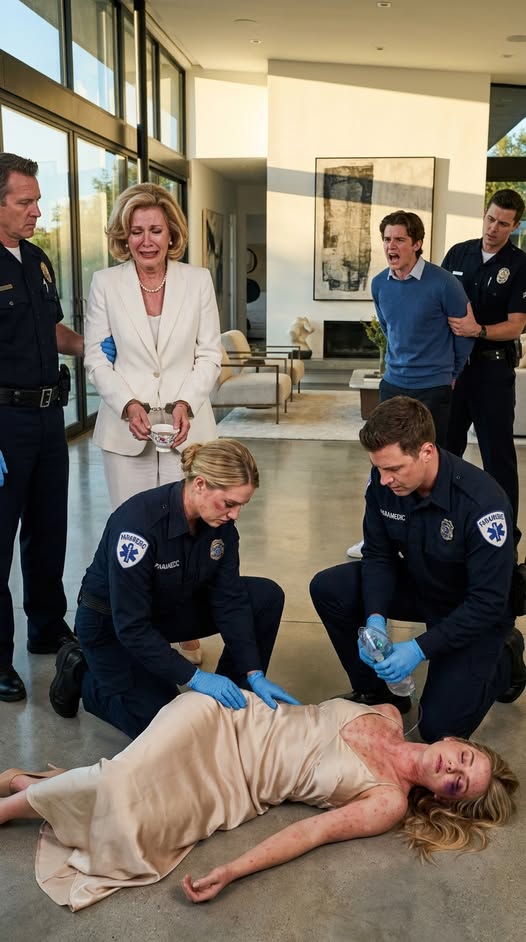
Seventy-two hours later, I faced my executioners. The sterile, blindingly white walls of my private room at Memorial Hospital offered a stark contrast to the dark, oppressive mahogany of the house I had nearly died in. My chest and neck were heavily wrapped in thick white gauze, soothing the second-degree burns. My throat was still raw, making my voice sound like boots crunching over broken glass, but my mind had never been sharper. Margaret sat rigidly across from my hospital bed. She was no longer draped in cream wool and pearls. She wore a violently bright orange
county jail jumpsuit, her wrists secured to the steel table by heavy metal cuffs. Daniel sat beside her. His tailored suit was gone, replaced by a rumpled gray holding-cell uniform. The gold wedding band was notably absent from his finger. He looked small. He looked entirely stripped of the
unearned confidence he had paraded around in for our entire marriage, and he had no mother brave enough to shield him from the consequences.
Positioned directly between us stood Detective Harris, my personal attorney, Elias Vance, and a sleek black tablet loaded with enough digital and forensic evidence to bury the Miller family under the prison.
Margaret lifted her chin, attempting to summon the ghost of her former aristocratic arrogance. “You set us up, Claire. This is entrapment. You staged a medical emergency to frame us.”
I offered her a faint, razor-thin smile. “I didn’t cook the chicken in highly concentrated almond oil, Margaret.”
Daniel leaned forward against his cuffs, his eyes red and swollen. “Claire, please. You have to listen to me. I panicked. The shock of seeing you fall… I froze. I never, ever wanted you dead.”
Elias Vance didn’t say a word. He simply tapped the screen of the tablet.
Daniel’s own voice instantly filled the quiet hospital room, crisp, clear, and utterly damning, recorded three weeks prior from the camera hidden in the bookshelf clock.
“She has to die before the open enrollment period ends and she can alter the policy beneficiaries again.”
Then, the audio shifted. Margaret’s voice, cold and clinical, recorded the afternoon of the dinner.
“Just make sure she eats enough of the sauce to trigger a full systemic cascade. Don’t let her run for the bathroom.”
Daniel’s complexion turned the color of wet cement. I watched the absolute last remnants of his pathetic lies physically drain from his face.
The financial crimes investigation had moved with breathtaking velocity while I was in the ICU. The forensic accountant I had hired months ago had finally unraveled the knot. She found the massive, systematic cash withdrawals from our joint savings account—money Daniel used to pay a shadow broker for illegal advice on circumventing life insurance beneficiary laws. She uncovered the clumsy digital trail where Daniel had brazenly forged my electronic signature to reinstate an old, cancelled two-million-dollar policy.
And they had pulled Margaret’s browser history. They found her deep-dive searches into the exact lethal dosage of tree nut proteins required to induce fatal anaphylaxis. They found the burner account she used to purchase the artisanal almond extract online. They found the deleted text messages she sent to her son, gleefully stating that “weak, sentimental women make for incredibly easy, rich widowers.”
They had meticulously planned for every single contingency.
Except my suspicion.
Except my proactive cancellation of the policy they were trying to collect on.
And except my last will and testament, which I had quietly amended four months earlier, leaving Daniel exactly one single US dollar, and leaving Margaret nothing but a highly publicized, deeply humiliating public record of her crimes.
Margaret’s mouth tightened into a hard, furious line. “You ruined my son. You destroyed his life.”
“No, Margaret,” I said, leaning back into the stiff hospital pillows. Every syllable scraped against my healing throat, but my delivery was as steady as a metronome. “I simply recorded him. You raised him.”
Daniel finally broke. He buried his face in his cuffed hands and began to openly, loudly weep.
Two years ago, the sight of his tears might have moved me. It might have triggered my empathy. That was before I found the mountain of hidden gambling debts. That was before I reviewed the audio files and heard him casually mocking my painful struggles with infertility with his mother in the very kitchen where I cooked his meals. That was before I realized he had been kissing my forehead every single morning while patiently waiting for me to become a highly profitable corpse.
“I loved you, Claire,” he sobbed into his palms, the ultimate, desperate plea of a cornered coward.
I looked at him for a long, quiet moment, feeling absolutely nothing but clinical detachment.
“You didn’t love me, Daniel,” I replied. “You loved access. You loved access to my credit score. You loved the deed to my house. You loved the prestige of my salary. And above all, you loved the absolute silence you thought you could enforce upon me.”
Harris stepped forward, sliding a thick, manila folder across the steel table until it hit Daniel’s cuffed wrists. “The District Attorney’s official charges include premeditated attempted murder in the first degree, criminal conspiracy, massive insurance fraud, felony forgery, and tampering with physical evidence.”
Margaret let out a sharp, ugly bark of laughter. It was the sound of a woman whose sanity was beginning to splinter. “You honestly think a jury will believe her over us? Look at her. She’s dramatic. She’s a fragile, emotional wreck.”
Vance picked up the tablet and turned the high-definition screen around so it faced Margaret directly.
He pressed play.
The video filled the screen. There was Margaret, kneeling gracefully over my paralyzed, suffocating body. There was the steaming teapot tilting in her hands. There were her manicured nails digging sadistically into my blistered, burned skin. And there was her voice, crisp, aristocratic, and dripping with venom, echoing off the hospital walls.
“Die quietly, trash.”
When the ten-second clip ended, the room plunged into an absolute, suffocating silence.
Margaret’s delusions of superiority collapsed into a million jagged pieces. The color drained from her lips until they were stark white. They trembled uncontrollably. Beside her, Daniel curled inward, trying to make himself as small as possible, hiding from the digital mirror reflecting his monstrosity.
I did not look away from them. I watched them drown in their own reflection.
Six months later, the gavel fell.
Margaret, refusing to admit guilt, took her chances at trial. She was swiftly convicted and sentenced to twenty-two years in a maximum-security state penitentiary. Daniel, terrified of the courtroom, took a cowardly plea deal and received fourteen years, plus complete financial restitution, and the devastating public humiliation that accompanied the televised trial coverage. Every forged signature, every greedy text message, and every cruel joke was broadcast to their entire social circle.
I sold the sprawling, oppressive mahogany house for significantly more capital than Daniel had ever hoped to steal from my life insurance.
I relocated to a much smaller, sun-drenched cottage perched on a rocky cliffside near the coast. I filled it with airy white linen curtains, vibrant thriving plants, and absolute peace. There were no oil portraits of old-money families who mistook sociopathic cruelty for power.
My physical scars slowly faded from an angry, raised red to a soft, barely visible silver. More importantly, the internal scars began to heal. I finally stopped flinching when the kettle whistled on the stove.
One brisk Tuesday afternoon, I stood on my wooden balcony, watching the rhythmic churning of the slate-gray ocean beneath a flawless blue sky.
I poured myself a cup of chamomile tea. I wrapped both of my hands around the delicate ceramic mug.
The porcelain warmed my palms. This time, absolutely nothing burned.
I closed my eyes and breathed in the salty sea air—deeply, freely, and without an ounce of fear. And for the very first time in years, the quiet silence in my home belonged to no one else but me.