Chapter 1: The Vanilla Frosting Facade. A cloying scent of spun sugar and extinguished wax hung thick in the dining room air. My seven-year-old, Harper, had been reaching for a chocolate-dipped strawberry when the bright, chiming sound of her laughter simply severed. For one surreal heartbeat, surrounded by drifting pastel balloons and the chaotic energy of a dozen sugar-fueled children tearing through my living room, I assumed a squirrel outside the bay window or a dropped toy had stolen her attention. Then, her small, sticky fingers slipped entirely from my grasp. Her knees buckled. They folded beneath her body with such an abrupt, unnatural looseness that a cold dread coiled in my gut long before my brain could process the geometry of her fall. I lunged. The movement was pure, primal reflex, my arms snapping forward just fast enough to absorb the impact of her delicate frame against my chest before she could strike the unforgiving oak floorboards beside the gift table. “Harper?” The ambient noise of the party evaporated. The entire house seemed to hold its breath. Upbeat pop music continued to filter quietly from the hidden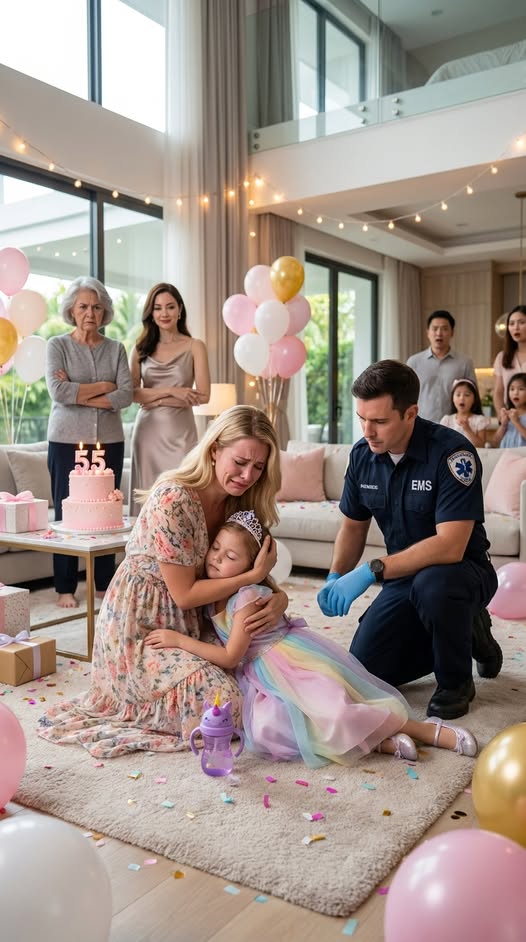
kitchen speakers, but the kinetic energy of the room flatlined. Every adult present—relatives, neighbors, school parents—pivoted toward us in terrifying unison. My daughter’s hazel eyes rolled, the pupils wide and totally unfocused. Her breathing felt profoundly wrong. It wasn’t the rapid panting of a startled child. It was a shallow, agonizing drag. Slow. Too slow. Panic crawled violently up my throat like a living thing. I pressed two trembling fingers against the soft, fragile hollow of her neck. Beneath her flushed skin, a pulse fluttered, but it terrified me how thin and reedy it
felt, like a moth trapped against a windowpane. Across the expanse of the sudden silence, my older sister, Sabrina Holloway, stood stationed beside the polished silver drink dispenser. One perfectly manicured hand rested casually near a tower of floral paper cups. While the faces of our
guests morphed into masks of horror and confusion, Sabrina remained an island of chilling serenity. She wasn’t startled. She wasn’t bewildered. She was waiting. A phantom smile, so brief it was almost a hallucination, twitched at the corner of her crimson mouth. Then, she tilted her head.
She manufactured a look of deep, patronizing concern—a performance that sounded like a rehearsed line from a daytime soap opera rather than the reaction of an aunt watching her niece collapse. “Camille, sweetheart, please don’t make this dramatic,” Sabrina cooed, her voice carrying
easily across the frozen room. “Kids get overtired at these things all the time. She just needs a nap.” Before I could spit vitriol back at her, the heavy scent of expensive gardenia perfume announced my mother’s arrival. Her gold bangles clattered together like warning bells as she crouched
beside me. Yet, as she looked down at her unconscious granddaughter, her expertly contoured face registered profound irritation, not maternal fear. “You always overreact to every little bump and bruise,” my mother hissed under her breath, pitching her voice precisely so the nearby aunts
and uncles could overhear. “Honestly, Camille. This is exactly why people think you’re emotionally unstable.” There it was. The poison dart. Unstable.
It was the same radioactive word Sabrina had spent the last four years carefully planting into the fertile soil of every family dinner, every holiday gathering, and every board meeting. It was her weapon of choice whenever I questioned her reckless corporate spending, whenever I flagged discrepancies in the ledgers, and most importantly, whenever I stubbornly refused to surrender my controlling voting shares in Holloway Provisions, the restaurant supply empire my grandfather had entrusted to me upon his retirement.
And now, as my only child lay limp and graying in my arms amid a sea of discarded wrapping paper, my own sister stared at me with the placid satisfaction of a woman who had already written the ending to tonight’s tragedy.
My husband shattered the tableau. Nolan Mercer pushed through the murmuring crowd with the brute force of a man who dealt with life-and-death crises for a living. He was still clad in his navy-blue emergency medical response uniform, having driven straight to the house from a grueling 12-hour downtown shift. The instant his eyes locked onto Harper’s pale face, the weary warmth of a returning father vanished, replaced entirely by the clinical, ice-cold focus of a first responder.
“What exactly did she consume?” Nolan barked, dropping heavily to his knees and prying Harper’s jaw open to check her airway.
“Cake. Some blueberries. Apple juice,” I stammered, my heart hammering against my ribs. “And… and the pink lemonade Sabrina mixed.”
I kept my eyes locked on my sister across the room. Her gaze flickered. It was a microscopic fracture in her composure, lasting perhaps a tenth of a second. Most people, caught up in the hysteria, would have entirely missed the tell.
I didn’t.
From near the stone fireplace, Sabrina’s husband, Preston, let out a low, condescending chuckle. He paused to shoot his cuffs, adjusting the sleeves of a bespoke jacket that cost more than my first car.
“Seriously, Camille?” Preston sneered. “You’re throwing wild accusations at your own sister while your kid is having a tantrum?”
Nolan ignored him completely. He was already a machine. He checked Harper’s pupillary response with a penlight, felt the clammy sweat on her brow, timed her depressed respirations by watching the shallow rise of her chest, and then looked up at me. His face was a mask of such terrifying, absolute control that it frightened me far more than if he had started screaming.
“Call emergency dispatch. Right now.”
Someone near the foyer nervously interjected, “But Nolan, you are emergency dispatch.”
Nolan didn’t blink. His voice dropped an octave, resonating with uncompromising authority.
“I said make the call.”
Sabrina seized the moment. She stepped out from behind the beverage table, crossing her arms over her silk blouse and letting out a long, theatrical sigh of victimization.
“Maybe Camille accidentally mixed something up herself when she was prepping the food,” she offered to the room, her tone dripping with poisoned honey. “She gets so easily overwhelmed these days. We’ve all seen the strain she’s been under.”
That was the exact second my tears dried up. The desperate pleading lodged in my throat dissolved. The urge to frantically defend my sanity to a room full of judgmental relatives simply vanished.
I stopped trembling, and I just looked at her.
Because while my mother and Preston still treated me like the meek, compliant daughter who would swallow any disrespect to maintain a toxic family peace, Sabrina had fundamentally forgotten something about my past. Long before I was forced to navigate the shark-infested waters of Holloway Provisions, and long before I experienced the vulnerable, terrifying joy of motherhood, I spent nearly a decade in Seattle working as a senior corporate fraud investigator.
In that grim, paper-choked world of embezzlement and white-collar sociopathy, I learned a universal truth about human nature—a truth that imprints itself on your bones.
Guilty people rarely panic first.
They don’t scream. They don’t rush to help. They stand perfectly still. They calculate. They watch the room to see if anyone has spotted the breadcrumbs they left behind.
And long before Harper’s knees had even buckled by the dessert table, I had already cataloged the precise location of the three high-definition security cameras I had secretly hardwired into the ceiling of our kitchen and dining room. Sabrina had practically begged to host the party at my house, claiming it would be a “neutral territory” that would make her look like the magnanimous, forgiving older sister.
What the idiot forgot was that in my house, the walls had eyes.
Chapter 2: The Calculated Silence
The ambulance sirens wailed through the suburban Illinois twilight less than ten minutes later, painting the manicured lawns in harsh flashes of red and white. Yet, the ensuing journey to the emergency room felt like wading through an ocean of thick tar. Harper remained terrifyingly lethargic. Nolan rode in the back of the rig, kneeling beside the gurney, his large hand completely enveloping her small shoulder as he relayed rapid-fire vitals to his paramedic colleagues.
I was tasked with following behind in my SUV. But before I even grabbed my car keys, I executed one critical, non-negotiable task.
I sealed the crime scene.
I didn’t just ask people to leave the kitchen. I physically ushered out a bewildered aunt and two cousins, pulled the heavy oak door shut, and slammed the deadbolt into place. I turned the brass lock with a loud, definitive click.
Sabrina, who had been hovering near the hallway trying to eavesdrop on the EMTs, noticed the action instantly.
For the first time all evening, the porcelain mask cracked. Real, unfiltered panic flared in her widened eyes before she viciously wrestled her features back into a scowl of indignation.
“Camille, what on earth are you doing? This is ridiculous,” she hissed, glancing nervously at the locked door.
I slid the heavy brass key deep into the pocket of my trench coat, my fingers wrapping tightly around the jagged metal edges.
“No, Sabrina,” I answered, my voice devoid of any sisterly affection. “This is standard preservation protocol.”
Preston materialized from the living room, stepping directly into my physical space. He wielded the smug, insulated arrogance of a man who firmly believed that inherited wealth was an impenetrable shield against consequences. He leaned down, his breath smelling of expensive scotch and peppermint, speaking low enough that the remaining guests wouldn’t catch the threat.
“You’re going to severely regret humiliating this family in front of our friends, Camille.”
I didn’t step back. I didn’t break eye contact. I stared directly into his pale, watery eyes.
“Not nearly as much as you and your wife are going to regret underestimating me.”
Upon arriving at the hospital, the chaos of the pediatric wing swallowed us whole. The attending physicians moved with urgent, coordinated speed after Nolan briefed them. He delivered a flawless clinical timeline, listing every single hors d’oeuvre, every sip of liquid, and every horrifying neurological symptom he had observed since the moment our daughter hit the floor. The medical team drew vials of blood and rushed them to the toxicology lab within minutes.
Hours bled into the night. Harper eventually fell into a deep, medically monitored sleep beneath a pile of heated blankets. The rhythmic, electronic chirp of her heart monitor was the only sound tethering me to sanity. The pediatric specialist had assured us her vitals were stabilizing, but my nervous system flatly refused to accept reassurance. I sat rigidly in the plastic chair beside her bed, my eyes tracking the subtle rise and fall of her chest, counting the breaths to prove to myself she was still alive.
At 9:17 PM, the sterile silence of the hospital room was broken by the vibration of my cell phone against the metal table.
The caller ID glowed: Sabrina.
I didn’t stand up. I didn’t step into the hallway to afford her privacy. I answered the call and immediately tapped the speakerphone icon, setting the device down so Nolan—who was standing like a sentinel by the window—could hear every syllable.
“Is she okay?” Sabrina’s voice floated through the tiny speaker. It was smooth, devoid of tremors, and meticulously measured.
Notice the phrasing. Not “Oh my god, how is Harper?” Not “I’ve been crying for hours, tell me she’s alive.”
Just okay.
She delivered the question with the detached curiosity of someone asking if a delayed flight had finally landed. She only wanted to know if her little experiment was going to result in a murder charge, or merely an incredibly convenient medical crisis.
“She’s stable,” I replied, keeping my tone entirely flat.
A heavy exhale hissed through the phone.
It was relief. Pure, unadulterated relief. Not the relief of an aunt whose niece was safe, but the relief of an arsonist watching the fire department successfully put out a blaze before it reached a neighboring house.
“Well, thank God,” Sabrina said briskly. “Then I expect you’ll be calling everyone tomorrow to apologize for turning a minor stomach bug into a public, hysterical spectacle. Mom is absolutely devastated, Camille. She had to take a sedative.”
I let the dead air stretch between us for five long seconds, weaponizing the silence.
“Why, exactly, is Mom devastated?” I asked softly.
Sabrina’s tone shifted. The faux-sweetness evaporated, replaced by the cold, calculating edge of the boardroom predator I knew so well.
“Because people talk, Camille. They saw you lock a door like a paranoid schizophrenic. They’re starting to wonder if you possess the mental fitness required to raise a child alone during stressful situations,” she stated, driving the knife deep. “And honestly? Family court judges take note of documented hysteria. Business partners and shareholders notice things like that too.”
Checkmate. Or so she thought.
There it was. The curtain had been pulled back. This entire horrific ordeal wasn’t about a birthday party. It was about a hostile takeover.
I glanced up at Nolan. The muscles in his jaw were feathering, his eyes dark with a murderous, protective rage.
“You really still want my controlling shares of the company that badly,” I said, stating a fact rather than asking a question.
Sabrina let out a short, breathy laugh. “Granddad always intended for me to run Holloway Provisions before you manipulated him in his old age.”
“He gave me sole voting authority because I caught you emptying the payroll accounts into offshore LLCs three different times, Sabrina.”
The silence on the line stretched out again. This time, it lasted exactly one heartbeat too long.
When she finally spoke, it was a sharp, venomous whisper. “You can’t prove a damn thing. Not about the company, and certainly not about tonight.”
A slow, terrifying sense of calm washed over me. The remnants of the terrified mother vanished, and the veteran fraud investigator resurrected in her place.
“Are you absolutely sure about that?” I asked.
I ended the call, my thumb pressing the red button with finality. Nolan walked over, his eyes locked on mine. “We have it, don’t we?” he asked softly.
“Oh,” I whispered, pulling my encrypted tablet from my bag. “We have the angle she never even considered.”
Chapter 3: The Unblinking Eye
The sterile white glare of the hospital’s family consultation room felt like an interrogation chamber by the time the sun began to threaten the horizon. My corporate attorney, Diana Vance, arrived just before 6:00 AM. She breezed through the heavy wooden doors carrying two thick leather portfolios and an iced Americano that she knew my traumatized stomach wouldn’t let me drink.
A few minutes later, Detective Lena Brooks from the county criminal investigations unit joined us. Brooks was a formidable woman in a rumpled suit, possessing the exhausted eyes and the low, gravelly voice of someone who had spent two decades listening to guilty people invent spectacularly bad alibis.
Nolan had already handed over his meticulous timeline of Harper’s symptoms. Crucially, the hospital staff—alerted by Nolan’s suspicion of a deliberate poisoning—had preserved every fluid sample drawn from my daughter overnight, creating an unbreakable chain of custody.
But the physical evidence was only half the battle.
My home’s primary security system was set to automatically compress and push all video data to a secure cloud server every night at midnight. Sabrina, who thought she was a mastermind, was well aware of the camera positioned above the living room mantel.
What Sabrina didn’t know was that three months ago, a careless HVAC contractor had accidentally severed a wire to our kitchen unit. When I replaced it, I didn’t just fix the broken camera. I installed a secondary, pinhole lens tucked discreetly into the custom molding directly above the breakfast counter, giving me a flawless, unobstructed view of the food prep station.
That hidden angle had recorded a masterpiece of malice.
Detective Brooks leaned forward, resting her elbows on the laminated table as the high-definition footage buffered on my tablet screen. Nobody breathed.
On the screen, the digital timestamp read 3:14 PM. Sabrina strutted into my empty kitchen. She paused near the refrigerator, explicitly checking over her left, then her right shoulder to ensure the hallway was devoid of witnesses.
Satisfied she was alone, she unclasped her designer purse. She withdrew a small, amber prescription bottle. With surgical precision, she tapped two small, white pills onto the marble countertop. Taking two heavy silver serving spoons, she methodically crushed the medication into a fine, powdery dust.
She then retrieved Harper’s favorite bright purple unicorn cup. She dumped the crushed powder into the pink lemonade, and using a plastic straw, she stirred the concoction slowly, thoroughly ensuring no grit remained at the bottom.
The video concluded with her wiping down the marble counter, sliding the bottle back into her bag, and walking out of frame with a horrifyingly placid expression.
The heavy silence in the consultation room fractured. Detective Brooks slowly leaned back in her chair, a muscle working in her jaw.