Chapter 1: The Bitter Extract: The scalding Earl Grey struck my chest like a splash of liquid phosphorus, and my paralyzed vocal cords refused to produce even a whimper. My airway was a rapidly collapsing tunnel, starving my brain of oxygen. My fingers, splayed awkwardly against the polished mahogany floorboards of our living room, spasmed with useless, frantic misfires of nerve endings. And looming directly above my tunneling vision, my mother-in-law, Margaret, wore the serene, satisfied expression of a woman who had just successfully scrubbed a stubborn wine stain from her favorite rug. “Die quietly, trash,” Margaret whispered. She tilted her delicate, gold-rimmed porcelain teacup, allowing the final, boiling drops to slide deliberately over my exposed collarbone. The freshly raised blisters screamed in protest. A brilliant, blinding white pain flashed behind my retinas, but my physical vessel remained absolutely frozen, utterly betrayed by the violent anaphylactic shock that had brought me to my knees precisely four minutes earlier. The execution had commenced with dinner. It had been a seemingly benign Tuesday evening.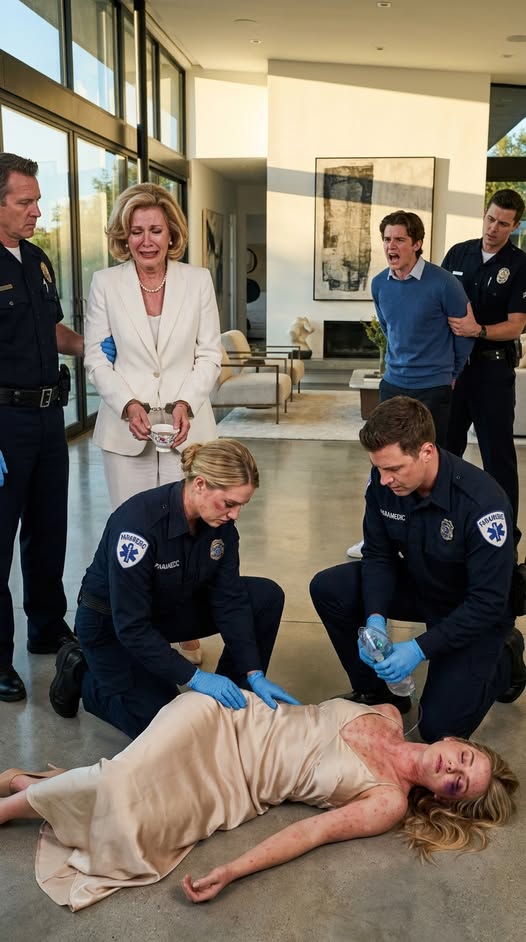
Margaret had insisted on preparing her “famous” braised chicken. I took exactly one spoonful. One single swallow of a rich, velvety sauce. Then came the strange, sharp, unmistakable bite of bitter almond blooming at the back of my palate. I looked up, coughing, only to find Margaret watching me from across the dining table. She wasn’t eating. She was simply waiting, a tight, pleased little smile playing at the corners of her painted mouth. My lethal hypersensitivity to tree nuts was practically a documented religion in this household. It wasn’t a secret. It wasn’t a mild
intolerance. It was a fatal flaw. My husband, Daniel, had once carried my prescribed epinephrine auto-injector in the breast pocket of his tailored suit jackets, treating the small plastic cylinder like a sacred, life-saving duty. Tonight, as I choked and clutched my throat, clawing desperately at
his jacket, that pocket had been flat. Empty. Now, Daniel hovered near the arched entryway of the hall. He was putting on a pathetic, Oscar-worthy performance of a terrified bystander. He hugged his own ribs, shaking his head, his face an expertly crafted mask of horror. “Mom,” he
stammered, his voice reedy and weak. “Mom, what are you doing?” But his polished leather loafers remained firmly planted on the Persian runner. He did not take a single step toward his dying wife. Margaret didn’t even bother to glance over her shoulder. She kept her cold, flat eyes pinned
to my suffocating face. “I am doing exactly what you should have done two years ago, Daniel.”
My pulse crawled through my veins like sludge. The edges of the room began to bleed away into a vignette of fuzzy gray. High above me, the grand crystal chandelier I had painstakingly selected in Venice morphed into a blurry, floating moon. My lungs burned with an agonizing, acidic fire, begging for an intake of air that my swollen trachea absolutely refused to permit.
Daniel dragged both of his trembling hands through his perfectly styled hair. “The cameras, Mom? What about the security system?”
“I unplugged the primary dome camera in the foyer,” Margaret snapped, swatting the air dismissively. “And your pathetic excuse for a wife is far too cheap to pay for a comprehensive, hardwired security network.”
A wet, broken hiss rattled against my teeth. It was the biological ghost of a laugh, trapped behind my swelling tongue.
Cheap.
That was the exact adjective they had spat at me six months ago. They called me cheap when I quietly sold the diamond tennis bracelet Daniel had given me for our anniversary to secretly put a forensic accountant on retainer. They called me cheap when I stubbornly refused to sign the paperwork for the newly expanded, multi-million-dollar life insurance policy Daniel kept trying to leverage behind my back. They called me cheap and paranoid when I demanded motion-sensor cameras for the perimeter after catching Margaret brazenly rifling through the locked drawers of my home office.
To them, I was just Claire. Soft, sentimental, compliant Claire. The kind of naive woman who wept in locked bathroom stalls after a harsh argument and instinctively apologized to the coffee table when she bumped her shin against it.
They had entirely forgotten who I was before I married into their toxic dynasty.
They did not know that before I chose the quieter, lucrative world of corporate compliance, I had spent six grueling years as a ruthless felony prosecutor for the district attorney’s office.
They did not know that the true security cameras were not the bulky plastic domes bolted to the ceiling corners. The real cameras were microscopic, high-definition lenses meticulously embedded inside the digital smoke detector in the hallway, the vintage bookshelf clock Daniel never wound, and the heavy brass reading lamp Margaret had hypocritically complimented just that morning.
And they definitely did not know that those covert lenses were currently live-streaming high-definition, audio-enabled footage directly to a secure server monitored by my former precinct contacts, triggered the exact millisecond the motion sensors registered my unnatural collapse.
Margaret crouched lower. The cloying scent of bergamot from her tea mingled sickeningly with the raw, metallic scent of her pure hatred.
“You were never family,” she hissed, her manicured finger tracing the edge of my jawline like a coroner examining a corpse. “You were just a temporary bank account.”
The darkness was pulling at me, heavy and seductive, promising an end to the burning in my chest. I forced my eyelids to remain locked open, staring directly into the abyss of her pupils.
No, my fractured consciousness whispered into the void. I am not family. I am the crime scene. And I am the evidence.
Suddenly, the heavy silence of the house was violently punctured by a sound that made the floorboards vibrate.
Chapter 2: The Blinking Red Eye
Daniel finally abandoned the safety of the hallway and dropped to his knees beside my rigid body.
But he didn’t reach for my airway. He didn’t check my fading pulse. His hands began a frantic, panicked sweep of the immediate area. He tossed the embroidered sofa cushions onto the floor. He swept his hands under the heavy oak coffee table. He roughly jammed his fingers into the pockets of the fine cashmere cardigan I wore.
“Where is the EpiPen?” he muttered, his breath coming in shallow, ragged gasps. “She always keeps a spare in her pocket. Where is it?”
Margaret backhanded his wrist with a sharp, stinging slap. “Stop being a dramatic idiot, Daniel. It is far too late now. Her airway is shut.”
Daniel rocked back on his heels, his face a terrifying canvas of pale, clammy sweat. “We need it to look natural, Mom! If the paramedics arrive and we haven’t even tried to administer the epinephrine, it looks like criminal negligence. Or worse.”
“It will look natural,” Margaret insisted, standing up and smoothing a non-existent wrinkle from her pristine cream wool skirt. She clasped her hands in front of her like a grieving widow rehearsing for a funeral. “Poor, fragile little Claire accidentally ingested an allergen. A tragic culinary oversight. You called emergency services the second she fell. They simply arrived too late to reverse the anaphylaxis. It is an everyday tragedy.”
My tongue felt like a dry, swollen block of granite stuffed into the back of my mouth. Every microscopic intake of oxygen was a brutal physical currency I was rapidly running out of.
Daniel leaned directly over my face. His pale blue eyes—the same eyes that had once looked at me with enough simulated warmth to make me abandon my natural skepticism and believe in the myth of a second chance—were now dilated and glassy with raw, selfish panic.
“I’m sorry, Claire,” he whispered. The words tasted like ash.
Margaret scoffed, a harsh, grating sound from above. “Oh, for god’s sake, Daniel. Don’t apologize to the furniture.”
That was the catalyst.
It wasn’t the bitter almond extract shutting down my organs. It wasn’t the boiling tea blistering my skin. It wasn’t even the agonizing physical pain.
It was the word furniture.
I forced all the remaining, dying energy in my nervous system into my ocular muscles. I locked my gaze onto Daniel’s face. The hazy fog of suffocation cleared for one singular, terrifying microsecond. I stared at him with the cold, unblinking intensity of a predator assessing prey.
Daniel physically recoiled, knocking his knee against the coffee table. He saw something in my dying eyes that completely shattered his fragile composure.
Perhaps it was memory.
Perhaps he finally remembered the woman who had once relentlessly cross-examined a corrupt orthopedic surgeon on the stand for four grueling hours until the man wept and confessed to falsifying medical records. The woman who quietly noticed his suddenly altered banking passwords, the mysteriously missing estate documents, and the sickeningly sudden surge of faux-affection from a man whose greed was outgrowing his patience. The woman who had swallowed her heartbreak and said absolutely nothing for three agonizing months, choosing instead to meticulously build a circumstantial and forensic case strong enough to survive a cynical judge, a bored jury, and the pathological lies of his monstrous mother.
A faint, high-pitched wail pierced the heavy rain currently lashing against the floor-to-ceiling windows.
A siren.
Margaret instantly froze, her spine snapping completely straight.
Daniel’s head whipped toward the rain-streaked glass. “Did you call them? Mom, did you already dial 911?”
“Of course I didn’t call them yet!” Margaret spat, her previous icy composure cracking down the center. She pointed a trembling finger at my paralyzed form. “She couldn’t have called them either. She can’t even blink properly!”
The wail mutated into a deafening scream. I could hear the heavy, aggressive hiss of wet tires braking violently against the asphalt of our driveway. Heavy car doors slammed with metallic finality.
Margaret scrambled backward, the heels of her expensive pumps slipping on the spilled tea. “Daniel. Do something.”
He scrambled to the front window, peeling back an inch of the heavy silk drape. He staggered backward as if he had been physically struck in the chest. “It’s the police. There are three cruisers.”
Margaret’s face twisted into a mask of pure, ugly denial. “No. No, that’s impossible. We didn’t trip the alarm. They must be here for something else. A neighbor.”
And then, as if responding to her denial, the heavy brass reading lamp on the side table engaged its secondary protocol.
The microscopic LED light hidden flush against the metal base blinked red.
Just once. A bright, sharp crimson pulse.
Daniel caught the flash in his peripheral vision. His head snapped toward the table. His chest heaved. “What the hell is that?”
Before Margaret could formulate a lie, a massive, thunderous fist began pounding against our reinforced oak front door. The wood groaned under the sheer force of the blows.
“Police! Open the door immediately!” a deep, commanding voice roared over the storm outside.
Margaret lunged toward the side table with the frantic, uncoordinated desperation of a cornered rat. She grabbed the heavy brass lamp and violently hurled it onto the hardwood floor. The glass bulb shattered, and the expensive silk shade rolled away into the shadows. But the impact only dislodged the protective casing of the base, revealing the tiny, black, unblinking eye of the camera lens, still pointed directly at the two of them.
Across the room, high on the wall, the digital smoke detector blinked red.
Then the bookshelf clock pulsed.
Then, the digital frame housing our wedding photo on the mantel illuminated with a solid, damning crimson glow.
Daniel turned his head slowly, looking down at my suffocating, blistered body. The realization hit him with the force of a freight train, draining the last drop of blood from his face.
“You…” he choked out, his voice cracking. “You recorded us?”
I could not move my lips to form the words, but I let my unwavering, hate-filled gaze deliver the answer.
Margaret let out a feral shriek. She grabbed the heavy, scalding ceramic teapot from the serving tray with both of her bare hands, entirely ignoring the heat burning her palms. She raised it high above her head, her face contorted into something demonic.
“You poisonous, treacherous little bitch—!” she screamed, preparing to bring the heavy ceramic down directly onto my skull.
The front door exploded inward with a deafening splintering of oak and brass.
Chapter 3: The Verdict of Silence
The heavy oak door slammed against the interior wall with enough concussive force to rattle the paintings in the foyer.
Two uniformed officers swarmed into the living room, their service weapons drawn and leveled directly at my husband and his mother. Hot on their heels were two paramedics hauling heavy trauma bags, their boots tracking mud and rainwater across the Persian rug.
But it was the voice of the man walking in dead last that cut through the chaos like a surgical scalpel.
“Step away from Claire Bennett immediately. Drop the weapon and put your hands where I can see them.”
It was Detective Tomas Harris. My old precinct partner. The man who had taught me how to read the microscopic tells of a lying suspect.
Margaret gasped, her fingers going numb. The heavy ceramic teapot slipped from her grasp, crashing onto the hardwood and exploding into a hundred jagged, steaming shards inches from my ear.
Daniel threw both of his hands into the air so fast he nearly dislocated his own shoulders. He fell backward onto his rear, scrambling away from my body. “Wait! This isn’t what it looks like! She had an allergic reaction! We were just trying to help!”