The room went silent so violently that I actually heard my own heart monitor skip a beat. The rhythmic beep-beep-beep faltered, mirroring the sudden, icy drop in my chest. Five newborns slept under the warm, hum-shielded lights of the neonatal intensive care unit. Their tiny chests rose and fell in unison, their little fists curled tightly under their chins like they were holding onto secrets the world wasn’t ready for. I was still bleeding, still trembling from the massive physical trauma of the surgery, and still half-drugged on a cocktail of painkillers. Yet, the fog in my brain vanished the moment my husband, Richard, took a stumbling step backward. He looked at the five incubators as if the fragile lives inside them were laced with poison. “Richard,” I whispered, my throat raw from the intubation tube they had just removed. “Don’t do this. Please.” His mother, Victoria, stood right behind him. She was impeccably dressed in a tailored Chanel suit and a string of South Sea pearls, draped in a white sterile coat she had absolutely no right to wear inside my private recovery room. She looked at the babies, then slowly turned her gaze to me. Her smile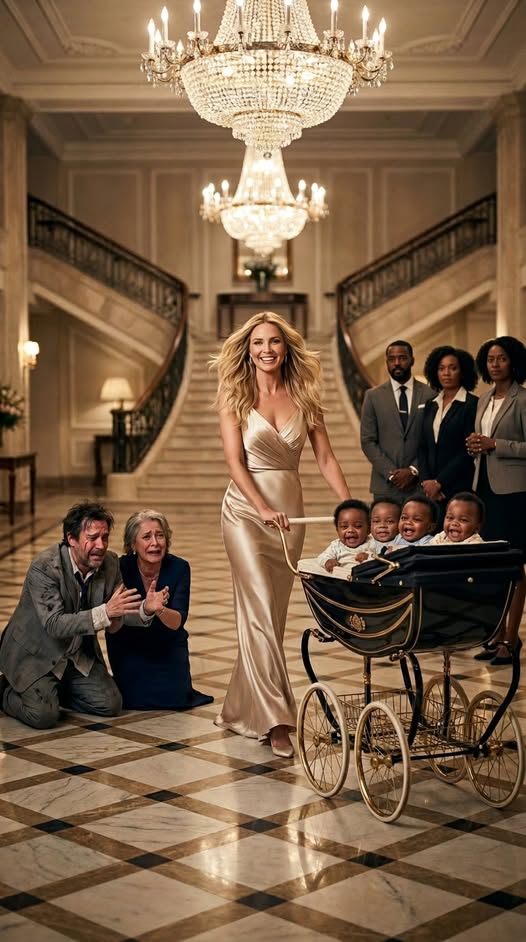
was sharp enough to cut through bulletproof glass. “My son is a Sterling,” Victoria said, her voice dripping with generations of inherited arrogance. “He is the heir to a Boston real estate empire. He will absolutely not raise another man’s children. This is an embarrassment.” I pushed myself up on my elbows, the stitches in my abdomen screaming in protest. “They are your grandchildren, Victoria. They are his.” Richard finally looked at me, and he laughed. It wasn’t a loud, angry sound. It was worse. It was hollow, cold, and utterly devoid of the man who had kissed me at the altar
two years ago. “I should have listened,” Richard muttered, running a shaking hand through his perfectly styled hair. “When my friends warned me about marrying outside of our circle. When my mother told me you were nothing but a gold-digger looking for a permanent payday. I defended
you.” The three attending nurses stared intensely at the linoleum floor. One of them, a young woman with kind eyes, silently reached for the privacy curtain, dragging it along its metal track as though a thin piece of blue fabric could somehow cover the sheer, suffocating humiliation unfolding in the room.
Victoria stepped closer to the edge of my bed, her expensive perfume masking the sterile smell of iodine and bleach. She lowered her voice to a lethal, corporate whisper.
“You will sign the nondisclosure and separation papers when my attorneys bring them this evening. You will make no claim on Richard. You will make no claim on the Sterling estate. There will be no scandal, Clara. We will simply tell the press that you became tragically unstable after a complicated birth and requested a quiet separation.”
I looked past her, fixing my tear-filled eyes on my five beautiful babies.
Their skin was a deep, rich brown. They were breathtakingly beautiful, but they looked nothing like my pale complexion, and nothing like Richard’s. But I knew exactly why. I knew what the genetic specialists had warned me about months earlier during a private consultation. I knew about the rare genetic throwback, a dormant melanin trait from my estranged father’s side of the family—an ancestry that Richard had casually mocked at dinner parties as “irrelevant history.”
“Richard, look at the medical file,” I pleaded, tears finally spilling hot down my cheeks. “It’s genetics. It’s a skip-generation trait. The doctors explained this was a possibility. Look at the blood types!”
Richard didn’t look at the files. He didn’t look at the babies. He looked at me with absolute disgust.
He violently ripped off his plastic hospital identification bracelet—the one that read FATHER—and threw it into the biohazard trash can near the door.
“I’m leaving,” he said, his voice hard and flat. “And Clara? If you ever try to come after my money, or drag my name through the mud with this litter, I will bury you so deep in legal fees you won’t be able to afford oxygen.”
He turned on his heel and walked out.
There was no kiss on the forehead. No lingering last look. He didn’t even bother to ask if we had chosen names for a single one of the children he had just abandoned.
Victoria paused at the door, pulling on her leather gloves. “You really should be grateful, Clara. We are giving you a golden opportunity to just disappear without being publicly branded an adulterer.”
Then, she followed her son out into the hallway.
The heavy door clicked shut. The nurses began to whisper furiously to one another. Somewhere down the long, antiseptic hallway, a baby began to cry.
I did not scream. I did not throw my water pitcher at the wall.
Instead, with every ounce of strength I had left, I reached through the side of the nearest bassinet and gently stroked the impossibly soft cheek of my firstborn daughter.
“My loves,” I whispered, my voice shaking with grief but crystal clear with resolve. “Your father just made the worst, most catastrophic mistake of his entire privileged life.”
What Richard, in all his arrogant glory, had completely failed to understand was one simple, devastating fact. Before I married him, before I foolishly took his prestigious last name, and long before I let his toxic family call me “lucky” to be at their dinner table… I had been a senior contracts attorney for a ruthless corporate firm.
I had read every single line of our prenuptial agreement.
And more importantly, I knew exactly what mandatory medical protocol had been triggered the moment five infants were pulled from a single mother.
For the first twelve months, Richard pretended we were dead.
His high-priced legal team sent heavy manila envelopes to my small apartment with cruel, mechanical efficiency. There were expedited divorce papers citing “irreconcilable differences.” There were heavy-handed defamation threats promising ruin if I spoke to the media. There was a formal cease-and-desist demand that I legally drop the Sterling name and revert to my maiden name immediately.
Victoria, playing the role of the aggrieved matriarch, arranged highly publicized interviews with Boston’s elite society magazines. She delicately referred to our marriage as “a tragic, brief chapter” and painted herself as “a fierce mother protecting her naive son from a grifter.”
Richard seamlessly transitioned into the role of the wounded, handsome prince of Boston real estate. Society wives threw their daughters at him.
He remarried exactly eighteen months after walking out of that hospital room.
Her name was Eleanor Vale, a blonde, impossibly thin charity board favorite whose family owned a string of luxury hotels. She wore diamonds like they were medieval armor. On the day of their lavish, two-million-dollar wedding, a paparazzi reporter shouted over the velvet ropes, asking Richard if he and Eleanor planned on having children.
Richard smiled warmly for the flashing cameras. “Real ones, someday. Yes.”
I watched that specific video clip at two in the morning. I was sitting on my worn living room rug, feeding two screaming babies with propped-up bottles while rocking a third in a bouncer with my bare foot.
I really should have cried. The sheer cruelty of his words should have broken me.
Instead, I saved the video to an encrypted hard drive.
That became my nightly habit. My ritual of survival.
Every lie they printed, I saved. Every polished magazine interview, every threatening legal letter drafted by his sharks, every unhinged voicemail where Victoria hissed that my “little scandal” would never be allowed to touch their empire. I meticulously built a file so thick and damning that it eventually required three heavy, fireproof locked cabinets in my home office.
I worked from my cramped kitchen table while five toddlers slept in a tangled pile of blankets beside my chair. By day, I handled freelance corporate contract reviews just to keep the lights on and buy formula. By night, I became a scholar of my own vengeance. I studied advanced genetic inheritance laws, subpoena protocols, trust fund bylaws, and every single structural weakness in the Sterling family’s corporate holdings.
Richard sent absolutely no child support. Not one single dollar. He didn’t even send a package of diapers.
That was his second fatal mistake.
His first mistake had been storming out of the hospital before the mandatory DNA collection was finalized. Because the birth of quintuplets is incredibly rare, it automatically triggered a federal medical research protocol. The hospital was legally required to take genetic samples of the mother, the infants, and the father on record. Richard had spit into a tube an hour before I went into labor, assuming he was the king of the world. He thought his post-birth denial and his pride made him legally untouchable.
He was wrong. Science had quietly, undeniably documented the absolute truth while he was busy running away.
When the children turned eight years old, Victoria Sterling finally realized she had a loose end, and she tried to buy me.
She arrived at my modest suburban home in a sleek, black chauffeured town car, literally stepping over the colorful sidewalk chalk my sons had drawn on the concrete driveway. She let herself in, looking around my chaotic, toy-filled living room with barely concealed revulsion.
“Two million dollars,” Victoria said, sitting at my scarred kitchen table like a monarch visiting a peasant. She slid a cashier’s check and a thick legal binder toward me. “You sign this permanent, iron-clad NDA. The children never, under any circumstances, approach Richard. You vanish from our world completely.”
My eldest daughter, Olivia, small, observant, and fiercely protective even at eight years old, listened quietly from the shadow of the hallway.
I didn’t look at the check. I calmly poured Victoria a cup of cheap herbal tea, letting the silence stretch until it became uncomfortable.
“No,” I said simply, taking a sip from my own mug.
Victoria’s perfectly manicured eyebrows pulled together. Her eyes narrowed into dangerous slits. “Excuse me? Are you holding out for more? Don’t be greedy, Clara. You think those illegitimate children can somehow inherit Richard’s estate? You have no proof. You have nothing but a disgraced reputation.”
I smiled. It was a slow, terrifying smile that didn’t reach my eyes.
That was the very first time I saw Victoria Sterling look genuinely uneasy. The confidence wavered, just for a fraction of a second.
“What exactly have you been doing out here for eight years, Clara?” she asked, her voice dropping its haughty tone.
“I haven’t been waiting for your money, Victoria,” I replied softly. “I’ve been raising them.”
What Victoria didn’t know as she hurried back to her town car, clutching her uncashed check, was that I hadn’t just been raising children. I had been raising a storm. I had been raising five distinct, brilliant minds that would one day systematically dismantle her entire world.
The children grew into absolute thunder.
Olivia became a razor-sharp civil rights and corporate attorney. She developed a courtroom presence so commanding, a voice so cold and precise, that she routinely made veteran judges lean forward in their seats just to catch her every word.
Ethan built a massive, ethical software company. His primary product was a highly encrypted, unbreakable database system that major hospitals across the country used to securely track newborn genetic records and prevent medical fraud.
Julian became a forensic accountant for the FBI before moving to a private firm. He could look at a heavily redacted corporate ledger and find a hidden offshore bank account faster than a bloodhound finding a scent.
Lucas became a fierce, Pulitzer-nominated investigative journalist for a major financial times publication. He specialized in exposing the deep-rooted corruption of old-money families.
And little Chloe, the quietest and most observant of the five, became a brilliant geneticist, holding a PhD from MIT, specializing in recessive hereditary traits.
I had never explicitly pushed them toward revenge. I never poisoned their minds with daily hatred. I simply gave them the unvarnished, documented truth. When they were eighteen, I unlocked the three fireproof cabinets and let them read the letters, watch the interviews, and see exactly what Richard and Victoria had done.
On their thirtieth birthday, the universe finally delivered the punchline I had been waiting three decades for.
Richard Sterling returned.
He didn’t return out of a sudden spark of paternal guilt. He returned because his carefully curated empire was violently bleeding out.
His trophy wife, Eleanor, had never given him children. His commercial real estate investors were circling like vultures, smelling insolvency due to years of Richard’s reckless spending and terrible market bets. Victoria, the iron matriarch, was on her deathbed, her mind fading rapidly.