Chapter 1: The Gilded Cage: When that heavy, brass-clasped manila folder scraped across the expanse of the polished dining table, the entire room seemed to hold its breath. It wasn’t the warm, contented silence of a family digesting a lavish Thanksgiving feast. It was a suffocating, predatory stillness—the kind of quiet that precedes a guillotine’s drop. I shifted my gaze toward my husband. He was intently studying the rim of his crystal wine glass, his jaw locked, refusing to meet my eyes. I reached out. My fingers were surprisingly steady as I flipped open the heavy cardstock cover. Divorce papers. Crisp, notarized, and freshly dated. A lesser version of myself might have shattered the fragile quiet. I could have screamed until my throat bled. I could have upended my untouched plate of turkey and sweet potatoes, or hurled that folder directly at my father-in-law’s smug, expectant face. I could have unleashed a torrent of devastation that would have left the twenty-two assembled guests choking on their expensive Cabernet. But I did absolutely nothing of the sort. I remained perfectly still at the perimeter of that endless table,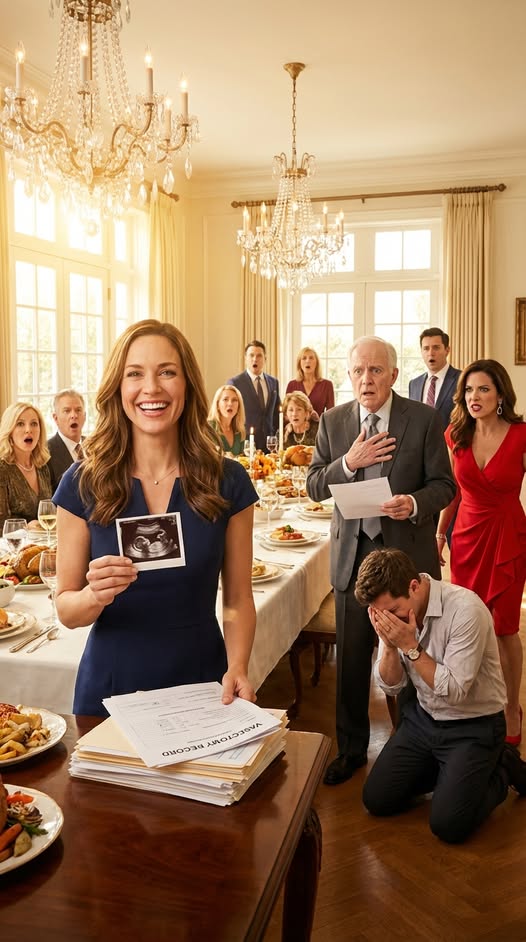
marooned amidst a sea of his relatives—people I had foolishly spent three years trying to convince myself were my own flesh and blood. Instead of breaking down, I read. I scanned every single clause, every stipulated surrender of assets, analyzing the text with the meticulous scrutiny my mother had drilled into me since childhood. Never put your name on something you don’t fully possess, she used to warn. When I finally lifted my chin to look at my husband once more, his eyes darted up. He held my gaze for perhaps a fraction of a second before the cowardice swallowed
him, and he looked at the floor. Without a word, I reached for the silver Montblanc pen his father had so helpfully positioned next to the documents. I uncapped it. What the breathless audience in that private dining room didn’t realize—what absolutely no one anticipated except my fiercely
loyal confidante, Sophie, seated three chairs away with a nondescript brown envelope resting in her tailored blazer pocket—was that I was already executing a masterstroke of my own. They thought this folder was my execution. They had no idea it was merely the prologue to their public
ruin. But to grasp the sheer audacity of that November evening, you have to understand the architecture of the Hargrove empire. I was twenty-eight when Daniel stumbled into my orbit at a crowded, gin-soaked birthday bash in downtown Chicago. I was a certified public accountant—
pragmatic, self-sufficient, fiercely proud of the lease with my name on it and the client roster I’d built from nothing. Daniel was disarmingly warm, quick to laugh, and possessed an endearing habit of calling his mother every single Sunday morning. It was a trait I initially interpreted as
sweetness. We navigated the urban dating scene for eighteen months before he presented me with a ring. It was only when he drove me out to the sprawling, manicured suburbs of Naperville to meet the architects of his existence that the first cracks appeared in the foundation. The
Hargrove Estate was a colossal brick colonial boasting a circular driveway and grounds that required a fleet of landscapers.
When his mother, Gloria, offered me a handshake that felt like clutching a frozen trout, I rationalized it as aristocratic nerves. When the patriarch, Mason, spent the entirety of the evening speaking over me as if my vocal cords were decorative, I chalked it up to generational arrogance.
I even forced myself to ignore the framed, silver-edged photographs of Daniel’s college sweetheart, Vanessa, which remained prominently displayed along the winding staircase of his childhood home. An oversight, I whispered to myself in the guest bathroom. Just an oversight.
I wasn’t a fool. At thirty, I had audited enough bankrupt companies to know when a ledger didn’t balance. I simply harbored a desperate, naive hope that love could serve as a sufficient mortar for a foundation built on red flags.
The first subtle interrogation occurred exactly four months after we exchanged vows. We were lounging in Gloria’s blindingly bright sunroom following a tedious Easter brunch. She delicately placed her bone-china teacup onto its saucer, the porcelain clicking like a ticking clock.
“So, Rachel, darling,” she purred, her smile perfectly hollow. “When exactly can we anticipate some joyous news?”
I offered a practiced, polite laugh. “We’re just reveling in the newlywed phase, Gloria. We’ll certainly start trying when the timing feels right.”
Her smile didn’t waver, but her eyes grew distinctly colder. “Of course. It’s just… Daniel’s father welcomed his firstborn at twenty-six. The men in this lineage possess a profound desire to establish their legacies young.”
I swallowed the sudden tightness in my throat and let the comment evaporate into the humid air. But it was only the beginning. Soon, the polite inquiries morphed into a relentless, suffocating drumbeat. It happened at every holiday gathering, every mandatory Sunday roast, even during random midweek phone calls where Daniel would suddenly shove the receiver into my chest, his face tight with panic, mouthing, Please, just handle her.
Gloria began aggressively recounting tales of every acquaintance’s new grandchild. Mason transitioned to delivering heavy-handed monologues about “dynastic continuity” and “fortifying what the family had built.” Through it all, Daniel remained a silent phantom beside me, entirely mute. On the long, tense drives back to the city, he would rub his temples and sigh.
“You know how they operate, Rach. They don’t genuinely mean anything malicious by it.”
But they did, I thought, watching the city lights blur through the windshield. They meant everything by it. And I was about to discover just how far they were willing to go.
Chapter 2: The Defective Appliance
Fourteen months into our marriage, the air in my gynecologist’s office felt sterile and thin. Dr. Aris sat across from me, her expression a mask of professional empathy.
“It’s Polycystic Ovary Syndrome,” she explained, tapping her pen against a chart. “PCOS. It’s relatively mild, certainly manageable, but it complicates things. Conceiving naturally is going to take significantly longer than the statistical average. We’ll need to implement strict monitoring cycles and, likely, pharmaceutical intervention.”
I nodded numbly, holding it together until I reached the safety of my sedan in the parking garage. There, I gripped the steering wheel and wept violently for twenty minutes. The tears weren’t just for the diagnosis; they were born from a terrifying, creeping dread about what this meant for my survival in the Hargrove family.
I drove home and laid the truth bare before Daniel. That night, in the dim light of our bedroom, he wrapped his arms tightly around my shaking shoulders. He murmured every syllable a terrified wife begs to hear. He swore that biology was irrelevant, that we would conquer the medical hurdles as a united front, that his love was tethered to me, not to a predetermined reproductive schedule.
I anchored my heart to his promises. I wanted to believe him so fiercely that I blinded myself to the shadows.
I should have paid clinical attention to the hushed phone call he made to his father three evenings later. I had been scrubbing dishes in the kitchen, the water running, when the cadence of his voice in the adjacent living room dropped to an urgent, conspiratorial murmur. I dried my hands and walked softly down the hallway. By the time my shadow crossed the threshold, he was aggressively pivoting the conversation to the stock market. But the damage was done. I had caught the tail end of his panicked whisper.
“I don’t know yet, Dad. I swear, I just don’t know.”
I felt a cold plummet in my stomach. I took that fragmented sentence, folded it into a tiny, sharp square, and buried it in the deepest, darkest vault of my subconscious. I don’t want to look at it, I told myself.
The second year of our union was a masterclass in psychological erosion. The polite veneer dissolved. Mason ceased using me as an intermediary; he began bypassing my phone entirely, calling Daniel directly to orchestrate lavish family dinners to which my invitation was mysteriously lost in the mail. Gloria’s tactics evolved into silent warfare. My inbox became a dumping ground for unsolicited medical journals detailing “Fertility-Enhancing Diets” and “Lifestyle Corrections for the Barren Woman”—always forwarded without a single word of text in the body.
The climax of their cruelty occurred during a summer barbecue. Mason, standing over a smoking grill with six extended relatives within earshot, casually remarked that he prayed Daniel would “finalize his decisions before the window of opportunity completely shut.”
I froze, the plastic cup in my hand crinkling under my grip. “What exactly do you mean by that, Mason?”
He turned slowly, leveling me with a gaze dripping with toxic pity. “I mean regarding your future, Rachel. As a cohesive family unit.”
Daniel flinched. “Dad, come on,” he muttered. It was the absolute maximum amount of defense he had ever mustered on my behalf.
During this slow-motion execution of my marriage, I relied on two pillars of sanity. The first was my mother, Linda, a pragmatic woman who drove up from Indianapolis every eight weeks. She would buy me overpriced salads, pour the wine, and listen to my unraveling life without offering a single piece of unsolicited advice.
The second was Sophie. We had shared a cramped dorm room in college, and she had since evolved into a lethal, fiercely intelligent paralegal specializing in high-stakes family law. Over dozens of late-night, tear-soaked phone calls, Sophie began executing a quiet, methodical education. She fed me legal statutes under the guise of casual conversation.
“I’m merely providing data, Rach,” she would say, her voice echoing through the phone as I paced my living room. “Knowledge doesn’t obligate you to pull the trigger.”
“You’re catastrophizing, Soph. He loves me.”
“Perhaps,” she replied, her tone sharp and unyielding. “But you need to be aware that Illinois operates under equitable distribution laws. You need to acknowledge that the deed to that beautiful colonial you two purchased is firmly in both your names. And you absolutely must realize that if Daniel ever decides to—”
“Stop it, Sophie! I know. Just… let me breathe.”
I let her finish her lectures. I absorbed the data. And then, like a coward, I filed it away in the exact same vault where I kept Daniel’s whispered phone call.
Then came November. Mason orchestrated what he grandiosely dubbed a “Generational Summit” for Thanksgiving. He informed Daniel it was a crucial opportunity to consolidate the family’s bonds. He booked the opulent private dining quarters at the Oakhaven Country Club, a stifling, wood-paneled cavern adorned with imposing oil portraits of dead men and a coat-check attendant who practically bowed when a Hargrove walked in.
I armored myself in a severe navy sheath dress and clasped my late grandmother’s vintage pearl earrings to my lobes. I even purchased a bottle of Bordeaux that cost more than my first car.
Sophie was in attendance, having recently embarked on a strategic, somewhat puzzling romance with Daniel’s cousin, Marcus. During the cocktail hour, while I was stiffly holding a glass of sparkling water, she materialized at my side. She didn’t offer a greeting. She leaned in, her eyes scanning the room like a sniper.
“What is your emotional baseline right now?” she whispered.
I blinked. “I’m fine. Just tired.”
“Excellent. Lock that in,” she commanded, her fingers briefly digging into my forearm. “Whatever unfolds in that room tonight, you remain absolutely made of ice. Do you understand?”
A chill rippled down my spine. “Sophie, what are you talking about? Whatever happens?”
Before she could answer, Gloria materialized from the throng, draped in a champagne silk blazer, her perfume suffocating the air. She kissed the empty space three inches from my cheek. “Rachel, you look… adequate. Come along. Mason’s senior partner, Harold, is simply dying to interrogate Daniel.”
I was swept away by the current of Gloria’s fake enthusiasm, losing Sophie in the sea of tailored suits. For forty agonizing minutes, I feigned interest in commercial zoning laws and the dismal state of the Chicago Bears. I desperately tried to convince myself that Sophie’s paranoia was merely an occupational hazard. She spent her days wading through the wreckage of broken marriages; naturally, she saw betrayal in every shadow.
But as the grandfather clock chimed seven, calling us to our seats, the oppressive weight in the room shifted, and I knew with a terrifying certainty that the shadows were about to come alive.
Chapter 3: The Ambush at Oakhaven
We took our places at the sprawling table. Mason, naturally, commanded the head. I was relegated three seats to his left, anchored beside a version of Daniel I barely recognized. He was pale, sweating slightly, and emanating a nervous energy that made my skin crawl.
The initial courses were a blur of culinary excess. Slices of roasted turkey, candied sweet potatoes, green beans smothered in toasted almonds. The cousins bickered loudly about college athletics while Gloria practically sprinted around the room, refilling wine goblets before anyone could register a thirst.
It happened precisely after the porcelain plates were whisked away, in that heavy, expectant lull before the dessert carts arrived. Mason pushed his chair back. The legs scraped against the hardwood like a scream. He tapped his sterling silver knife against his crystal goblet.
Clink. Clink. Clink.
“I wish to command the floor for a moment,” Mason announced, his baritone voice echoing off the wood-paneled walls. “To speak on the subject of legacy.”
A cold sweat broke across the back of my neck. The speech was rigidly rehearsed, devoid of any genuine holiday warmth. He pontificated about the Hargrove dynasty, about the blood, sweat, and capital it had taken to forge their name into the bedrock of Chicago’s elite. He spoke of the sacred duty every generation bore to expand, not diminish, their empire.
As he spoke, his icy blue eyes tracked around the table, making brief, authoritative contact with his disciples. When his gaze finally locked onto mine, it didn’t move. It anchored there, heavy and suffocating.
“Occasionally,” Mason continued, his voice dropping an octave, “leadership demands agonizing choices. We do not make them out of malice, but because true devotion to the empire we’ve built requires absolute, uncompromising honesty. Even when that honesty is brutal.”
He reached beneath the heavy mahogany table. Slowly, deliberately, he produced the manila folder. He didn’t hand it to Daniel. He slid it directly down the polished wood, stopping inches from my water glass.
“Daniel and I have exhausted all avenues of discussion regarding this matter,” Mason proclaimed. “This is the necessary correction. For everyone’s benefit.”
The ensuing silence wasn’t the shocked gasp of a crowd witnessing a tragedy. It was the terrifying, complicit silence of a jury that had already voted to convict. They knew. Half the room had been waiting for this exact moment.
I looked at Daniel. He was visually dissecting the stem of his wine glass, rendering himself completely invisible.
I opened the folder. The paper felt thick, expensive. The legal jargon blurred momentarily before coming into sharp, devastating focus. I took my time, allowing the silence to stretch until it became agonizing for everyone else. My hands, miraculously, did not shake. The vintage pearls at my throat felt like ice against my skin. Down the table, someone coughed nervously, the sound echoing like a gunshot.
When I reached the final page, I flattened the document against the table.
“The settlement provisions are excessively philanthropic, Rachel,” Mason stated, his chest puffing out with the arrogant satisfaction of a man who dictates reality. “You retain the property. A handsome six-month severance of—”
“I am perfectly capable of comprehending the stipulations, Mason,” I interrupted, my voice devoid of any inflection. “I just read them.”
He offered a curt, patronizing nod. Daniel remained a statue.
“There is… a singular addition,” Gloria chimed in. Her voice was strained, vibrating with a rehearsed, nervous energy.
She rose from her seat, practically gliding toward the arched oak entrance of the dining suite. She offered a theatrical wave to someone lingering in the corridor.
A woman stepped over the threshold.
She was breathtakingly young, perhaps twenty-six, radiating the kind of effortless, wealthy confidence that takes a lifetime to cultivate. Her dark hair tumbled in perfect waves over an emerald-green designer dress. She beamed at the room with the practiced poise of an understudy finally taking center stage.