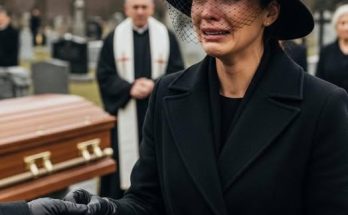
Chapter 1: The Hollow Earth: My name is Emily Carter, and if you had asked me a week ago what the absolute worst day of my life would look like, I would have described the exact scene unfolding around me. I was standing under a canopy of suffocating gray clouds at the Oakwood Memorial Cemetery, shivering in a black wool coat that felt entirely too heavy for the damp autumn air. We were burying my mother. I had done everything right, or at least everything the sterile, bureaucratic machinery of death required of a surviving daughter. Six agonizing days ago, I had stood under the humming fluorescent lights of the morgue at St. Joseph’s Hospital and officially identified a body pulled from a mangled car wreck. I had filled out the insurance claims with numb, trembling fingers. I had spent the entire morning shaking hands with distant relatives and former colleagues who offered empty, recycled platitudes about how she was “finally at peace.” But the absolute last thing I anticipated in the middle of this suffocating grief was for the cemetery gravedigger to step away from his idling backhoe, deliberately peel off his mud-caked leather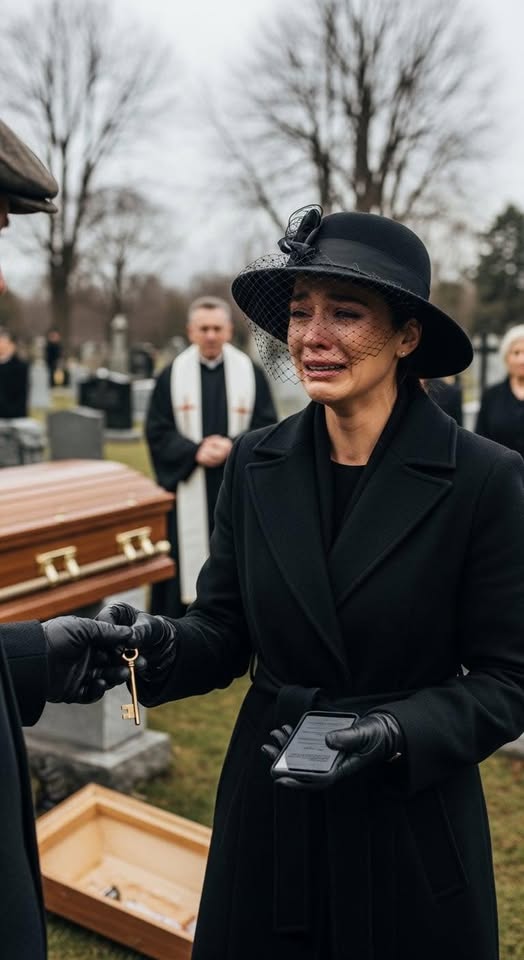
gloves, and gesture for me to approach him as if we were conspiring to commit a federal crime. His embroidered canvas name tag simply read Earl. His face was an intricate map of deep, weathered lines, looking older and more permanent than the granite headstones surrounding us. When I stepped away from the murmuring crowd, he leaned in, the smell of damp earth and stale tobacco clinging to his jacket. He kept his voice to a gravelly whisper. “Ma’am,” Earl rasped, his pale eyes darting nervously toward the glossy mahogany casket resting on the mechanical lowering
device. “Your mom paid me a premium cash sum last Tuesday to bury an empty wooden box.” I stared at him, my brain completely stalling. I was certain that profound exhaustion and grief had finally induced a psychotic break. “Excuse me? Stop fooling around. This isn’t the time or the place.”
Earl did not offer a comforting smile. He didn’t backtrack. Instead, he reached out and pressed something small, rigid, and freezing cold directly into my palm, folding my trembling fingers over it. It was a heavy brass key. Stamped into the tarnished metal were two tiny, black numbers: 16.
“I’m not joking with you, kid,” he whispered, stepping back into the shadows of a large oak tree. “Do not go back to your house. Go to Unit 16. Right this second.”
Before I could even process the absurdity of his command—before I could demand to know how a dead woman had handed him cash a day before she supposedly died—a sharp, mechanical vibration buzzed against my hip.
I pulled my phone from my coat pocket. I looked down at the glowing screen, and a wave of pure, icy dread pooled in my gut. My vision swam.
It was a text message. From my mother’s cell phone number.
Come home alone.
My lungs seized. I had personally watched the police hand over her shattered phone in a plastic evidence bag. She had been legally dead for nearly a week. And yet, her familiar contact photo was currently glowing on my screen as casually as if she were simply reminding me to pick up milk from the grocery store.
I violently snapped my head up, searching the perimeter. The pastor was still droning on about eternal salvation. My aunt Linda was loudly weeping into a crumpled tissue. Richard Hale—my mother’s boss of nineteen years—was standing near the front row, his head bowed in a picture-perfect display of corporate mourning. Absolutely no one else had witnessed the exchange. Earl was already walking back to his heavy machinery, his back turned to me.
I should have screamed. I should have alerted the police standing near the cemetery gates. Instead, my thumb traced the jagged teeth of the brass key. I slid it deep into the lining of my purse, turned my back on the mourning crowd, and walked briskly toward the gravel parking lot, abandoning my own mother’s funeral before the first shovel of dirt ever hit the mahogany lid.
Chapter 2: The Steel Sanctuary
The drive out of the cemetery was a psychological blur of swerving metal and blaring horns. The brass key felt like it was burning a hole through the leather of my purse.
Unit 16 was located at a sprawling, desolate storage facility on the extreme western edge of Columbus, situated awkwardly between an abandoned strip mall and a roaring stretch of the interstate. A flickering, neon sign hanging off a chain-link fence announced the property as SAFELOCK STORAGE. The entire compound was virtually a ghost town—just endless, monotonous rows of corrugated orange metal doors baking beneath the overcast sky.
I parked my sedan three rows away, the tires crunching loudly against the loose gravel. The silence of the facility was oppressive, broken only by the distant, rhythmic hum of highway traffic.
I walked down the narrow concrete aisle until I found the faded, painted 16 stenciled onto a rusted door. My hands were shaking so violently that the brass key slipped from my grip, clattering loudly against the pavement. I cursed under my breath, snatched it up, and forced it into the heavy padlock.
The tumblers clicked with a heavy, satisfying thud. I grabbed the metal handle, threw my weight backward, and hauled the corrugated door up about three feet. I ducked beneath the lip and froze, my eyes struggling to adjust to the dim interior.
I had expected to find forgotten living room furniture, cardboard boxes filled with childhood photo albums, or perhaps racks of moth-eaten winter coats.
Instead, the ten-by-ten concrete cube looked like a fallout shelter prepared for an apocalypse.
Sitting in the exact center of the room was a cheap, aluminum folding chair. Beside it sat a heavy-duty battery lantern, three gallon-jugs of distilled water, and a thick, fireproof legal file box. But what made the breath catch painfully in my throat was the item resting neatly on the seat of the chair.
It was a navy-blue designer handbag. It was the exact purse my mother had supposedly been carrying the night her vehicle plunged off the embankment. The police had told me it was incinerated in the crash.
Taped to the premium leather of the bag was a stark white envelope. My name was written across the front in her unmistakable, looping cursive.
For Emily. If you’re reading this, they lied to you first.
My heart hammered a frantic, irregular rhythm against my ribs. I took a hesitant step forward, reaching for the envelope.
Right at that exact second, the heavy, unmistakable sound of tires slowly grinding over the exterior gravel echoed behind me.
I pivoted so fast I slammed my shoulder hard against the metal doorframe. Peering through the narrow gap I had left open, I watched a massive, black SUV roll into the adjacent lane, creeping like a predator stalking prey. It glided to a halt just two rows over, the engine left rumbling in a low, aggressive idle. The windows were tinted so darkly they looked like obsidian; it was impossible to see the occupants inside.
For one agonizing heartbeat, I simply stood there, paralyzed by a massive surge of adrenaline. I held my mother’s cryptic envelope in my left hand and the heavy brass padlock in my right, feeling entirely as though I had accidentally wandered onto the set of a violent crime.
Then, sheer, animalistic survival instinct finally overrode my paralysis.
I dropped to my knees, grabbed the interior handle of the corrugated door, and yanked it downward with all my body weight. I pulled it flush against the concrete, leaving only a microscopic, half-inch sliver of daylight illuminating the floor. I pressed my back against the cold steel, trapped inside the cage.
Outside, a heavy car door slammed shut.
Then, a second one followed.
The slow, deliberate crunch of heavy boots walking across the gravel began to echo through the complex.
Chapter 3: The Plywood Escape
I held my breath for so long that my lungs began to burn, the lack of oxygen making black spots dance in my peripheral vision. I squeezed my eyes shut, listening to the agonizingly slow progression of the footsteps. They paused outside Unit 14. Then they moved to Unit 15.
Suddenly, a broad, dark shadow eclipsed the thin strip of daylight at the base of my door. The boots stopped.
Whoever was standing on the other side of that thin, corrugated metal lingered there long enough to broadcast a terrifying message: this was absolutely not a coincidence. They had tracked me here.
A man’s voice called out through the metal. It wasn’t a yell. It was eerily calm, modulated, and dripping with a sickeningly friendly corporate tone. “Ms. Carter? We know you’re in there. We just want to have a quick, reasonable conversation.”
I clamped a hand over my own mouth, terrified that the sound of my ragged breathing would give me away. I didn’t make a sound.
A second voice chimed in, this one significantly sharper, laced with raw irritation. “Don’t make this difficult, Emily. Your mother involved you in an operation she had absolutely no business touching. We just need to recover company property.”
Company property. The fireproof legal box sat just inches from the toe of my shoe. I crouched down in the stifling dark, my hands trembling uncontrollably as I ripped open the envelope. I angled it toward the sliver of light to read the hurried scrawl inside.
Emily, if anyone follows you to this unit, do NOT trust the local police. Do NOT trust Richard Hale. Do NOT trust anyone associated with Lawson Financial. Take the red folder. Leave through the back fence immediately. I am so sorry for everything.
Richard Hale. The grieving, weeping uncle-figure who had just hugged me an hour ago over an empty grave. My mother had served as his executive assistant at Lawson Financial Group for nearly two decades. He was the architect of whatever nightmare I had just inherited.
Outside, the situation escalated. Something heavy and metallic—a crowbar, maybe—scraped violently against the exterior latch of my unit.
I fumbled with the clasps on the fireproof box and flipped the heavy lid open. Inside, illuminated by the faint ambient light, were dozens of meticulously labeled manila folders, a black USB flash drive securely taped to the underside of the lid, stacks of highlighted banking statements, and one glaringly bright Red Folder.
Through the translucent crimson plastic, I could clearly make out photocopies of driver’s licenses, massive offshore wire transfer receipts, and a legally binding document bearing Richard Hale’s unmistakable signature.
My pulse roared in my ears like a jet engine.
Leave through the back fence. I blindly reached out in the dark, my hands grazing the rear wall of the storage unit. My fingers met the rough, splintered surface of a large sheet of plywood leaning casually behind a stack of empty cardboard boxes. I shoved the boxes aside and hauled the heavy wood backward.
Hidden entirely from view was a jagged, vertical slit cut directly through the facility’s perimeter chain-link fence. It was just wide enough for a desperate person to squeeze their shoulders through.
Outside, the man with the sharp voice barked an order. “Open the damn unit, Emily. Your mother is dead strictly because she stopped cooperating with us. Don’t make the same mistake.”
My blood instantly turned to glacial ice.
Is dead. Not an accidental car crash. Not a tragic loss of control on a slick, rain-swept highway, which was the neat, tidy narrative the local police precinct had spoon-fed me. This was a deliberate execution, and they were admitting it through the door.