I believed I was saving my dying son by donating my kidney to him. His wife kept insisting I had no choice because I was his mother. But moments before the surgery was about to begin, my 9-year-old grandson asked one horrifying question that froze everyone in the room. The hospital room at St. Vincent’s Medical Center in Seattle carried the smell of disinfectant, stale coffee, and terror. Margaret Collins sat on the edge of the pre-op bed wearing a thin blue gown, her silver hair tucked beneath a paper cap, her left hand shaking under the IV tape. Through the glass partition, she could see her son, Daniel, lying in the room beside hers, pale and bloated, his eyes half-shut while machines murmured around him. He was forty-two years old, her only child, and his kidneys were shutting down. “Mrs. Collins,” Dr. Patel said softly, looking over the chart attached to the foot of her bed, “we’re almost ready. The transplant team is prepared. Are you still certain you want to proceed?” Margaret swallowed against the dryness in her throat. “He’s my child.” Across the room, her daughter-in-law, Rebecca, stood with her arms crossed over her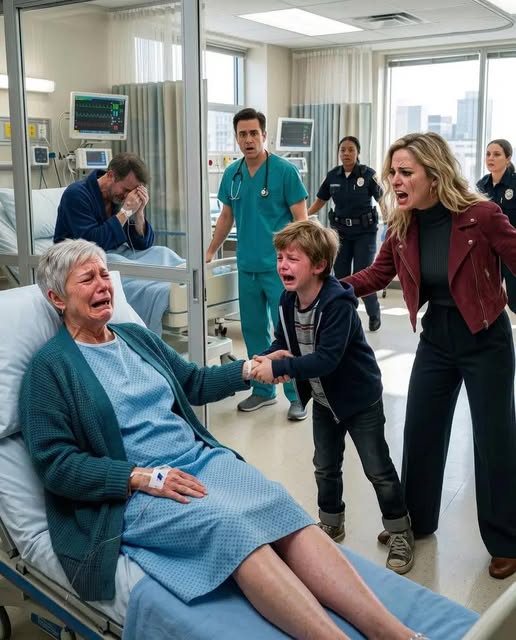
designer coat. Her expression looked tight with impatience, not sorrow. “It’s your obligation,” Rebecca said. “You’re his mother. A real mother wouldn’t hesitate.” Margaret flinched, but she stayed quiet. She had hesitated. Not because she did not love Daniel. God knew she had loved him beyond reason her whole life. She had taken double shifts after his father died, paid off his college debts, rescued him from poor investments, and opened her door when his marriage nearly fell apart. Every time, Daniel promised he would do better. Every time, Margaret believed him. But
this was not the same. A kidney was not money she could lend. It was a part of her own body. Still, when Daniel called three weeks earlier, crying that dialysis was no longer working and no matching donor had been found, Margaret agreed to be tested. When the doctor confirmed she was
compatible, Rebecca sobbed over the phone and called it a miracle.
Now, as nurses prepared the equipment around Margaret, a small voice broke through the hallway.
“Grandma!”
Margaret turned her head.
Her nine-year-old grandson, Ethan, stood outside the operating area in a wrinkled school hoodie, his cheeks flushed and his eyes wet. A nurse tried to block him, but he slipped past and ran directly to Margaret’s bed.
“Ethan?” Rebecca snapped. “What are you doing here?”
The boy ignored his mother completely. He took Margaret’s hand in both of his.
“Grandma,” he whispered, trembling so badly his teeth clicked together, “should I tell the truth about why Dad needs your kidney?”
Everything in the room stopped.
Dr. Patel lifted his eyes from the chart.
Margaret felt her heart beat once, heavy and slow. “What truth, sweetheart?”
Rebecca’s face drained of color. “Ethan, stop talking.”
But Ethan pressed himself closer to Margaret and looked down at the floor.
“Dad said if I told,” he cried, “Mom would send me away.”
Margaret’s IV hand turned cold.
Dr. Patel stepped forward. “This surgery is paused.”
Rebecca moved toward her son. “He’s confused. He’s a child.”
Ethan screamed, “Dad didn’t get sick by accident!”
PART 2
Dr. Patel did not shout. Somehow, that made his order even more frightening.
“Security,” he said to the closest nurse. “And page hospital administration. No one moves this child from this room.”
Rebecca stopped halfway across the floor.
Margaret pulled Ethan against her side, even though the IV line tugged sharply at her skin. She could feel his small ribs shaking beneath his hoodie.
“Ethan,” Dr. Patel said carefully, lowering himself until he was at the boy’s eye level, “you are not in trouble. We need to know if there is something that affects your grandmother’s consent to surgery. Can you tell us what you mean?”
Ethan looked at Margaret first, almost as though he needed permission to breathe.
She held his face in her hands. “Tell the truth, baby. Whatever it is.”
His lips shook.
“Dad took stuff,” he said. “A lot. Pills, mostly. And shots. Mom said he needed energy for work and nobody could know because Grandma would stop helping us.”
Rebecca made a sound that was half laugh, half choke. “That is insane. He’s nine.”
Ethan turned toward her, suddenly burning with the helpless rage of a terrified child. “You said the bottles were vitamins! But I saw the labels! Dad threw up blood in the garage, and you told him to get cleaned up before Grandma came over!”
Margaret’s sight blurred.
The nurses looked at one another. Dr. Patel stood, his face now impossible to read.
“What substances?” he asked.
“I don’t know all the names,” Ethan said. “But there was one called oxy… oxy something. And little bags Dad hid in the toolbox. He said his kidneys hurt because of the ‘cycle’ and because he drank the workout drinks with the pills. Mom told him, ‘Don’t tell the transplant doctor or they’ll make you wait.’”
Rebecca stepped backward like she had been struck.
Margaret looked through the glass wall into Daniel’s room. Her son’s eyes were open now. He was watching them.
Not with confusion.
With fear.
“Daniel,” Margaret said, barely able to hear her own voice.
He turned his face away.
That small movement wounded her more deeply than any blade could have.
Dr. Patel stayed professional, but a colder edge had entered his voice. “Mrs. Collins, based on what has just been disclosed, your consent may have been obtained without full information. We cannot ethically proceed.”
Rebecca’s mouth twisted. “So you’re going to let him die because of gossip from a child?”
“No,” Dr. Patel said. “We are going to investigate a serious allegation that the patient concealed substance use and medical history relevant to transplant eligibility.”
Margaret pushed herself upright. A nurse stepped closer to support her.
Rebecca turned on her. “Don’t you dare back out now. You already agreed.”
Margaret looked at the woman she had welcomed into her family fifteen years ago. She remembered paying their mortgage after Daniel’s business collapsed. She remembered keeping Ethan every weekend so Rebecca could “rest.” She remembered Daniel asking for money with the same soft eyes he had used as a child.
“You knew,” Margaret said.
Rebecca’s expression went hard. “I knew he needed help. I knew you had what he needed. That’s all that matters.”
“No,” Margaret said, her voice growing steadier. “It matters that you lied.”
Daniel’s door opened. A nurse stood inside, stopping him from getting up.
“Mom,” Daniel rasped. “Please. Don’t listen to him. I made mistakes, okay? But I’m still your son.”
Margaret stared at him for a long moment.
He did not apologize.
He did not ask whether she was scared.
He only looked at her body as though it were the final bank account he had not yet drained.
Margaret pulled the surgical cap off her head.
“I’m not doing it today,” she said.
Rebecca screamed, “You selfish old woman!”
Ethan hid his face against Margaret’s shoulder.
Dr. Patel signaled to security as Rebecca tried to shove past the nurses. In the hallway, Daniel’s monitor alarms began beeping, but Margaret did not go toward him. For the first time in her life, she remained exactly where she was.
PART 3
The hospital did not fall silent after Rebecca was escorted out.
Hospitals never truly became silent. Their noise only changed shape.
Margaret sat inside a private consultation room with a blanket over her shoulders while a social worker named Linda Morales brought Ethan a hot chocolate from the cafeteria. He held the paper cup with both hands without drinking, staring down into it as if the truth might still punish him if he looked away.
Margaret had changed back into her clothes, though her blouse was buttoned unevenly and her shoes felt too tight. The IV was gone. A square piece of gauze had been taped to the back of her hand.
That tiny bandage made her feel foolish.
She had almost surrendered an organ without knowing the whole truth.
Dr. Patel entered with a transplant coordinator and a hospital administrator. They did not speak in dramatic tones. They used careful phrases: “medical review,” “informed consent,” “patient disclosure,” “mandatory reporting,” “child safety concerns.”
The meaning underneath all of it was simple.
Daniel had lied.
Hospital records showed that Daniel had described his kidney failure as the result of a rare autoimmune disease made worse by high blood pressure. But his lab history suggested repeated toxic damage. Further screening, completed after Ethan’s statement, raised additional concerns. There were signs of hidden drug use, steroid misuse, and heavy supplement abuse. None of it meant Daniel could not receive treatment, but every piece of it mattered for transplant approval.
A donated kidney could fail quickly if the recipient continued the same habits.
Margaret listened without cutting in.
Finally, Dr. Patel sat down across from her.
“Mrs. Collins, I want to be clear. You have the absolute right to refuse donation at any point. Even if there had been no new information, you could stop the process. No one is entitled to your kidney.”
Margaret nodded, but her gaze moved to Ethan.
“What happens to him?” she asked.
Linda, the social worker, leaned closer. “Because Ethan disclosed threats and possible neglect, Child Protective Services has been contacted. We’ll need to speak with him further. We’ll also need to assess whether he has a safe place to stay tonight.”
Ethan’s face tightened.
Margaret took his hand. “He can stay with me.”
Linda’s expression softened. “That may be possible, depending on the emergency placement decision.”
Before anyone could answer, the door opened again. Daniel stood there in a hospital robe, pale and unsteady, with a nurse and a security guard behind him. He had pulled one monitor lead from his chest, leaving a red mark on his skin.
“Mom,” he said.
Dr. Patel stood. “Daniel, you need to return to your room.”
“I need to talk to my mother.”
Margaret looked directly at him. “Then talk.”
Daniel’s eyes moved to Ethan, then to the unfamiliar faces in the room. Shame crossed his face briefly, but it did not remain. Desperation quickly replaced it.
“Ethan misunderstood things.”
Ethan shrank back in his chair.
Margaret tightened her hold around his hand. “Do not start by calling your son a liar.”
Daniel opened his mouth, then shut it again.
For one second, Margaret saw the boy he had once been: seven years old, running across the yard with scraped knees; twelve, weeping as his father’s coffin was lowered; seventeen, promising he would take care of her one day.
Then she saw the man standing in front of her now.
A man who had forced his own child to carry a secret far too heavy for his age.
“I was under pressure,” Daniel said. “Work was killing me. I needed to keep up. The pills started after my back injury. The other stuff was for training. Everybody does something, Mom. You don’t understand.”
“You’re right,” Margaret said. “I don’t understand asking my grandson to hide it.”
Daniel’s face twisted. “Rebecca told him not to talk. Not me.”
Ethan lifted his head. His voice was small, but clear. “You said Grandma would hate me if I ruined it.”
Margaret felt those words hit the room.
Daniel looked at his son.
For the first time that day, he seemed to have no defense left.
Rebecca appeared in the hallway behind security, arguing with another administrator. Mascara had streaked beneath one eye. When she saw Daniel standing there, fury lit her face.
“Tell them,” she demanded. “Tell them your mother is letting you die.”
Daniel did not look toward her.
Margaret rose slowly. Her knees hurt. She was sixty-six, exhausted deep in her bones, and suddenly done being used as proof of everyone else’s love.
“No,” she said. “I am not letting you die. I am refusing to be deceived into surgery.”
Rebecca gave a bitter laugh. “What kind of mother chooses herself?”
Margaret turned to face her. “The kind who finally realizes love without truth becomes a weapon.”
Rebecca’s face hardened. “You always hated me.”


