“I paid your rent for eight months,” Margaret said. “I watched Ethan when you disappeared for weekends. I bought Daniel’s medication when he said insurance was delayed. I sat through every emergency you two created and called it family. Don’t confuse boundaries with hatred.” The hallway went quiet. Daniel gripped the doorframe, breathing heavily. “Mom, I’m scared.” Those words nearly broke her. Nearly. Margaret stepped close enough to smell the sour sickness on his skin. “I’m scared too,” she said. “I’m scared you’ll take my kidney and destroy it. I’m scared Ethan will learn that love means silence. I’m scared I taught you that my body, my money, and my forgiveness would always be available, no matter what you did.” Tears gathered in Daniel’s eyes. “Please,” he whispered. Margaret touched his cheek. “I will support your treatment. I will sit with you during dialysis. I will help you enter a recovery program. I will not give you my kidney while you are lying.” Daniel closed his eyes. Rebecca shouted, “Recovery program? He needs surgery!” Dr. Patel answered before Margaret could speak. “He needs stabilization, full disclosure, and a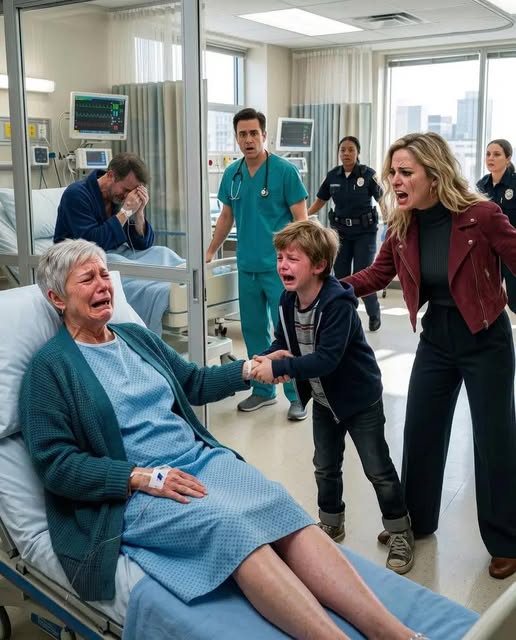
reassessment. A transplant is not simply a procedure. It is a lifelong commitment.” Rebecca pointed toward Margaret. “She poisoned everyone against us.” Ethan stood up then, still holding his untouched hot chocolate. “No,” he said. “You told me to lie.” Every adult turned toward him. His voice shook, but he went on. “Dad got sick in the garage. He fell down and couldn’t stand up. Mom said if the hospital knew everything, Grandma wouldn’t be allowed to help. Dad said I had to be brave for the family. But I didn’t feel brave. I felt sick every day.” Margaret wrapped him in her
arms. Rebecca stared at her son as though he had betrayed her. That look settled everything. Linda stepped into the hallway and spoke quietly with the CPS worker who had arrived. Within an hour, an emergency safety plan had been arranged. Ethan would leave the hospital with Margaret
while the investigation continued. Rebecca objected until she was warned that another disturbance could get her removed from the hospital property.
Daniel was taken back to his room.
Before Margaret left, she went to see him alone.
He was lying against white pillows, looking smaller than he had in years. Without Rebecca at his side, he seemed less like a cornered man and more like someone finally staring at the depth of the hole he had dug for himself.
“I didn’t think it would go this far,” he said.
Margaret sat in the chair beside him. “I believe that.”
Hope flickered across his face.
Then she added, “But not thinking is not the same as not choosing.”
He turned his face toward the window. Rain slid down the glass, blurring Seattle’s lights into trembling streaks.
“I’m going to die,” he said.
“You might,” Margaret answered truthfully. “Or you might live if you fight for the right things.”
He gave a bitter, tired laugh. “You sound like a counselor.”
“I sound like a mother who ran out of easy lies.”
For a while, neither of them spoke.
Then Daniel whispered, “Is Ethan afraid of me?”
Margaret considered lying to soften the moment. She had softened too many moments already.
“Yes,” she said.
Daniel cried then. Not loudly. Not dramatically. Just silently, with one hand covering his eyes.
Margaret stayed until the nurse came in to check his vitals. She did not promise him her kidney. She did not promise that everything would turn out fine. She told him she would return tomorrow if he agreed to speak with addiction medicine and tell the transplant team the full truth.
He nodded.
That night, Ethan slept in Margaret’s guest room beneath an old quilt she had made when Daniel was still a teenager. He left the hallway light on. Margaret did not switch it off.
At 2:13 a.m., she found him standing in the kitchen.
“Can I have water?” he asked.
“Of course.”
He drank half the glass, then looked down at the floor. “Are you mad I told?”
Margaret knelt down, ignoring the ache in her knees.
“No,” she said. “You saved me from making a choice without the truth.”
He blinked at her. “Did I hurt Dad?”
“Your dad was already hurt,” she said. “The truth didn’t hurt him. It showed everyone where the hurt was.”
Ethan leaned into her, and she held him until his breathing settled.
The months that followed were difficult.
Daniel did not receive Margaret’s kidney. His case was placed under review, and he stayed on dialysis while beginning a supervised treatment program. At first, he blamed everyone: his mother for refusing, Rebecca for pushing, Ethan for speaking up, and the doctors for judging him. But the body had a way of forcing quiet. Dialysis left him drained. Recovery meetings left him exposed. Therapy stripped away excuse after excuse.
Rebecca filed motions, made accusations, and tried to take control of the narrative. But text messages, pharmacy records, and Ethan’s consistent statements revealed a pattern too obvious to dismiss. She had not created Daniel’s illness by herself, but she had helped conceal the truth and used Margaret’s love as pressure.
Ethan stayed with Margaret through the school year. The court permitted supervised visits with Daniel once he showed he was following treatment. Rebecca’s visits were restricted further after she repeatedly pressured Ethan to change his statement.
Margaret’s home changed with Ethan there. Sneakers appeared by the door. Cartoons filled Saturday mornings. A science fair volcano spilled baking soda across her kitchen table. For the first time in years, Margaret’s love had somewhere to go that did not require her to bleed for it.
Six months after the surgery was canceled, Daniel asked Margaret to bring Ethan to the dialysis center.
He looked thinner, but clearer. His eyes no longer slipped away from hard questions.
Ethan stood beside Margaret, unsure.
Daniel did not reach for him. He did not ask for a hug.
“I’m sorry,” Daniel said. “Not because I got caught. Because I scared you. Because I made you responsible for an adult secret. Because I told you Grandma would hate you if you told the truth.”
Ethan’s chin trembled.
Daniel continued, “That was a terrible thing to say. You did the right thing.”
Margaret watched a small amount of tension leave her grandson’s shoulders.
“Are you still sick?” Ethan asked.
“Yes,” Daniel said. “But I’m doing what the doctors tell me now.”
“Are you mad at Grandma?”
Daniel looked at Margaret.
She held his gaze.
“No,” he said at last. “I was. But she was right.”
Margaret did not smile. The truth needed no decoration.
A year later, Daniel was approved to be reconsidered for the transplant list, not with Margaret as a living donor, but through the normal process. He had documented sobriety, steady treatment attendance, and honest medical disclosures. His future was still uncertain. Real life did not wrap pain into perfect bows.
But Ethan laughed more often.
Margaret slept more peacefully.
And Daniel, for the first time in many years, learned that being loved did not mean being rescued from every consequence.
On the anniversary of the day the surgery was stopped, Margaret found a folded note waiting on her kitchen table. Ethan had written it in pencil.
Grandma, I was scared when I told the truth. But you still loved me. So now I know truth does not make love disappear.
Margaret sat down and cried quietly, pressing the note to her chest.
She had entered that hospital prepared to lose a kidney for her son.
She had left with something she had almost lost instead: the right to belong to herself.
And by saving herself, she had saved a little boy from believing silence was the cost of family.


