The billionaire kissed his mistress beneath the glare of eighty-three cameras, three nationwide television networks, two celebrity gossip livestreams, and the very woman he believed was too shattered to appear. Conrad Whitmore didn’t offer a restrained or courteous kiss. He wrapped an arm around Marissa Vale’s waist, swept her backward beneath the golden glow outside the Harrington Arts Museum, and kissed her as though the red carpet belonged exclusively to him, as though his marriage had already been buried, as though all of New York had gathered to witness the ceremony. For a brief fraction of a second, everything fell silent. Then the media frenzy erupted. Bursts of light flashed one after another, bleaching the evening white. Journalists shouted his name from every direction. Wealthy guests froze in place with champagne smiles still fixed to their faces. Marissa straightened up laughing, flushed and breathless, pressing a hand dramatically against Conrad’s chest as if she had just been crowned royalty. “Conrad! Where is your wife?” “Mr. Whitmore, is this your new partner?” “Marissa, are you replacing Evelyn tonight?” Conrad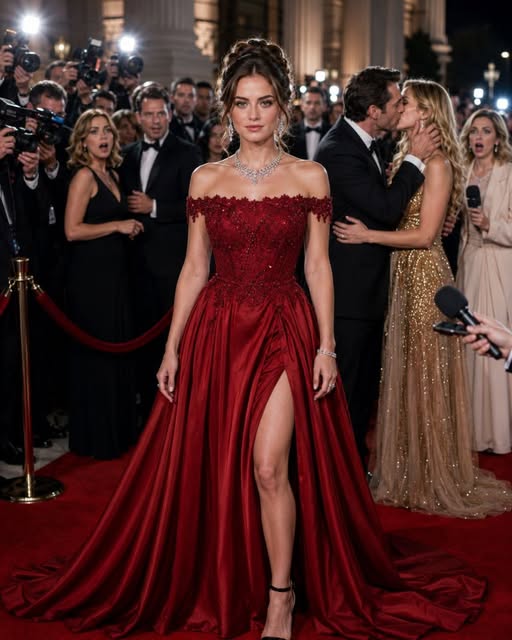
grinned through the uproar. Later, that smile would remain burned into Evelyn’s memory. Not the kiss. Not Marissa proudly slipping her hand into the bend of his arm. Not the shocked reactions of people who had dined at her table and praised her charitable work to her face. It was the smile. That relaxed, self-satisfied curve of Conrad’s mouth as he stared directly into a live television camera and silently informed his wife that he controlled the narrative now. He couldn’t have been more mistaken. Exactly one minute later, a black town car rolled to the curb at the far end
of the carpet. At first, nobody paid attention. The crowd remained consumed by Conrad’s scandal. A billionaire publicly disgracing his wife during the Whitmore Legacy Gala was the kind of spectacle capable of fueling cable news coverage until morning. Then the museum director rushed
down the front steps. Then the chairman of the gala committee rose to his feet. Then the orchestra visible through the glass entrance suddenly stopped playing. A reporter from Manhattan Weekly turned toward the vehicle, narrowed her eyes at the license plate, and murmured, “That’s
not one of Conrad’s cars.” The back door opened. Evelyn Whitmore emerged wearing a white gown so strikingly austere and radiant that it appeared almost clinical beneath the lights. No diamonds sparkled around her neck. No evidence of tears marked her face. Her silver-blond hair was
swept neatly away from her cheekbones, while her blue eyes remained dry, icy, and unnervingly composed. She resembled a judge arriving to deliver a sentence rather than a woman betrayed by her husband.
The atmosphere of the red carpet shifted around her. Every camera that had been focused on Conrad turned toward Evelyn in perfect unison. She moved without haste. She never glanced toward the kiss that was already replaying across countless phones throughout America. Instead, she
rested one gloved hand lightly on the museum director’s arm and continued forward.
Conrad’s smile vanished before she reached the first stair.
Marissa’s grip tightened around his sleeve. “Conrad?” she whispered. “Why are they looking at her like that?”
He said nothing.
Because at last, he was seeing exactly what the reporters had already noticed.
Behind Evelyn, two museum employees unfolded a replacement backdrop that had been concealed beneath layers of black velvet. The original words, WHITMORE LEGACY GALA, disappeared from sight. Replacing them, printed in bold black lettering against a white background, stood a title Conrad had never authorized.
THE EVELYN HALE FOUNDATION
INAUGURAL BENEFIT
A reporter let out an audible gasp that microphones immediately captured.
“Wait,” someone said. “She owns the event?”
Another reporter, younger and quicker to react, opened the gala program on her phone. Her expression changed instantly.
“Conrad isn’t the host,” she announced into her live broadcast. “The sole sponsor and controlling donor is Evelyn Hale Whitmore. The museum, the foundation, the guest list—this is her event.”
Conrad instinctively stepped backward.
Evelyn arrived at the top of the staircase and halted directly before him.
Marissa attempted to maintain her confidence, but it had already drained away. The silver dress that had looked bold and glamorous moments earlier now appeared inexpensive beneath the museum lighting. Conrad glanced from his wife to the cameras and back again, calculating consequences far too late.
“Evelyn,” he said, forcing a laugh. “You’re making quite an entrance.”
“No,” Evelyn said softly. “You did.”
The nearest microphone captured every syllable.
Conrad’s eyes flicked toward it.
Evelyn leaned in slightly, close enough for him to catch the faint scent of gardenias he once bought for her back when he still made an effort to pretend. Her voice lowered into something private, though her expression remained perfectly controlled for the cameras.
“You should have read the contract before you kissed her.”
The color drained from his face.
Marissa looked back and forth between them. “What contract?”
Evelyn never broke eye contact with Conrad. “The one he signed this morning.”
At the foot of the stairs, reporters surged forward as one.
Conrad’s jaw hardened. “Evelyn, not here.”
She offered the slightest smile.
“Here,” she said, “is exactly where you wanted it.”
Then she turned away from him and faced the crowd of cameras.
“Ladies and gentlemen,” Evelyn said, her voice smooth, poised, and amplified through the red-carpet speaker system Conrad had unknowingly funded after she altered the installation order, “Thank you for attending the first gala of the Evelyn Hale Foundation. Tonight is about the protection of women whose names powerful men tried to erase.”
The crowd became completely silent.
“And before we go inside,” Evelyn continued, “I would like to thank my husband for giving the world such a clear demonstration of why this foundation exists.”
Conrad reached toward her arm.
Before his fingers could brush her glove, the museum’s head of security stepped between them.
And in that moment, Conrad Whitmore—the most intimidating figure in Manhattan finance—finally understood that the wife he had publicly humiliated had not arrived to weep.
She had arrived to collect.
Six months earlier, Evelyn had discovered the affair because of a receipt for strawberries.
Not lingerie. Not hotel charges. Not a lipstick stain on a collar. Conrad was too careful for those obvious mistakes. The receipt had been folded into the pocket of his midnight-blue tuxedo jacket after a board dinner at the Pierre. Two glasses of vintage champagne, one private suite, and a bowl of chocolate-covered strawberries delivered at 1:13 a.m.
Evelyn had stood in his dressing room beneath soft recessed lights, staring at that ridiculous little slip of paper, and felt something inside her go still.
She had suspected before. Of course she had. A woman married to a man like Conrad Whitmore learned to read absences the way other wives read love notes. A delayed flight that never appeared on airport records. A sudden meeting in Miami with no calendar invite. A new cologne he claimed was a gift from a client but wore only on Thursdays.
But suspicion was fog. Proof was a blade.
That night Conrad came home at 2:06 a.m., smelling like champagne and another woman’s perfume. Evelyn was waiting in their kitchen, wearing a cream robe, her hair loose around her shoulders, the receipt on the marble island between them.
He looked at it.
Then he laughed.
That laugh changed everything.
“Evelyn,” he said, taking off his watch, “you’re too intelligent to become ordinary.”
“Ordinary?”
“Jealous. Dramatic. Small.”
She stared at the man she had helped build.
Fifteen years earlier, Conrad Whitmore had been a handsome, ambitious investment manager with an old family name and a mountain of debt hidden behind polished manners. Evelyn Hale had been the daughter of a respected Boston attorney and a mother who built shelters for abused women before society found such causes fashionable. Evelyn brought discipline, connections, strategy, and the quiet capital Conrad needed to transform Whitmore Capital from a fragile boutique firm into a national empire.
Conrad brought charm.
The world gave him credit.
At first, Evelyn told herself that was the bargain. He could stand at podiums. She could shape the decisions. He could shake hands. She could read people. He could be thunder. She would be architecture.
Then thunder began believing it had built the house.
The affairs came gradually. An art consultant. A lobbyist. A television anchor who smiled too widely at charity auctions. Evelyn knew. She documented. She waited. What stopped her from leaving was never weakness. It was timing.
Her mother, Eleanor Hale, had taught her that.
“Never walk away from a burning house empty-handed,” Eleanor once said from a hospital bed, her voice ruined by cancer but her eyes still fierce. “If a man sets the fire, make sure you carry out the deed.”
After the receipt, Evelyn called Lydia Cross.
Lydia was not the kind of attorney who advertised on billboards or appeared on daytime television. She represented women whose marriages were wrapped around corporations, trusts, political careers, and secrets sharp enough to draw blood. She had white hair, black suits, and a reputation for making powerful men settle before discovery began.
In Lydia’s office overlooking Bryant Park, Evelyn laid out twelve years of documents.
Private transfers. Emails. Misused corporate flights. Donations moved through the Whitmore Family Fund to cover entertainment expenses. A suspicious consulting contract awarded to Marissa Vale’s image-management company three weeks after Conrad started sleeping with her.
Lydia read silently for twenty minutes.
Then she removed her glasses.
“Your prenup is difficult,” Lydia said.
“I wrote the emotional misconduct clause myself,” Evelyn replied.
Lydia’s eyebrow rose. “Most judges dislike those.”
“This one is tied to measurable reputational and financial harm. If Conrad commits an act of public humiliation that damages any foundation, trust, or corporation in which I have controlling interest, all settlement caps dissolve.”
Lydia sat back slowly.
“You expected this.”
“No,” Evelyn said. “I understood him.”
The plan did not begin as revenge. That was what Evelyn told herself for months. It was protection. It was survival. It was the careful rescue of everything her mother had built before Conrad could turn it into a vanity wing of his empire.
The Whitmore Legacy Gala had always been Conrad’s favorite stage. Every November, he stood beneath museum chandeliers and pretended his wealth had a soul. He spoke about women’s safety while ignoring the women in his own house. He praised Evelyn in public and belittled her in private. He donated enough to be applauded and controlled enough to be obeyed.
But the museum lease was not in Conrad’s name.
It belonged to the Hale Trust.
Eleanor had insisted on that years earlier, when the gala was still small and sincere. Conrad never noticed because the invoices went through his office and the speeches carried his logo. To him, ownership was whatever people believed.
Evelyn spent six months changing what people would believe.
She transferred the gala sponsorship from Whitmore Legacy to the Evelyn Hale Foundation, a dormant nonprofit her mother had created. She invited women Conrad underestimated: judges, journalists, board wives, prosecutors, museum trustees, and three major donors who hated Conrad but liked his money. She let the old branding remain until the last second.
Then she let Conrad get comfortable.
Marissa Vale made that easy.
Marissa was twenty-nine, blond, ambitious, and not nearly as foolish as she pretended. She had come from a small town in Ohio and reinvented herself in New York with a new name, new accent, and borrowed diamonds. Conrad liked women who made him feel generous. He liked being worshipped. Marissa worshipped beautifully.
Evelyn watched them through investigator photos and felt less jealousy than disgust.
The final piece arrived the morning of the gala.
Conrad came into the breakfast room wearing a charcoal suit and impatience.
“I need your signature on a donor consent packet,” he said, dropping a folder beside her tea.
Evelyn opened it. The top page authorized last-minute production expenses. The fourth page acknowledged the updated gala ownership structure. The seventh confirmed that all public conduct by Whitmore Capital executives at the event would be subject to reputational liability provisions.
Conrad had initialed every page.
He was on the phone when she asked, “Did you read this?”
He waved a hand. “Evelyn, you handle the boring things.”
So she handed him a pen.
He signed his own trap at 8:41 a.m.
That evening, as Evelyn dressed in white, her assistant brought her a tablet showing Conrad’s town car route. It had stopped outside Marissa’s hotel.
Evelyn watched the blinking dot for five seconds.
Then she turned to the mirror.
Her mother’s pearl earrings rested in a velvet box on the table. For years, Evelyn had saved them for anniversaries, memorials, quiet occasions of grief. Tonight she put them on like armor.
“Mrs. Whitmore,” her driver said through the intercom, “your car is ready.”
Evelyn looked at her reflection and saw, for the first time in years, not Conrad’s wife.
Eleanor Hale’s daughter.
“Good,” she said. “Let him arrive first.”